


The production board at my old client's bakery looked like someone threw magnetic strips at a wall and called it a system. Orders scattered across three clipboards. A whiteboard showing yesterday's production counts—nobody bothered updating it. Post-it notes marking special requests that might disappear before the morning shift showed up.
Most bakeries run production through memory, experience, and whatever communication method survived the longest. It works until someone calls in sick, a wholesale order doubles unexpectedly, or the new baker doesn't realize Tuesday croissants need to start proofing by 3 PM Monday.
The gap between taking orders and handing them to customers is packed with handoffs, decisions, and failure points. Each one compounds the mess. A missed order on the intake sheet becomes wrong batch quantities, which becomes overproduction or stockouts, which becomes either waste or angry customers at pickup.
Why production systems break at exactly 47 orders per day
There's this weird threshold around 45-50 daily orders where memory-based systems just collapse. Below that, one experienced person can hold the entire operation in their head. They know Mrs. Chen wants her sourdough sliced thin. They remember the coffee shop needs delivery by 6:30 AM sharp. They adjust batch sizes instinctively based on yesterday's leftovers.
Above that threshold, information starts leaking everywhere. Orders get missed. Batch sizes drift from optimal. The morning baker makes decisions the afternoon decorator doesn't know about. Customers show up for orders that never made it from the phone to the production sheet.
The real problem isn't volume—it's handoffs. Each transition between stages loses information:
Order intake → Batching: Special requests vanish. Pickup times get rounded to "morning" or "afternoon." Quantity adjustments for regular customers get forgotten.
Batching → Production: Consolidated orders lose individual customer details. The production team makes 60 dinner rolls without knowing 20 need sesame seeds for the Gordon wedding order.
Production → Packing: Items get made but not labeled for specific orders. The decorator finishes custom cookies but doesn't know which ones need gift boxes.
Packing → Pickup: Completed orders sit unmarked. Counter staff scramble to figure out which of three chocolate cake orders belongs to the customer standing in front of them.
Each gap creates its own workaround. Soon you're running five different tracking systems that don't talk to each other.
Order intake: where precision prevents downstream disasters
The order intake system determines everything downstream. Sloppy intake means every subsequent stage operates on bad information.
Never miss a bake or delivery again.
Bakeryly helps you schedule, track, and manage every order effortlessly.
- Unified order tracking
- Real-time inventory alerts
- Staff shift management
No credit card required
Most bakeries collect orders through multiple channels—phone, walk-in, email, social media DMs, text messages to the owner's personal phone. Each channel has its own capture method. Phone orders go on a paper form. Online orders print automatically. Instagram orders stay in the app until someone remembers to check.
-
Customer name and phone
-
Items with exact specifications
-
Quantity for each item
-
Pickup or delivery date
-
Pickup or delivery time window
-
Payment status
-
Special handling needs
-
Which items need same-day production
-
Which can be made ahead and frozen
-
Decoration requirements and timing
-
Assembly or packaging needs
-
First-time vs regular customer
-
Previous issues or preferences
-
Flexibility on timing
-
Price sensitivity markers
The intake person needs a single form or screen that captures everything, regardless of order source. No scattered notebooks. No "I'll remember to tell the baker" situations.
Here's a quick visual of the intake-to-production handoff workflow.
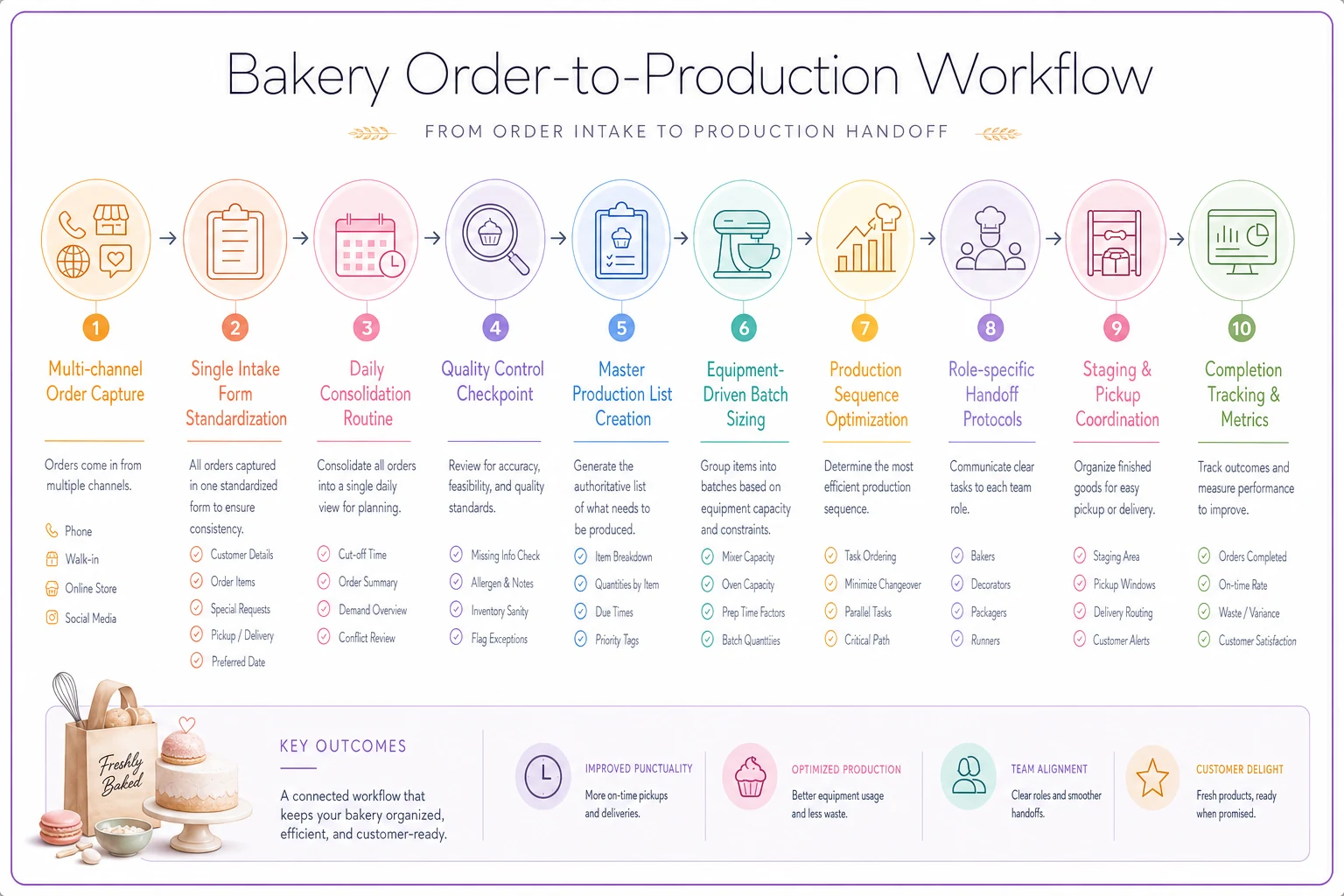
Use the single intake form for every channel so requests and allergies never get lost between phones and the production board.
The daily order consolidation routine
-
Verify unclear orders Call customers about ambiguous requests before production starts
-
Flag conflicts Two wedding cakes due the same Saturday morning need staggered pickup times
-
Check inventory impact Tomorrow's 200 cupcakes will clear out the chocolate chips
-
Identify rush items Mark orders that need early morning start times
-
Group by production area Separate bread orders from pastry orders from cake orders
The consolidated list becomes the single source of truth. Not the original order forms. Not what someone remembers. The master list drives everything.
Batching rules that actually match your equipment capacity
Batching isn't about making nice round numbers. It's about matching production to actual equipment constraints while minimizing changeovers.
Your oven holds 6 sheet pans. Each pan fits 12 muffins. That means batches of 72, not 50 or 100. Fighting your equipment's natural batch sizes creates inefficiency everywhere—partial oven loads, weird leftover quantities, unnecessary production runs.
Equipment-driven batch sizes:
| Equipment | Capacity | Natural batch | Don't fight it |
|---|---|---|---|
| Deck oven | 8 loaves | Multiples of 8 | Making 10 means two oven cycles |
| Sheet pan | 12 muffins | Multiples of 12 | 15 muffins wastes space |
| Mixer | 20 lbs dough | Full or half batches | 13 lbs wastes time and energy |
| Proofer | 4 racks | Fill completely | Empty rack space is lost production |
The batching decision isn't just about quantity—it's about sequence. Chocolate chips in the mixer means the next batch needs chocolate too, or you're cleaning between batches. The proofer running for sourdough means everything else waits.
The production sequence that minimizes changeovers
Start with items requiring longest lead time. Overnight-proof breads go first. Then same-day proof items. Quick-turn products like muffins and cookies last.
Within each category, group by same ingredient profile, same temperature needs, same equipment path, and same finishing needs.
A morning production sequence actually looks like this:
4:00 AM - Oven startup and prep Pre-heat ovens to bread temperature (450°F). Pull overnight proofs from retarder. Stage ingredients for first batches.
4:30 AM - Bread production Bake all sourdough (already proofed). Mix and shape tomorrow's sourdough. Bake all baguettes. Mix other bread doughs needing same-day proof.
6:00 AM - Pastry production Drop oven temp to 375°F. Bake croissants (proofed overnight). Bake Danish and morning pastries. Start cake batters while oven occupied.
7:30 AM - Quick-turn items Muffins (already mixed). Cookies (dough from yesterday). Scones (mix and bake immediately).
9:00 AM - Decoration and finishing Cake assembly and decoration. Pastry glazing and filling. Special order customization.
This isn't rigid. Tuesday might need early cupcakes for a school order. Friday might need extra bread production. But the baseline sequence creates predictability.
Role checklists that prevent the 6 AM scramble
Every position needs a physical checklist. Not guidelines. Not "everyone knows what to do." Actual checkboxes that get marked throughout the shift.
Morning Baker Checklist:
-
Check overnight proof status (4
00 AM)
-
Review day's production list (4
05 AM)
-
Start oven preheat sequence (4
10 AM)
-
Pull items from retarder in baking order (4
15 AM)
-
Begin baking sequence per production list (4
30 AM)
-
Mix tomorrow's overnight doughs (5
30 AM)
-
Update production board with completed items (ongoing)
-
Note any shortages or issues (ongoing)
-
Clean and reset station for next shift (8
30 AM)
Decorator Checklist:
-
Review decoration orders for day (7
00 AM)
-
Verify all base items ready (7
10 AM)
-
Set up decoration station (7
15 AM)
-
Complete custom orders by priority (7
30 AM)
-
Standard decoration on remaining items (9
00 AM)
-
Package decorated items with labels (10
00 AM)
-
Stage completed orders for pickup (10
30 AM)
-
Prep tomorrow's decoration needs (11
00 AM)
Counter Staff Checklist:
-
Review pickup orders for day (6
00 AM)
-
Verify display case stocked (6
15 AM)
-
Check special orders staged correctly (6
30 AM)
-
Update sold-out items on boards (ongoing)
-
Mark pickups as collected (ongoing)
-
Consolidate end-of-day orders (3
00 PM)
Physical checklists beat memory every time. They also make training easier—new staff can follow the checklist even before they understand why each step matters.
The handoff protocol that stops orders from vanishing
Information disappears at handoffs. The morning baker tells the decorator about the nut allergy on the Johnson order. The decorator remembers but doesn't tell counter staff. Customer has allergic reaction.
Every handoff needs three components: physical transfer of documentation, verbal confirmation, and written record of the transfer.
Critical handoff points
End of morning bake → decoration team: What's ready for decoration, what's still cooling, any damaged items needing remake, priority order sequence.
Decoration complete → packaging: Which orders are complete, special packaging requirements, items needing refrigeration, label requirements.
Packaged → pickup staging: Customer name clearly marked, pickup time noted, payment status shown, any special instructions visible.
Shift change (any position): What's completed, what's in progress, what's delayed, any customer issues.
The handoff protocol isn't about trust. The best teams still miss verbal communications when it gets busy. Written handoffs prevent information loss when someone's focused on not burning the croissants.
Ready-to-steal templates and run-lists
Here's the actual paperwork that makes this system run:
Master Production Sheet Template
Date: Day: Baker: __
BREAD PRODUCTION
| Item | Ordered Qty | Batch Qty | Start Time | Complete | Notes |
|---|---|---|---|---|---|
| Sourdough | ___ | ___ | ___ | □ | ___ |
| Baguette | ___ | ___ | ___ | □ | ___ |
| Whole wheat | ___ | ___ | ___ | □ | ___ |
PASTRY PRODUCTION
| Item | Ordered Qty | Batch Qty | Start Time | Complete | Notes |
|---|---|---|---|---|---|
| Croissant | ___ | ___ | ___ | □ | ___ |
| Danish | ___ | ___ | ___ | □ | ___ |
| Muffins | ___ | ___ | ___ | □ | ___ |
SPECIAL ORDERS
| Customer | Item | Qty | Pickup Time | Special Requirements | Complete |
|---|---|---|---|---|---|
| ___ | ___ | ___ | ___ | ___ | □ |
Order Intake Form
ORDER #: DATE: TAKEN BY: __
CUSTOMER INFO:
-
Name
____
-
Phone
___
-
Email
___
ORDER DETAILS:
| Item | Qty | Special Requests | Price |
|---|---|---|---|
PICKUP/DELIVERY:
-
[ ] Pickup [ ] Delivery
-
Date
__
-
Time
__
-
Address (if delivery)
____
PAYMENT:
-
[ ] Paid in full
-
[ ] Deposit paid ($)
-
[ ] Pay at pickup
-
Method
PRODUCTION NOTES:
-
[ ] Standard production
-
[ ] Needs early start
-
[ ] Special decoration required
-
[ ] Allergen considerations
Daily Handoff Log
Date: Shift:
MORNING → AFTERNOON HANDOFF
-
Completed
__
-
In progress
__
-
Issues
__
-
Priority items
__
Items moved to:
-
[ ] Decoration station
____
-
[ ] Cooling racks
____
-
[ ] Walk-in
____
-
[ ] Display case
____
AFTERNOON → CLOSE HANDOFF - Tomorrow's prep complete: [ ] Yes [ ] Partial [ ] No - Items to finish: - Customer issues: - Inventory needs: __
When pickup becomes a puzzle nobody can solve
The customer arrives at 2 PM for their order. Counter staff can't find it. They check the walk-in, the display case, the decoration area. The customer insists they ordered. The staff insists nothing's under that name. Twenty minutes later, someone finds it labeled with the customer's first name instead of last name.
This costs more than just that customer's frustration. Every minute spent hunting for orders is a minute not helping other customers. The line backs up. The phone rings unanswered. Other orders might get grabbed by mistake.
The pickup staging system that actually works
Designate one area—only one—for completed orders awaiting pickup. Not "usually the left side of the walk-in but sometimes the counter and occasionally the decorating table." One spot.
-
Morning pickups (6 AM - 11 AM) Front section
-
Afternoon pickups (11 AM - 4 PM) Middle section
-
Evening pickups (4 PM - close) Back section
Within each time block, arrange alphabetically by last name. Use waterproof labels showing customer last name (LARGE), first name, order number, pickup time, and paid/unpaid status.
The counter staff checking orders needs a pickup list showing the same information in the same order. Physical order matches list order. No hunting required.
The three-tier escalation system for problems
Problems happen. The mixer breaks during morning rush. The decorator calls out sick. A customer changes their order after production started. Most bakeries handle these through panic and improvisation.
Better to have escalation tiers:
Tier 1 - Handle at station (no escalation needed):
-
Minor quantity adjustments (±10%)
-
Standard substitutions
-
Timing shifts within same day
-
Small cosmetic issues
Tier 2 - Shift supervisor decision:
-
Major quantity changes
-
Next-day order additions
-
Equipment failures
-
Staff shortage adjustments
-
Customer complaints
Tier 3 - Manager/owner involvement:
-
Complete order cancellations
-
Health/safety issues
-
Major equipment failures
-
Significant customer issues
-
Anything affecting next day's production
Each tier has different response protocols. Tier 1 gets logged but not reported. Tier 2 gets same-day notification. Tier 3 means immediate contact.
Measuring what matters (and ignoring what doesn't)
Most bakeries track the wrong metrics. They count units produced, total sales, maybe waste percentage. These numbers don't drive better operations.
Track these instead:
Order accuracy rate: Orders delivered correctly ÷ total orders Target: >95% If below: Check handoff protocols
On-time completion rate: Orders ready by promised time ÷ total orders Target: >98% If below: Review batching sequence
Pickup wait time: Average time from customer arrival to order located Target: <2 minutes If above: Fix staging system
Rework hours: Time spent fixing mistakes ÷ total production hours Target: <5% If above: Check order intake accuracy
Setup/changeover time: Non-production time ÷ total shift time Target: <15% If above: Revise batching logic
These metrics point to specific fixes. High rework hours means the intake system needs attention. Long pickup wait times means staging needs reorganization. The numbers tell you what to fix, not just that something's wrong.
The "almost-disaster" automation advantage
Modern AI-powered operational software changes the equation here. Not by replacing bakers or decorators, but by catching almost-disasters before they happen.
The order that conflicts with another order gets flagged during intake, not at pickup. Batch sizes automatically calculate based on equipment capacity and order requirements. Production schedules adjust when someone calls out sick, automatically redistributing tasks based on remaining staff skills.
Smart batching algorithms group orders by production requirements, ingredient
Ready to elevate your bakery operations?
Join 2,000+ bakeries using Bakeryly to streamline workflows, reduce waste, and delight more customers.