

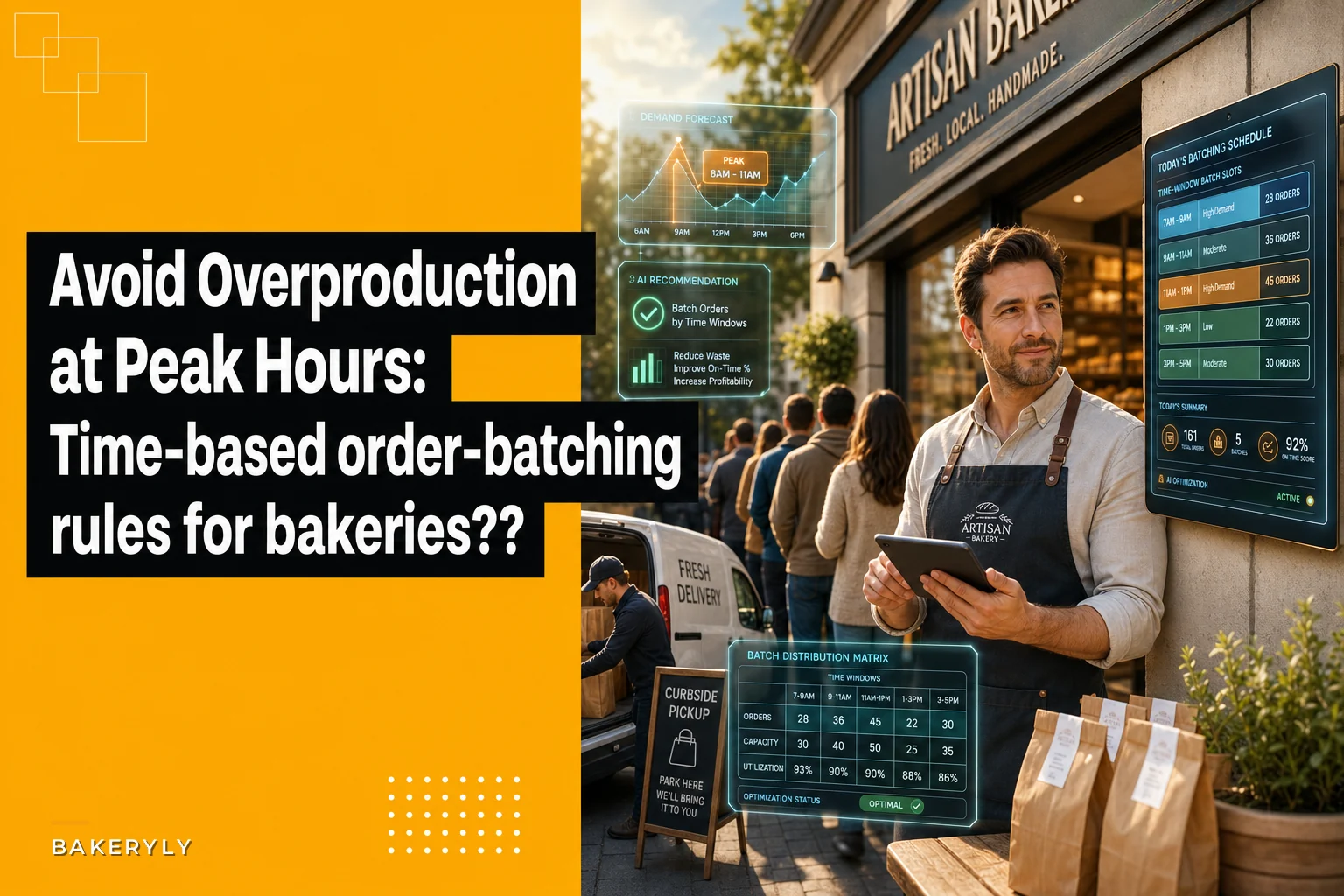

That 7 AM scramble where your team is juggling walk-ins, wholesale deliveries, and online pickups all at once? It's probably costing you hundreds in wasted product every week.
Most bakeries handle orders the same broken way: first come, first served, regardless of channel or timing. Your team ends up making three separate batches of croissants because orders trickled in at 6:15, 6:45, and 7:30. Meanwhile, half your morning pastries go unsold because you overproduced trying to cover every possible walk-in scenario.
The real problem isn't your team's speed or your oven capacity. You're treating every order like an emergency instead of grouping them intelligently. When orders flow through multiple channels without batching rules, production becomes reactive chaos.
Why bakeries fall into the overproduction trap
Your wholesale client texts at 5:45 AM asking if they can add two dozen muffins to their standing order. Three online orders come in between 6:00 and 6:30 for 8 AM pickup. Walk-ins start flowing around 7:00.
Without clear batching rules, your production team sees that wholesale text and immediately starts an extra muffin batch. Then the online orders trigger another production run. By 7:30, you've made roughly 40% more product than you'll actually sell, but somehow still run out of specific items because timing was off.
This pattern gets worse during peak seasons. One bakery was throwing away nearly $400 worth of product every Saturday morning during summer tourist season. They'd overproduce trying to be ready for everything, yet still disappoint customers when popular items ran out by 9 AM.
The overproduction happens because each channel operates on its own timeline. Wholesale wants early delivery. Online customers expect their exact order ready at pickup time. Walk-ins want to see full cases. Your team tries to satisfy everyone by making more of everything.
Channel-specific cutoff times that actually work
Different channels need different rules. Here's what's worked across dozens of bakeries:
Never miss a bake or delivery again.
Bakeryly helps you schedule, track, and manage every order effortlessly.
- Unified order tracking
- Real-time inventory alerts
- Staff shift management
No credit card required
| Channel | Order Cutoff | Production Batch | Buffer % | Notes |
|---|---|---|---|---|
| Wholesale | Previous day 2 PM | 4:00 AM | 5% | Fixed quantities, predictable |
| Online (morning) | Previous day 8 PM | 4:30 AM | 10% | Group all pickups 7-10 AM |
| Online (afternoon) | Same day 10 AM | 11:30 AM | 15% | Smaller batch, higher variance |
| Walk-in | Rolling forecast | 5:00 AM + 8:00 AM | 20-25% | Two main batches based on patterns |
| Special orders | 48 hours | Varies | 0% | Exact quantities only |
Wholesale and online orders are predictable if you enforce cutoffs. Walk-ins follow patterns you can forecast. Special orders should never drive overproduction.
Those buffer percentages aren't random. Wholesale gets the smallest buffer because quantities are fixed. Walk-ins get the highest because they're least predictable. But even walk-in buffers should be based on historical patterns, not panic.
Building your morning production schedule
Here's exactly how this plays out in a real production schedule. Take a bakery doing around $8k in daily sales across all channels:
4:00 AM - Wholesale batch starts
Everything for wholesale delivery goes in first. These orders were locked yesterday at 2 PM. No changes, no additions, no "just one more thing." Your wholesale buyers learn quickly that cutoff means cutoff.
4:30 AM - Online morning batch
All online orders for 7-10 AM pickup get produced together. Instead of making croissants three times, you make them once with a 10% buffer. If someone orders at 9 PM for 8 AM pickup, too bad—they get offered 10:30 AM instead.
5:00 AM - First walk-in batch
Based on your typical morning patterns, produce your core walk-in items. This isn't guesswork—it's Tuesday, you typically sell 45-55 morning buns on Tuesday, so you make 50.
8:00 AM - Second walk-in batch
Smaller "refill" batch based on morning sales pace. If you're tracking sales every 30 minutes, you know by 7:30 whether you need more product for the 9-11 AM window.
11:30 AM - Afternoon online batch
Lunch items and afternoon pickups produced fresh, not sitting since morning.
Below is a simple workflow visualization of those timed batches.
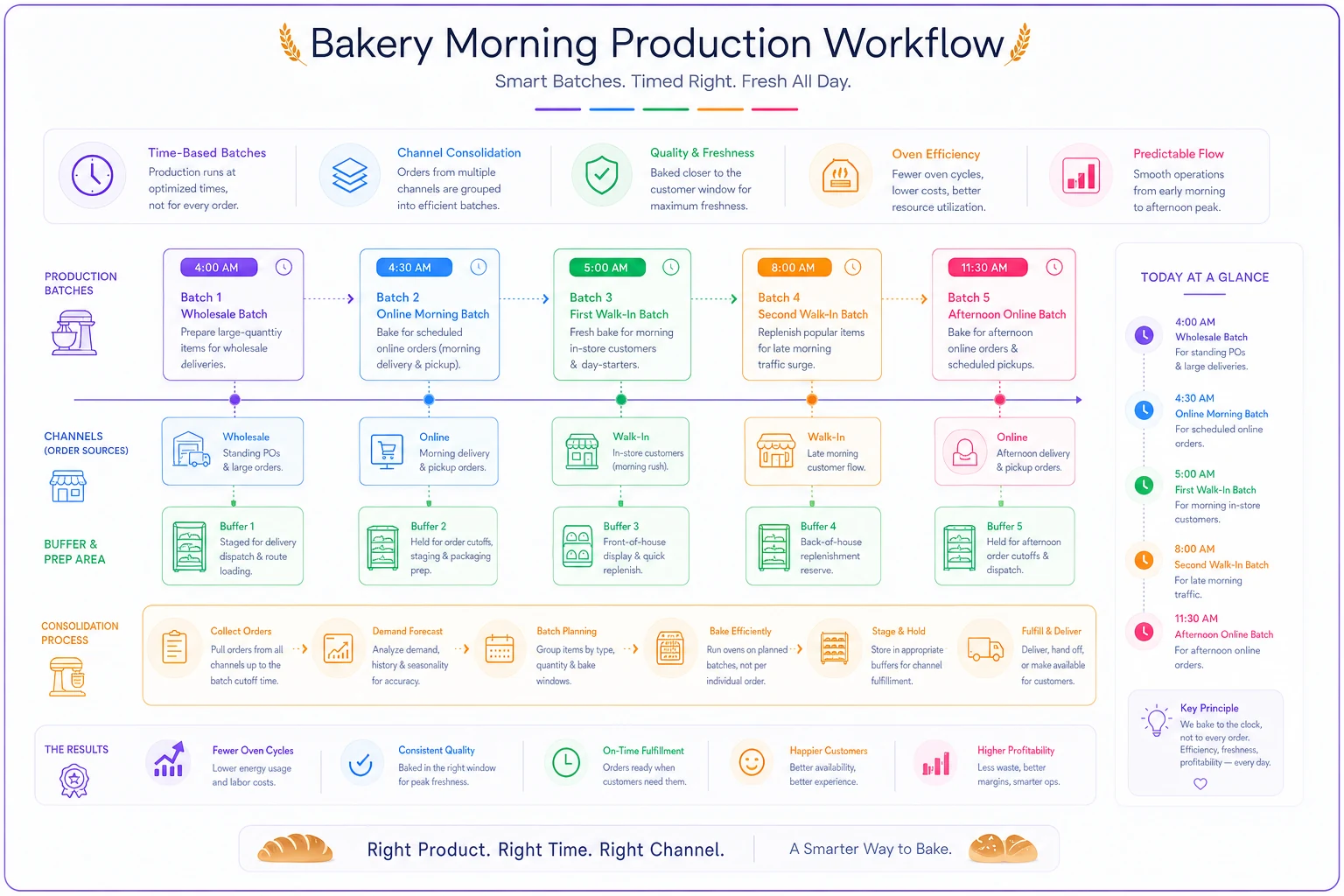
The magic happens in what you DON'T do: you don't fire up ovens every time an order comes in. You don't panic-produce when you see a line forming. You don't make "just in case" batches.
Calculating optimal batch sizes
Most bakeries pick batch sizes based on oven capacity or recipe yields instead of actual demand patterns. Your batch size should minimize waste while maintaining service levels.
-
Wholesale orders
60 units (fixed)
-
Online morning orders
35 units (from actual orders)
-
Walk-in forecast
80-95 units (historical average)
-
Total batch
185 units
(includes 10-unit buffer)
Not 200 because that's a nice round number. Not 240 because that's what your oven holds. Exactly 185 because that's what data says you need.
Track your accuracy for two weeks. If you're consistently running out, increase buffers by 5%. If you're throwing product away, reduce by 5%. Most bakeries find their sweet spot within a month.
The walk-in problem (and the only solution that works)
Walk-ins are every bakery's production nightmare. You can't tell them to order ahead, and you can't perfectly predict when they'll show up. But you can spot patterns that make batching possible.
One bakery tracked walk-in sales by 15-minute intervals for three weeks. They discovered that 65% of morning walk-in sales happened in two waves: 7:00-8:15 AM (commuters) and 9:30-10:45 AM (late breakfast crowd). Instead of continuous production, they now run two targeted batches that cover 80% of demand with 40% less waste.
The uncomfortable truth about walk-ins: you'll never achieve perfect availability. The question is whether you want controlled stockouts of specific items or random disappointment across your entire menu. Batching gives you control.
Your regular walk-in customers actually prefer consistency over variety. They'd rather know chocolate croissants are always available at 7:30 AM than gamble on whether you'll have their favorite item on any given day.
Making the system work across peak periods
Peak periods break most batching systems because owners panic and abandon their rules. Weekend mornings, holiday rushes, tourist seasons—suddenly everyone's making executive decisions about production.
Increase batch frequency, not batch sizes. During summer tourist season, add a 6:30 AM batch instead of doubling your 5:00 AM batch. Smaller, more frequent batches mean less waste when demand drops unexpectedly.
Tighten cutoff windows, don't eliminate them. Move your online cutoff from 8 PM to 10 PM during busy periods, but keep the cutoff. Accepting orders until 5 minutes before pickup guarantees chaos.
Create overflow rules. When online orders exceed your morning batch capacity, automatically push new orders to the afternoon pickup window. Customers prefer a later pickup to finding out their order couldn't be filled.
Use dynamic buffers. Your normal Tuesday buffer might be 15%, but the Tuesday before Thanksgiving needs 35%. Build a simple multiplier system based on historical peaks.
When batching rules actually save money
Real numbers from a mid-sized bakery doing about $280k monthly revenue. Before implementing batching rules:
-
Daily product waste
$120-180
-
Overproduction during peaks
35-40%
-
Staff overtime from reactive production
12-15 hours weekly
-
Customer complaints about availability
8-10 weekly
-
Daily waste
$40-60
-
Overproduction
12-15%
-
Overtime
3-4 hours weekly
-
Complaints
2-3 weekly (mostly about cutoff times, not availability)
The monthly impact? Roughly $2,400 less in waste, $1,800 less in overtime, and ironically, higher customer satisfaction because core items were consistently available.
Common batching mistakes that kill the system
The biggest mistake is making exceptions. "Just this once" for a good wholesale client becomes twice weekly. "Special favor" online orders after cutoff become expected. Your team stops trusting the system, and you're back to chaos.
Second: complicated rules nobody can remember. If your batching matrix needs a PhD to understand, it won't survive a busy morning.
Third: not communicating changes to customers. When you implement cutoffs, some customers will test them. Stand firm. After two weeks, they adjust. After a month, they prefer the predictability.
Fourth: batching everything exactly the same way. Bread has different dynamics than pastries. Items with 3-day shelf life need different rules than same-day products.
Tools and tracking that make batching sustainable
You can't run this system on memory and intuition. You need basic tracking that tells you whether your batches align with reality.
Track these numbers:
-
Items sold by hour (not just daily totals)
-
Waste by product and time period
-
How often you run out of key items
-
Order patterns by channel and day
Log sales every hour for two weeks and mark stockouts; patterns usually emerge fast and decisively.
A simple spreadsheet works fine for most bakeries. Log sales every hour for two weeks. Note when you run out of items. Record what gets thrown away. Patterns emerge quickly.
For online and wholesale orders, even basic operational software can automatically group orders by time windows. Instead of manually checking what needs to be made, you get a consolidated production list for each batch. Some platforms now use AI automation to predict walk-in demand based on weather, local events, and historical patterns—surprisingly accurate once they have a few weeks of data.
The goal isn't perfect prediction. It's replacing chaos with a system that works right 85% of the time and fails predictably the other 15%.
Why most bakeries abandon batching (and how to stick with it)
Batching fails when owners treat it as a rigid law instead of a flexible framework. Your rules should evolve as you learn patterns, not get carved in stone.
Start with basic time windows. Test for a month. Adjust based on waste and stockout patterns. Test again. Within three months, you'll have a system that cuts waste by 30-50% without disappointing customers.
The temptation to abandon batching peaks during busy periods. That's exactly when you need it most. Every time you break the rules for perceived emergencies, you train your team that the system is optional.
Customers adapt to consistent rules faster than you think. They complain about changes for a week, adjust their behavior in week two, and prefer the new system by week three. But only if you hold the line.
Making peace with controlled stockouts
Running out of specific items at specific times is actually better than overproducing everything.
When you overproduce, you lose money on waste, stress your team, and still disappoint customers when timing is off. When you batch properly with controlled stockouts, you lose some sales but gain predictability, reduce waste, and can actually tell customers when items will be available.
A customer who knows chocolate croissants are gone by 9 AM adjusts their schedule. A customer who never knows what's available stops coming regularly. Predictable disappointment beats random availability.
Your next steps
Stop trying to be everything to everyone at every moment. Pick one channel—probably wholesale since it's most predictable—and implement cutoff times this week. Make them stick for two weeks before adding another channel.
Build your batching matrix gradually. Start with time windows, add batch sizes after you see patterns, then optimize buffers based on actual waste data. The entire system takes about six weeks to dial in, but you'll see waste reduction within days.
The hardest part isn't creating the system—it's maintaining discipline when that regular customer texts asking for "just a small favor" outside your cutoff window. That discipline separates bakeries drowning in operational chaos from those running smooth, profitable operations.
Your morning rush doesn't have to be chaos. Your team doesn't need to guess at production quantities. Your profits don't need to end up in the waste bin. Channel-based batching isn't fancy, but it works. The only question is whether you'll implement it before or after your next painful Saturday morning.
Ready to elevate your bakery operations?
Join 2,000+ bakeries using Bakeryly to streamline workflows, reduce waste, and delight more customers.