


You finally landed that coffee shop wholesale account. Three dozen croissants, two dozen muffins, delivered by 6:30 AM sharp every Tuesday and Thursday. Great news, except now your morning crew has to choose: start the wholesale batch at 3 AM and risk stale afternoon pastries in your own display case, or maintain cafe quality and risk losing the wholesale client when deliveries run late.
This isn't about poor planning. It's about two different business models fighting for the same oven space, the same mixer time, and the same hands. Most bakeries try to run them as separate operations — wholesale gets the early shift, cafe gets whatever's left. But that approach guarantees either disappointed wholesale clients or disappointed walk-in customers. Usually both.
The fix isn't working harder or starting earlier. It's building an integrated production system that treats wholesale and cafe as two outputs of the same operation, not competing priorities.
Why separate production schedules always fail
Every bakery owner thinks they can manage it. Wholesale orders go on the left side of the production board. Cafe items on the right. Simple enough until Tuesday morning when your best decorator calls in sick and suddenly you're choosing between shorting the wholesale delivery or opening late.
The problem runs deeper than staffing. When you treat wholesale and cafe as separate operations, you create duplicate work everywhere. Two inventory counts. Two quality checks. Two production schedules that never quite align. Your head baker ends up running two kitchens in the same space.
A bakery in Denver tried to solve this by dedicating specific ovens to wholesale. Seemed logical until their wholesale orders grew and they needed those ovens for cafe production during peak hours. They ended up buying another deck oven they couldn't really afford, only to find their wholesale orders had become too unpredictable to justify the investment.
The real damage happens in product freshness. When wholesale production starts at 2 AM for a 6 AM delivery, those same recipes for your cafe — using the same ovens, same ingredients — have to wait. By the time your cafe opens at 7 AM, you're either selling yesterday's leftovers or frantically baking while customers wait.
Mixed-day scheduling that actually preserves freshness
Forget the idea that wholesale has to happen first. The smartest production schedule works backward from peak freshness windows, not forward from opening time.
Never miss a bake or delivery again.
Bakeryly helps you schedule, track, and manage every order effortlessly.
- Unified order tracking
- Real-time inventory alerts
- Staff shift management
No credit card required
Map every product's freshness curve against its destination timeline. Croissants stay excellent for about 6 hours, good for 10. Sourdough holds for days. Danish deteriorates after 4 hours. Once you know these windows, you can build a production schedule that delivers peak quality to both channels.
A bakery in Portland runs this perfectly. Their wholesale croissants for 6:30 AM delivery start at 4 AM. But their cafe croissants for the 8 AM rush start at 5:30 AM. Same recipe, same oven, offset by 90 minutes. The wholesale batch goes straight from oven to delivery van. The cafe batch goes from oven to display case just as the morning rush begins.
This only works with the right prioritization matrix:
Priority 1: Time-locked items (wholesale deliveries, special orders)
Priority 2: High-turnover cafe items (morning pastries, lunch sandwiches)
Priority 3: Stable inventory (breads, cookies, items that hold)
Priority 4: Afternoon refreshers (items to restock depleted cases)
The key is treating both channels as part of the same flow, not separate streams. Your 4 AM wholesale croissants and 5:30 AM cafe croissants share prep work, share ingredient pulls, share oven preheating. The efficiency comes from integration, not separation.
Building the prioritization matrix
Most prioritization systems fail because they're too rigid. "Wholesale always first" sounds clear until a 50-person catering order arrives for the same morning as your biggest wholesale delivery.
A working prioritization matrix needs three dimensions: deadline firmness, profit margin, and operational flexibility.
Deadline firmness is obvious but often misjudged. That coffee shop wants delivery by 6:30 AM, but they actually need product on shelves by 7 AM when they open. That's 30 minutes of hidden flexibility. Meanwhile, your cafe customers expect fresh pastries in the case when doors open. No flexibility there.
Profit margin matters more than most bakers admit. If wholesale croissants net $1.20 each and cafe croissants net $2.80, the math is clear. But factor in the guaranteed volume of wholesale versus the variable demand of retail. A guaranteed 36 croissants at $1.20 might beat hoping for 20 at $2.80.
Operational flexibility is where real decisions happen. Can you partial-bake dinner rolls for wholesale and finish them on-site? Can the coffee shop accept frozen cookie dough they bake themselves? These flexibilities create production windows you didn't know existed.
Here's a real prioritization matrix from a Baltimore bakery doing $400K annually:
| Product Category | Deadline Type | Margin | Flexibility | Production Priority |
|---|---|---|---|---|
| Wholesale morning pastries | Fixed (6:30 AM) | $1.20-1.80 | None | 1 - Start 3:30 AM |
| Cafe morning pastries | Semi-fixed (7 AM open) | $2.40-3.20 | 30 min | 2 - Start 4:45 AM |
| Wholesale breads | Fixed (6:30 AM) | $0.90-1.40 | Can deliver previous evening | 3 - Previous day 4 PM |
| Cafe breads | Flexible | $2.00-4.50 | All day | 4 - Rolling production |
| Special orders | Fixed (varies) | $3.50-5.00 | None | Slot into gaps |
Notice how wholesale breads shifted to previous evening production once they realized the coffee shop could store overnight. That single change freed up two hours of morning oven time.
Packaging workflows that don't slow production
The biggest time drain isn't baking — it's the transition from baking to packaging. Watch any bakery at 5 AM and you'll see it: products cooling on racks while bakers scramble to find boxes, print labels, locate tape. Twenty minutes lost here, ten minutes there. By 6 AM, wholesale orders are running late and nobody's prepped the cafe display.
Smart packaging starts during production, not after. While croissants proof, someone stages boxes. While muffins bake, someone prints labels. The packaging station should be prepped like mise en place — everything positioned before products leave ovens.
A Chapel Hill bakery cut 40 minutes off morning packaging with this checklist system:
Night before closing:
-
Count tomorrow's wholesale boxes needed
-
Pre-fold boxes if storage allows
-
Print all wholesale labels
-
Stage tape, twist ties, stickers at packaging station
-
Set out delivery manifests
During production:
-
Assign one person to packaging prep while others bake
-
Stage boxes near cooling racks, not in storage
-
Start packaging items as soon as they hit safe temperature
-
Pack wholesale first, but use same station for cafe items
The 2-minute rule: Any packaging task taking over 2 minutes gets its own checklist. Custom box assembly. Special labeling requirements. Allergen stickers. If someone has to think about how to package it, you need a checklist.
Stage boxes and labels together near cooling racks so packaging moves without backtracking.
The real efficiency comes from integrating wholesale and cafe packaging. Same station, same supplies, same workflow. The only difference is destination — delivery box versus display case. When you maintain separate packaging areas for wholesale versus retail, you duplicate effort and create bottlenecks.
Allocation rules when demand exceeds capacity
Thursday morning, 5:45 AM. Wholesale orders packed, ready for delivery. Then you realize the morning bake came up short — only 28 croissants instead of 36. Do you short the wholesale order and risk losing the account? Pull from cafe inventory and disappoint walk-in customers?
This plays out every week in growing bakeries. The answer isn't choosing sides. It's having clear allocation rules before the shortage happens.
The 90% rule: Wholesale gets 90% of ordered quantity guaranteed. That missing 10% is your buffer for production issues, damaged items, quality control pulls. If you promise 36 croissants, plan production for 40, deliver at least 32. Most wholesale clients accept minor shortages if you communicate early and consistency stays above 90%.
The freshness override: If cafe items from yesterday are still good quality, use those to fill wholesale orders while fresh-baked goes to retail. Your cafe customers see products made that morning. Wholesale clients get perfectly good products they'll sell within hours anyway. Everyone wins except your perfectionism.
The substitution protocol: Build substitution options into wholesale agreements upfront. Can't deliver 12 blueberry muffins? Send 8 blueberry, 4 cranberry orange. Make it systematic: same category, similar price point, previous purchase history. The coffee shop that orders croissants might accept danish. The one ordering bagels won't take muffins.
-
Check total quantity
Do we have enough units regardless of variety?
-
If yes
Allocate exact matches first, then substitute within categories
-
If no
Apply 90% rule to wholesale, communicate shortage by 5:30 AM
-
If under 90%
Pull from tomorrow's prep or offer partial credit
-
Document everything
Track every shortage, substitution, and resolution
The documentation part matters more than bakery owners realize. After three months of tracking, you'll see patterns. Always short on Thursday croissants? That's a production planning issue. Regular substitutions of one product? Maybe discontinue it wholesale. The data tells you what your gut misses during morning chaos.
Software that connects both sides
Running integrated wholesale and cafe production on paper boards and Excel sheets works until it doesn't. Usually that breaking point comes around $30K monthly revenue when the complexity overwhelms manual systems.
The problem with most bakery management software is it treats wholesale like a different business. Separate order forms, separate production schedules, separate inventory tracking. You end up managing two systems that don't talk to each other, exactly the problem you're trying to solve.
What actually works is operational software that sees wholesale and cafe as two outputs from the same production system. Orders flow in from both channels, get combined into single production batches, then split again for packaging and distribution. The same croissant recipe serves both channels, tracked through the same inventory system, scheduled on the same production board.
Here's a quick visual of the order-production-delivery workflow.
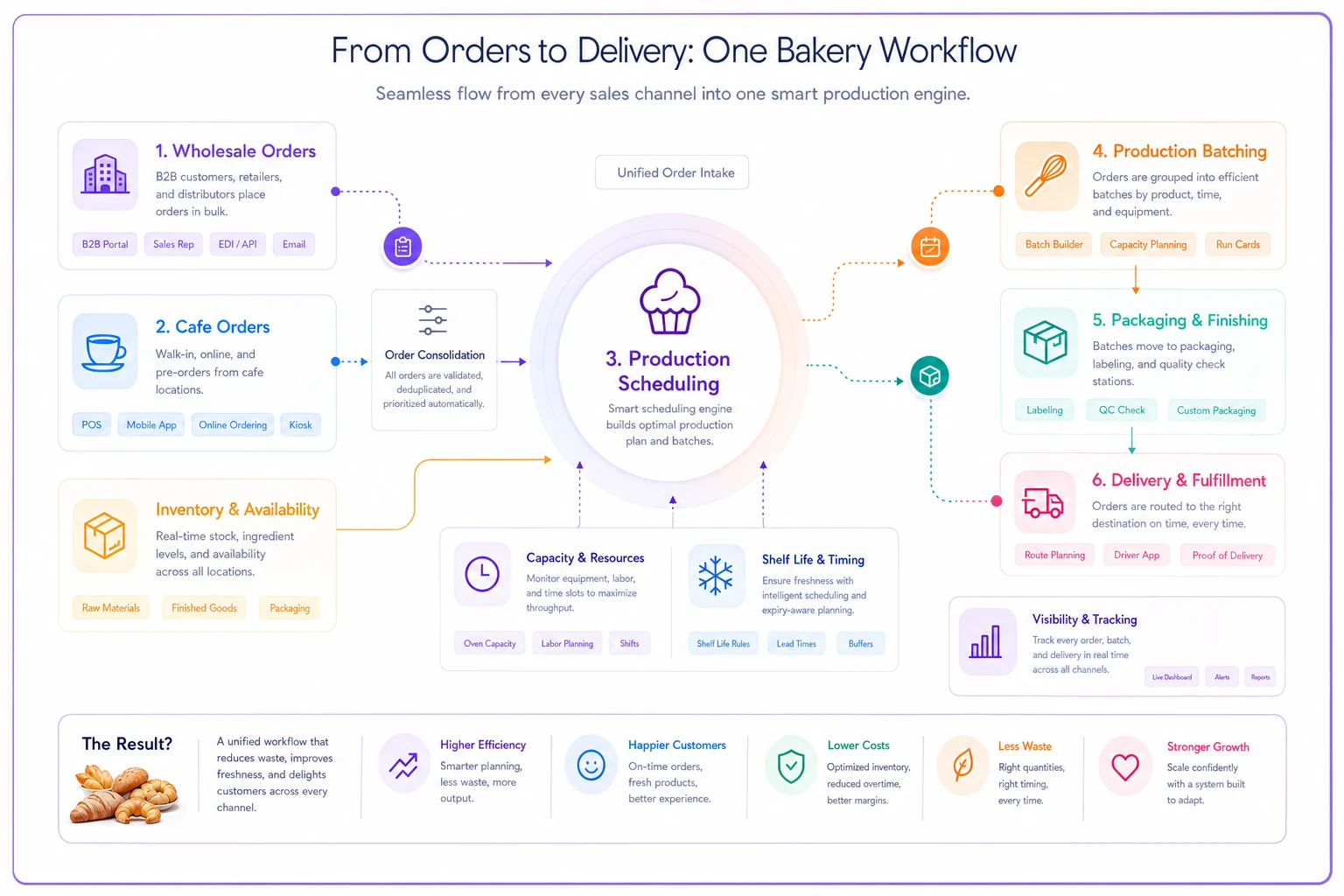
Modern platforms handle the complexity with AI automation that learns your patterns. After a few weeks, the system knows Tuesday wholesale orders average 180 units, cafe typically needs 40 morning pastries, and your ovens max out at 200 per batch. It automatically suggests production schedules that serve both channels without manual calculation.
The real value isn't just scheduling. It's the connections between ordering, production, and delivery. When a wholesale client places Tuesday's order on Sunday night, the system automatically adjusts Monday's prep list, updates Tuesday's production schedule, and calculates whether you need to order more butter for Wednesday delivery. These connections are what paper systems can never maintain consistently.
Before and after integration
Tuesday, 4 AM before integration: Head baker arrives to find sticky notes with last-minute wholesale changes. The production board shows wholesale on one side, cafe on the other, but nobody updated cafe needs based on yesterday's sales. By 5 AM, the team realizes they're short on eggs for both wholesale and cafe items. Someone races to Restaurant Depot while others scramble to adjust recipes. Wholesale leaves late at 6:45 AM. Cafe opens with half-empty cases. The afternoon shift spends two hours trying to figure out what actually got produced versus what was planned.
Tuesday, 4 AM after integration: Head baker checks the integrated production screen showing combined wholesale and cafe needs, already adjusted for yesterday's sales patterns. Ingredients were pulled and staged yesterday afternoon based on the unified production plan. The team follows a single, prioritized task list that ensures wholesale ships on time while cafe cases fill before opening. By 6:15 AM, wholesale is loaded and cafe display is 80% complete. The afternoon shift sees exactly what was produced, what's remaining, and what needs supplementing for tomorrow.
The difference wasn't working harder or hiring more people. It was stopping the fight between two competing operations and building one integrated system that serves both channels.
A Sacramento bakery made this shift last year. Before integration, they were considering dropping wholesale entirely — too much stress, constant quality complaints, never enough product for both channels. Six months later, wholesale revenue grew 40% while cafe sales stayed steady. They didn't increase production capacity. They just stopped wasting it on duplicate processes and competing priorities.
Integrating wholesale and cafe production isn't about choosing one over the other. It's recognizing they're the same business with different delivery mechanisms. The croissant doesn't care if it ends up in a coffee shop or your display case. Your ovens don't differentiate between wholesale and retail batches. Only your organizational system creates that artificial separation.
Start with one integrated production day. Maybe Thursday, when both wholesale and cafe demands peak. Build a single production schedule that serves both channels. Use the prioritization matrix to resolve conflicts. Track what works and what doesn't. Then expand to other days as your team gets comfortable with integrated thinking.
The bakeries thriving with both wholesale and retail aren't working magic. They've stopped fighting themselves. They've built systems where wholesale and cafe support each other instead of competing for resources. Where morning production serves both channels efficiently. Where freshness standards apply everywhere, not just to favored customers.
Your wholesale accounts want consistency and reliability. Your cafe customers want freshness and variety. An integrated production system delivers both without compromise. The question isn't whether to integrate, but how quickly you can stop letting these two sides of your business undermine each other's success.
Ready to elevate your bakery operations?
Join 2,000+ bakeries using Bakeryly to streamline workflows, reduce waste, and delight more customers.