


Most bakeries figure out recipe scaling the hard way—through a weekend of dense croissants, separated buttercream, and mysteriously grainy muffins. The math seems straightforward enough: double the batch, double everything. Except baking doesn't work that way, and neither does your mixer.
The real headache starts when you scale up production for a catering order or holiday rush. Your tried-and-tested recipes suddenly produce different textures, your yields drop by 15%, and that perfectly flaky pastry dough turns into something closer to cardboard. Meanwhile, you're burning through ingredients trying to figure out what went wrong.
Why scaling formulas trigger texture disasters
Bakers usually learn about baker's percentages early on—everything calculated as a percentage of flour weight. Makes sense on paper. But watch what happens when someone scales a croissant recipe from 5kg to 50kg of flour. The dough temperature climbs during mixing, butter melts into the layers, and suddenly you're making bread, not croissants.
The problem runs deeper than temperature though. Your 20-quart mixer handles small batches differently than large ones. Gluten develops faster in bigger batches because of increased friction. Sugar and salt distribute unevenly. Fat coats flour differently when there's more mass involved. Those carefully balanced percentages that work at one scale completely fail at another.
Bakeries lose entire production runs because they don't account for these physics changes. A wholesale client needs 500 cupcakes instead of your usual 50, so you 10x the recipe. Seems logical until the cupcakes dome weirdly, the crumb turns coarse, and the frosting splits because the butter-to-sugar ratio doesn't scale linearly when you're creaming 10 pounds of butter instead of one.
The percentage drift problem nobody talks about
Ingredient percentages drift when you change batch sizes, and nobody catches it until texture goes wrong.
Never miss a bake or delivery again.
Bakeryly helps you schedule, track, and manage every order effortlessly.
- Unified order tracking
- Real-time inventory alerts
- Staff shift management
No credit card required
Take a standard brioche formula:
-
Flour
100%
-
Eggs
50%
-
Butter
40%
-
Sugar
15%
-
Milk
10%
-
Yeast
2%
-
Salt
1.8%
Scale this up 8x and watch what actually happens in production. The butter percentage effectively increases because it takes longer to incorporate, giving it more time to warm and affect gluten development. The yeast percentage needs to drop because larger dough masses retain heat and ferment faster. Salt distribution becomes uneven, creating pockets of over-salted and under-salted dough.
A bakery scaling brioche from 3kg batches to 25kg batches needs to adjust:
-
Reduce yeast to 1.6%
-
Increase mixing time by only 40% (not 8x)
-
Drop dough temperature by 3-4°C before mixing
-
Add butter in three stages instead of one
-
Reduce salt to 1.7% but improve distribution method
These aren't random tweaks—they're systematic adjustments based on how physics changes at scale. Miss them and you get brioche that's either too dense or falls apart.
The percentage drift happens gradually too, which makes it harder to catch. Your first 4x scale might work fine with minor adjustments. Push to 6x and suddenly things go wrong, but you blame the weather or ingredients instead of recognizing the cumulative effect.
Yield tracking reveals scaling failures early
Theoretical yield calculations mean nothing if you're not tracking actual output. A recipe that yields 24 muffins at small scale might only produce 21 when you 5x the batch size. Where'd those three muffins go? Usually into overmixed batter, uneven portioning, or batch remainder that can't fill another tin.
Pre-production check: Compare expected weight of mixed product against actual weight. A 10kg batch should weigh roughly 10kg minus equipment residue (usually 1-2%). Bigger variance means ingredient measuring errors.
Post-mixing validation: Portion one test unit and weigh it. Multiply by expected units. Does it match your batch weight? Off by more than 5%? Your portioning assumptions are wrong at this scale.
Bake completion audit: Count actual sellable units. Track defects separately. If yield drops below 92% of theoretical, something in your process broke during scaling.
One operation was scaling Danish pastry from 20 units to 200 units. Their yield dropped to 78%—nearly a quarter of product lost. Turns out their lamination process couldn't handle the larger dough mass. Butter broke through layers, creating leakage during proofing. They had to split the scaling into two 100-unit batches to maintain texture and yield.
Quick texture tests that prevent disasters
You can't always wait for full production runs to validate scaling changes. Quick tests catch problems before you waste a day's ingredients.
The stretch window test (for bread/pizza dough): Pull a small piece of mixed dough. Stretch it thin enough to see light through. At proper gluten development, it should stretch without tearing for at least 10cm. Larger batches usually need 15-20% less mixing time to reach this same window.
The spread test (for cookies/pastries): Portion three pieces at standard size. Bake immediately, after 30 minutes, and after 60 minutes of rest. Measure spread diameter. If spread varies more than 15% between samples, your fat distribution isn't scaling properly.
The crumb tear (for cakes/muffins): Bake one test unit at your standard time minus 2 minutes. Tear it open while warm. You're looking for consistent crumb structure from edge to center. Uneven crumb means your chemical leavening isn't distributing evenly at the larger scale.
The layer count (for laminated dough): Cut a cross-section after final fold. Count visible layers. You should see roughly the same layer count regardless of batch size. Fewer layers mean butter is melting into dough. More layers mean butter is too cold and shattering.
These tests take maybe 15 minutes total. Compare that to discovering scaling problems after you've already committed 50kg of ingredients to a batch.
Scaling rules that actually work in production
Forget the theory—here's what works when you're scaling up for that unexpected catering order or holiday rush.
| Scaling Factor | Critical Adjustments | Warning Signs |
|---|---|---|
| 2x-3x | Increase mixing bowl size, watch temperature | Minor texture variations, 2-3% yield loss |
| 4x-6x | Adjust mixer speed down 10%, stage ingredient additions | Uneven mixing, temperature spikes, 5% yield loss |
| 7x-10x | Reduce yeast/leavening by 15%, split into multiple batches for mixing | Major texture changes, separation, 10%+ yield loss |
| Over 10x | Reformulate percentages, invest in different equipment | Product failure, inconsistent results, 20%+ yield loss |
The biggest mistake is assuming linear scaling. Doubling a recipe three times (2x, then 2x, then 2x) creates different results than scaling 8x directly. Each incremental scale has its own friction, temperature, and distribution characteristics.
Temperature control during scale changes
Temperature might be the single biggest factor everyone overlooks. That dough temperature you carefully maintain at 24°C for small batches? It'll hit 28°C in large batches just from mixer friction.
For every 5kg increase in dough mass, expect roughly 1°C temperature increase from mixing friction in a standard planetary mixer. Spiral mixers run cooler, maybe 0.6°C per 5kg. This assumes room temperature ingredients and normal mixing times.
So a 25kg batch gains about 5°C during mixing versus a 5kg batch in the same mixer. That's enough to accelerate yeast activity by 40%, melt butter in laminated doughs, and change how gluten develops.
Your options:
-
Chill ingredients before mixing (water, eggs, even flour)
-
Reduce mixing speed and extend time
-
Add ice as part of water weight
-
Mix in stages with rest periods
-
Invest in a jacketed mixer bowl
The bakery that ignores temperature during scaling is the one posting on forums asking why their bread is overproofing and their croissants are leaking butter.
Common formula adjustments by product type
Different products need different scaling strategies. A muffin batter scales differently than bread dough, which scales differently than buttercream.
Bread doughs: Reduce yeast by 0.2% for every 10kg increase in batch size. Drop water temperature by 2°C per 10kg. Extend bulk fermentation by 10-15% to compensate for slower yeast activity.
Cake batters: Increase leavening by 5% when scaling beyond 5x (sounds backwards, but larger masses need more lift). Reduce mixing time by 20% to prevent overdevelopment. Add liquids in three stages instead of all at once.
Buttercream/frostings: Never scale beyond 3x in a standard mixer—the paddle can't properly emulsify larger quantities. If you must scale larger, split the butter creaming from the sugar incorporation. Temperature control becomes critical above 2kg of butter.
Laminated doughs: Maximum 2x scaling without equipment changes. Beyond that, you need a sheeter or the dough temperature will spike during hand lamination. Butter blocks should be scaled separately and assembled cold.
Cookie doughs: These scale well up to 5x, then friction becomes a problem. High-fat cookie doughs actually scale better than low-fat ones because the fat lubricates and reduces friction. Refrigerate between mixing and portioning for any batch over 5kg.
There's no universal scaling formula. Each product category has its own physics limitations.
The validation checklist that saves production runs
Before committing to a scaled recipe in full production, run through this validation:
-
Mix a test batch at new scale (minimum viable size for your mixer)
-
Check dough/batter temperature immediately after mixing
-
Portion three test units—beginning, middle, and end of batch
-
Weigh all three portions (should be within 3% of each other)
-
Bake test units
-
Check internal temperature at standard bake time
-
Cool completely and evaluate texture
-
Calculate actual yield vs theoretical yield
-
Document all adjustments made
-
Run second test batch with adjustments
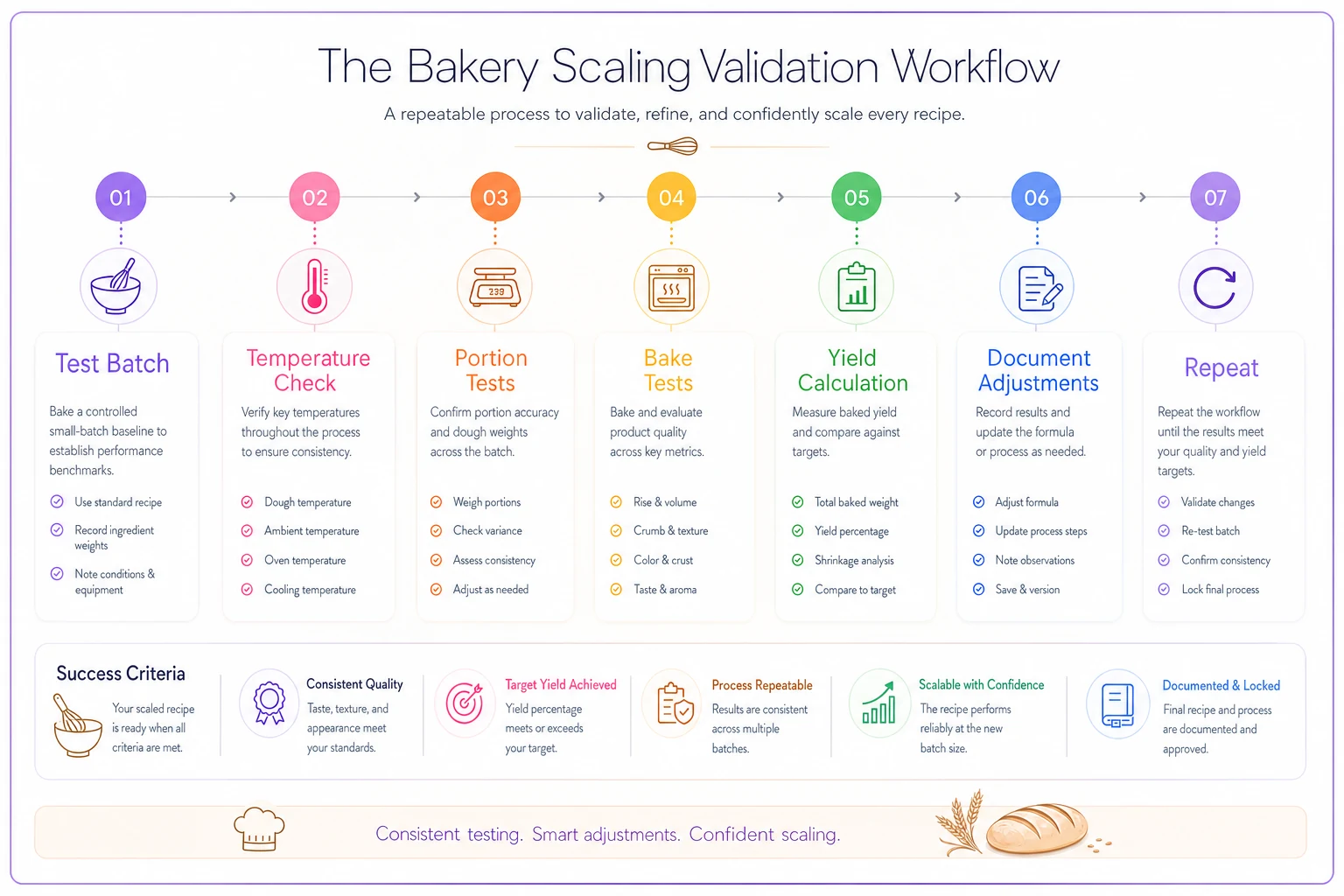
A simple visual helps teams follow the steps without skipping anything.
This takes maybe 2 hours and $30 of ingredients. Compare that to losing a full production run of 300 croissants because you didn't test your 10x scale-up.
Skip steps and you'll regret it. A busy Saturday morning isn't when you want to discover that your scaled muffin batter overflows the tins.
Software that tracks scaling performance
Manual tracking of scaling adjustments turns into a mess of notebooks and post-its. You make an adjustment for that big holiday order, then six months later you're trying to remember what you changed and why.
Modern operational software handles this differently. Instead of static recipes, you get dynamic formulas that adjust based on batch size. The system flags when percentages drift outside acceptable ranges. It tracks yield history at different scales. It even warns you when equipment constraints might affect quality—like trying to mix 30kg of dough in a 20-quart mixer.
The value shows up in production planning. The software learns from your yield patterns. If your chocolate chip cookies consistently yield 92% at 5x scale but 85% at 10x scale, it factors that into ingredient ordering and production scheduling. No more running out of dough because your yields dropped unexpectedly.
Temperature logging integrates directly with scaling records. You see patterns like "croissant dough runs 3°C hot at 15kg batches in summer months" and can pre-adjust your water temperature accordingly. Some bakeries connect temperature probes that feed data directly into their production software, creating an automatic adjustment system.
AI-powered operational software takes this further by identifying scaling patterns you might miss. It notices that your brioche yields drop every time humidity exceeds 70%, or that certain flour lots require different hydration when scaled beyond 8x. The system builds institutional knowledge that survives staff turnover and reduces the learning curve for new bakers.
Building a scaling knowledge base
Every bakery develops its own scaling patterns based on equipment, environment, and products. The 20-year-old Hobart mixer behaves differently than a new spiral mixer. Your humid coastal kitchen creates different challenges than a dry mountain bakery.
Document what works:
-
Record successful scaling ratios for each product
-
Note seasonal adjustments needed
-
Track equipment limitations discovered
-
Build maximum batch sizes for each mixer/oven combination
-
Create scaling cards for your top 20 products
This becomes your operational playbook. New bakers can follow proven formulas instead of learning through failed batches. You can confidently quote catering orders knowing your scaling limits.
Making scaling decisions under pressure
Friday afternoon, a customer wants 200 cupcakes for Monday. Do you 10x your standard recipe or run multiple smaller batches?
The answer depends on your validation history. If you've successfully scaled that recipe to 8x, push it to 10x with minor adjustments. If you've only ever doubled it, run five 2x batches. Yes, it takes longer. But it's better than delivering 200 dense cupcakes.
Your scaling decision matrix:
-
Validated scale range → proceed with documented adjustments
-
Within 2x of validated range → test batch first, then proceed
-
Beyond 2x validated range → split into multiple smaller batches
-
New recipe, any scale → always test first
-
Time pressure + unvalidated scale → decline or negotiate deadline
The money isn't worth the reputation damage from scaled recipes gone wrong. Every experienced baker has stories about the wedding cake that didn't rise or the catered pastries that turned out tough because someone pushed scaling too far. These disasters stick with customers much longer than successful deliveries.
Recipe scaling in a bakery goes way beyond multiplying ingredients. It's about understanding how physics changes at different scales, tracking yield patterns, and building systematic validation processes. The bakeries that scale successfully treat it as an operational discipline, not just math.
Start with your highest-volume products. Build scaling documentation for each one. Test incrementally—don't jump from 2x to 10x without validating the steps between. Track yields obsessively. Use temperature as your early warning system.
When you combine careful testing with good documentation—whether in notebooks or operational software—scaling becomes predictable instead of problematic. You'll know exactly when that croissant dough will start causing problems, which recipes can handle 10x scaling, and when to split batches instead of pushing your luck.
The difference between bakeries that scale profitably and those that don't isn't talent or secret recipes. It's having systems that catch problems before they become expensive mistakes. Build those systems, and scaling turns from a crisis into just another controlled process in your operation.
Ready to elevate your bakery operations?
Join 2,000+ bakeries using Bakeryly to streamline workflows, reduce waste, and delight more customers.