

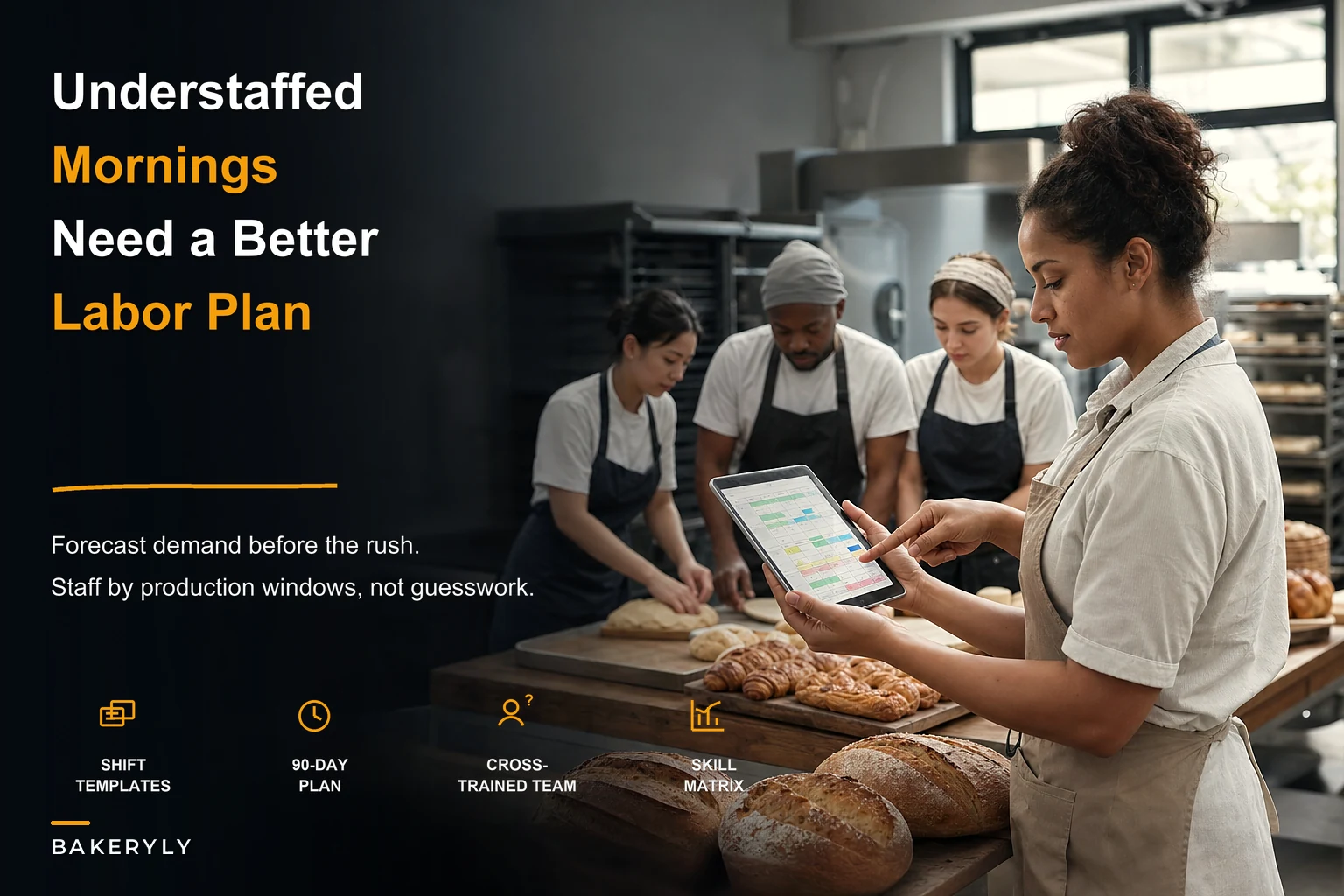

Picture walking into your bakery at 3:45am and realizing your bread mixer called out sick. Your decorator is running the ovens. The front counter person is pulling croissants. And your morning rush starts in two hours.
This exact scenario happened last month at a 12-person bakery operation I was working with. The owner had been using the same schedule for eight months straight – basically copying what worked during their slow season and hoping it would scale. Their busiest production window (4am-9am) was chronically understaffed while afternoons had people standing around cleaning already-clean surfaces.
The real problem wasn't the sick call. Nobody else knew the mixer's full routine. The decorator could run the spiral mixer, sure, but didn't know the bagel dough timing. The counter person had never touched the divider. When one person dropped out, the entire morning production schedule collapsed.
Most bakery staffing systems are just copied Excel schedules from three years ago with names swapped out. They work until they don't – usually right when you're launching that new wholesale account or opening for Sunday brunch.
Why Tuesday mornings need different people than Saturday mornings
Your Tuesday 5am crew faces completely different demands than Saturday 5am, yet most bakeries staff them identically. Tuesday might be 80% wholesale prep with predictable par levels. Saturday is walk-in chaos with custom cake pickups, doubled breakfast pastry demand, and lines out the door by 7am.
I spent three weeks tracking actual task completion times across multiple bakery operations. The variance was huge. A morning bake that takes 2.5 hours with your experienced Tuesday crew stretches to 4+ hours on weekends when you're pulling in part-timers who only work Saturdays. Same ovens, same recipes, wildly different output.
The traditional approach treats all morning shifts as equal. Five people for opening, regardless of whether you're baking 200 or 800 croissants. This creates a pattern: Tuesday's crew finishes early and starts deep-cleaning (killing time), while Saturday's crew is still pulling pastries at 10am when they should be prepping lunch items.
What actually drives your labor needs:
Production windows matter more than shift times. Your sourdough starter doesn't care that Jessica usually works 6am-2pm. It needs feeding at specific intervals. Your croissants need laminating when they need laminating. Build your schedule around production requirements, then fit people into those windows.
Historical sales only tell half the story. Last Tuesday's sales show you needed 300 morning pastries. But they don't show you sold out of almond croissants by 8am and had 40 plain croissants left at close. Tracking sell-through times by product changes everything. Maybe you need the same total units but distributed completely differently across your morning bake.
The skills mismatch makes this worse. Your best bread person might be scheduled Tuesday through Saturday. But Wednesday is dead for specialty breads while Sunday (when they're off) gets slammed with special orders. You're paying premium skills to stand around Tuesday while Sunday struggles with basic batards.
The expensive truth about single-skilled bakers
A baker who only does breads costs you more than their hourly rate suggests. Not because they're overpaid, but because they create scheduling rigidity that ripples through your entire operation.
Never miss a bake or delivery again.
Bakeryly helps you schedule, track, and manage every order effortlessly.
- Unified order tracking
- Real-time inventory alerts
- Staff shift management
No credit card required
When your bread specialist takes vacation, you either scramble to cover with overtime, accept lower quality output, or just don't make certain items. I watched one operation stop making their signature sourdough for a full week because only one person knew the starter maintenance routine. They lost around $2,800 in margin that week – far more than cross-training would have cost.
The single-skill trap builds gradually. Someone shows aptitude for decorated cakes, so they become "the decorator." Someone else nails the croissant lamination, they become "the pastry person." Seems efficient until you realize you're now managing five different specialized schedules instead of one flexible team.
Cross-training stalls for predictable reasons. Training happens during slow periods, but slow periods are when you cut hours. Or training happens during busy periods, but then it's rushed and incomplete. The new person learns just enough to be dangerous – they can run the sheeter but don't know to check dough temperature first.
-
Schedule inflexibility (can't move shifts without disrupting production)
-
Coverage gaps (nobody qualified to cover their specific role)
-
Overtime spikes (pulling in others at 1.5x rate to cover)
-
Quality variance (untrained coverage making preventable mistakes)
-
Inventory waste (products not made rather than made poorly)
The math shifts fast. That $3/hour difference becomes meaningless when you're paying overtime every time your specialist calls out or takes vacation.
Building your 90-day cross-training system
Most cross-training fails because it's treated as "watch and learn" during regular shifts. This doesn't work. The trainee either slows production (annoying everyone) or stands around watching (learning nothing).
A functional 90-day system builds competency in stages. Not "today you learn breads," but "today you learn to scale ingredients for five specific formulas." Small, measurable skills that compound into station mastery.
| Phase | Details |
|---|---|
| Days 1-30 | Focus on universal bakery basics that apply everywhere. Scaling, mixing, temperature monitoring, basic equipment operation. These aren't tied to specific products but create the baseline for everything else. Schedule these during overlap periods – that 30-minute window when morning and afternoon shifts cross. Nobody's rushed, trainer isn't pulled away. |
| Days 31-60 | Station rotation: Three hours per week at different stations, but with limited scope. At the bread station, they're only responsible for mixing and initial shaping, not the full bake. At decorating, they're doing base coats and simple borders, not custom work. This prevents overwhelming while building real skills. |
| Days 61-90 | Production ownership: Now they own specific products start to finish. Begin with forgiving items (muffins, cookies) before moving to technical products (croissants, artisan breads). They work alongside the specialist but have clear ownership. Mistakes are theirs to fix, successes theirs to claim. |
The timeline matters less than the structure. Some people compress this into 60 days, others need 120. The key is documented progression – knowing exactly which skills someone has verified competency in.
Run foundation skills during overlap periods so trainers can observe without disrupting peak production.
Here's a simple visual workflow for how trainees move from basics to ownership.
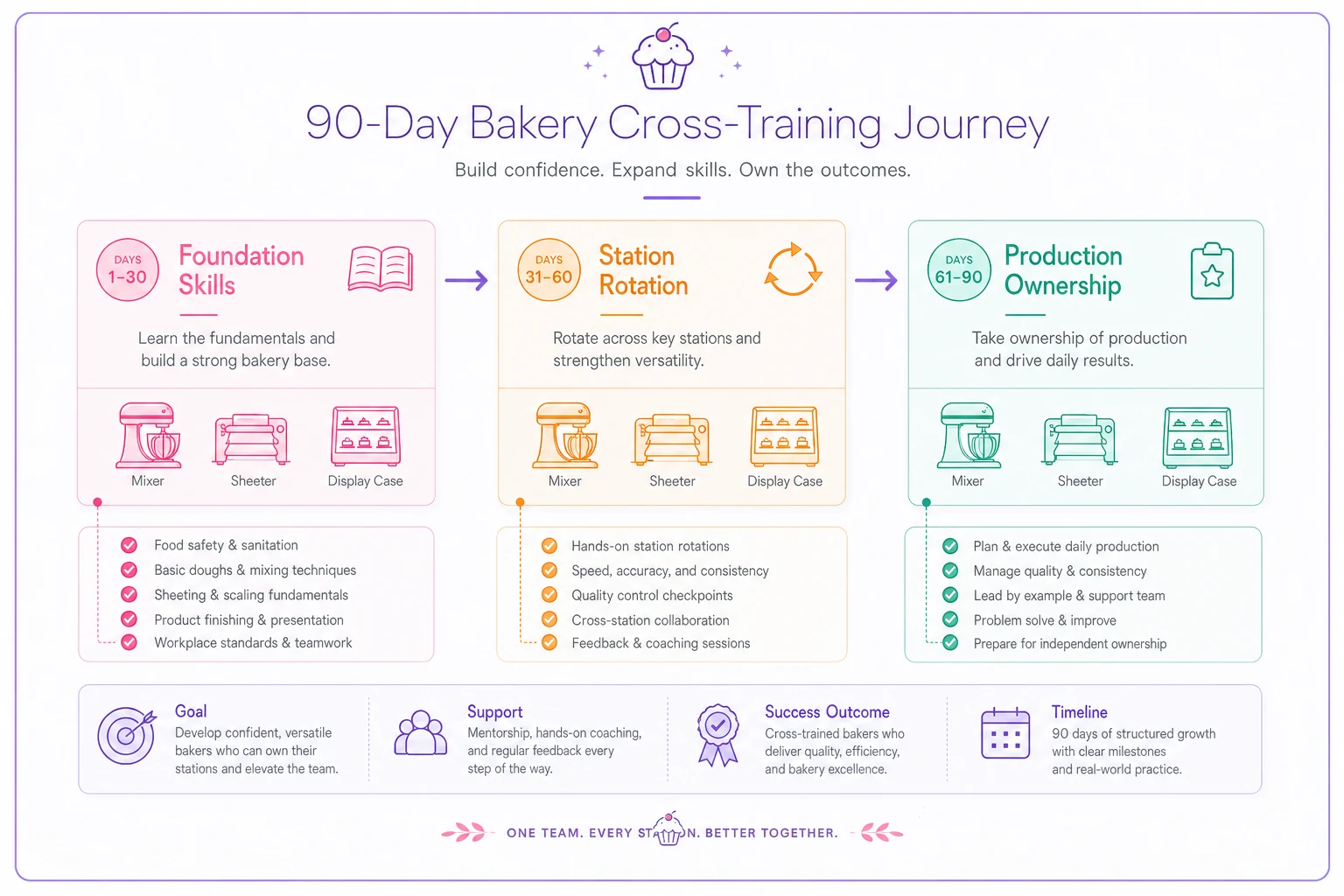
The system's success comes from measurable, documented steps rather than vague "learning on the job" expectations.
Your skills matrix isn't a fancy spreadsheet – it's a production guarantee
A real skills matrix shows you exactly who can cover what at what quality level. Not "Sarah knows cakes" but "Sarah can independently complete buttercream cakes up to two tiers, requires supervision for fondant work, cannot do sugar flowers."
Most bakeries track this in their heads or not at all. Then Thursday morning happens – your decorator calls out sick, and you're scrolling through mental notes trying to remember if Tom ever learned piping. By the time you figure it out, you've already had to refuse two custom orders.
Matrix structure that works:
-
0
Cannot perform
-
1
Can assist with supervision
-
2
Can complete with periodic checks
-
3
Can complete independently
-
4
Can train others
Categories that match your actual production:
-
Equipment operation (specific machines, not "all ovens")
-
Product formulas (individual items, not "all breads")
-
Decorating techniques (specific skills, not "decorating")
-
Customer service tasks (POS, special orders, wholesale coordination)
-
Opening/closing procedures (detailed task lists, not "knows closing")
Update triggers that actually happen:
-
Monthly skill review during slow periods
-
Post-training documentation
-
After any production error (what skill was missing?)
-
During performance reviews
The matrix feeds directly into your scheduling. Your POS should show minimum skill requirements for each shift. Tuesday morning needs: Level 3 bread, Level 2 pastry, Level 2 front counter. Now scheduling becomes matching available skills to required skills, not guessing whether coverage will work.
Forecasting that accounts for Mother's Day and random Tuesday slumps
Standard forecasting looks at last year's same week, maybe factors in some growth percentage, and calls it good. This breaks down fast in bakery operations where a rainy Saturday can crater sales while a sunny Tuesday after a holiday weekend might double them.
Demand-based forecasting for bakeries needs multiple data streams:
Local event calendars change everything. The marathon route that passes your shop. The farmer's market moving locations. School schedules, construction projects, concerts in the park. One bakery discovered their "random" busy Thursdays aligned perfectly with a nearby yoga studio's evening class schedule – 200 people getting out at 7pm, quarter of them stopping for pastries.
Weather patterns by product category. Rain doesn't uniformly suppress sales. Coffee and soup sales might spike while custom cake pickups still happen regardless. Cold mornings drive hot breakfast items while killing salad sales. Track product mix changes, not just total sales.
Ordering patterns that predict tomorrow. Three custom cake orders for Saturday tells you more than last Saturday's sales. Wholesale orders placed by Wednesday forecast Thursday's production needs perfectly. These leading indicators are more accurate than historical trailing data.
A functional forecasting system combines:
-
Baseline historical demand (last 4-6 weeks, same weekday)
-
Seasonal adjustment factor (comparing to last year's same period)
-
Event impact modifier (known local events, holidays)
-
Weather adjustment (by product category)
-
Advance order intelligence (what's already committed)
The output isn't just "we need 7 people Thursday morning" but "we need 7 people Thursday morning with these specific skills for these production windows." Your 5am-7am window might need heavy mixing and shaping capability. Your 7am-9am window shifts to baking and finishing. Same headcount, different skill distribution.
When your best decorator quits: the hidden cost of skill concentration
Every bakery has that one person. They've been there forever, know every recipe by heart, can fix any equipment problem. When they leave, you realize they weren't one employee – they were three employees' worth of institutional knowledge walking out the door.
Skill concentration creates operational fragility. The more specialized your team becomes, the more vulnerable you are to single points of failure. It's not about people being replaceable (they're not), but about operations being resilient.
The real impact shows up in unexpected ways:
Customer relationships tied to individuals. "Only Marie knows how Mrs. Johnson likes her special order." "Tom always handles the wholesale accounts." When they leave, those relationships become vulnerable. Orders get messed up, trust erodes, accounts drift away.
Undocumented process modifications. Your senior baker adjusted that sourdough formula two years ago for your specific oven's hot spots. Never wrote it down. New baker follows the written recipe perfectly and wonders why everything burns on the left side.
Equipment workarounds. The mixer that needs a gentle tap at the 3-minute mark. The oven door that sticks unless you lift while opening. The proofer that runs 5 degrees cold. Years of accumulated knowledge that disappears instantly.
Building redundancy without redundant labor costs requires systematic knowledge transfer. Not everything needs documenting, but critical processes need at least two people with working knowledge. This isn't about replacing your experienced staff – it's about protecting the operation when life happens.
The software piece: where bakery staffing gets interesting
Manual scheduling breaks at scale. Works fine when you're tracking five people across standard shifts. Falls apart when you're managing 15+ people with varying skills, availability constraints, and production requirements that change daily.
The challenge isn't making a schedule – it's making a schedule that aligns skills with demand, respects labor budgets, accommodates time-off requests, and maintains coverage for critical production windows. Do this manually and you're spending 3-4 hours weekly on scheduling alone, usually Sunday nights when you should be recharging.
Modern bakery staffing systems handle the complexity by connecting multiple data streams. Sales forecasting feeds into production planning. Production planning determines skill requirements. Skill requirements match against available staff. The system suggests optimal schedules that you adjust, not build from scratch.
What changes with intelligent scheduling:
Labor costs align with actual demand. Instead of flat staffing every Tuesday, you're scaling to match predicted sales. Slow Tuesday? Minimum viable crew. Holiday week Tuesday? Surge staffing for the rush.
Skills match production needs. The system knows Sarah has Level 4 decorating but only Level 2 bread skills. It won't schedule her as sole coverage for bread production but will prioritize her for high-decoration days.
Cross-training becomes strategic. The system identifies skill gaps – "If Tom gets sick, nobody else can run the laminator." Now you know exactly what cross-training provides maximum coverage flexibility.
Time-off requests process automatically. Request flows in, system checks coverage requirements, either approves (coverage exists) or flags for review (creates skill gap). No more manual checking whether you can afford to lose someone specific days.
The automation handles the mathematical optimization while you handle the human elements. The system might suggest an optimal schedule, but you know Jennifer and Mark work terribly together, so you adjust. It flags that Thursday needs more coverage, but you know the forecast is wrong because of construction next door, so you override.
From 5am chaos to predictable mornings
The difference between bakeries that scale successfully and those that hit operational walls usually comes down to staffing systems. Not having enough people, but having the right people with the right skills at the right times.
A demand-based staffing system removes the guesswork. Your Tuesday morning runs smooth because you staffed for Tuesday's actual demand, not some generic "morning shift." Your decorator calls out sick and you know exactly who can cover which aspects of their role. Custom orders increase and you can see months ahead which skills need development.
The progression typically looks like:
Month 1-2: Document current state. Who actually knows what? Which production windows consistently struggle? Where does overtime spike? What causes quality issues?
Month 3-4: Build the skills matrix and start structured cross-training. Small wins – someone learns a second station, overtime drops slightly, coverage improves.
Month 5-6: Implement demand-based scheduling. Match labor to actual needs, not historical patterns. Labor costs stabilize while service improves.
Month 7+: System refinement. Forecasting gets more accurate. Cross-training fills remaining gaps. Schedule creation becomes a 30-minute task instead of a 3-hour headache.
The transformation isn't dramatic – it's systematic. Instead of putting out fires, you're preventing them. Instead of hoping coverage works, you know it will. Instead of your best people burning out from constant overtime, they're developing others and building resilience.
Your 4am doesn't have to be chaos. With the right staffing system, it becomes what it should be – productive, predictable, and profitable. The ingredients are the same, the recipes unchanged. What changes is how you deploy your most valuable resource: your people.
The bakeries that thrive aren't necessarily the ones with the best recipes or locations. They're the ones that figured out how to consistently deliver quality products by having the right people with the right skills exactly when needed. Everything else – customer satisfaction, profitability, growth potential – flows from getting your staffing system right.
The difference between bakeries that scale successfully and those that hit operational walls usually comes down to staffing systems. Not having enough people, but having the right people with the right skills at the right times.
A demand-based staffing system removes the guesswork. Your Tuesday morning runs smooth because you staffed for Tuesday's actual demand, not some generic "morning shift." Your decorator calls out sick and you know exactly who can cover which aspects of their role. Custom orders increase and you can see months ahead which skills need development.
The transformation isn't dramatic – it's systematic. Instead of putting out fires, you're preventing them. Instead of hoping coverage works, you know it will. Instead of your best people burning out from constant overtime, they're developing others and building resilience.
Ready to elevate your bakery operations?
Join 2,000+ bakeries using Bakeryly to streamline workflows, reduce waste, and delight more customers.