


Every bakery owner I've worked with has tried tracking the same generic metrics at some point. Food cost percentage. Labor cost percentage. Average transaction value. They calculate these numbers each month, file them away, and keep running their bakery exactly the same way.
The problem isn't tracking metrics. It's tracking metrics that don't connect to actual decisions.
A bakery owner in Portland showed me her spreadsheet last month—twenty-three different metrics, color-coded and graphed. When I asked what changed after discovering her croissant yield had dropped 4%, she paused. "Well, I noticed it," she said. "But I wasn't sure what to do about it."
Most bakery KPI systems measure outcomes without creating decision triggers. They tell you something's wrong but not when to act or what to change.
The operational reality of bakery metrics
Most bakery KPIs fail because they measure the wrong level of detail at the wrong cadence with no clear action threshold.
Take waste percentage. Nearly every bakery tracks it monthly. By the time you see that number, you've already thrown away hundreds of pastries. The damage is done. The patterns that created that waste are buried under a month of averaged data.
Or consider labor cost percentage—the metric every consultant tells you to watch. A bakery doing $40,000 in monthly sales with 28% labor costs knows they're spending $11,200 on wages. Great. Now what? Does that mean you're overstaffed? Underpaying? Running inefficient prep schedules? The percentage alone tells you nothing actionable.
Real bakery operations need metrics that connect three things: what's happening, when to care, and what to change. Without all three, you're just collecting numbers.
Why traditional bakery KPIs create analysis paralysis
Standard bakery metrics create more confusion than clarity because they measure at the wrong altitude.
Never miss a bake or delivery again.
Bakeryly helps you schedule, track, and manage every order effortlessly.
- Unified order tracking
- Real-time inventory alerts
- Staff shift management
No credit card required
Food cost percentage aggregates everything from your sourdough starter to your specialty chocolate. When it shifts from 32% to 35%, you know costs increased somewhere. But was it flour prices? Over-portioning? Recipe drift? Supplier changes? The aggregate number hides the operational story.
Customer count works the same way. A bakery averaging 180 customers daily might see that drop to 165. Concerning? Maybe. But if those 165 customers are buying more per visit, or if the drop is entirely in low-margin drip coffee sales, the operational response changes completely.
The metrics themselves aren't wrong. The problem is using endpoint measurements to manage process problems. It's like checking your weight to determine if you should change your workout routine. The scale number is the result of dozens of daily decisions, not a guide for making them.
Bakeries that actually improve their operations track decision-driving metrics at the right frequency. They know exactly when a number means "change something now" versus "monitor for another week."
The 10 bakery KPIs that actually trigger operational changes
After analyzing hundreds of bakery operations, certain metrics consistently drive real decisions. Not vanity metrics or industry benchmarks, but numbers that tell you exactly when and how to adjust operations.
1. Per-item yield variance (tracked daily)
Calculation: (Actual units produced / Expected units from batch size) × 100
A sourdough bakery should get 24 loaves from a 15-pound batch. When Tuesday's batch only produces 22 loaves, that's an 8.3% negative variance.
Report cadence: Daily, by product category
Decision trigger: Any variance over 5% for two consecutive days = investigate process immediately. Over 10% once = stop and diagnose before next batch.
This metric catches problems while they're fixable. Recipe drift, scaling errors, equipment issues—they all show up here first, not in your monthly P&L.
2. Morning inventory accuracy (tracked at open)
Calculation: (Items actually available at open / Items planned for opening) × 100
Nothing frustrates customers more than seeing empty shelves at 8 AM. But over-producing to avoid stockouts creates afternoon waste.
Report cadence: Daily at opening
Decision trigger: Below 95% accuracy three times in a week = adjust production planning. Below 90% once = immediate production schedule review.
3. Peak hour throughput (customers per labor hour)
Calculation: Customers served during peak ÷ Total staff hours during peak
Forget overall labor percentage. What matters is whether you can handle your rush efficiently.
Report cadence: Daily for each two-hour peak window
Decision trigger: Below 80% of your baseline for two consecutive days = adjust staffing or prep schedules. Below 60% once = immediate investigation.
4. Product-specific waste rate (tracked at close)
Calculation: (Units disposed ÷ Units produced) × 100, by product
Tracking total waste hides which products consistently over-perform or under-perform.
Report cadence: Daily by product, weekly summary
Decision trigger: Any item over 15% waste for a full week = reduce production or eliminate. Over 25% for two days = immediate production adjustment.
5. Prep-to-shelf time (for fresh items)
Calculation: Time from oven/completion to display availability
A croissant that takes 45 minutes to go from oven to display case is losing quality and sales opportunity.
Report cadence: Spot checks three times weekly
Decision trigger: Over 30 minutes for any fresh item = review cooling and display procedures. Over 45 minutes = immediate process intervention.
6. Per-item direct labor cost
Calculation: (Labor minutes × hourly rate) ÷ Units produced
That beautiful lattice pie might take 12 minutes of skilled labor. At $18/hour, that's $3.60 in direct labor per pie. If you're selling it for $8, the math gets challenging quickly.
Report cadence: Weekly for top 10 items, monthly for full menu
Decision trigger: Direct labor over 30% of selling price = evaluate pricing or process. Over 40% = must change price or method immediately.
7. Category velocity rate
Calculation: Units sold ÷ Hours available for sale
Your savory items might move at 2.3 units per hour while sweet pastries move at 4.1. This drives both production planning and display allocation.
Report cadence: Weekly by category
Decision trigger: 20% variance from baseline = adjust production ratios. 30% variance = investigate customer preference shift.
8. Ingredient usage efficiency
Calculation: (Standard ingredient amount ÷ Actual used) × 100
If your recipes call for 50 pounds of flour daily but you're consistently using 54 pounds, that 8% variance compounds quickly.
Report cadence: Weekly for top 5 ingredients
Decision trigger: Variance over 5% = retrain or review recipes. Over 10% = audit all recipes using that ingredient.
9. Customer dwell time (peak vs. off-peak)
Calculation: Average minutes from entry to exit
A customer spending 3 minutes during morning rush is good. A customer spending 3 minutes at 2 PM when you're empty suggests service or product issues.
Report cadence: Weekly comparison
Decision trigger: Off-peak dwell under 50% of peak time = review service model. Over 150% of peak = evaluate if becoming workspace, adjust accordingly.
10. Profitability per linear foot of display
Calculation: (Category gross profit ÷ Display feet allocated) ÷ Days
That gorgeous bread display might generate $40 per foot daily while your grab-and-go case generates $85 per foot.
Report cadence: Monthly
Decision trigger: Any category under $30/foot = reduce space or eliminate. Under $20/foot = immediate change required.
Building the reporting rhythm that drives decisions
The metrics mean nothing without a reporting system that creates action. Most bakeries fail here, generating reports that no one reads or acts upon.
Start with daily flash reports. Not novels, just five numbers that determine today's immediate decisions:
-
Yesterday's yield variance
-
This morning's inventory accuracy
-
Yesterday's peak hour throughput
-
Yesterday's waste by category
-
Current day's pre-order volume
These five numbers, reviewed during morning prep, catch problems before they compound. Takes three minutes to review, tells you exactly what needs attention today.
Weekly operational reviews go deeper. Every Tuesday, spend 20 minutes reviewing per-item labor costs for new products, category velocity trends, ingredient usage variances, customer flow patterns, and display space productivity.
This is where you spot trends before they become problems. The chocolate croissant that's gradually taking more labor. The afternoon dead zone that's getting longer. The flour usage that's creeping up despite stable production.
Monthly strategic reviews connect operations to finances.
| Review Type | Frequency | Key Focus | Time Investment |
|---|---|---|---|
| Daily Flash | Every morning | Production decisions for today | 3 minutes |
| Operational | Weekly | Trend identification | 20 minutes |
| Strategic | Monthly | Financial-operational alignment | 45 minutes |
Once monthly, combine your operational metrics with financial results to see which products drive profit vs. just revenue, whether operational improvements actually improved margins, if menu changes achieved intended results, and where to focus next month's operational attention.
The decision rules that eliminate guesswork
Metrics without thresholds are just interesting numbers. Every metric needs a clear "if this, then that" rule.
A neighborhood bakery struggled with afternoon waste until they created simple decision rules. If morning pastries had less than 10% waste yesterday, maintain production. Between 10-15%, reduce by one batch. Over 15%, reduce by two batches. No meetings, no debates, just clear actions triggered by specific numbers.
Their bread production rules were similarly straightforward. Peak-hour stockout = increase tomorrow's production by 20%. Closing inventory over 8 loaves = decrease tomorrow by 10%. The rules removed emotional decision-making and created consistent responses.
Document these rules before you need them.
Some rules trigger investigations rather than immediate changes. A 5% yield variance might mean "note and monitor." A 10% variance means "investigate after shift." A 15% variance means "stop production and diagnose now."
Decision rules eliminate paralysis. They turn data into action. They remove emotion from operational choices. They make terrible numbers into specific next steps.
Here's a simple workflow showing how a metric alert becomes an operational action.
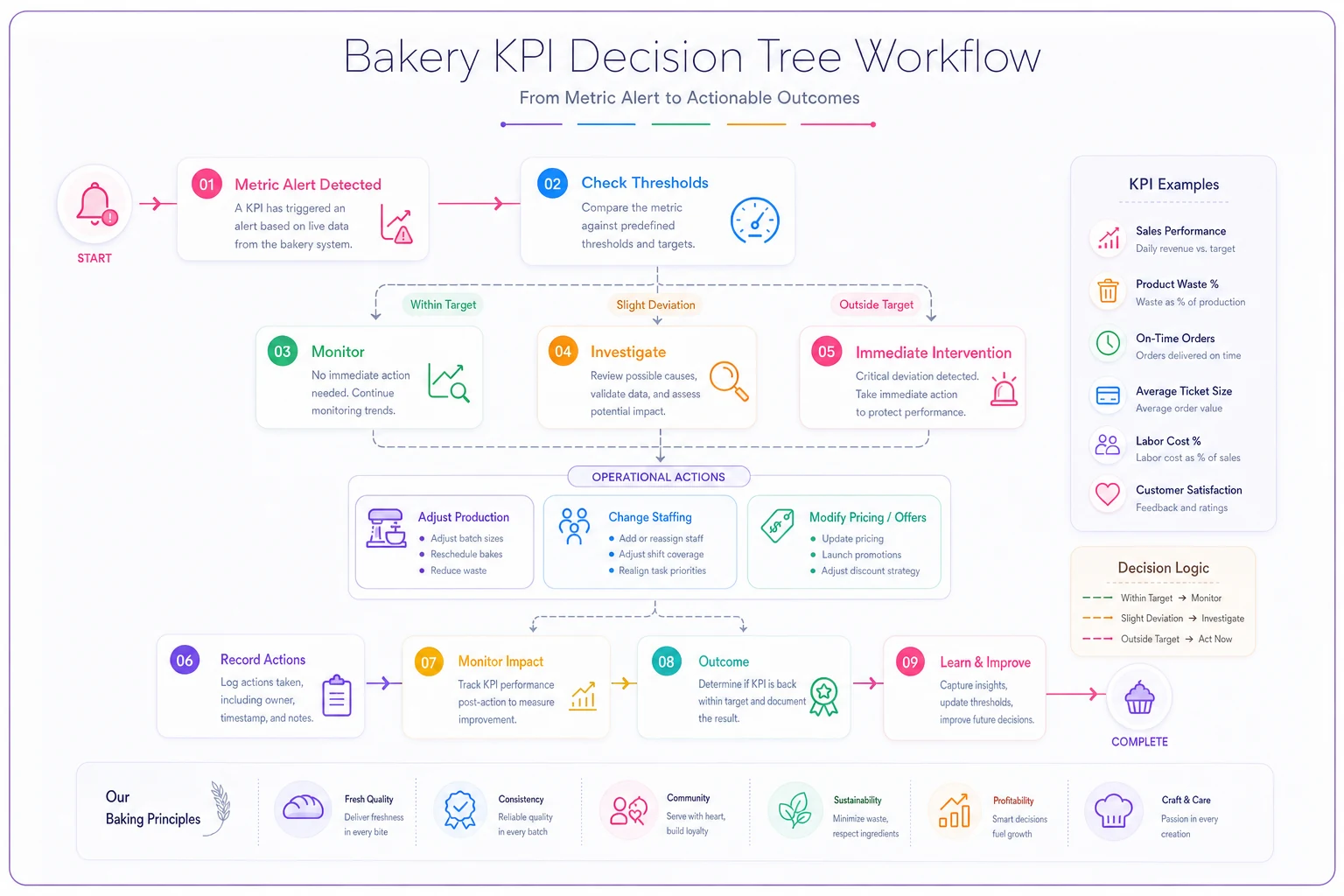
Document these rules before you need them. When Thursday's numbers show 18% croissant waste, you don't have a discussion. You follow the rule: reduce Friday production by 25% and evaluate the recipe or process before Monday.
The real-world impact of measurement-driven operations
A small bakery in Denver implemented this KPI system after years of flying blind. They didn't change their recipes, add staff, or renovate their space. They just started measuring the right things at the right cadence.
Their morning inventory accuracy went from around 75% to 92% within six weeks. Not perfect, but the reduction in customer frustration was noticeable. Peak-hour throughput improved from 14 customers per labor hour to 19, purely through better prep scheduling.
The biggest impact came from product-specific waste tracking. They discovered their beautiful fruit tarts, while Instagram-worthy, had a 35% waste rate. The mushroom quiche they almost discontinued? Only 8% waste with higher margins. The menu shift based on these numbers added roughly $2,200 monthly profit without increasing sales.
Decisions got faster and less stressful. The owner stopped agonizing over whether to adjust production or change staffing. The numbers made the decision clear. When croissant waste hit 20% for two consecutive days, they knew to reduce production immediately, not debate it for a week.
Three months later, they were running leaner operations with better customer satisfaction and improved profitability—not through intuition, but through responsive measurement.
Where AI-powered systems transform bakery metrics
The challenge with this level of tracking isn't the math—it's the consistency and connection. Calculating per-item labor costs weekly sounds simple until you're doing it for 40 products while managing morning rush and training new staff.
Modern bakery management platforms with AI automation eliminate the manual calculation and connection burden. Not replacing judgment, but maintaining the consistency that makes these metrics actionable. The system calculates yield variance in real-time, alerts you when metrics hit trigger points, and suggests optimal production adjustments based on patterns.
The AI components particularly help with pattern recognition across metrics. When Tuesday's lower foot traffic combines with higher afternoon temperatures and your historical waste patterns, the system can recommend precise production adjustments you'd never calculate manually.
AI-powered tracking maintains consistency. It calculates per-item labor costs every single day, not just when you remember. It spots the gradual recipe drift before it becomes a profitability problem. It connects weather patterns to sales velocity in ways human analysis would miss.
The technology handles the measurement burden so you can focus on operational decisions rather than data collection.
Moving from reactive to predictive bakery management
The bakeries that thrive don't just track what happened—they use their KPIs to anticipate what's coming. When your metrics include clear trigger points and decision rules, patterns become predictable.
You start noticing that yield variance often precedes equipment failure. That customer dwell time changes predict sales shifts. That certain waste patterns indicate staff training needs before quality complaints arrive.
The metrics become a conversation between past operations and future decisions. Not a report card on what went wrong, but a guide for what to adjust tomorrow.
This only works when you track the right things at the right frequency with the right response triggers. Generic industry KPIs tell you how you compare to other bakeries. Operational KPIs tell you how to run yours better tomorrow.
Predictive management feels less stressful because you're ahead of problems instead of reacting to them. Your production planning becomes more accurate. Your staffing becomes more efficient. Your customers experience fewer disappointments because you anticipated the issues before they affected service.
Creating your bakery's operational scorecard
Stop tracking metrics that don't drive decisions. If knowing your food cost percentage doesn't change how you operate, it's just trivia.
Start with three to five metrics that directly connect to daily decisions. Track them at the frequency that allows intervention, not just observation. Create clear trigger points that remove debate and drive action.
Build from there, adding metrics as your operation develops the capacity to respond to them. There's no point tracking per-item profitability if you're not ready to adjust your menu based on the results.
The goal isn't comprehensive measurement—it's operational clarity. Every number should answer a specific question that drives a specific decision. When metrics become actionable rather than just informational, they transform from burden to competitive advantage.
The bakeries winning in competitive markets aren't necessarily making better croissants. They're making better operational decisions, faster and more consistently. The right KPIs, tracked at the right cadence, with clear decision triggers—that's the difference between knowing your business and actually improving it.
Ready to elevate your bakery operations?
Join 2,000+ bakeries using Bakeryly to streamline workflows, reduce waste, and delight more customers.