


The bakery owner handed me their allergen control binder last month. Thick as a phonebook. Color-coded tabs. Legal disclaimers. Cross-contamination matrices. Training sign-off sheets dating back three years.
Then I watched their morning shift.
The prep cook wiped down the same cutting board between gluten-free brownies and regular cookies with a damp towel. Not because they didn't care—they literally didn't have time to follow the 12-step sanitization protocol buried on page 47 while trying to get 300 items ready before 7am opening. This disconnect between complex allergen documentation and actual kitchen reality kills bakeries. Not just legally, but operationally. Your team starts cutting corners because the system is impossible to follow, then someone gets sick, and suddenly you're dealing with health department shutdowns and lawsuits that could've been prevented with simpler, actually-usable procedures.
The morning rush reality check
Watch any small bakery between 4am and 8am and you'll see why complex allergen SOPs fail. Your overnight baker is decorating cakes, mixing tomorrow's dough, trying to remember if they cleaned the mixer paddle between the almond croissants and the nut-free sugar cookies. The counter person arrives at 6:30am to set up displays while fielding early customer questions about ingredients.
Nobody has time to reference a manual.
Staff develop their own shortcuts. Maybe they dedicate certain tools to allergen-free items. Maybe they clean "extra good" between products. Maybe they just hope nothing goes wrong. These informal workarounds become your real allergen control system—completely undocumented and inconsistent between shifts.
You probably don't even know what your actual allergen procedures are. You know what's written down, but that's not what's happening at 5am when your baker is racing to fill the cases.
Station segregation that works in 900 square feet
Forget the industrial kitchen layouts in those food safety textbooks. Your bakery probably has one prep table, two ovens, and a mixer that everyone shares. Traditional allergen segregation advice—separate rooms, dedicated equipment, isolated storage—doesn't work when your entire kitchen fits in a residential garage.
Never miss a bake or delivery again.
Bakeryly helps you schedule, track, and manage every order effortlessly.
- Unified order tracking
- Real-time inventory alerts
- Staff shift management
No credit card required
The left-to-right flow system
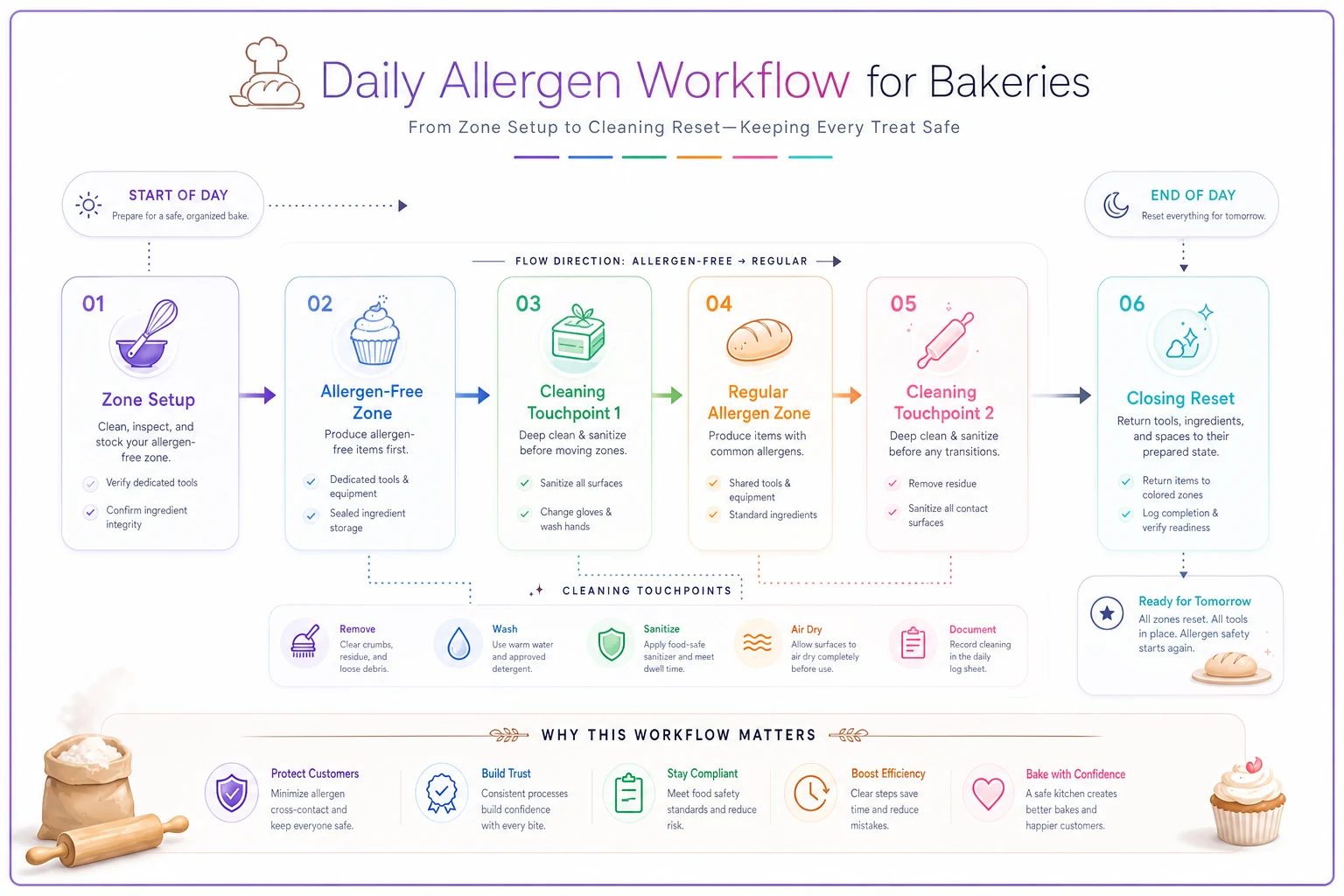
Set up your prep area so allergen-free items always move left to right, never backwards. Gluten-free station on the far left, then dairy-free, then nut-free, then regular items on the right. Even on a single 8-foot prep table, this creates natural boundaries. Train everyone: allergen-free starts left, moves right, never reverses.
Color-coded zones, not equipment
Instead of buying duplicate mixers and ovens (impossible for most small bakeries), create color zones. Red tape marks the gluten-free prep corner. Blue tape marks dairy-free. Yellow for nut-free. Same equipment, but clear visual boundaries that remind staff to clean between zones. Costs about $30 in colored tape versus $15,000 in duplicate equipment.
Use colored tape on hooks and edges so morning bakers can spot zones quickly in dim light.
The daily reset rule
Every item returns to its home zone at closing. Measuring cups back to their colored hooks. Cutting boards to their marked slots. Sheet pans to their designated racks. Morning shift always starts with proper segregation, even if afternoon shift got chaotic.
GRAPH: Daily allergen workflow from zone setup through cleaning reset - shows the left-to-right movement pattern, cleaning touchpoints between zones, and closing reset process that maintains segregation
A bakery in Denver implemented this system with 850 square feet of kitchen space. Their health inspector actually photographed their setup as a best practice example. Cost them under $200 to implement, mostly in tape and labels.
Two-minute cleaning protocols between allergen zones
That 12-step sanitization process in your manual? Nobody's doing it. Not when they have 40 dozen items to prep before opening. Your team needs cleaning protocols that take two minutes max and actually eliminate cross-contamination.
The three-spray system
-
Scrape debris (10 seconds)
-
Spray with allergen-removal solution (20 seconds coverage)
-
Spray rinse and single-use towel dry (30 seconds)
One minute total. Keep spray bottles at each station—no walking to sinks. Use single-use paper towels for allergen cleans, regular towels for everything else. This visual difference reminds staff they're doing an allergen clean, not just wiping down.
Equipment-specific protocols
| Equipment | Quick Clean Method | Time | When to Full Clean |
|---|---|---|---|
| Mixer bowl & paddle | Wipe, spray, wipe, flip upside down | 90 seconds | After nuts/dairy, end of shift |
| Sheet pans | Parchment liner swap, edge wipe | 30 seconds | End of shift only |
| Work surface | Scrape, spray, new cutting mat | 45 seconds | Between each allergen zone |
| Measuring tools | Dedicated sets per zone, no sharing | 0 seconds | End of shift wash |
| Decorating bags | Single use for allergen items | 0 seconds | Never—dispose after use |
Different equipment gets different protocols. Not everything needs deep sanitization between uses. Parchment paper becomes your best friend—it's faster to swap paper than to wash pans.
Visual labeling that prevents 5am mistakes
Your overnight baker doesn't have time to check ingredient lists at 4am. They're working on muscle memory and whatever labels they can see without turning on extra lights. Most allergen mistakes happen because someone grabbed the wrong ingredient in dim lighting or assumed something was safe because it looked familiar.
The three-layer labeling system
-
Colored lid (bright green for gluten-free, blue for dairy-free, orange for nut-free)
-
Bin label with allergen status in 72-point font
-
Shelf label indicating what belongs there
Even if one label falls off or gets covered in flour, two backups remain visible. Takes maybe 20 minutes to set up initially, then maintains itself.
Production labels that actually get used
-
CONTAINS
GLUTEN, DAIRY, EGGS
-
GLUTEN-FREE - Dedicated Equipment Used
-
NUT-FREE - Cleaned Equipment Protocol Followed
Keep these in clear dispensers at each station. Dating and labeling takes 5 seconds when you're just peeling and sticking, versus 30 seconds to hand-write everything. Your team will actually use labels that are faster than not labeling.
The morning setup card
``
TUESDAY MORNING BAKE
□ GF Brownies (RED ZONE FIRST)
□ Almond Croissants (CLEAN AFTER)
□ Sugar Cookies (nut-free batch)
□ Regular Brownies
□ Sourdough Loaves
``
Update it during closing shift for the next morning. Your 4am baker knows exactly what order to work in without checking recipes or thinking too hard.
Staff scripts that actually sound natural
"Is this gluten-free?" might be the most common question in your bakery, but watch how differently each employee answers. Some say yes. Some say "I think so." Some launch into a medical disclaimer about shared equipment. This inconsistency confuses customers and creates liability.
Your team needs exact phrases that sound natural but cover your legal bases:
For confirmed allergen-free items:
"Yes, our [item] is made without [allergen]. We prepare it on cleaned equipment in our kitchen that does handle [list other allergens]."
For uncertain situations:
"Let me double-check that for you" [retrieve the allergen binder or call the baker]. Never guess. Never say "probably."
For items with allergen ingredients:
"Our [item] contains [allergens]. If you're looking for something without [allergen], our [alternative] is a popular option."
For severe allergy concerns:
"We take allergens seriously, but want you to know we're a small bakery that handles all major allergens in our kitchen. While we follow strict cleaning protocols, we cannot guarantee against cross-contamination for severe allergies."
Write these on index cards. Keep them by the register. New employees literally read from the cards their first week until the language becomes natural. Sounds stilted? Maybe, but it's way better than a lawsuit because someone freelanced their answer.
Shift-level checks without the paperwork mountain
Those daily allergen check sheets with 47 checkboxes? They become pencil-whipped fiction by week two. Your morning shift is checking boxes without actually checking anything because they need to open the store.
Replace complex audits with three simple shift checks:
-
Opening check (30 seconds)
Allergen zones set up correctly? Cleaning supplies stocked at each station? Today's production card posted?
-
Mid-shift check (during natural break)
Any allergen near-misses or confusion? Any equipment sharing between zones? Any customer allergen questions we weren't sure about?
-
Closing reset (5 minutes)
All equipment back to home zones. Tomorrow's production card ready. Any allergen incidents to log (only if something actually happened).
No daily novels about what didn't go wrong. Only document actual issues and corrections. A simple notebook works better than elaborate forms. Date, issue, fix, initial.
One Portland bakery switched from 3-page daily audit forms to this simple system. Their actual allergen protocol compliance went up because staff weren't overwhelmed by documentation. Their health department loved it because the simple logs showed real attention to issues, not checkbox theater.
When complexity becomes dangerous
The more complex your allergen SOP, the more likely it fails during actual emergencies. Your elaborate decision tree for handling allergic reactions doesn't help when a customer is struggling to breathe and your counter person is panicking.
The two-card emergency system
Card 1 (by register):
-
Call 911 immediately
-
Ask "Do you have an EpiPen?"
-
Keep person sitting upright unless they feel faint
-
Stay with them until help arrives
Card 2 (by phone):
-
"We take this very seriously. Let me get our allergen documentation."
-
Retrieve the incident log and current SOP
-
Don't admit fault or speculate about causes
-
Provide requested documentation promptly
Two simple cards that anyone can follow under stress. No flowcharts. No decision matrices.
Making it stick without constant training
The best bakery allergen control SOP fails if it only lives in your head or in a binder nobody opens. But you don't have time for weekly allergen training sessions when you're running on skeleton crews.
Zone captains, not general training
Assign each experienced employee one allergen zone to own. They're responsible for keeping that zone properly set up and teaching new staff just that zone's protocols. Five minutes of targeted training beats hour-long general sessions.
The buddy open
New employees work their first three opening shifts with someone experienced, but not as general training. They literally mirror every movement. Where experienced staff spray, they spray. Where they check labels, new staff checks labels. Learning by copying exact movements sticks better than verbal instruction.
Monthly allergen item rotation
Each month, feature one allergen-free item prominently. This forces everyone to practice those protocols regularly instead of only when a customer specifically asks. October might be gluten-free month. November is nut-free. Keeps skills fresh without feeling like training.
The tech stack that takes 10 minutes to set up
You don't need expensive allergen management software. A few simple tools make the difference between SOPs that work and ones that get ignored:
Digital timer apps with labels
Set recurring timers for allergen cleaning. "Clean mixer after nuts" pops up on the kitchen tablet. Takes 30 seconds to set up, reminds staff forever.
Shared photo folder for allergen setups
Take a photo of correct zone setup each week. New staff can reference what "correct" looks like from their phones. Updates automatically when you change layouts.
Simple inventory tracking for allergen ingredients
A basic spreadsheet that flags when you're low on gluten-free flour or dedicated allergen-free supplies. Running out mid-shift forces dangerous improvisation.
Pick tools your team already uses. If everyone has smartphones, use photo folders. If you have a kitchen tablet, use timer apps. Don't introduce new technology just for allergen control.
Real numbers from simplification
A small Nashville bakery with around 1,100 square feet simplified their allergen SOPs last year. They went from a 62-page manual to a 3-page quick reference guide, colored zones, and the two-minute cleaning protocols.
-
Zero allergen incidents (down from 3-4 yearly close calls)
-
Morning prep time dropped by roughly 20 minutes (no more hunting for dedicated equipment)
-
Health inspection score went from 87 to 96
-
Insurance premium reduced by about $800 annually after showing simplified but consistent protocols
-
Counter staff confidence handling allergen questions improved noticeably
The owner said the biggest change wasn't the metrics—it was that their team actually followed the procedures. "My overnight baker actually uses the system at 4am. That never happened with our old manual."
When simple isn't enough
Some situations legitimately need complex allergen protocols. If you're producing packaged goods for retail. If you're selling to schools or hospitals. If you advertise as a dedicated allergen-free facility. These scenarios require the full documentation mountain.
But for most small bakeries serving walk-in customers? Simple, followable SOPs beat complex plans every time. Your customers care more about consistent safety than impressive documentation.
Ask yourself: would I rather have a perfect allergen manual that nobody follows, or a simple system that prevents actual contamination? That's not really a choice.
Building your Monday morning system
Start with Monday morning. When mistakes happen—weekend brain fog, new week rushing, everyone trying to catch up. If your allergen SOPs work on Monday morning, they'll work all week.
This week, try just three changes:
-
Tape colored zones on your prep area (even just masking tape with marker works)
-
Print those exact phrase cards for counter staff
-
Create tomorrow's production card tonight
Don't revamp everything at once. Small changes that actually get used beat dramatic overhauls that overwhelm everyone.
The goal isn't perfection. It's progress that sticks. A small bakery operating safely with simple protocols beats a contamination lawsuit with perfect documentation any day. Your 40-page allergen manual might make lawyers happy, but it won't protect customers at 5am when your baker is running on autopilot. Simple visual cues, two-minute protocols, and systems that match your actual kitchen reality—that's what keeps people safe.
When health inspectors see colored tape zones and staff actually following procedures, they care way less about the thickness of your manual.
Ready to elevate your bakery operations?
Join 2,000+ bakeries using Bakeryly to streamline workflows, reduce waste, and delight more customers.