

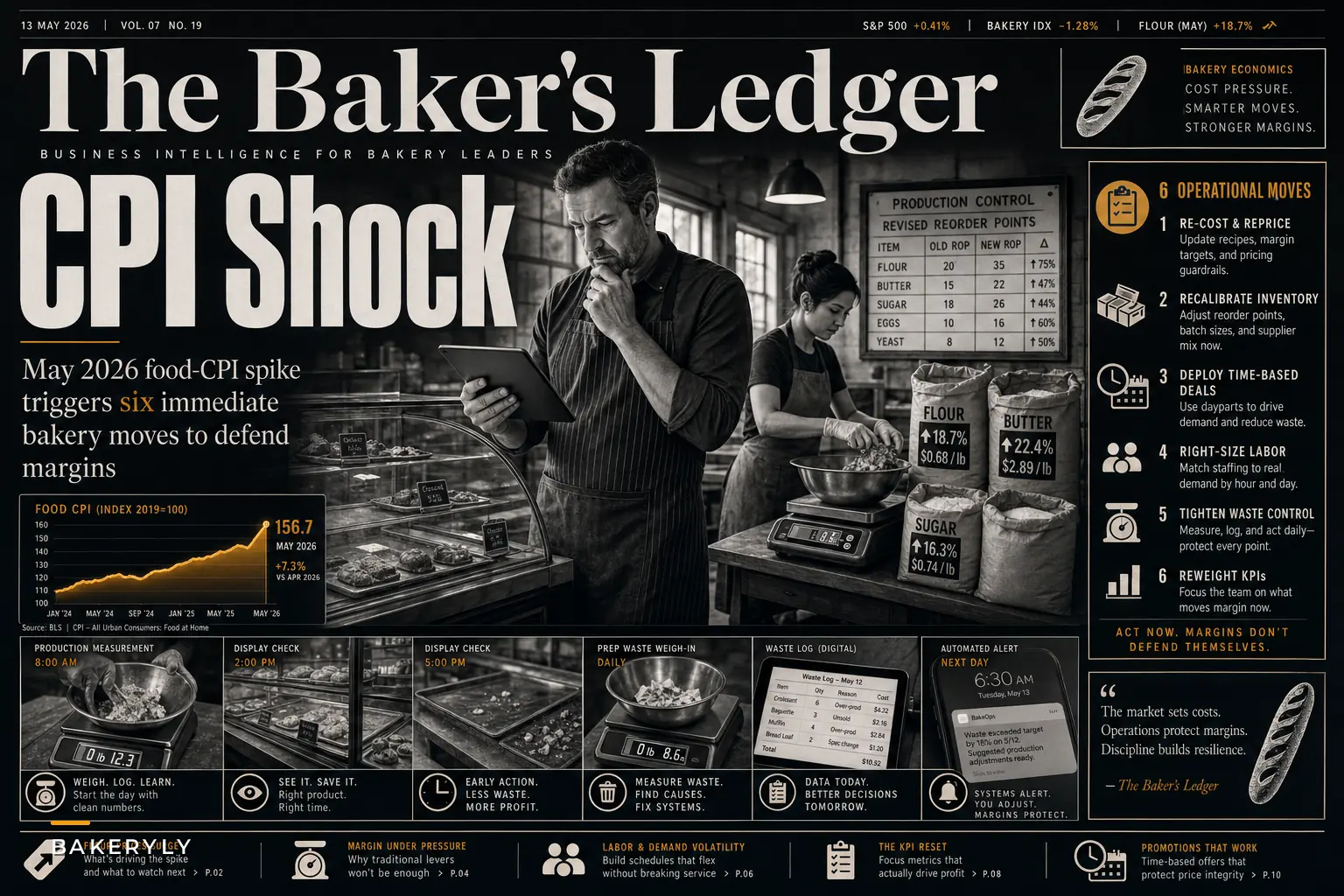

The May CPI numbers dropped yesterday, and if you're running a bakery, you probably felt that gut punch. CNBC reported the 4.2% year-over-year jump — the highest we've seen in three years. Cereals and bakery products are outpacing general inflation again, while energy costs for delivery and production keep climbing.
I talked to three bakery owners yesterday who were already feeling squeezed before this report. One runs a 12-person operation in Denver. His flour costs jumped 18% since March, diesel delivery expenses went up another $400 monthly. They're stuck between raising prices again and watching their thin margins vanish completely.
This isn't another inflation scare. The timing makes it brutal — summer demand is ramping up just as costs explode. Most bakeries already burned through their pricing power earlier this year. What you do in the next 30 days determines whether you're still profitable by September.
Move 1: Kill your loss-leader items (yes, even the popular ones)
Every bakery has them — those items customers love that barely break even. Maybe it's your $2.50 plain croissant that hasn't changed price since 2023, or the wholesale sheet cakes you sell at razor-thin margins to keep that hotel account happy.
With ingredient costs where they are now, these items went from break-even to active losses. You can't afford to subsidize customer favorites anymore.
Pull your actual production costs from last week. Not your recipe cards from six months ago — your real costs including this month's flour invoice. Add 15 minutes of labor at current wages, plus your new utility rates. You'll probably discover items that cost you $3.80 to make and sell for $3.50.
-
Reformulate to hit the margin (smaller portions, ingredient swaps)
-
Raise the price to clear the threshold
-
Discontinue it completely
Don't raise prices equally across everything. Some items can handle a 20% increase without losing customers. Others will see demand crater after a 5% bump. The difference comes down to perceived value and substitution options.
| Loss leader options |
|---|
| Reformulate to hit the margin (smaller portions, ingredient swaps) |
| Raise the price to clear the threshold |
| Discontinue it completely |
Create a simple margin threshold and stick to it. Nothing leaves your kitchen unless it clears 35% gross margin after all direct costs. For items below that line, you have three options:
One Portland bakery discovered their signature sourdough loaf was losing 80 cents per unit after May's flour spike. Instead of raising the price from $6 to $8 (which would have killed demand), they introduced a "market price" model for that one item. Price floats weekly based on ingredient costs, clearly posted. Customers adapted faster than expected — they understand inflation when you're transparent about it.
Move 2: Restructure your supplier relationships right now
Most bakeries treat supplier relationships like marriages — till bankruptcy do us part. That loyalty made sense when prices were stable. Now it's killing you.
Never miss a bake or delivery again.
Bakeryly helps you schedule, track, and manage every order effortlessly.
- Unified order tracking
- Real-time inventory alerts
- Staff shift management
No credit card required
Your suppliers are dealing with the same cost pressures you are. Some are passing along every penny of increases immediately. Others are absorbing costs temporarily to keep customers. The spread between suppliers has never been wider, and you're probably overpaying by 12-20% simply from relationship inertia.
Start calling suppliers outside your usual network. Not next month — this week. Get quotes on your top 10 ingredients by volume. Include delivery in your comparison, since fuel surcharges vary wildly right now.
Payment terms matter as much as prices during inflationary periods. A supplier offering 2% cheaper flour with net-30 terms beats one with 5% cheaper flour demanding payment on delivery. Cash flow kills more bakeries than margins.
The real opportunity is in cooperative buying. Three bakeries sharing a flour delivery cuts transportation costs by 30-40%. Set up a simple rotation — you order this month, they store the excess, next month they order and you draw from their inventory. The supplier gets a larger order, you both get better pricing and lower delivery fees.
Don't wait for perfect coordination. Even informal arrangements between two bakeries can drop your delivered cost per pound by 15-20%. One group in Austin started with a shared WhatsApp thread for coordinating orders. Six months later, they're saving $1,800 monthly each on deliveries alone.
Move 3: Implement waste tracking that actually changes behavior
Waste always matters, but at current ingredient prices, every pound of discarded dough represents real money burning. The problem is that generic waste tracking doesn't change behavior — it just documents failure.
Most tracking systems fail because they measure the wrong things at the wrong time. End-of-day waste logs tell you what got thrown out, not why it happened or how to prevent it tomorrow. You need intervention points, not autopsy reports.
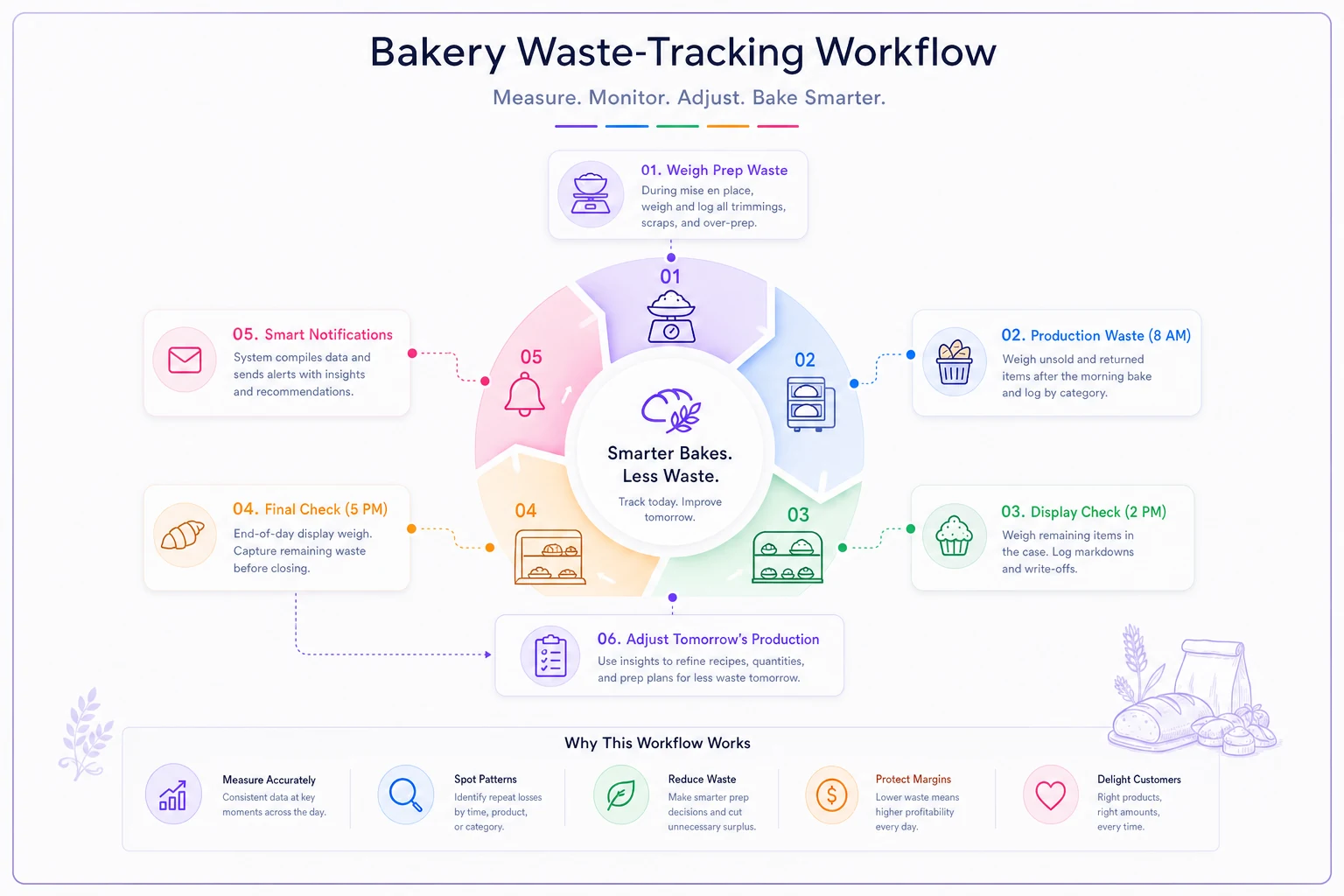
Set up measurement at three critical moments:
Production waste — measured immediately after baking, not at close. If your morning baguettes are consistently 15% over target weight, you're giving away hundreds of dollars monthly in flour. Catch this at 8 AM, not 8 PM.
Display waste — tracked at 2 PM and 5 PM. This tells you which items aren't moving and need production adjustments tomorrow. A cranberry walnut loaf that hasn't sold by 2 PM won't magically find a customer by close.
Prep waste — weighed during mise en place, not after. That trim from portioning butter croissants? If it's more than 8% of total dough weight, your portioning process needs adjustment.
The game-changer is connecting waste to tomorrow's production immediately. Display waste at 2 PM should trigger a text to tomorrow's morning baker: "Cut cranberry walnut by 4 units." No meetings, no weekly reports — just immediate operational adjustments.
Connect your 2 PM display checks to an automatic text or group message so the morning baker gets direct, actionable instructions.
Visualize this workflow to make implementation simple.
A small chain in Phoenix implemented this system and saw their food cost drop from 38% to 33% in eight weeks, purely from waste reduction. They didn't need sophisticated software — they use a shared Google Sheet that sends automatic notifications when waste exceeds thresholds.
Move 4: Shift to flexible daily production planning
Traditional bakery production runs on weekly cycles. You make 40 croissants every Monday because you've always made 40 croissants on Monday. This worked when ingredient costs were stable and customer patterns were predictable.
That world doesn't exist anymore. Food prices are increasingly volatile, and customer behavior shifts weekly based on their own budget pressures. Rigid production schedules literally bake in waste and missed opportunities.
The solution isn't complicated forecasting models. Build flexibility into your daily production decisions. Start with a baseline production plan, then adjust based on three signals:
Previous day sales — If yesterday's almond croissants sold out by 10 AM, increase today's batch by 20%. If three remained at close, cut tomorrow's by three.
Weather and events — Rain forecast? Cut outdoor-friendly items by 30%. Local sports event? Double your grab-and-go items.
Day-of-week patterns — Track your actual sales by day and hour, not your production. Most bakeries discover their Tuesday production should be 40% lower than Monday, but they're making the same amounts.
The resistance to flexible production usually comes from bakers who want predictable prep lists. Solve this with ranged prep instructions: "Croissants: 30-45 based on morning check-in." Give your team decision authority within ranges instead of fixed numbers.
This isn't about perfect prediction. It's about rapid response to actual demand. A bakery in Sacramento switched to this model and reduced their evening waste by 60% while actually increasing sales — they were finally making what customers wanted, when they wanted it.
Move 5: Create surge pricing for peak demand periods
Hotels and airlines figured this out decades ago. When demand spikes, prices should too. Yet most bakeries charge the same for a Saturday morning croissant as a Tuesday afternoon one.
With current costs, you can't afford to leave money on the table during peak periods. Weekend mornings, holiday weeks, and special events should carry premium pricing. Not because you're greedy — because covering your costs during slow periods requires maximizing revenue during busy ones.
Make surge pricing feel natural, not punitive. Label it differently: "Weekend Fresh Premium" or "Holiday Batch Pricing." Customers accept a $1 upcharge on Saturday much better than a $1 discount on Tuesday.
Start conservatively — 10-15% increases during your four busiest hours weekly. Track the impact on both revenue and customer count. You'll likely discover demand barely drops while revenue jumps substantially. One shop in Berkeley added 15% to all items from 8-11 AM on weekends. They lost maybe 5% of transactions but gained 12% in revenue.
The elegant approach is tiered pricing throughout the day. Fresh-from-oven items at 7 AM carry premium prices. Same items at 3 PM are marked down 20%. This isn't desperation discounting — it's margin optimization that matches customer value perception.
Your POS system probably already supports time-based pricing. If not, even manual price changes twice daily beats flat pricing during inflationary periods.
Move 6: Build a 90-day cash cushion using operational efficiency
Every operational improvement mentioned above frees up cash. The mistake is letting that cash disappear into general operations. With inflation volatility ahead, you need that buffer separated and protected.
Simple math: if the changes above improve your margins by just 5%, on $40,000 monthly revenue, that's $2,000 monthly. Three months gets you a $6,000 cushion. That cushion means you can buy ingredients in bulk when prices dip, or weather a slow month without panic pricing.
Open a separate business savings account specifically for this buffer. Name it something motivating — "Inflation Fighter" or "Margin Protection." Every Friday, transfer the week's operational savings there. Don't touch it except for strategic inventory purchases or true emergencies.
The psychological effect matters as much as the financial one. Knowing you have a cushion changes how you make decisions. You can hold firm on pricing when competitors panic. You can buy that discounted flour pallet when opportunity strikes. You stop making fear-based choices that compound problems.
Connect this to your broader tracking systems
None of these moves work in isolation. You need to see how changes in one area affect everything else. Cutting portions might improve margins but tank customer satisfaction. Flexible production might reduce waste but increase labor costs.
This connects directly to building a reporting system that actually drives decisions. Real-time visibility into margins, waste, and cash flow turns these individual tactics into a coordinated response.
Most bakeries try to track everything manually in spreadsheets, which breaks down exactly when you need it most — during crisis periods like now. AI-powered operational software can automatically pull data from your POS, track waste patterns, calculate real-time margins, and alert you when metrics drift outside acceptable ranges.
Instead of spending hours every week calculating food costs, you get immediate alerts when specific items drop below margin thresholds. The difference between bakeries that survive inflation spikes and those that don't isn't about working harder. It's about operational visibility and rapid response.
Every day you delay these changes costs money you can't afford to lose right now.
The next 30 days determine the next 12 months
The May CPI numbers aren't an anomaly — they're the new reality we're operating in. Ingredient costs won't magically return to 2023 levels. Transportation costs will stay elevated. Your customers' budgets will remain tight.
But the bakeries who act decisively in the first month after a shock perform dramatically better than those who "wait and see." Not because they predict the future better, but because they adapt their operations faster.
Start with Move 1 tomorrow morning. Pull your real costs and identify loss leaders. By Friday, have quotes from three new suppliers. By next week, implement waste tracking that creates immediate production adjustments.
This isn't about perfection. It's about movement. Every operational improvement compounds, and the bakeries taking action now will have healthier margins by July while others are still hoping things improve.
The inflation wave is here. You can either ride it with smart operational changes, or let it wash over you while you cling to old processes. The choice — and the timeline — is entirely yours.
This isn't about perfection. It's about movement. Every operational improvement compounds, and the bakeries taking action now will have healthier margins by July while others are still hoping things improve.
The inflation wave is here. You can either ride it with smart operational changes, or let it wash over you while you cling to old processes. The choice — and the timeline — is entirely yours.
Ready to elevate your bakery operations?
Join 2,000+ bakeries using Bakeryly to streamline workflows, reduce waste, and delight more customers.