

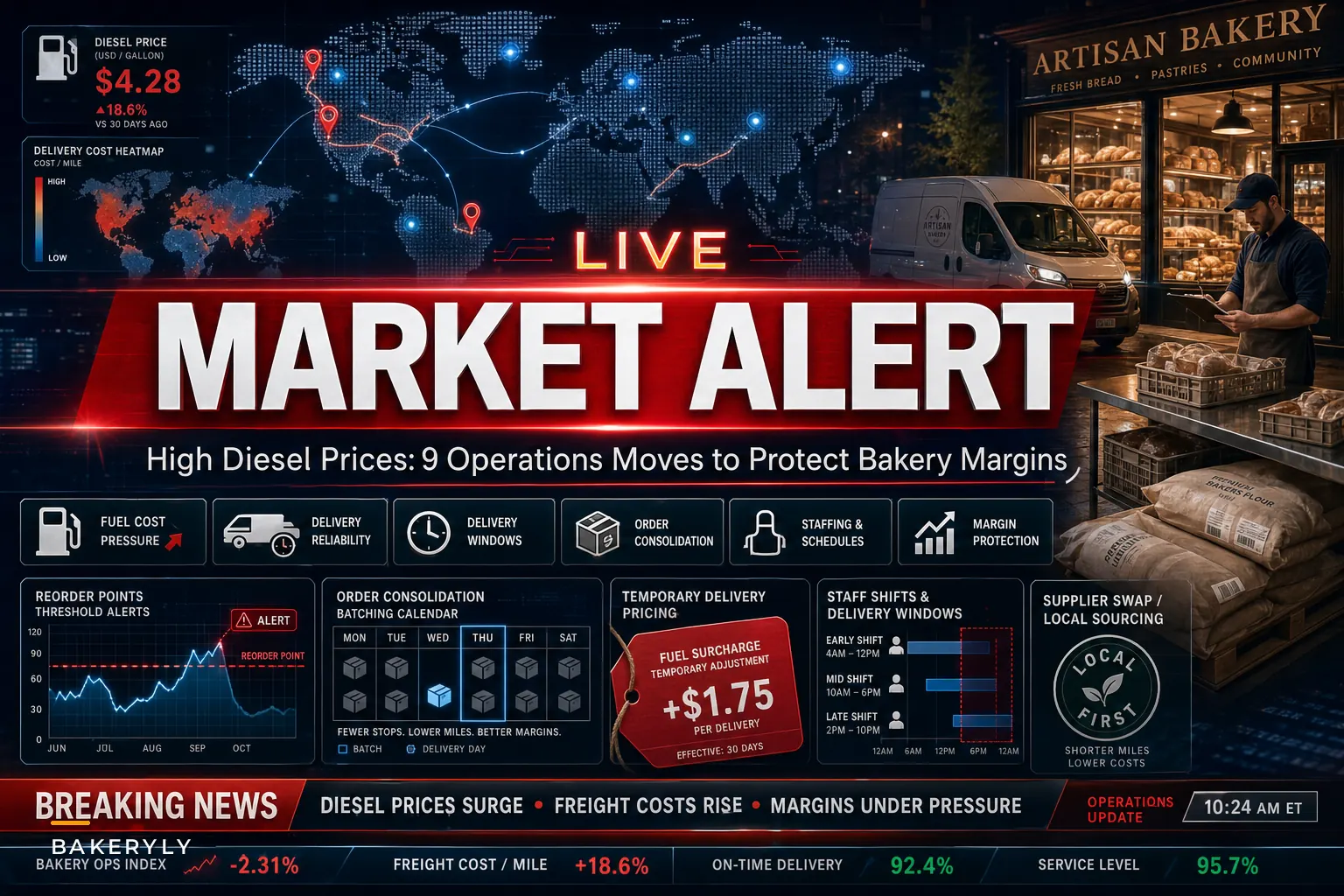

Diesel ripped past $6 a gallon across much of the U.S. in the back half of September 2026, and the timing couldn't be worse. A Reuters report on the global diesel spike flagged that further increases are still possible as export markets stay tight. For most industries that's an annoying line item. For a bakery running perishable ingredients on tight delivery windows, it quietly rewires your whole cost structure — inbound freight, last-mile fees, and the surcharges your suppliers are already slipping into invoices.
The surge itself isn't really the story. What the spike exposes is how much of a bakery's delivery and procurement model was built around cheap, predictable transport. When that assumption breaks, a bunch of decisions you never had to think hard about — reorder points, delivery radius, minimum order size — suddenly all need answers at once.
So skip the hand-wringing. Here's what you can actually adjust this week.
First, find where the diesel cost is actually hiding
Most owners assume the pain shows up only on the delivery van. It doesn't. A diesel spike leaks into your P&L through at least three doors, and if you only watch the obvious one you'll miss the bigger bleed.
-
Inbound freight and supplier surcharges. Your flour, butter, and packaging vendors move product on diesel too. Expect fuel surcharges to appear as a separate line — or get baked into unit pricing — within a billing cycle or two.
-
Last-mile delivery. The van you own, or the third-party courier you pay per drop. This is the visible one.
-
Opportunity cost on inefficient routes. The drop you make across town for a single $14 dozen — that was marginal at $3.50 diesel and is actively losing money at $6.
A quick way to size it: pull last month's delivery count, multiply by rough miles per run, and look at what a roughly 60–70% jump in fuel does to your cost-per-delivery. A bakery running around 120 deliveries a month at an average 9 miles each can see per-drop fuel cost climb from maybe $2.80 to $4.60. That's a couple hundred dollars a month on fuel alone — before any courier surcharge, before any supplier passthrough.
CNBC's coverage of how record diesel prices ripple through the economy made the broader point well: freight-dependent, thin-margin businesses feel this first and hardest. Perishable food fits that description almost perfectly.
Move 1: Re-cost your delivered SKUs, not just your menu
A mistake that shows up constantly — owners re-cost the recipe when inputs move, but treat delivery as a flat, separate thing. In reality, the true cost of a delivered dozen is recipe cost plus its share of that day's transport.
Build a simple delivered-cost view per order type:
| Order type | Avg order value | Est. fuel + courier share | Delivered margin before | Delivered margin after |
|---|---|---|---|---|
| Single-dozen home delivery | ~$18 | $2.80 → $4.60 | thin | often negative |
| Multi-item home delivery | ~$55 | $3.10 → $5.00 | healthy | still fine |
| Standing wholesale drop | ~$240 | $4.00 → $6.50 | strong | strong |
The pattern jumps out fast: small, single-item home deliveries are where diesel quietly turns a profit into a loss. Multi-item and wholesale drops absorb the increase easily because the fuel cost spreads across more revenue. That tells you exactly where to adjust policy next.
Move 2: Raise the delivery minimum before you raise prices
When margins get squeezed, the instinct is to bump prices across the board. But a flat price hike right before holiday season risks spooking customers who are already watching their spending. A cleaner lever is the delivery minimum.
If your single-dozen drops are the ones going underwater, lifting the home-delivery minimum from, say, $20 to $35 does two things at once. It filters out orders that can't carry their transport cost, and it nudges customers to add a second item — which is where your real margin lives anyway.
In practice, when a bakery moves the minimum up by $10–$15, a decent chunk of customers add to their cart rather than cancel. You lose a few low-value orders, but the ones you keep are far more profitable per mile. That's a better trade than irritating every customer with a visible price increase.
Move 3: Consolidate delivery days and tighten your radius
Running deliveries five or six days a week made sense when fuel was cheap. At $6 diesel, scattered low-density routes are the enemy. Two adjustments help immediately:
-
Cut delivery days to high-density windows. If Tuesday and Thursday together carry most of your volume, consider making those your two home-delivery days and routing everything into them. Denser routes mean more drops per gallon.
-
Re-draw your delivery radius by profitability, not distance. That outer zone where you make one lonely drop per trip? Either set a higher minimum for it, add a zone surcharge, or quietly stop serving it. One isolated run can cost more in fuel and driver time than the order is worth.
A useful benchmark: aim for no fewer than 6–8 stops per route. If a given day can't hit that, push those orders to the next consolidated window instead of sending a van out half-empty.
Move 4: Pull your inbound freight into fewer, bigger deliveries
The transport math cuts both ways. If diesel is raising your suppliers' costs, every extra inbound delivery you take is another surcharge you absorb. A bakery getting flour on Monday, dairy on Wednesday, and packaging on Friday is paying for three separate freight runs.
Consolidating to fewer, larger inbound deliveries lowers your per-unit freight and often unlocks better pricing. The catch is that bigger orders mean more on-hand inventory — which ties up cash and, for perishables, raises spoilage risk. So this works cleanly for shelf-stable items like flour, sugar, and dry goods, and needs more care with dairy and eggs.
This is where a disciplined ordering cadence earns its keep. If you don't already run one, this is a good moment to build it — our breakdown on a procurement system for small bakeries walks through setting reorder points, minimums, and vendor cadence so you're not reacting to surcharges one invoice at a time. A fuel spike is exactly the kind of shock a steady procurement rhythm absorbs quietly instead of painfully.
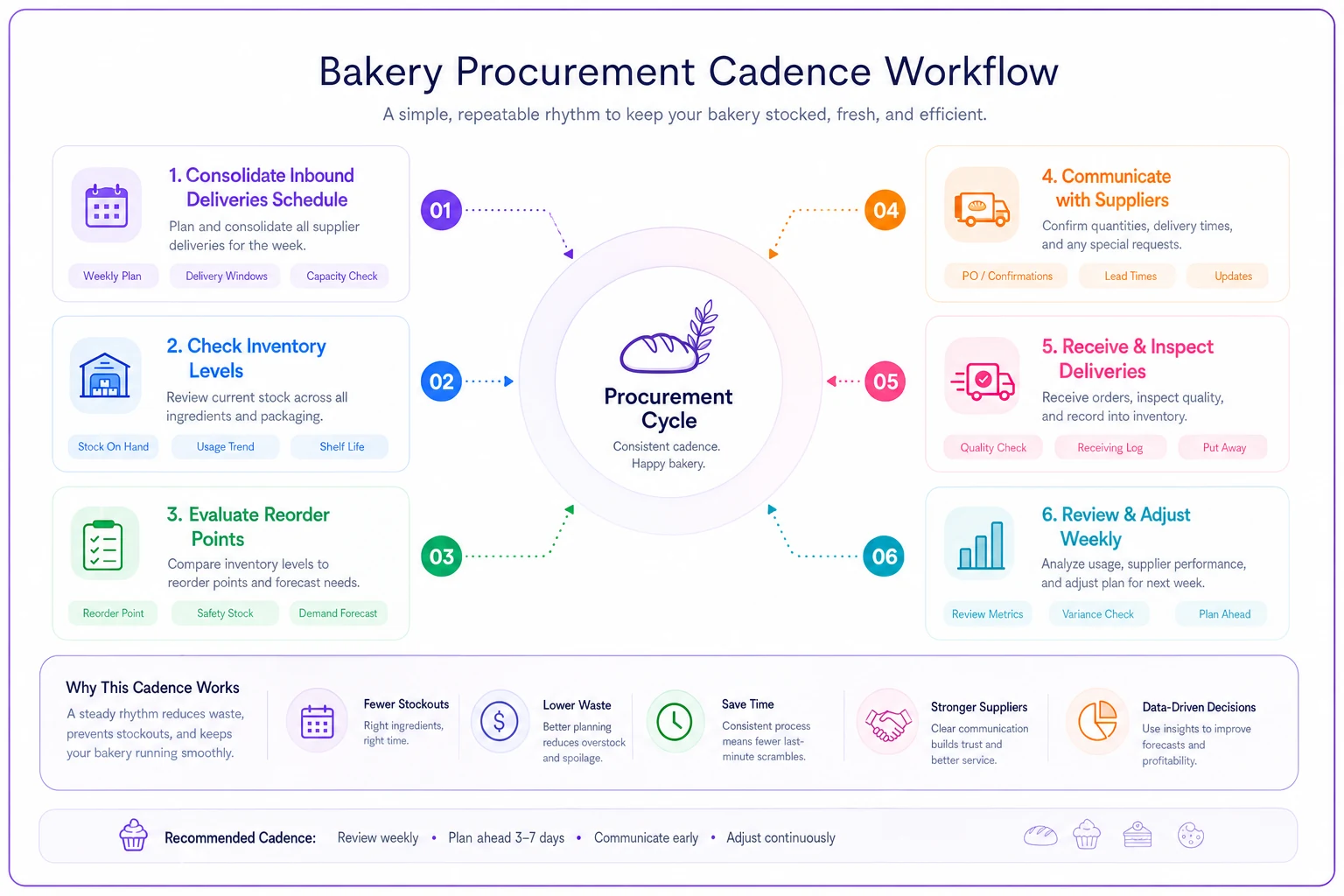
A simple visual like this keeps your team aligned on when to place larger inbound orders and which items are safe to bulk up on.
Move 5: Shift marginal volume to local suppliers
When freight is the problem, distance is the enemy. A supplier 200 miles away who was a few cents cheaper per unit can lose that edge the moment a fuel surcharge lands. A local mill or regional dairy with a shorter haul suddenly competes well even at a slightly higher base price.
You don't need to rip out your whole supplier list. Just identify the two or three ingredients where freight distance is longest and ask for local quotes. Run the comparison on delivered cost, not shelf price:
-
Current supplier
base price + fuel surcharge + inbound freight
-
Local alternative
base price + (often lower) freight
Sometimes local wins outright. Sometimes it's close enough that you keep the local option as a backup for when surcharges spike again. Either way, you've built optionality — and that's what protects you the next time diesel jumps.
When switching suppliers is a bad idea
Don't swap a reliable vendor for a cheaper local one right before holiday peak. The worst time to test an unproven supplier's consistency is the exact week your volume triples. If you want to trial local sourcing, do it on a low-stakes ingredient during a quieter stretch, then scale it once you trust the fill rate and quality.
Move 6: Add a transparent fuel adjustment to wholesale accounts
Home customers hate visible surcharges. Wholesale accounts understand them — because they're paying fuel surcharges to their own suppliers too. For standing wholesale and corporate delivery accounts, a modest, clearly communicated delivery adjustment is both fair and expected.
Keep it simple: a small per-drop adjustment tied to current diesel levels, with a note that it'll come back down when fuel does. Framing it as temporary and external keeps the relationship intact. What damages trust is a silent price creep they discover buried in an invoice.
Move 7: Protect your mornings and your drivers
A cost people often forget: fuel pressure changes driver behavior and scheduling. If you consolidate delivery days, your driver's workload concentrates into fewer, heavier runs. That can create bottlenecks — a 7 a.m. loadout that used to be relaxed becomes a scramble, and a rushed load is where fragile boxes get crushed and orders get mixed up.
-
Stage consolidated routes the night before. Pre-sort and label by stop sequence so the morning load is a lift-and-go, not a sorting puzzle.
-
Cross-train a backup driver. When all your volume rides on two routes a week, a single sick day can take down a whole delivery window. One trained backup removes that single point of failure.
Stage the most complex route first so the team builds momentum and avoids a morning scramble.
The staffing angle matters because fuel cost pressure tempts owners to cut hours, then quietly pay for it in missed deliveries and refund requests. Trimming the wrong hour costs more than the fuel it saved.
Move 8: Use order batching to raise route density
Batching isn't just a production tool — it's a delivery tool. If customers can pick any delivery slot freely, you end up with sparse routes. If you steer orders toward preset windows, routes fill up and cost-per-drop falls.
A practical setup: offer two or three fixed delivery windows per week with a cutoff time for each. Orders placed after cutoff roll to the next window. This does three useful things at once — it concentrates deliveries into dense routes, gives your kitchen predictable production batches, and stops the one-off "can you drop this across town today" requests that destroy fuel efficiency.
Customers adapt to windows faster than most owners expect, especially when the alternative is a higher delivery fee. Scarcity of slots actually makes the service feel more premium, not less.
Move 9: Watch cashflow, not just margin
A diesel spike doesn't only shrink margin — it stresses working capital. If you consolidate inbound orders into bigger deliveries (Move 4), you're tying up more cash in inventory. If suppliers add surcharges, your per-order outlay rises before your revenue catches up. Both pull cash forward.
-
Re-check your reorder points so you're not over-buying perishables just to save on freight
-
Time bigger inbound orders to land right before high-sales days, not during slow midweek lulls
-
Keep a small buffer for surcharge volatility so a surprise fuel line doesn't force a panic decision
The owners who weather fuel spikes well aren't the ones who cut the most — they're the ones who kept enough cash flexibility to make calm decisions instead of reactive ones.
A real scenario: the single-dozen trap
A small bakery doing both café service and home delivery was running around 110 home deliveries a week, a lot of them single-dozen drops across a wide radius. At $3.50 diesel the delivery program ran roughly break-even — not a profit center, but it drove café loyalty, so it stayed.
When diesel pushed past $6, the owner ran the delivered-cost math for the first time and found the single-dozen drops were losing roughly $1.50–$2.50 each once fuel and driver time were factored in. Across the week that was a quiet few-hundred-dollar leak, growing right as holiday orders ramped up.
The changes were unglamorous: delivery minimum lifted from $20 to $35, home deliveries consolidated from five days to three, outer-radius customers got a small zone surcharge. A handful of low-value customers dropped off. But average delivered order value climbed toward the mid-$40s, routes got denser, and the program flipped from a slow bleed to modestly profitable — without a single menu price increase that customers could see. The café loyalty benefit stayed intact because the people who actually valued delivery just ordered a little more per drop.
What to do this week
If you only have a few hours, start here:
-
- [ ] Pull your delivery count and average miles, and calculate real cost-per-drop at current diesel levels
-
- [ ] Identify which SKUs or order types go negative once transport is included
-
- [ ] Raise your home-delivery minimum to push single-item drops toward larger carts
-
- [ ] Consolidate home deliveries into fewer, denser days
-
- [ ] Get local quotes on your two longest-haul ingredients, compared on delivered cost
-
- [ ] Add a transparent, temporary fuel adjustment to standing wholesale accounts
-
- [ ] Re-check reorder points so bigger inbound orders don't strand your cash
None of these require new technology or a big project. They're pricing, routing, and procurement decisions you can make with a spreadsheet and an honest look at where each delivered order actually stands.
The deeper lesson in a fuel shock is that most bakeries never priced transport as a real variable — it was cheap enough to ignore. The spike just forces a question that was always lurking: which deliveries actually earn their keep, and which were quietly subsidized by cheap diesel? Answer that clearly now, and you'll be in far better shape heading into the busy season — whatever fuel does next.