

Most bakery owners handle procurement like they're running a home kitchen—texting suppliers when the flour bin gets low, calling around when prices seem off, scrambling when deliveries don't show. This works fine until you're managing twelve suppliers, juggling minimum order quantities that don't match your production cycles, and realizing nobody tracked whether that new vanilla supplier has been shorting you 10% on every order for the past three months.
The problem isn't just disorganization. Bakery procurement runs on mismatched timelines. Your croissant dough needs butter tomorrow morning at 4am. Your supplier needs orders by Thursday for Tuesday delivery. Your cash flow needs you to hit minimums without overstocking. And your production schedule swings wildly between Wednesday wholesale orders and Saturday morning rushes.
A proper bakery supplier procurement system isn't about fancy software or complex spreadsheets. It's about matching supplier rhythms to your actual production patterns, building buffers for the stuff that always goes wrong, and tracking just enough data to spot problems before they blow up your weekend.
The 6–12 week forecast that actually works
Forget trying to predict exactly how many pounds of bread flour you'll need on March 17th. That level of precision is pointless when a rainy weekend cuts foot traffic by 40% or a last-minute catering order doubles your brioche production.
Build your procurement forecasts around production bands instead. Look at your forecast patterns for weekends versus weekdays over the past quarter. You'll usually find three distinct consumption levels:
Base consumption: The minimum you'll burn through even on your slowest weeks. For a neighborhood bakery doing roughly $8k–12k weekly, this might be 150 pounds of AP flour, 40 pounds of butter, 15 dozen eggs.
Normal range: Where you operate 70% of the time. Same bakery probably uses 150–220 pounds AP flour, 40–65 pounds butter, 15–24 dozen eggs.
Peak capacity: Your absolute maximum with current equipment and staff. Maybe 280 pounds flour, 85 pounds butter, 35 dozen eggs when you're slammed with wholesale orders plus a wedding.
Map these bands forward 12 weeks, accounting for seasonality you already know about. December weeks 2–3 will hit peak capacity. First week of January drops to base. Valentine's week spikes specialty ingredients but not basics.
Now the critical part: align your ordering cadence to these bands, not to calendar weeks.
Order base consumption ingredients weekly with 5-day lead times. Order normal-range volumes bi-weekly with 10-day lead times. Order peak ingredients monthly with special scheduling three weeks ahead.
This system handles 80% of situations automatically. You're never caught completely empty, never sitting on six weeks of inventory, and suppliers get predictable order patterns they can actually fulfill.
Supplier cadence rules that prevent Thursday panic
Every supplier has their own rhythm, and fighting it just guarantees problems. Map out each vendor's actual operational pattern—not what their sales rep claims, but what really happens.
Never miss a bake or delivery again.
Bakeryly helps you schedule, track, and manage every order effortlessly.
- Unified order tracking
- Real-time inventory alerts
- Staff shift management
No credit card required
Your produce supplier might promise daily delivery but actually batches small orders for Tuesday/Thursday/Saturday runs. Your specialty flour distributor takes orders until noon Thursday for next Tuesday delivery, period. Your local egg farm delivers Mondays and Fridays but needs 48-hour notice for anything over 20 dozen.
Build your ordering calendar backward from production needs:
-
Saturday morning bake needs ingredients Friday 2am
-
Friday 2am prep needs deliveries Thursday afternoon
-
Thursday afternoon delivery needs order placed Tuesday noon
-
Tuesday order needs inventory check Monday close
Stack all your suppliers onto this timeline and you'll immediately see the conflicts. Three suppliers all need orders Tuesday but you can't check inventory for all three Monday. Two critical Friday deliveries both arrive "between 2pm and 6pm."
You can't change supplier schedules—they won't budge for a small bakery's $2k monthly orders. Instead, create offset ordering cycles:
-
A-week suppliers Flour, sugar, basic dairy, eggs Order Tuesday for Thursday/Friday delivery
-
B-week suppliers Specialty ingredients, chocolate, nuts, dried fruit Order Thursday for Monday/Tuesday delivery
-
Weekly touchpoints Produce, berries, cream, milk Standing orders with Monday modification window
-
Monthly shipments Packaging, boxes, labels, cleaning supplies First Tuesday of month, delivery mid-month
This rotation means you're never juggling more than 3–4 supplier orders on any given day, and critical ingredients have built-in redundancy.
Managing minimums without drowning in inventory
Minimum order quantities kill small bakery cash flow. Your butter supplier wants 40-pound minimums but you use 12 pounds weekly. The specialty chocolate requires $500 orders but you need $80 worth monthly. Organic vanilla beans come in wholesale lots of 100 but you use maybe 15 monthly.
Here's how to handle the minimum order trap:
| Group | Description |
|---|---|
| Group 1 - Buy to minimum, no stress: | Sugar, flour, shelf-stable basics. These store forever, you'll always use them, and tying up $200 in extra AP flour won't kill you. Hit minimums, store properly, move on. |
| Group 2 - Coordinate with production pushes: | Butter, chocolate, nuts. These keep 2–3 months properly stored. Time minimum orders with seasonal production. Order 40 pounds of butter when you know November–December will burn through it. Hit chocolate minimums before Valentine's week. |
| Group 3 - Split with other businesses: | Specialty ingredients, unique items. That vanilla bean minimum? Split with two other bakeries. The $500 chocolate order? Partner with the café down the street. Informal buying groups work surprisingly well for expensive, slow-moving items. |
| Group 4 - Find alternate suppliers: | Sometimes the minimum just doesn't work. If you need 2 pounds monthly of something with a 25-pound minimum, find a restaurant supplier, pay 20% more per pound, and protect your cash flow. |
Formalize informal buying groups with a short written agreement to avoid confusion when splitting minimums.
Track minimum impacts monthly:
-
Amount tied up in excess inventory
-
Number of ingredients approaching expiration
-
Cash flow hit from minimum orders
-
Savings from bulk pricing
When excess inventory consistently exceeds 15% of monthly ingredient costs, your minimums are quietly killing profitability.
The emergency playbook that saves Saturday morning
Thursday afternoon: your Friday flour delivery just got cancelled. Truck broke down, driver called in sick, warehouse system crashed—doesn't matter why. You need 80 pounds of bread flour for Saturday morning production or you're shutting down your biggest revenue day.
Most bakeries handle this with pure panic. Call every supplier, beg competitors, send someone to Restaurant Depot at 5am. This works exactly once. The second time kills morale. The third time, your team stops trusting operations entirely.
Build your emergency playbook before you need it:
-
Tier 1 emergencies - Same-day fixes required - Main flour delivery fails (Thursday for Saturday production) - Dairy shortage discovered at 4am - Equipment failure contaminating ingredients Response: Pre-approved emergency suppliers with credit cards on file. Restaurant Depot membership for owner plus one manager. List of three nearby bakeries with standing emergency trade agreements. Clear decision rules—pay up to 50% premium for critical ingredients, up to 100% premium for Saturday morning saves.
-
Tier 2 emergencies - Next-day scrambles - Specialty ingredient shortage - Quality issues discovered during prep - Order entry errors Response: Secondary supplier list with next-day capability. Pre-negotiated rush delivery fees (usually $50–75 flat rate). Approved substitution list for non-critical ingredients. Clear communication templates for customers when items need to be 86'd.
-
Tier 3 emergencies - Week-long disruptions - Supplier goes out of business - Food safety recall - Extended delivery interruptions Response: Complete alternate supply chain mapped quarterly. Simplified menu plan that runs on 60% of normal ingredients. Cash reserve specifically for emergency procurement (typically one week's normal ingredient costs).
Document every emergency: what failed, why, what the fix cost, how to prevent recurrence. After three similar emergencies, that's not bad luck anymore—it's bad planning.
The vendor scorecard that actually drives decisions
Most bakeries track vendor performance in their heads. "That flour guy is pretty reliable." "The egg lady sometimes forgets stuff." "The chocolate supplier is expensive but good."
This vague scoring breaks down the moment you need to make real decisions. Should you switch flour suppliers to save 8%? Is the cheaper egg vendor worth occasional shorts? When do you actually fire a supplier?
Build a simple scorecard that tracks what actually matters:
-
On-time delivery rate Not just "did it arrive" but "did it arrive within the promised window." Track monthly. Below 85% is a problem. Below 70% is grounds for replacement.
-
Order accuracy Percentage of orders delivered complete and correct. Weight shortages over 2% count as errors. Wrong items obviously count. Missing items definitely count. Target: 95% or better.
-
Quality consistency Pass/fail monthly. Did ingredients meet spec? Any returns? Any production issues traced to ingredients? Two fails in three months triggers a supplier conversation.
-
Price stability Not looking for cheapest, looking for predictable. Track price changes monthly. More than 10% swing outside documented commodity prices needs explanation. More than 20% breaks trust.
-
Communication score Binary monthly score. Did they notify about delays? Respond to questions within 24 hours? Provide advance notice of price changes? Yes = 1, No = 0.
Score monthly, review quarterly:
-
90+ average
Preferred vendor, gets flexibility on minimums
-
75–89
Acceptable, monitor for improvement
-
60–74
On probation, actively seeking alternatives
-
Below 60
Replace immediately
This isn't about beating up suppliers. It's about having real data when procurement decisions actually matter. That charming flour rep who always remembers your birthday but delivers late 30% of the time? The scorecard shows you exactly what that relationship costs.
Tying it all together with minimal overhead
The complete procurement system looks like this:
-
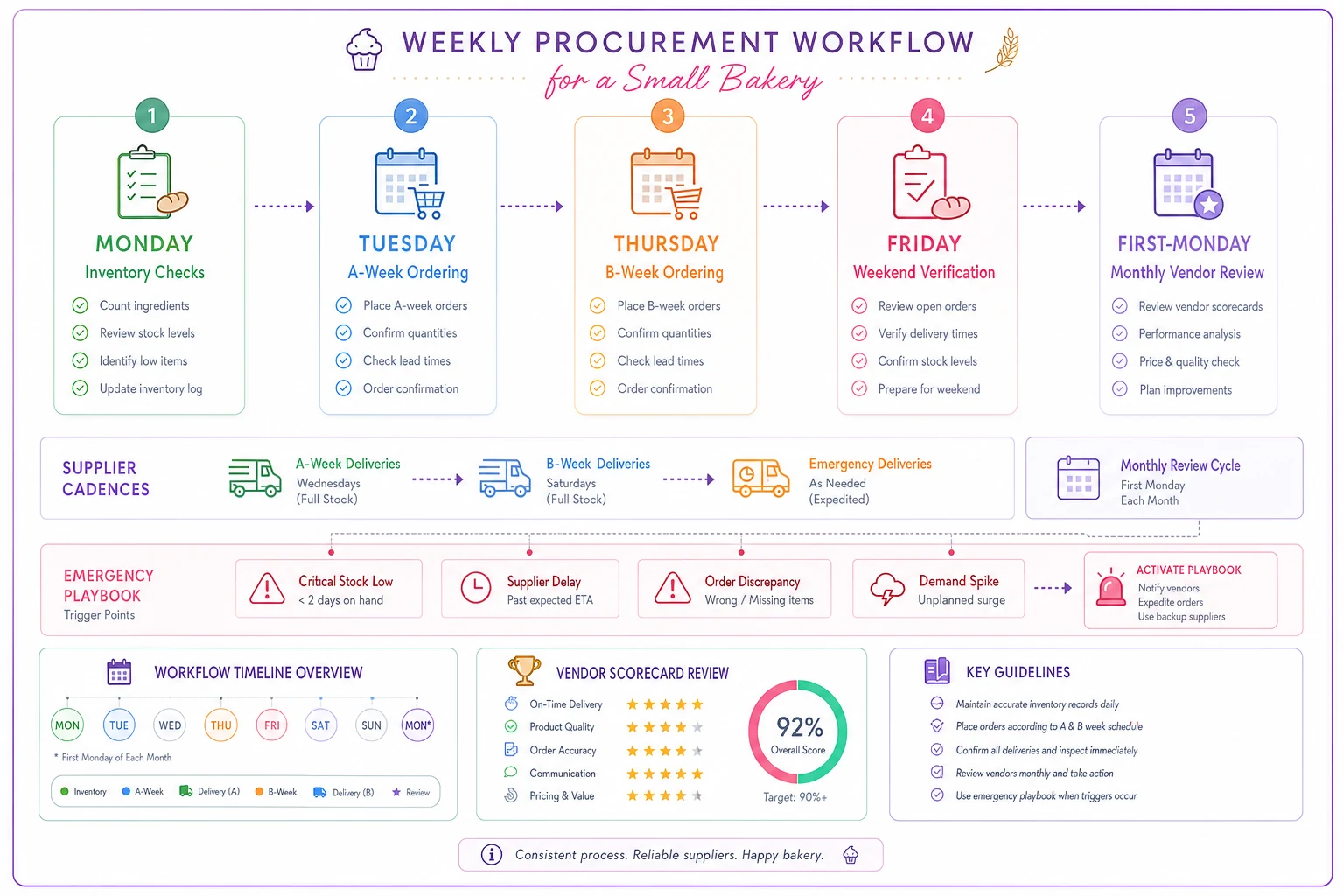
Monday Check inventory levels against forecast bands. Flag anything dropping below two-week reserves.
-
Tuesday morning Place A-week orders (flour, sugar, dairy, eggs). Confirm Thursday/Friday deliveries. Update emergency contact if anyone's out.
-
Thursday morning Place B-week orders (specialty items). Verify all Friday deliveries are tracked for arrival. Complete monthly scorecard updates.
-
Friday afternoon Verify weekend inventory is complete. Check next week's production schedule against confirmed deliveries. Flag any gaps for Monday resolution.
-
First Monday monthly Review vendor scorecards. Adjust approved supplier list. Update emergency playbook with new contacts or lessons learned. Check forecast versus actual consumption patterns.
Visualize this weekly workflow to spot conflicts early.
Total time investment: maybe 3–4 hours weekly, mostly in 15-minute chunks. But those hours prevent the 3am scrambles, the Saturday shortages, the slow bleed of paying 20% premiums on emergency orders.
When AI-powered operational software makes sense
Once you hit around $30k monthly revenue, managing this system manually starts eating real time. You're tracking 20+ suppliers, juggling 50+ ingredients, and every forecast adjustment ripples through multiple ordering cycles.
This is where AI automation in operational platforms can genuinely help—not by replacing your procurement thinking, but by handling the repetitive tracking and alerting that humans consistently miss.
Operational software with AI automation can monitor consumption patterns and flag when usage drifts outside normal bands before you notice the variance. It tracks delivery windows and alerts you when a supplier's reliability is quietly declining. It can cross-reference your production schedule with supplier calendars and surface ordering conflicts three weeks out instead of three days.
The valuable part isn't the AI making procurement decisions. It's catching the hundred small signals that indicate problems brewing. That flour supplier who's been delivering 2% later each month for four months straight. The egg vendor whose quality scores are slowly sliding. The correlation between Thursday rain and Friday dairy delays.
AI-assisted operational software catches these patterns while you focus on managing supplier relationships and negotiating better terms—turning procurement from a reactive scramble into something you can actually predict.
Making procurement boring (in the best way)
The goal isn't procurement perfection. You'll still have emergency orders. Suppliers will still occasionally fail you. Weird demand spikes will still catch you off guard.
But with this system, those become rare exceptions instead of weekly crises. Your team stops wondering if ingredients will arrive. Your morning bakers stop finding empty butter fridges. Your customers stop hearing "sorry, we're out of that."
Most importantly, you stop managing procurement through stress and start managing it through systems. Check the scorecards, follow the cadence, execute the emergency playbook when needed. Boring, predictable, profitable.
That's what a real bakery supplier procurement system delivers. Not magic, just consistency. And in small bakery operations, consistency is what keeps the ovens running and the cases full.
Ready to elevate your bakery operations?
Join 2,000+ bakeries using Bakeryly to streamline workflows, reduce waste, and delight more customers.