

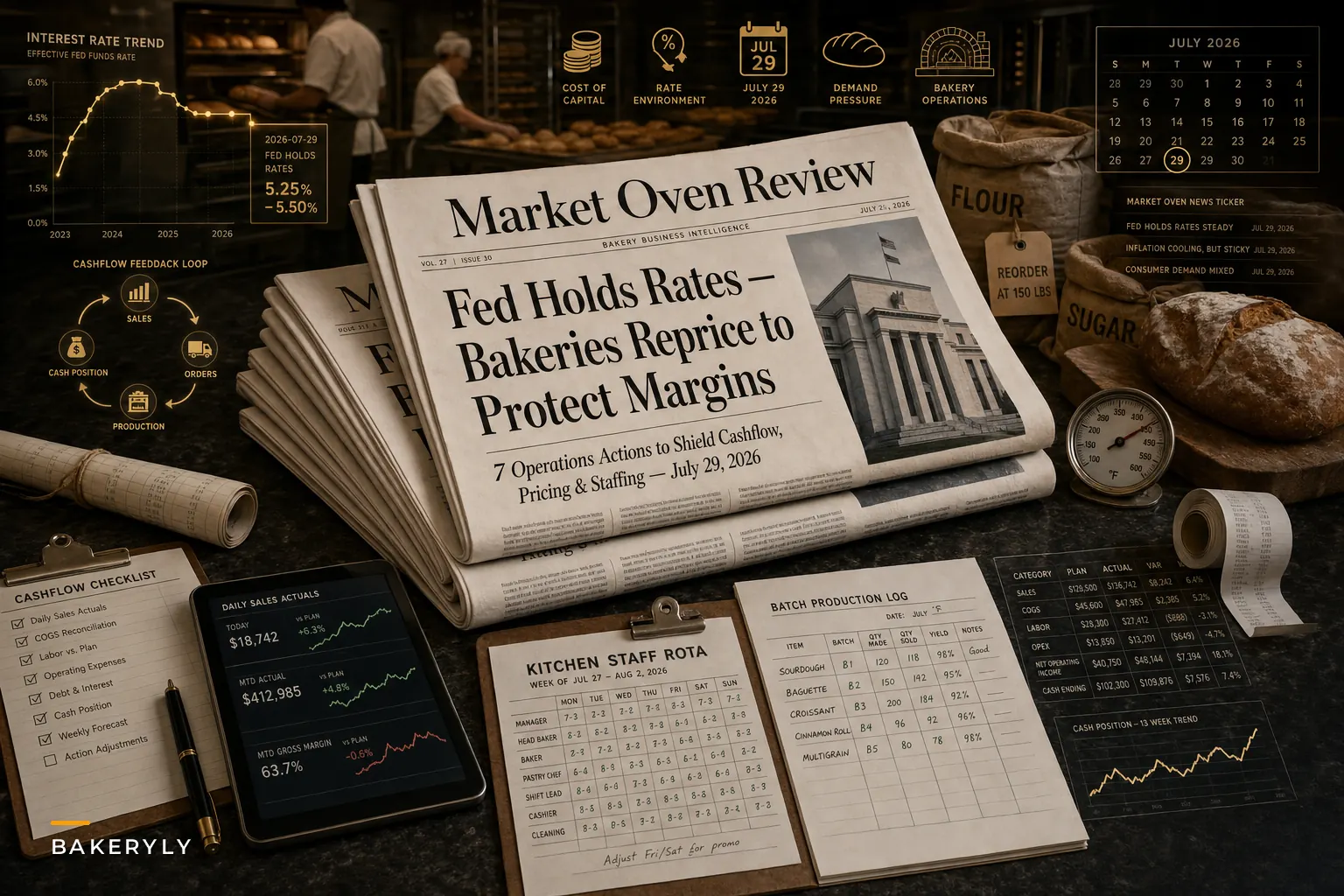

The Federal Reserve held rates at 3.50%-3.75% yesterday, and if you're running a bakery, you probably felt that decision before the press release even dropped. Your equipment loan payment stayed painfully high. That supplier who used to give you net-30 terms started asking for COD. The line of credit you were planning to tap for the new display case suddenly costs an extra $180 a month.
According to the Fed's statement, the committee remains focused on bringing inflation back to 2%, which means rates aren't dropping anytime soon. For bakeries already operating on 3-8% margins, this isn't just monetary policy news—it demands immediate adjustments to how you handle cash, price products, and schedule staff.
The triple squeeze hitting bakeries right now
Running operational software for bakeries gives you a front-row seat to how Fed decisions ripple through actual businesses. Right now, three pressures are hitting at once.
Credit costs are eating into working capital. A bakery in Ohio that borrowed $85,000 for a new deck oven last year is paying roughly $1,400 more per month than they would have three years ago. That's nearly $17,000 annually that can't go toward ingredients, wages, or building any cash reserves.
Suppliers are tightening terms. Flour distributors who used to float net-45 are demanding net-15 or prepayment. One wholesale supplier in Texas cut credit lines for roughly 40% of their bakery clients. When your flour bill runs $8,000-$12,000 monthly, losing those payment terms creates an immediate cash crunch—not a slow bleed, an immediate one.
Customer spending is getting pickier. The $6 croissant that flew off shelves in 2024 now sits until noon. Regulars who came in daily are down to twice a week. Catering orders that used to include dessert platters are trimming to just entrées.
This isn't speculation. It's what transaction data shows across bakeries using operational platforms to track sales patterns and supplier payments.
Why traditional bakery financial management breaks under rate pressure
Most bakeries track finances backward: monthly P&L reviews, quarterly inventory counts, annual budgets. When rates are stable and credit is cheap, this works fine. You absorb surprises with a credit line. Float checks if needed. Push supplier payments out a few weeks during a slow stretch.
Never miss a bake or delivery again.
Bakeryly helps you schedule, track, and manage every order effortlessly.
- Unified order tracking
- Real-time inventory alerts
- Staff shift management
No credit card required
Sustained high rates flip that model entirely. Now every financial decision compounds:
-
Miss a supplier discount because cash is tied up? That's 2% lost on a $10,000 order
-
Can't buy flour in bulk due to cashflow? You're paying 15% more per pound
-
Staff an extra baker "just in case" for Saturday? That's $180 in wages you might not recover
Bakeries surviving this environment have shifted from backward-looking accounting to forward-looking cashflow management—weekly cash projections, daily margin checks, staffing adjustments based on actual demand rather than habit.
Cashflow: Your new production schedule driver
Forget the model where production drives everything else. In a high-rate environment, cashflow drives production.
Here's what that looks like operationally:
Weekly cash mapping. Every Monday, map out the week's cash position:
-
Starting cash on hand
-
Expected daily sales (based on the last 4 weeks' average, adjusted for any events)
-
Fixed outflows
rent, loan payments, scheduled deliveries
-
Variable outflows
hourly wages, ingredients for confirmed orders
-
Daily ending cash position
If Thursday's projected balance drops below your comfort level, you adjust Tuesday's ingredient order or Wednesday's staffing. Simple, but most bakeries aren't doing it.
Ingredient buying shifts. Instead of buying to ideal par levels, you buy based on confirmed demand plus a minimal buffer. A bakery in Portland reduced their flour inventory from 14 days to 7, freeing up around $3,200 in working capital. Yes, they pay slightly more per pound. But the cashflow flexibility matters more than the unit cost right now.
Production tied to pre-orders. Speculative baking gets dangerous when cash is tight. One bakery moved 40% of their production to pre-order only. Their Saturday spread shrank from 12 pastry types to 7, but waste dropped from 18% to 6%—effectively recovering margin that interest costs had stolen.
The following diagram illustrates how cashflow signals should feed back into production and staffing decisions throughout the week:
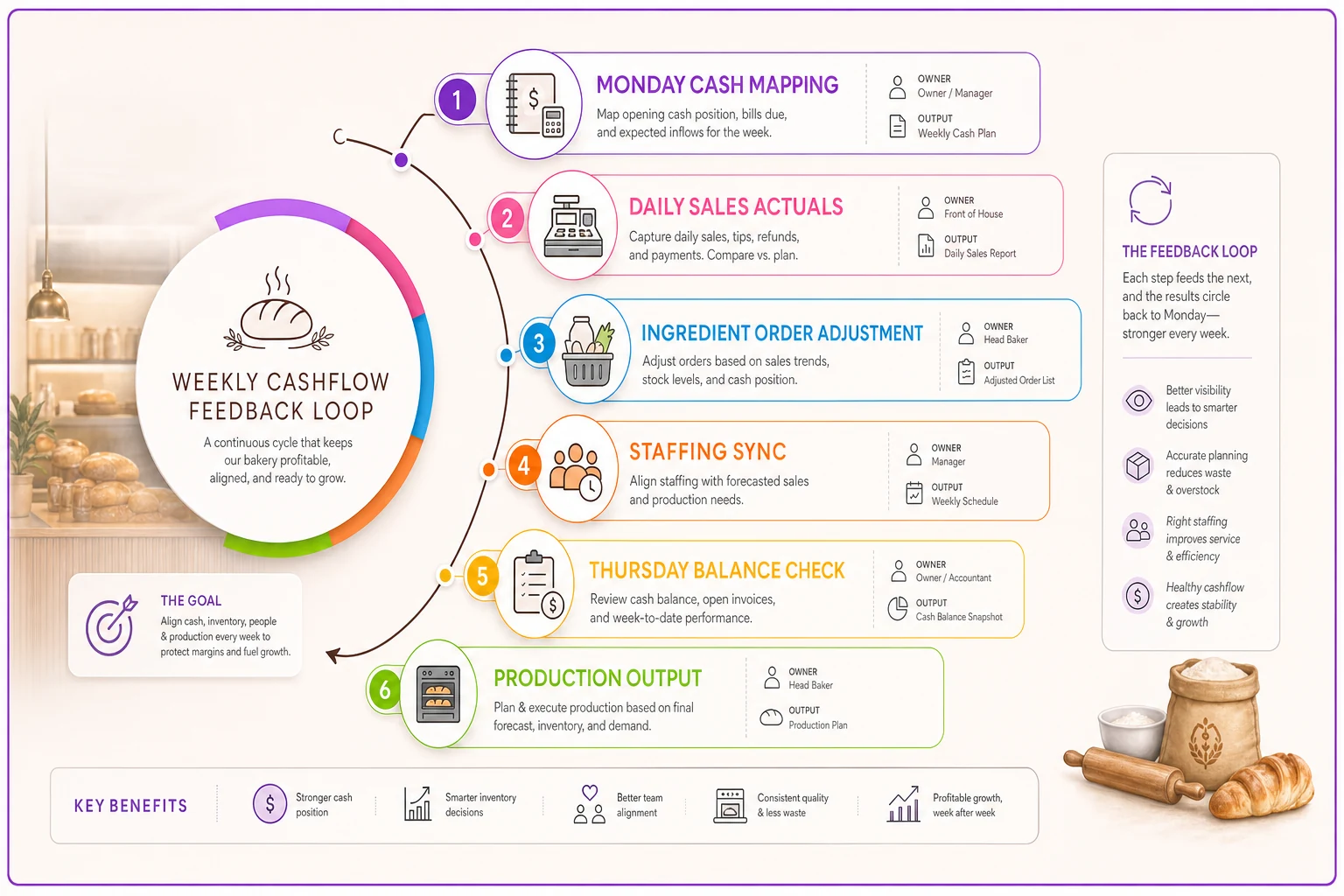
Use the loop to keep production aligned with cash throughout the week.
The pricing trap (and escape route)
The instinct when costs rise is to raise prices across the board. But markets are skeptical about sustained consumer strength, and your customers feel the same rate pressure you do. Blanket increases risk losing the regulars who keep your cashflow stable.
The smarter move: surgical pricing based on actual demand elasticity.
Figure out which items customers buy regardless of price—usually your signature items and morning coffee. Those can absorb 8-12% increases without meaningful volume drops. Impulse items—the third cookie, the afternoon danish, the fancy latte—need to stay accessible or they disappear from tickets entirely.
One bakery built what they call channel-based pricing. The same sourdough loaf sold at three different price points depending on how it was purchased:
| Channel | Price | Reason |
|---|---|---|
| Walk-in | $8.50 | Convenience premium |
| Pre-order | $7.75 | Guaranteed sale |
| Subscription | $7.00 | Predictable revenue |
This improved cashflow predictability by around 30% while actually lowering the average price point by $0.40. The trade-off worked because subscription and pre-order revenue could be counted on for supplier payments and payroll. Walk-in revenue, by comparison, is harder to plan around.
Staffing: From coverage-based to demand-synchronized
Traditional bakery staffing follows a coverage model: X bakers from 4am-noon, Y counter staff from 6am-close. When labor was cheaper and margins were fatter, that was fine. Now, with rates eating into margins, every excess labor hour hurts twice—wages plus the opportunity cost of that cash.
Cutting hours blindly isn't the answer. Syncing staffing to actual demand is.
Micro-shifts replace standard shifts. Instead of scheduling a baker for 4am-noon, you might do:
-
4am-8am
full production for morning rush
-
8am-10am
prep only, reduced headcount
-
10am-noon
light production for lunch items
A bakery in Denver cut labor costs 15% this way without reducing output. The key was tracking actual production needs by hour rather than assuming constant production across the full shift.
Cross-training becomes mandatory. When you're running lean, everyone needs to cover more ground. The morning baker who can run register during rush. The counter person who can proof dough between customers. This flexibility lets you operate with fewer scheduled hours while keeping service levels intact.
Scheduling from POS patterns. Manual scheduling based on gut feel leaves money on the table. Bakeries using AI-powered scheduling tools that pull in POS data, weather, and local event calendars are landing within 5% of optimal labor spend. Manual scheduling typically runs 15-20% over. That gap adds up fast.
Finding cash in your operations (beyond the obvious)
Every bakery knows to cut waste and negotiate with suppliers. The real improvements come from less obvious places.
Prepayment incentives that actually pencil out. Offering 5% off for prepaying custom orders sounds expensive, but consider: you're borrowing at 5% instead of 8-12% from a credit line. And prepaid orders never become bad debt. One bakery moved 60% of custom orders to prepayment and improved working capital by around $8,000 monthly.
SKU rationalization based on cashflow contribution. That gorgeous fruit tart might show a 65% margin on paper. But if the berries require a special supplier order and tie up $200 in inventory for three days, the actual cashflow return could be negative. Cutting low-velocity, high-working-capital items frees up cash that margin calculations completely miss.
Payment timing. If your card processor offers daily deposits for 0.15% extra, that might actually be worth it right now. Getting revenue 2-3 days faster improves your cash conversion cycle and reduces how often you need to dip into expensive credit.
The technology leverage most bakeries miss
The bakeries weathering this environment best aren't just working harder—they're operating with better information and more automation handling the repetitive oversight work.
A bakery without integrated systems might take three days to realize they're running 20% over labor budget for the week. By then, the damage is done. Bakeries running AI-assisted platforms catch these trends as they develop and can adjust before it becomes a real problem.
When your POS, scheduling, inventory, and financial systems actually talk to each other, you start catching things like:
-
Ingredients ordered but never fully used (cash sitting in waste)
-
Overstaffing relative to actual transaction volume by hour
-
Payment terms slipping without anyone in the building noticing
This kind of visibility used to require a dedicated analyst. AI automation now handles the pattern recognition and surfaces only what needs a human decision. It's not magic—it's just having eyes on every transaction instead of reviewing a summary three weeks later.
A 90-day action plan for rate resilience
The Fed isn't cutting dramatically anytime soon. Here's a practical timeline for adjusting:
-
Weeks 1-2
Cashflow baseline
— Map daily cash positions for the last 30 days, identify your actual cash buffer needs, and flag suppliers with deteriorating payment terms. -
Weeks 3-4
Pricing surgery
— Analyze item-level sales from the last 90 days, test price adjustments on about 20% of SKUs, and track volume impacts before touching anything else. -
Weeks 5-6
Staff scheduling overhaul
— Document actual production needs by hour, identify cross-training gaps, and test micro-shifts for one full week. -
Weeks 7-8
Operational cash hunt
— Review all SKUs for working capital efficiency, negotiate prepayment programs with loyal customers, and optimize payment processor timing and deposit schedules. -
Weeks 9-12
Systematic implementation
— Roll out what worked from the tests, connect systems for real-time visibility, and build weekly cash projection into your standard routine.
Every step in this plan is reversible if something doesn't fit your specific operation. The point isn't to follow it perfectly—it's to stop operating on autopilot while rates stay elevated.
The uncomfortable truth about the next 18 months
Bakeries operating on yesterday's playbook won't survive tomorrow's reality. The comfortable margin cushions are gone. Cheap credit is gone. And customer patience for price increases has real limits.
But this also creates separation. Bakeries that build cashflow discipline and tighter operations now will come out of this period stronger than competitors still waiting for rates to fall.
The question isn't whether to adjust. It's whether you do it now with a plan or later in crisis mode.
For bakeries ready to systematize their financial operations beyond basic bookkeeping, this financial control framework has detailed templates and workflows that tie directly into the cashflow approach outlined above.
The Fed made their call yesterday. The next 90 days will do more to determine your bakery's future than any rate decision in Washington ever will.
Ready to elevate your bakery operations?
Join 2,000+ bakeries using Bakeryly to streamline workflows, reduce waste, and delight more customers.