



Most bakeries track their finances backwards. They wait for monthly P&Ls, look at quarterly trends, maybe check weekly sales if they're organized. By then, margin erosion has already eaten through weeks of profit.
I watched a bakery owner discover they'd been losing $180 per wholesale account for two months straight. Not because costs suddenly spiked—flour had crept up 3% weekly, butter another 2%, and their pricing spreadsheet hadn't been touched since January. The wholesale margins looked fine on paper because nobody was checking actual ingredient costs against actual selling prices in anything close to real-time.
That's the core problem with bakery financial control. Everyone assumes they need complex accounting software or a part-time bookkeeper. What they actually need is a daily habit, a weekly checkpoint, and a monthly reconciliation that connects directly to operational decisions.
Why traditional financial tracking breaks in bakeries
Bakeries face a specific financial challenge that most industries don't. Input costs shift constantly—flour moves with wheat futures, dairy swings seasonally, specialty ingredients disappear and reappear at different price points. Meanwhile, your menu prices stay relatively fixed. You can't reprice croissants every Tuesday when butter moves.
The standard approach looks like this: set prices based on a target margin, update them quarterly maybe, check the P&L monthly to see if you're profitable. This works until it doesn't.
Here's what actually happens in operations. Your morning shift lead notices buttercream costs more to make but doesn't have authority to adjust cake pricing. The wholesale manager matches competitor pricing without checking current margins. The owner reviews financials monthly, but by then you've already baked and sold hundreds of units at negative margins.
Traditional financial systems assume stable costs and clear decision rights. Bakeries have neither. You need a system that catches margin problems daily, escalates them weekly, and drives pricing decisions before you've lost money for a month.
The three-layer bakery financial control system
The bakeries that maintain margins consistently do three specific things, in this order, on this schedule.
Layer 1: Daily cash position (5 minutes at close)
-
How much cash came in today?
-
How much went out for ingredients and supplies?
-
Are we up or down versus the same day last week?
This isn't accounting—it's pattern recognition. When Tuesday's cash drops 20% while sales stay flat, you know something's off before it compounds. Bakeries that start doing just this step tend to catch problems two to three weeks earlier than they used to.
Layer 2: Weekly SKU margin review (30 minutes Sunday night)
Pick your top 10 items by revenue. Every Sunday, calculate actual margin on each using that week's actual ingredient costs. Not theoretical costs from recipe cards—actual costs from actual invoices.
The math is simple: (selling price - actual ingredient cost) / selling price = margin percentage.
When margin drops below your threshold—usually 60-65% for retail, 40-45% for wholesale—you have a decision point. Not a panic, not a meeting to schedule. A decision point with clear predetermined rules.
Layer 3: Monthly P&L with operational triggers (2 hours, first Monday)
Your monthly P&L becomes useful when it triggers specific operational actions. Not "we should watch costs" but "when gross margin drops below 55%, we run the price adjustment protocol."
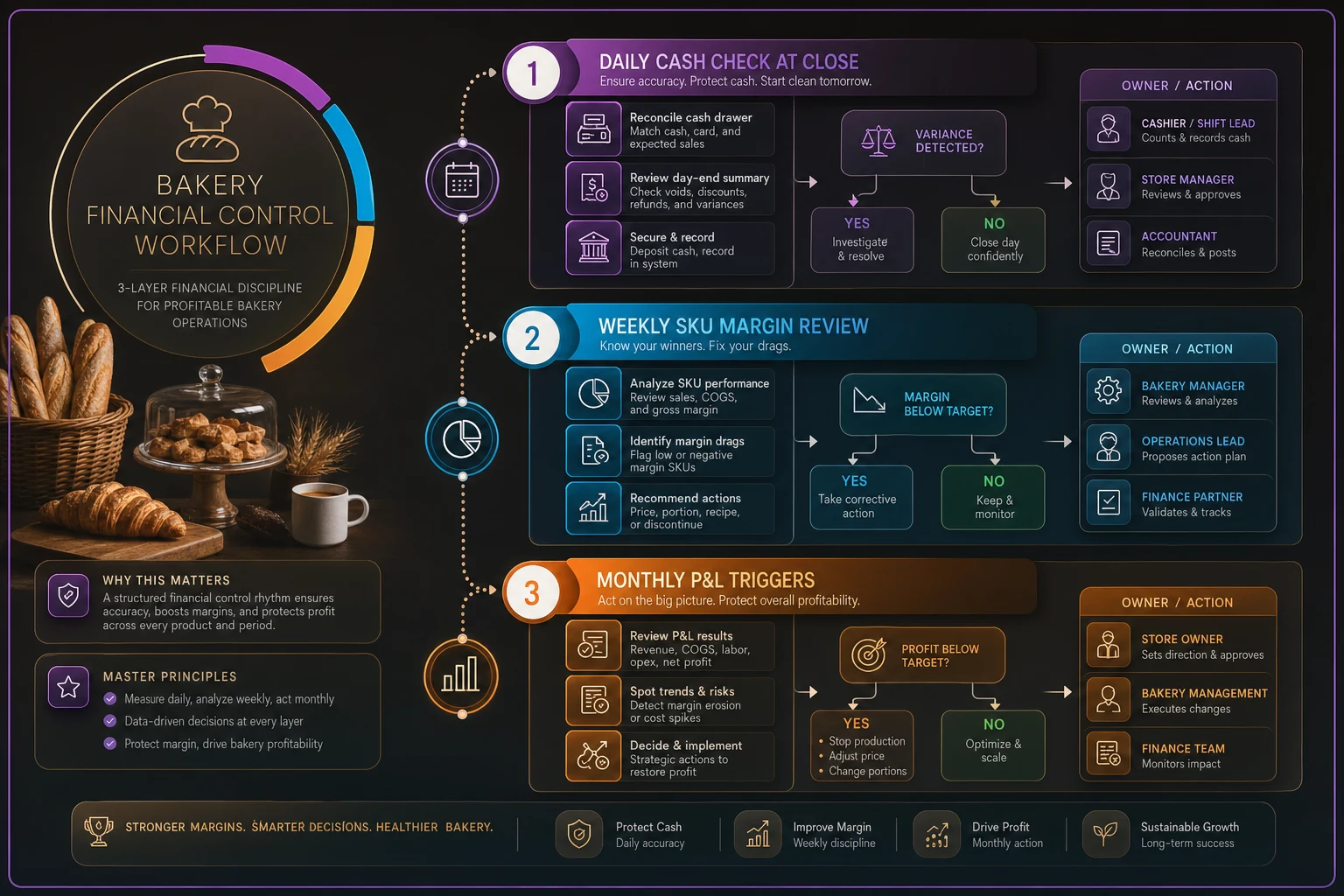
A simple visual makes the cadence clear so staff understand who does what and when.
Building decision rules that actually get followed
Knowing your margins are eroding and actually doing something about it are two different things. Most bakery financial systems die in the gap between them. What you need are pre-made decisions that trigger automatically when certain conditions hit.
Here's what works:
For ingredient cost increases:
-
Under 5% increase
absorb it, note for quarterly review
-
5-10% increase
reduce portion size by 5-8% or find a substitute ingredient
-
Over 10% increase
immediate price adjustment or menu removal
For margin drops by SKU:
-
5% margin drop
flag for weekly review
-
10% margin drop
must adjust within 72 hours via pricing, portioning, or promotion change
-
15% margin drop
stop production until resolved
For cash flow alerts:
-
Daily cash down 10%
check for unusual expenses
-
Daily cash down 20%
review tomorrow's production plan
-
Daily cash down 30%
owner reviews immediately
Post the trigger table where production teams can see it to remove delay in execution.
These aren't suggestions. When the condition hits, the action happens. No meetings, no debates, no "let's see what next week looks like."
The weekly SKU margin review template
Every bakery needs a simple spreadsheet pulling three numbers per SKU: last week's selling price, this week's actual ingredient cost, resulting margin. Here's the setup that actually gets used consistently:
| SKU | Weekly Units Sold | Selling Price | Actual Ingredient Cost | Margin % | Action Trigger |
|---|---|---|---|---|---|
| Sourdough loaf | 340 | $7.50 | $2.88 | 61.6% | OK |
| Chocolate croissant | 580 | $4.75 | $2.30 | 51.6% | Review portion |
| Carrot cake slice | 120 | $6.50 | $3.90 | 40.0% | Increase price |
| Blueberry muffin | 450 | $3.75 | $1.35 | 64.0% | OK |
| Sandwich special | 200 | $12.50 | $7.80 | 37.6% | STOP production |
Look at the sandwich special. At 37.6% margin, it's actively losing money once you factor in labor. Without a weekly checkpoint like this, you'd keep making 200 units and losing roughly $0.70 per unit after full costs. That's around $140 weekly, $560 monthly—just gone.
Five columns. The action trigger column is what makes it work. When margin drops below threshold, the action is predetermined. No analysis paralysis.
Connecting financial alerts to production schedules
The hard part isn't identifying margin problems—it's changing production fast enough to stop the bleeding. Most bakeries lock in production schedules days ahead. By the time you spot a problem, you've already ordered ingredients for tomorrow's negative-margin items.
A few things that help:
Create a "margin watch" list of items hovering near your threshold. These get checked daily, not weekly. If sourdough margins drop to 62% (just above your 60% floor), it goes on watch. Tomorrow's production can pivot if needed.
Build substitution rules directly into production schedules. When chocolate croissant margins drop, you already know the call: reduce chocolate filling by 15% or substitute with compound chocolate. Decision is pre-made, the production team just executes.
Most importantly, give your production lead actual authority to stop negative-margin items. Not reduce, not flag for discussion—stop. If the Wednesday margin check shows red, Thursday's production adjusts immediately.
When to adjust pricing versus portions versus promotions
Every margin problem has three potential fixes: raise prices, reduce costs, or increase volume through promotions. Most bakeries default to the wrong one.
Adjust pricing when:
-
Ingredient costs increase across multiple SKUs (systematic issue, not isolated)
-
Competitors have already moved prices up
-
You haven't adjusted in 6+ months
-
The item has real pricing power—signature or specialty products
Adjust portions when:
-
A single ingredient is driving the cost increase
-
Customers won't notice a 5-10% size reduction
-
A price increase would cross a psychological threshold ($9.99 to $10.50 stings more than it should)
-
You're testing market sensitivity before committing to repricing
Run promotions when:
-
You have excess capacity—ovens running below 70%
-
Ingredient costs are temporarily elevated and likely to normalize
-
You need volume to maintain supplier minimums
-
There's a cross-sell opportunity (loss-lead morning pastry paired with profitable coffee)
The key is deciding before the pressure hits. When flour costs spike 15%, you should already know: breads get repriced, pastries get portion-adjusted, promotional bundles pause.
The cash flow forecast that actually prevents crises
Cash flow kills more bakeries than profitability. You can be profitable on paper while unable to pay next week's flour delivery. The fix isn't complex modeling—it's a simple weekly forecast that connects to daily operations.
Every Thursday, map out the coming week:
-
Expected daily sales (based on prior 4-week average)
-
Known ingredient deliveries and amounts
-
Scheduled payments—rent, utilities, payroll
-
Resulting daily cash position
When Thursday's forecast shows negative cash on Tuesday, you have four days to act. Cut Monday's production, push a supplier payment to Wednesday, run a weekend flash sale. The interventions are obvious when you see them coming four days out.
Monthly cash flow projections that assume smooth daily sales don't work for bakeries. Your Monday cash position might be -$2,000 while Friday lands at +$8,000. Monthly averages hide the Tuesday crisis entirely.
Building your implementation checklist
Setting up a bakery financial control system doesn't require new software or complex training. It requires consistent execution of simple checks.
Week 1: Start daily cash tracking
-
Assign a person (usually closing shift lead)
-
Create a simple tracking sheet
date, cash in, cash out, net
-
Compare to same day previous week
-
Five minutes at close
Week 2: Add weekly margin review
-
Pick top 10 SKUs by revenue
-
Build the margin calculation spreadsheet
-
Set margin thresholds (60% retail, 40% wholesale)
-
Schedule 30-minute Sunday review
Week 3: Create decision triggers
-
Document what happens at each threshold
-
Share with production and pricing teams
-
Practice one intervention—portion or price adjustment
-
Track the impact
Week 4: Monthly P&L mapping
-
Connect P&L categories to operational metrics
-
Build "if-then" rules for each major line item
-
Run your first monthly review session
-
Identify three improvement priorities
The whole system takes roughly two hours weekly once it's running. Compare that to the time you lose when margin problems compound quietly for a month.
Technology integration without the complexity
Modern bakery operations benefit from platforms that track these metrics automatically. When daily cash positions, weekly margins, and monthly P&Ls flow into a unified dashboard, patterns emerge faster and decisions happen sooner.
AI-powered operational software can pull invoice data, calculate real-time margins, and alert you when triggers hit—so instead of manually checking 10 SKUs every Sunday night, the system monitors everything continuously. When butter costs spike, you know immediately which items need attention.
The value isn't the automation itself. It's the speed of response. Catching margin erosion daily versus monthly can save 2-3% gross margin. On $50k monthly revenue, that's around $1,500 straight to the bottom line. The reporting systems that drive actual decisions need that kind of real-time connectivity to be useful.
That said, the manual version works fine. Plenty of bakeries run this entire framework with a notebook and a basic spreadsheet. Discipline matters more than tools.
Realistic expectations and common failure points
This system fails in predictable ways.
The daily cash check stops when the assigned person leaves or goes on vacation. Fix: rotate responsibility weekly, not monthly. More people stay practiced, fewer single points of failure.
The weekly margin review gets skipped during busy seasons. Fix: drop to top 5 SKUs during peak periods but never skip entirely. Even 15 minutes beats nothing.
Decision triggers get ignored when they're inconvenient. If the trigger says stop production but you have a big wholesale order due, the temptation to override is strong. Fix: build override rules too. "Can continue negative-margin production for confirmed orders but must reprice within 7 days."
The monthly P&L review turns into a discussion forum instead of a decision point. Fix: time-box the discussion to 15 minutes. Decisions happen in the meeting, not "later."
Adapting the system as you scale
At one location doing $30k monthly, the owner handles all three layers personally. At two locations doing $100k monthly, daily cash tracks per location, weekly margins cover the top 20 SKUs, and monthly P&Ls compare locations directly.
At $250k or more monthly across multiple channels, you need automated data flows. Manual tracking breaks down around 30-40 SKUs or three-plus revenue streams. That's when operational software starts paying for itself—not because manual is broken in principle, but because the time cost exceeds the software cost.
The principles stay constant regardless of scale: daily cash awareness, weekly margin vigilance, monthly strategic adjustment. The tools and depth change.
What about truly small operations—say, $10k monthly from weekend farmers markets? Strip it down further. Track daily cash in a notebook. Check margins on your three best sellers weekly. Review full finances monthly. The framework scales down as easily as it scales up.
Seasonal adjustments and special events
Bakery financial patterns shift a lot with seasons. December might show 70% margins on holiday items while August drops to 50% on everything as foot traffic softens. Your financial control system needs seasonal calibration.
Build separate trigger thresholds for peak season (November-December, April-May) versus slow season (January-February, July-August). A 55% margin in December is a crisis. The same margin in August might be acceptable depending on your cost structure.
Special events need their own framework. Catering orders, wholesale contracts, farmers market popups—each has different margin requirements and cash flow patterns. The daily/weekly/monthly cadence stays the same but the thresholds shift.
The menu engineering system you use for regular evaluation becomes especially important here. When you know which items hold margins under pressure, special events become predictable rather than chaotic.
Making the system stick
Start with just daily cash tracking. Do nothing else for two weeks. Once that habit is solid, add weekly margins. Then decision triggers. Then monthly review. Building habits sequentially works far more often than trying to implement everything at once.
Make the numbers visible. Post daily cash position somewhere staff can see it. Share weekly margin alerts with production leads. When people see the impact of their decisions in numbers, behavior shifts.
Connect financial metrics to things people actually care about. When margins improve, upgrade equipment. When cash flow stabilizes, give bonuses. The financial control system can't feel like overhead—it needs to drive outcomes staff want.
And acknowledge that perfection isn't the goal. Missing a daily check during a crisis week, skipping a review over the holidays—these happen. The system handles occasional gaps fine. What kills you is systematic neglect: months without checking, quarters without adjusting.
The bottom line on bakery financial control
You don't need an accountant to prevent margin erosion. You need a simple, repeatable system that catches problems daily, analyzes them weekly, and fixes them monthly.
The bakeries that maintain healthy margins don't have more sophisticated financial systems. They have more consistent financial habits. They check cash daily, margins weekly, P&L monthly. They follow predetermined triggers instead of debating each decision. They adjust quickly instead of analyzing endlessly.
Will this catch every financial issue? No. Will it prevent most margin erosion and cash crunches? Yes, reliably.
The framework is simple enough to start tonight. Pick someone to check cash at close. Calculate margins on your top five items this Sunday. Set three decision triggers for next week. Build from there.
Because somewhere between your recipe costing and your monthly P&L, margins are leaking. Not dramatically, not obviously—just steadily. A few percent when flour prices drift up. A few more when portion sizes slip. Another few when a promotional price quietly becomes permanent.
The leaks compound. By the time you notice on the P&L, you've lost weeks of profit. This system is designed to catch those leaks before they become something bigger—make quick decisions before analysis paralysis kicks in, maintain margins through operational discipline rather than financial complexity.