

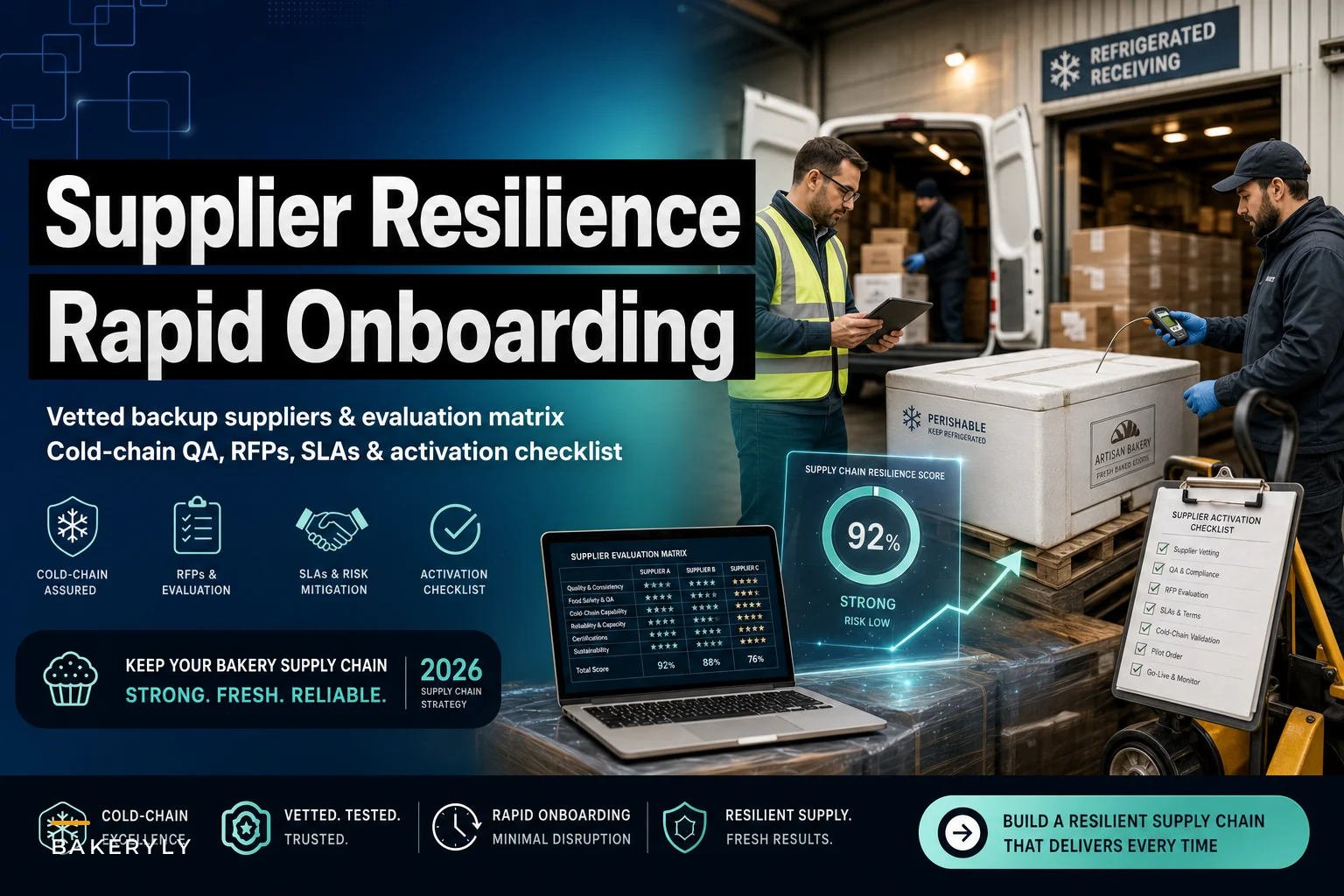

Most bakeries don't think about a backup supplier until the primary one fails. That's the wrong order of operations. The day your croissant dough supplier calls at 5 a.m. to say the delivery truck broke down and nothing's coming until Thursday is not the day to start cold-emailing distributors asking about minimum order quantities.
A backup supplier you've never bought from isn't really a backup. It's a phone number. You don't know their lead time under pressure, you haven't verified their cold-chain handling, you don't know if their par-baked batard tastes anything like yours, and you have no pricing locked in. When you call them in a panic, you're a stranger asking for a favor at full retail.
This guide is about doing the opposite: building a qualified, contracted, pre-tested roster of backup bakery product suppliers so that switching over on a bad morning is a 20-minute operational task, not a day-long scramble. We'll cover a tiering framework, an evaluation matrix, a sample RFP you can send this week, a cold-chain verification checklist, the contract clauses that actually matter for perishables, and a rapid-onboarding playbook that plugs into whatever continuity plan you already run.
Start by separating "backup" from "second vendor"
There's a distinction that gets blurred constantly, and blurring it causes bad sourcing decisions.
A second vendor is someone you split volume with regularly to reduce dependence and keep your primary honest on pricing. A backup supplier is someone you may buy from twice a year, only when something breaks, and who needs to deliver fast with no ramp time.
These are not the same relationship, and they shouldn't be qualified the same way. A second vendor is judged mostly on cost and consistency. A backup is judged on speed to activate and acceptable-under-pressure quality. A backup that's 8% more expensive but can deliver tomorrow is worth more than a cheaper one that needs four days' notice — because the whole point is that your primary just gave you zero notice.
A pattern that shows up a lot in bakery procurement: owners try to make one vendor serve both roles, and it fails at the worst moment. The cheap, reliable second vendor you split flour orders with has a 72-hour lead time, so they can't actually rescue you when your par-baked supplier goes dark on a Friday before a holiday weekend.
So before you source anything, decide which SKUs genuinely need a true rapid-activation backup. Usually it's a short list:
-
Products you can't produce in-house at required volume (par-baked items, specialty laminated dough, certain breads)
-
High-margin or high-reputation items where a stockout damages customer trust
-
Anything tied to a contractual obligation — wholesale accounts, subscriptions, corporate standing orders
Everything else can ride on normal diversification. You don't need a backup for your house chocolate chip cookies if you can bake them yourself. Don't over-engineer this.
A supplier-tiering framework for perishable backups
Once you know which products need coverage, tier your candidate suppliers by how fast and how fully they can step in. This tiering drives how much effort you put into qualifying each one.
| Tier | Role | Lead time under pressure | What you pre-negotiate | How much you test |
|---|---|---|---|---|
| Tier 1 – Hot backup | Can cover critical SKUs within 24h | Same-day to next-day | Pricing, min order, standing PO template, cold-chain terms | Full product trial + 1 live test order per quarter |
| Tier 2 – Warm backup | Covers critical SKUs in 2–3 days | 48–72h | Pricing band, availability expectations | Product trial, 1 live order per year |
| Tier 3 – Cold fallback | Last resort, partial coverage | 3–5 days | Basic contact + rate card on file | Spec review only, no trial required |
The mistake is treating every potential supplier like a Tier 1 relationship. You can't afford to deeply qualify ten vendors, and you don't need to. For most single-location and small multi-site bakeries, the realistic target is one Tier 1 and one Tier 2 per critical SKU group, plus a couple of Tier 3 names in a spreadsheet for the truly ugly days.
Tier 1 is where your real effort goes. That's the one you test live, keep a current contract with, and whose product your customers would accept without noticing a meaningful drop.
The evaluation matrix: scoring candidates before you commit
When you're comparing two or three candidate backups, gut feeling isn't enough — especially because the cheapest quote often hides the slowest lead time. Score each candidate across the dimensions that actually determine whether they can rescue a perishable operation.
-
Activation speed (25%) — realistic time from your call to product on your dock
-
Product match (20%) — how close is it to your current spec on taste, size, bake color, shelf life
-
Cold-chain capability (20%) — documented temperature control through transport and handoff
-
Capacity headroom (15%) — can they absorb your emergency volume on top of their existing orders
-
Commercial terms (10%) — pricing, minimums, payment terms
-
Reliability signals (10%) — references, food safety certs, how they handled your test order
Score each 1–5, multiply by weight, and you get a comparable number. The value isn't really the final score — it's the conversation the scoring forces. A supplier who scores a 5 on price and a 2 on activation speed is not a backup. They're a second vendor at best.
One thing worth flagging: suppliers almost always overstate activation speed in the sales conversation and understate it when you place a real test order. The only way to get a true number is to run a live order, which is exactly why Tier 1 candidates get tested and the rest get taken at their word with appropriate skepticism.
A sample RFP you can send this week
You don't need a 12-page procurement document. For backup sourcing, a tight RFP that surfaces the few things that matter beats a bloated one that buries them. Here's a structure that works:
-
Who we are Single-location bakery / X locations, average weekly volume on [product], typical delivery window.
-
What we need Specify the SKU(s), current spec (weight, dimensions, par-bake level, ingredients/allergens, shelf life), and expected emergency order size range.
-
The critical question "If we placed an order by [time], what is your realistic earliest delivery, and what's the maximum units you could supply on 24 hours' notice?"
-
Cold-chain "Describe your temperature control during transport and your handoff process. Can you provide temperature logs on delivery?"
-
Commercial Price per unit at listed volumes, minimum order, payment terms, any rush/expedite fees.
-
References Two current customers of similar size.
-
Samples Request samples for a paid or comped trial.
The most revealing line in that whole RFP is the critical question in point 3. The way a supplier answers it — specific and confident, versus vague and hedged — tells you more than any brochure. Vendors who can't give you a straight activation number aren't backup material.
Cold-chain verification: don't skip this for perishables
This is the step most bakeries cut corners on, and it's the one that bites hardest. A backup supplier whose product arrives at the wrong temperature isn't a backup — they're a food safety incident waiting to happen, on a day you're already stressed.
-
- [ ] Documented transport temperature for your specific product type (frozen, refrigerated, ambient) with a target range in writing
-
- [ ] Temperature logging — do they provide logs or probe readings at delivery, or at least on request?
-
- [ ] Transit time realism — does their stated delivery window keep product in-spec, or does it push shelf life to the edge?
-
- [ ] Handoff protocol — who signs, what happens if you reject on temperature, how is that credited?
-
- [ ] Packaging for your product — is frozen laminated dough shipped in a way that survives their transit, or does it partially thaw and re-freeze?
-
- [ ] Your own receiving check — a defined temp-at-receipt threshold and a documented reject process on your side
That last point matters as much as anything the supplier does. Your receiving staff need a clear rule: product arriving above [X]°C gets probed, logged, and potentially rejected — even from a backup you're relieved to see. The pressure of a bad morning makes people wave things through. A one-line receiving SOP prevents a stockout from turning into something worse.
Assign a single receiving contact for backup activations so temp checks and reject decisions don't fall between shifts.
If you've already built out refrigeration load plans and staging maps for your service windows, your backup product needs to slot into that same discipline. A supplier whose delivery timing wrecks your staging sequence creates a second problem while solving the first.
Contract and SLA clauses that actually matter for backups
Backup supplier agreements are different from standard supply contracts because the whole relationship is about the exception, not the routine. The clauses that matter are the ones that govern behavior when you're desperate and they know it.
-
Price protection / rate card validity. Lock a price or a price band that holds for a defined period, so your emergency order isn't quoted at a panic premium. A backup contract with no price floor defeats its purpose.
-
Guaranteed response window. They commit to confirming availability within a set time (e.g., 2 hours during business hours) of your request.
-
Activation lead time SLA. The maximum time from confirmed order to delivery for stated volumes — in writing, not verbal.
-
Minimum order flexibility. Backups often have high standard minimums; negotiate a smaller emergency minimum so you're not forced to buy three days of product you can't sell.
-
Quality and temperature acceptance criteria. Define what "in-spec" means and your right to reject, plus how rejected product is credited.
-
No-penalty dormancy. Confirm there's no fee or minimum-purchase requirement for periods when you don't order. You're paying for optionality, not volume.
The dormancy clause trips people up. Some distributors will only hold pricing if you commit to minimum annual volume, which turns your "backup" into a standing obligation you didn't want. Walk away from those, or route them to Tier 2 where you're not depending on them.
Rapid-onboarding playbook: making the backup actually usable
Having a contract in a folder isn't the same as being able to switch in 20 minutes. The gap between "we have a backup" and "we activated our backup smoothly" is operational readiness. Here's the playbook to close it.
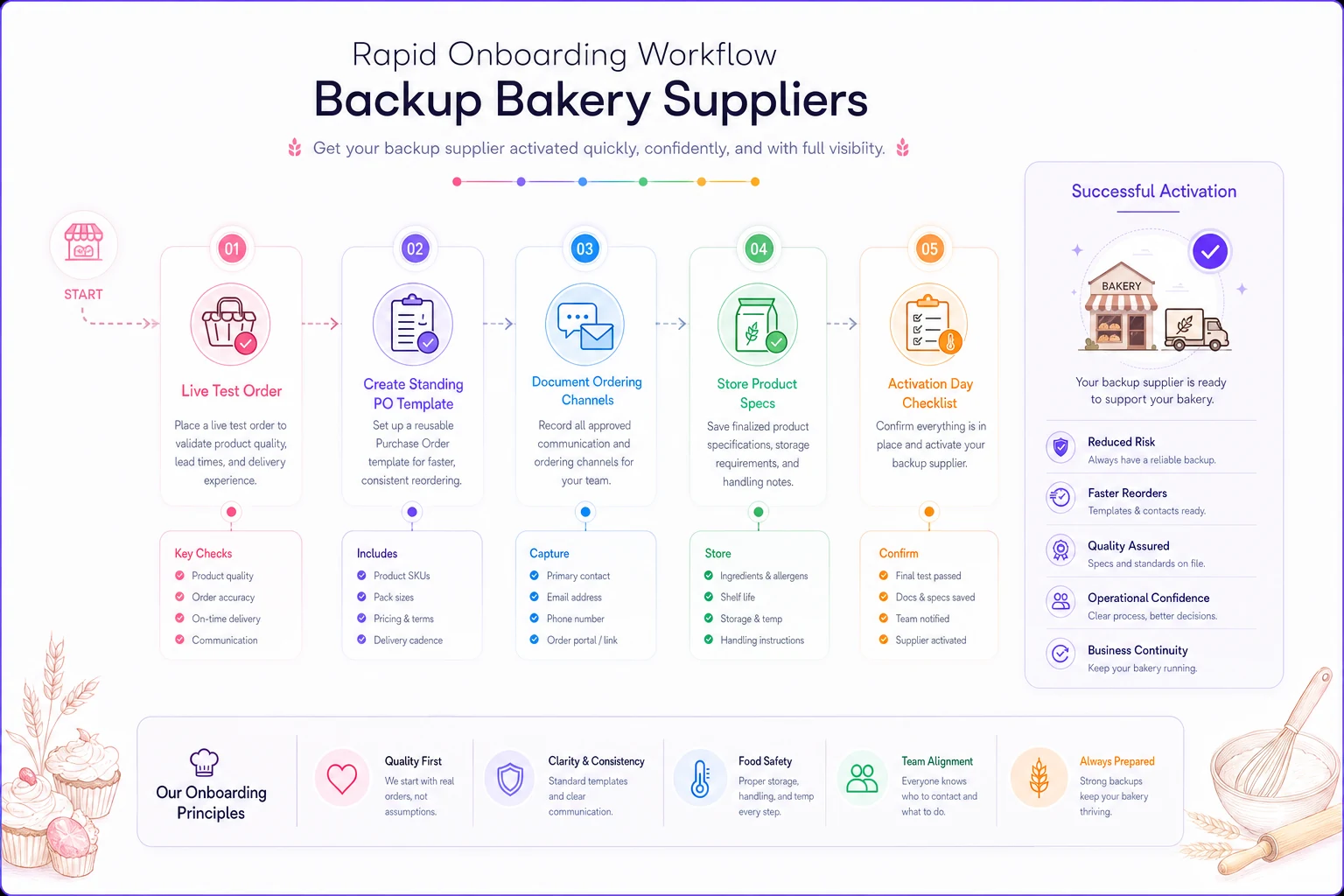
Before you ever need them (one-time setup):
-
Run one live test order at normal volume. This validates the activation time, the product quality, and your receiving process all at once.
-
Pre-build a standing purchase order template with their SKU numbers, your account, delivery address, and receiving contact already filled in.
-
Document their exact ordering channel — phone, portal, email — and who on your side is authorized to trigger it.
-
Store the product spec side-by-side with your primary's so staff can see the differences (size, bake color, labeling) at a glance.
-
Pre-write any customer-facing note you'd use if the backup product looks slightly different ("baked fresh from our partner kitchen today").
Visual overview of the onboarding steps.
On the day you activate:
-
Confirm the gap — which SKU, what volume, how many days.
-
Place the pre-built PO through the documented channel.
-
Get written confirmation of delivery time, and update your production plan around it.
-
Brief receiving on the temp-check and spec differences.
-
Log the event so you can review supplier performance afterward.
The single biggest unlock is step 1 of the setup: the live test order. Bakeries that run one test order a year with their Tier 1 backup activate smoothly under pressure. Bakeries that never test discover their "24-hour" supplier actually needs 48, their product is two centimeters smaller, and their portal login expired — all at once, on the worst possible morning.
This whole playbook should sit inside your broader continuity plan, not beside it. If you've already mapped out what happens when equipment or suppliers fail, your backup-supplier activation steps belong right there as a named trigger and response — so the person on shift knows exactly which document to pull and which supplier to call.
Keeping it manageable as the roster grows
Once you've got a Tier 1 and Tier 2 per critical SKU group, you're managing a handful of relationships, each with its own spec, contract renewal date, and last-tested date. For a single location that's a simple spreadsheet. Across multiple sites it gets messier fast — different locations may rely on different backups, and a contract that lapsed six months ago is invisible until you need it.
This is where keeping supplier records, specs, contract dates, and test-order history in one place actually earns its keep. Whether that lives in a shared workbook or inside a workflow platform that tracks vendor records and flags renewals and overdue tests, the point is the same: a backup supplier whose contract silently expired is no backup at all. The value isn't the tool — it's that someone gets a nudge before the price protection runs out, not after.
When this effort is worth it — and when it isn't
It's worth it when: you have critical SKUs you can't produce in-house, you hold contractual obligations to wholesale accounts or subscriptions, or a single stockout would meaningfully damage a key customer relationship.
It's overkill when: you can bake the item yourself at needed volume, the product is low-margin and easily substituted, or demand is flexible enough that going without it for a day costs you almost nothing. Don't spend Tier 1 effort on SKUs that only need a Tier 3 name in a spreadsheet.
Who should hold off entirely: a brand-new bakery still nailing down its primary supply shouldn't be sourcing backups yet. Get your core supply stable and your receiving SOPs solid first. Backup sourcing is a maturity step, not a day-one priority.
Real scenario: a par-baked bread backup that paid for itself
A small café-bakery doing roughly €9k–€11k a week relied on a single supplier for the par-baked sourdough batards that anchored their morning service and two wholesale accounts. No backup, because the supplier had been reliable for two years.
When that supplier's delivery route got disrupted for the better part of a week, the bakery lost the batards entirely for three days. The wholesale accounts went unfilled, one of them started looking elsewhere, and the café ran out of its most-ordered bread by mid-morning each day. The rough cost over those three days — lost sales plus a strained wholesale relationship they spent weeks repairing — landed somewhere around €2k–€2.5k, most of it in long-tail reputation damage rather than the immediate sales numbers.
Afterward they qualified one Tier 1 backup and one Tier 2, ran a single live test order to confirm a true next-day activation, and pre-built the standing PO. The whole setup took maybe a day and a half of work plus the cost of one test order. The next time their primary had a hiccup — a much smaller one, a single missed delivery — they activated the backup in under half an hour and most customers never noticed the batards came from a different kitchen that day.
The outcome wasn't dramatic. That's exactly the point. A well-prepared backup makes a supplier failure boring, which is what you want for a perishable operation that can't afford drama at 6 a.m.
Closing thought
The bakeries that handle supplier failures well aren't the ones with the most vendors — they're the ones who did the qualifying, testing, and contracting before anything broke. A backup supplier is only as good as the last time you tested them and the clarity of the plan that tells your morning shift exactly when to call. Source a short, serious roster, keep it current, run one live order a year, and wire the activation steps into your continuity plan.
Then the next time a truck breaks down before a holiday weekend, it's a 20-minute task instead of a very long, very expensive day.