


Most bakeries don't fail because of one big disaster. They wobble because a mixer motor burns out on a Friday before a wedding weekend, and then the backup flour delivery slips two days, and then two decorators call in sick, and suddenly the whole operation is being held together by whoever happens to be on shift and clever enough to improvise.
That improvisation is the real risk. When continuity depends on the memory and instincts of whoever's standing in the kitchen, you don't have a system—you have luck. And perishable products punish you fast when luck runs out. A restaurant can hold inventory. A bakery is throwing away yesterday's margin every single morning, and any disruption in equipment, supply, or staffing lands directly on product that already had a shelf life measured in hours.
This is about building the layer above the daily fire drill: a resilience system that inventories what can break, ranks how badly it hurts, and pre-decides your response so nobody's inventing solutions at 4 a.m.
Why continuity plans fall apart in real bakeries
The typical "continuity plan," if it exists at all, is a repair guy's phone number taped inside a cabinet. That's not a plan. That's a single point of contact for a single failure mode.
Failures don't arrive in isolation. In real operations, disruptions cluster. A heat wave stresses your refrigeration and spikes local demand for cold-holding capacity and makes proofing unpredictable, all in the same week. A supplier's plant goes down and suddenly three different SKUs you didn't realize shared an ingredient are all at risk.
Small food operations tend to plan for the failure they've already experienced. Had a freezer die once? There's now a freezer plan. Never had a supplier ghost you mid-season? No plan exists—and that's exactly the one that'll cost you a corporate account.
The gap isn't intelligence. Resilience feels like insurance—you pay for it and hope you never use it—so it never gets prioritized over the thing on fire today. The result is a bakery that handles the emergencies it's rehearsed and freezes on the ones it hasn't.
Start with a risk inventory, not a to-do list
Before you write a single response plan, you need to know what you're defending against. Most owners skip this and jump straight to solutions, which is why their "plans" only cover a random handful of scenarios.
-
Equipment ovens, mixers, proofers, refrigeration, freezers, POS, delivery vehicles
-
Supply core ingredients (flour, butter, eggs, chocolate), packaging, single-source specialty items
-
People openers, lead decorators, drivers, anyone who is the only person who knows a critical task
-
Utilities & facility power, gas, water, the physical space itself
-
Systems ordering platform, payment processing, anything that stops you taking or fulfilling orders
Flag single-source suppliers and single-person tasks early—those quiet dependencies cause the biggest cascades.
The insight most people miss: single-source dependencies are the real killers, not the obvious expensive equipment. Everyone worries about the oven. Fewer people notice that one specialty chocolate supplier feeds four of their top-margin SKUs, or that only one employee actually knows how the subscription batching works. Those quiet dependencies are where a small disruption turns into a bad week.
Rank the damage: impact tiers
A risk inventory without prioritization just becomes an anxiety list. You can't defend everything equally, so you rank by impact. Three tiers is enough:
| Tier | What it means | Example | Response speed |
|---|---|---|---|
| Tier 1 – Critical | Stops production or breaks a committed customer promise | Main deck oven down; refrigeration failure; only decorator out during wedding week | Immediate, pre-authorized action |
| Tier 2 – Serious | Degrades output or margin but you can still operate | Secondary mixer down; one core ingredient short; driver out | Same-day workaround, managed |
| Tier 3 – Manageable | Annoying, contained, absorbable | One SKU's packaging delayed; POS glitch on one till | Log it, handle in normal flow |
The point of tiering isn't the label—it's what the label authorizes. A Tier 1 event should trigger pre-approved spending and decisions without anyone waiting for the owner to wake up and answer a text. If your shift lead has to call you before renting an emergency oven during a Tier 1 failure, you've built a bottleneck into your own emergency response.
A common mistake is treating every problem as Tier 1 because everything feels urgent in the moment. That burns out staff and blows budget on manageable issues. The tiers force you to decide—calmly, in advance—what actually justifies the emergency playbook.
Pre-approved substitutions and the cost of not having them
Substitution decisions made under pressure are almost always worse and more expensive than the same decision made calmly on a Tuesday. When butter's short at 5 a.m. and you're staring at 200 croissants that need to be laminated, "figure it out" costs you either the product or your margin, and sometimes both.
This is where a pre-approved swap list earns its keep. You decide in advance which substitutions are acceptable, what they cost, and what they trigger downstream—labeling changes, allergen re-checks, texture expectations. The procurement approach to handling supplier gaps covers the ingredient side of this in depth, and the principle carries into your broader continuity system: a swap isn't just an ingredient decision, it's a cost and compliance decision.
The piece owners often forget is the cost-accounting trigger. When you substitute a premium ingredient for a cheaper one, or an emergency-priced one for your normal supplier, that changes the true cost of the product. If you don't flag it, you'll happily sell at a loss all day without noticing. A good substitution rule includes: swap this, relabel that, and log the cost variance so someone actually sees what the emergency did to margin.
Inter-site transfers: leverage you build before you need it
If you run more than one location, or even a production kitchen plus a cafe, your other sites are your best emergency buffer—but only if you've set up transfers to actually work under stress.
The failure pattern is predictable. Site A's oven dies, Site B has capacity, but nobody knows Site B's real available slack, there's no agreed way to move product across town, and the two managers end up negotiating logistics by text while croissants go stale. By the time it's sorted, you've lost the morning.
-
Visibility — each site knows the others' realistic spare capacity, not a guess
-
Rules — who authorizes a transfer, how product moves, who covers the cost, and how it's accounted between sites
-
Triggers — the conditions under which a transfer just happens rather than requiring a meeting
Something multi-site operators figure out pretty quickly: transfers work when they're treated as a standing arrangement, not an emergency favor. If Site B's manager feels like every transfer is a hit to their numbers, they'll resist, and your resilience evaporates exactly when you need it. Sort the internal cost-accounting so helping another site is neutral to their performance, and cooperation stops being a fight.
Emergency staffing: the failure everyone under-plans
Equipment gets the attention, but staffing gaps cause more quiet damage. A decorator out during a heavy custom week, or two openers sick on a Saturday, hits you just as hard as a broken proofer—and it happens far more often.
-
Map every critical task and note how many people can genuinely do it
-
For any task with a count of one, that's a flagged risk—cross-train toward two minimum
-
Keep a short, honest list of who can be called in and what they can actually do
-
Pre-agree on-call or short-notice pay so the ask is clear, not awkward
-
Define which shifts can be simplified (reduced menu day) when you're short-handed
That last one matters and gets ignored. Sometimes the right emergency staffing move isn't finding more people—it's deciding in advance which products you drop for the day to protect the ones that matter. A pre-approved "reduced production mode" keeps a short-staffed morning from turning into a chaotic one.
Customer SLA templates: control the promise before it breaks you
When something fails, the damage often isn't the failure itself—it's how it lands with customers, especially wholesale and corporate accounts who plan around your reliability.
The SLA you set is the promise you have to keep under stress. Vague promises ("we'll get you fresh croissants every morning") become impossible commitments the moment your oven's down. Specific, tiered SLAs give you room to handle disruption without breaching trust.
-
Delay notice — "Your order will arrive by [time] instead of [time], here's why, here's your options"
-
Substitution notice — for approved swaps, so the customer isn't surprised at delivery
-
Partial fulfillment — when you can deliver 70% and need to prioritize
-
Full miss + make-good — the rare full failure, with a pre-decided goodwill response
The reason to template these is speed and consistency. In a real disruption, whoever's dealing with it shouldn't be composing a careful apology email from scratch while the kitchen's on fire. The message should already exist. Customers forgive disruptions far more readily when the communication is fast, honest, and specific—and they lose patience fast when they're left guessing.
How the pieces actually connect
None of this works as separate documents in separate binders. The whole value is in the connections.
The flow below captures the chain: a failure, flagged in the risk inventory, assigned a tier, and then a series of pre-decided actions that cascade through substitutions, transfers, staffing and customer communications.
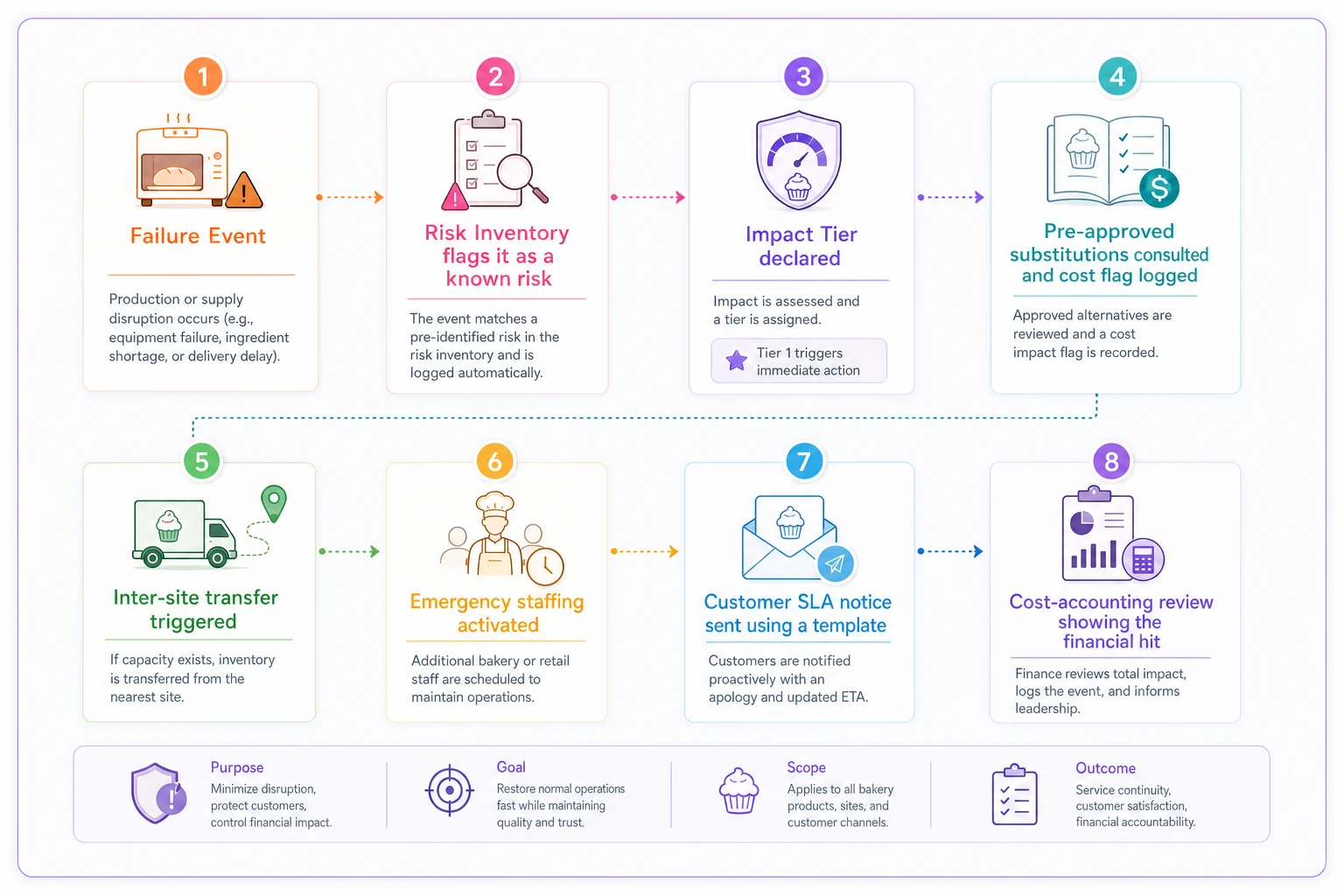
Say refrigeration fails at your main kitchen. Your risk inventory already had this on the list, so it's not a novel shock. The Tier 1 flag authorizes immediate action without waiting on the owner. Pre-approved substitutions tell you which products can shift to shelf-stable alternatives and which get dropped. An inter-site transfer kicks in if another location has slack. Emergency staffing activates if you need extra hands to re-plan the morning. Affected wholesale accounts get the pre-written delay notice before they even realize something's wrong, and every substitution and emergency purchase throws a cost flag so you see the true financial hit afterward—not at month-end when it's too late to do anything about it.
A real scenario
A two-site bakery-cafe operation, doing roughly $40k–$50k a month across both locations with a growing wholesale side, kept getting burned by disruptions they technically "survived." The pattern was familiar: something broke, the morning got saved by heroics, and nobody realized the true cost until later.
One month it all landed at once. A compressor failure at the main kitchen, a butter shortage the same week, and a lead decorator out for three days. Individually, each was manageable. Together, they cost an estimated $2k–$3k in wasted product, emergency purchases at bad prices, and one wholesale account that quietly reduced its standing order after a couple of botched deliveries with no warning.
The fix wasn't dramatic. They spent about two weeks building the risk inventory and tiers, pre-approving a short list of substitutions with cost flags, agreeing on simple transfer rules between the two sites, and writing four customer notice templates.
The next time a compressor issue hit, the response was almost boring. Tier 1 declared, some production shifted to the other site, two SKUs dropped for the day under the reduced-production rule, affected accounts notified before they noticed anything wrong. The estimated loss that day was a few hundred dollars instead of a few thousand—and no customer left. The disruption still happened. It just stopped costing them a month's worth of margin every time.
Where a system helps versus where it doesn't
Continuity systems are worth building when your operation has grown past the point where one person can hold all the responses in their head. If you're a single owner-operator baking alone, you are the system, and a light checklist is probably enough. The moment you have multiple staff, multiple sites, or wholesale commitments, the improvisation model starts leaking money you can't see.
Where a workflow platform with AI-assisted automation earns its place is in the connective tissue—keeping the risk inventory current, watching for cost-accounting triggers when substitutions happen, flagging single-person task dependencies before they bite, and firing the right customer templates without someone remembering to. The value isn't the software making decisions for you; it's that the decisions you already made in advance actually execute consistently, even at 4 a.m. when the person on shift has never seen this particular failure before.
The mistake to avoid: buying a tool and expecting it to be your continuity plan. It won't. The thinking—the inventory, the tiers, the pre-approved responses—has to exist first. Software makes a good system run reliably; it can't manufacture a system you never built.
Bringing it together
The bakeries that stay steady through equipment failures and supplier chaos aren't luckier or better funded. They've just done the unglamorous work of deciding, in advance, what they'll do when things break—and connecting those decisions so one failure triggers a clean response instead of a panicked one.
Perishable business continuity for a bakery isn't a binder you write once and forget. It's a living layer: what can break, how much it hurts, what you'll swap, where you can shift production, who you'll call, and what you'll tell customers. Build those pieces so they talk to each other, and the next 4 a.m. freezer alarm becomes a manageable morning instead of a lost week and a lost account.
Start with the risk inventory. It's the least exciting part and the one everything else depends on. Everything after it is just deciding your response before the pressure gets to choose for you.