


Most bakeries don't get taken down by a single catastrophic supplier failure. They get bled slowly by a string of small ones: the butter shipment that shows up two days late during holiday week, the box supplier who suddenly can't hit your SKU, the specialty flour that goes on allocation and arrives at 60% of what you ordered. Each one is survivable. The problem is that none of them were mapped, so each one gets handled as a fresh emergency — usually by whoever happens to be on shift.
This guide is about fixing that — not by finding new vendors (that's a different job), but by assessing which supplier relationships carry real risk and building the policies, stock buffers, and contract language that absorb the shock. If you've already read the broader continuity playbook for equipment and supplier failures, think of this as the supplier-side deep dive that sits underneath it.
Start by sorting suppliers the way a line cook sorts tickets
The single biggest mistake in supplier risk work is treating all vendors as roughly equal. They aren't. A bakery might have 30–40 active suppliers, but the ones that can stop production tomorrow number maybe four or five.
The useful split isn't "big vendor vs. small vendor." It's criticality — how badly a failure hurts you — crossed with substitutability — how fast you can replace them without changing your product.
Here's a pattern worth paying attention to: the ingredients bakers worry about (vanilla, specialty chocolate, seasonal fruit) are often not the ones that actually halt production. Those are frequently substitutable or non-daily. The real chokepoints tend to be boring — a single flour mill, one butter distributor, the one box printer who has your custom die, the gas or propane supply if you're running certain ovens.
| Supplier | Criticality (stops production?) | Substitutability | Risk tier |
|---|---|---|---|
| Primary flour mill | High — daily, every product | Low — blends vary, needs testing | Tier 1 |
| Butter distributor | High — daily | Medium — alt brands exist, cost varies | Tier 1 |
| Custom box printer | Medium — can ship in plain boxes short-term | Low — custom die, 3–4 wk lead | Tier 2 |
| Specialty chocolate | Medium — specific SKUs only | Medium | Tier 2 |
| Seasonal fruit | Low — limited SKUs, seasonal | High | Tier 3 |
| Paper goods / napkins | Low | High — commodity | Tier 3 |
Tier 1 is where almost all your planning energy should go. A failure there is a same-day problem that affects nearly everything you sell. Tier 3 you can mostly handle by keeping a little extra on the shelf and moving on.
One thing worth sitting with: substitutability isn't a fixed property. It depends on how tightly your recipes are locked to a specific input. A bakery that has never tested an alternate flour has artificially made its mill a Tier 1 single-source dependency. A bakery that has a validated backup blend has effectively demoted that same mill to something more manageable. You can change your risk tier through prep work — which is a point most risk conversations miss entirely.
Map the failure, not just the vendor
Once you've got your tiers, go one layer deeper on the Tier 1s and ask what kind of failure you're actually exposed to. "Supplier risk" is several different problems wearing the same coat:
-
Late delivery — they have the product, it arrives the wrong day. Buffer stock fixes this.
-
Partial fill / allocation — they ship 50–70% of order. Diversification and minimums fix this.
-
Quality failure — product arrives but off-spec (low-gluten flour lot, butter with high water content). Incoming QC and an approved alternate fix this.
-
Total outage — fire, insolvency, recall. Only a second qualified source fixes this.
-
Price shock — still available, suddenly 40% more expensive. Contract terms and pre-negotiated ceilings help here.
A typical example: a mid-size cafe-bakery assumed their flour risk was "the mill goes down." In practice, over about two years, every disruption they actually experienced was allocation during demand spikes — they'd get 70% of a holiday order. Their mitigation plan was built for the wrong failure. They'd prepped a backup mill (expensive, rarely used) when what they actually needed was a standing minimum order and a second mill on a small regular order so the relationship was already warm when they needed to flex it up.
Map the failure mode you keep hitting, not the dramatic one you fear.
Diversification without drowning in vendor management
Diversification is the obvious answer and also the one bakeries get wrong most often — either over-diversifying into chaos or under-diversifying into fragility.
The rule that works: for Tier 1 inputs, keep a second qualified source warm; for everything else, don't bother. A "warm" source means a supplier you already buy from in small, regular volume — not one you've only talked to once. That distinction matters enormously. A supplier you've never actually ordered from won't prioritize you in a crisis; a supplier getting 15% of your flour business every week will.
A practical split for a Tier 1 ingredient often looks like 80/20 or 70/30 — primary vendor gets the bulk, secondary gets a steady minority. It costs a little (secondary pricing is usually worse at low volume) but buys three things: a tested fallback recipe, a live account relationship, and negotiating leverage on your primary.
-
Tier 3 commodities — splitting your napkin order across two vendors just doubles admin for zero real protection.
-
When your volume is too small to matter to anyone — if you can't be meaningful to even one supplier, being tiny to two is worse. Better to consolidate, become a valued account, and lean on buffer stock instead.
-
Highly recipe-specific inputs where a swap changes the product — here, diversification isn't a sourcing decision, it's a product decision, and it belongs in R&D conversations, not procurement.
The operational core is this: diversify the few things that can actually stop you, and refuse to spread yourself thin on everything else.
Minimum stock and lead-time policies that aren't just gut feel
Buffer stock is where most of the real protection lives, and it's also where bakeries either hoard (tying up cash and risking spoilage) or run too lean and panic monthly.
The formula people actually use isn't complicated:
Minimum stock = (average daily usage × supplier lead time) + safety buffer
The safety buffer is the part worth thinking about carefully. It should scale with two things: how variable your demand is, and how unreliable the supplier actually is. A rock-solid daily flour delivery needs almost no buffer. A butter distributor with a history of 1–2 day slips during peak season needs a buffer sized to that slip plus some cushion.
A worked example for flour at a bakery using about 180 kg/week (roughly 26 kg/day), with a 2-day lead time:
-
Lead-time demand
26 × 2 = ~52 kg
-
Safety buffer for a moderately reliable supplier
~40% of lead-time demand ≈ 21 kg
-
Minimum (reorder point)
~73 kg
-
When on-hand hits 73 kg, you reorder.
The insight most people miss: perishability caps your buffer, so your lead-time policy has to do the heavy lifting. You can't stockpile butter the way you'd stockpile boxes. For perishable Tier 1 inputs, the real lever is shortening and de-risking lead time — ordering more frequently in smaller lots, splitting the order across primary and warm-secondary, and keeping the reorder point disciplined rather than padded.
For perishable Tier 1 inputs, prioritize shortening and de‑risking lead time over trying to carry large physical buffers.
For non-perishable Tier 1/Tier 2 items — packaging, flour if your storage allows, shelf-stable inputs — you can lean more on buffer stock and carry a deeper cushion through known risk windows like holidays.
Emergency sourcing: the procedure that runs when the policy fails
Buffers and diversification reduce how often you hit a true emergency. They don't eliminate it. So you need a short, pre-decided procedure that any shift lead can run without calling the owner at 5 a.m.
The failure in most bakeries isn't that options don't exist in an emergency — it's that the knowledge lives in one person's head. The owner knows which cash-and-carry stocks a usable alternate flour. Nobody else does. When the owner's on vacation, the emergency becomes a crisis.
-
Confirm the gap — exact item, quantity short, and the production run it affects. (Short by 10 kg before a 40-kg batch is different from short by 2 kg.)
-
Check the warm secondary first — place or expand the standing order. This is why you kept them warm.
-
If secondary can't cover, go to the pre-listed local fallbacks — the cash-and-carry, restaurant supply, or wholesale club you've already identified and tested product from.
-
Apply the approved substitution rules — if you have to swap grade or brand, follow the validated swap list and labeling rules so you don't create a quality or allergen problem.
-
Log the event — item, cause, cost premium, resolution. This feeds your supplier review later.
Here's a quick visual of the steps a shift lead should follow when a Tier 1 shortfall is confirmed.
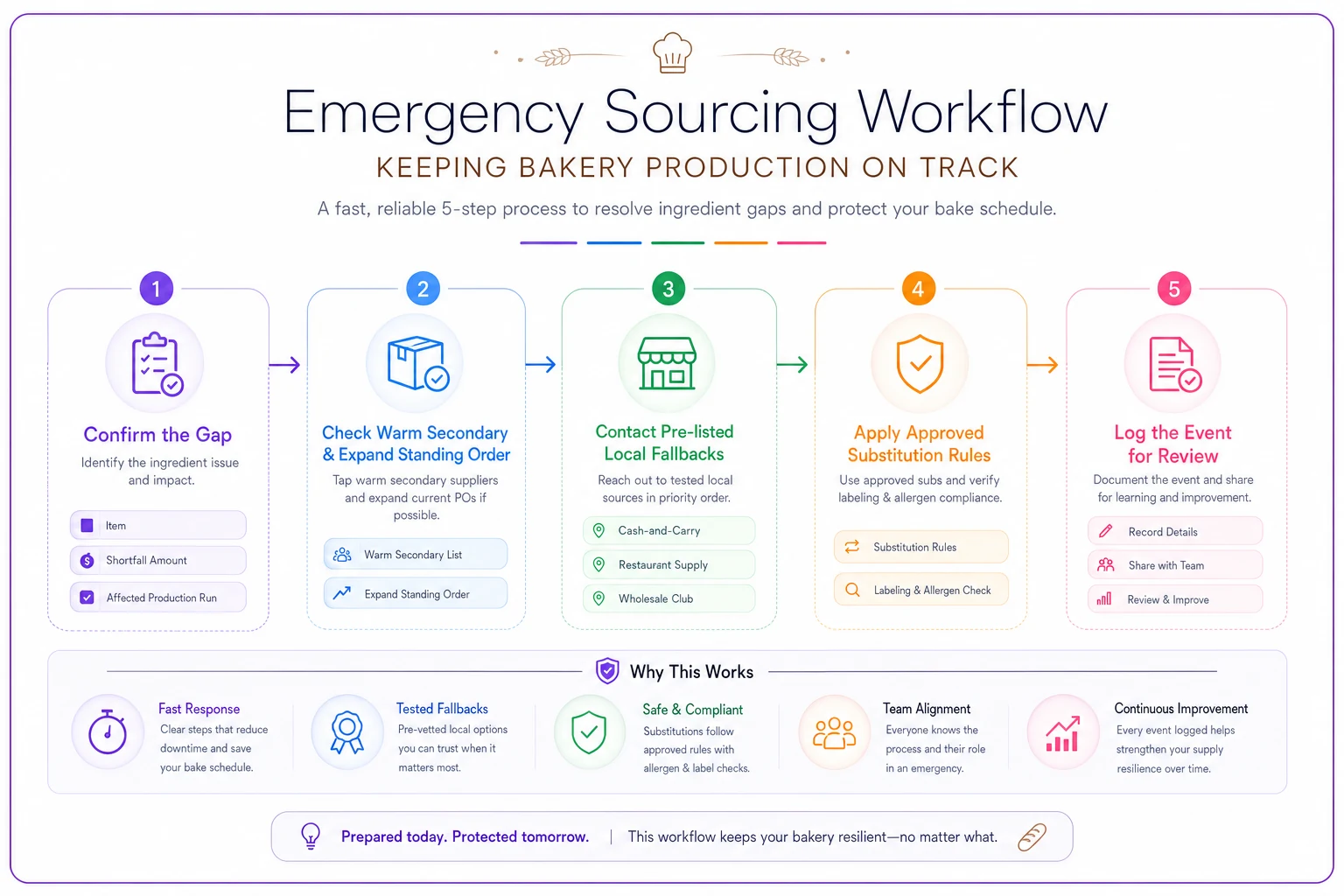
Steps 3 and 4 only work if you've done the prep before the emergency. The pre-listed fallbacks need to be real places you've bought a test batch from and run through a bake — not a Google search done at panic speed. Tie this into your broader continuity playbook so the supplier procedure and the equipment procedure live in the same place your team already checks during a disruption.
Contract contingency clauses worth actually asking for
Small bakeries assume they have no leverage on contract terms. For commodity volumes that's partly true, but there are a handful of clauses suppliers will often agree to because they cost the supplier very little — and protect you a lot.
-
Allocation priority / fair-share clause — in a shortage, you receive your proportional share based on historical volume rather than being dropped. This is the single most valuable clause for the allocation failure mode.
-
Lead-time guarantee with a remedy — commits to a delivery window, with a defined remedy (credit, expedited replacement) if missed. Even a modest remedy changes supplier behavior.
-
Price cap / ceiling for the term — caps how far price can move inside a contract period, or ties increases to a published index rather than the supplier's discretion.
-
Notice-of-disruption clause — supplier must notify you within a set window (e.g., 48 hours) of any known supply issue affecting your orders. This converts surprises into advance warning.
-
Quality spec and rejection terms — defines acceptable spec and your right to reject off-spec lots without penalty.
A short template line you can adapt for the allocation clause: "In the event Supplier is unable to fully meet aggregate customer demand, Supplier shall allocate available product to Buyer on a pro-rata basis determined by Buyer's trailing 12-week order volume, and shall notify Buyer within 48 hours of any anticipated shortfall."
You won't win all of these, especially at low volume. Prioritize the allocation and notice clauses — they protect against the two failure modes bakeries hit most often, and they're the ones suppliers are most willing to concede because they don't cost money upfront.
KPIs and trigger points that make risk visible before it bites
Supplier risk is easy to ignore because nothing's wrong — until it suddenly is. The fix is a small set of metrics tracked per Tier 1/Tier 2 vendor, each with a trigger point that forces a decision.
| KPI | What it tells you | Trigger point |
|---|---|---|
| On-time delivery rate | Reliability trend | Below ~90% over 8 weeks → review / activate secondary |
| Fill rate (% of order delivered) | Allocation exposure | Below ~95% twice in a quarter → raise minimums |
| Quality rejection rate | Spec drift | Any rejection → log; 2+ in a quarter → QC conversation |
| Lead-time variance | Buffer adequacy | Variance exceeding your safety buffer → resize buffer |
| Price change vs. index | Price-shock exposure | Increase above cap/index → renegotiate or shift volume |
The point of trigger points is to remove the judgment call in the moment. You decide now, calmly, that a fill rate under 95% twice means something — so when it happens, the response is automatic instead of debated.
The common mistake is tracking the metrics but never wiring them to an action. A vendor scorecard that nobody acts on is just a spreadsheet of regret. Every KPI above should have a named owner and a pre-agreed response.
This is also one of the few places where lightweight operational software genuinely earns its keep. Not as some grand transformation — but tracking delivery dates, fill rates, and rejection logs by hand across dozens of orders is exactly the kind of boring, consistent data entry that falls apart under pressure. When order and receiving data gets captured automatically in whatever system you run, the scorecard builds itself, and trigger points can flag you instead of relying on someone remembering to check. The value is in consistency, not sophistication.
A real scenario
A single-location cafe-bakery doing roughly $40k–$45k a month ran on one flour mill and one butter distributor — both single-source, no buffer policy, everything in the owner's head. Over one winter they got hit twice: a butter delivery slipped two days during the week before Christmas, and a flour lot came in off-spec in February, costing a scrapped morning of croissant dough.
What they changed was unglamorous. They tiered their suppliers (four Tier 1s total), put butter and flour each on an 80/20 split with a small standing order to a second vendor, set reorder points with safety buffers sized to each supplier's actual slip history, and wrote a one-page emergency sourcing sheet listing two tested local fallbacks per Tier 1 item. They added an allocation and 48-hour notice clause to the flour agreement at renewal.
The following holiday season, when their primary flour went to partial allocation again, the pro-rata clause and the warm secondary covered the gap with no scrapped production. The off-spec problem didn't recur because incoming lots now got a quick check against spec before going into the mix.
Nothing dramatic happened — which was exactly the point. The cost was a modestly higher blended flour price (a few percent) and about half a day of setup work. The return was two avoided production losses and an owner who could take a week off without the supply chain holding its breath.
Drill and audit checklists
Policies rot if they're never tested. Two short routines keep this alive.
Quarterly supplier-risk audit (about 30 minutes):
-
[ ] Review Tier 1/Tier 2 scorecards — any KPI past its trigger point?
-
[ ] Confirm each Tier 1 warm secondary is still active (placed an order in the last quarter?)
-
[ ] Re-check reorder points against recent usage and any lead-time changes
-
[ ] Verify emergency sourcing sheet fallbacks are still open and still carry the tested product
-
[ ] Note any contract renewals coming up and the clauses to push for
Emergency sourcing drill (twice a year, 20 minutes):
-
[ ] Pick a Tier 1 item and declare a simulated outage
-
[ ] Have a shift lead (not the owner) walk the emergency procedure from the sheet alone
-
[ ] Time it — can they locate the fallback and the substitution rule without help?
-
[ ] Confirm the substitution labeling/allergen steps are understood
-
[ ] Capture anything that was unclear and fix the sheet
The drill matters more than it sounds. The whole point of writing the procedure down is so it survives the owner being unreachable — and the only way to know it does is to make someone else run it while nothing's actually on fire.
Running these audits also tends to surface things you wouldn't catch otherwise: a fallback supplier that quietly stopped carrying your product, a reorder point that was set when you were doing half the volume you do now, a substitution note that references a vendor you no longer use. Thirty minutes a quarter is genuinely enough to keep the system honest, as long as you're actually acting on what you find.
Where to focus if you only do three things
If this feels like a lot, the three moves that return the most are: tier your suppliers so you know your real Tier 1s, keep a warm secondary on each Tier 1, and set reorder points with buffers sized to each supplier's actual reliability. Those three absorb the overwhelming majority of disruptions a bakery actually experiences, and none of them require a vendor hunt or a big spend.
Supplier risk management isn't about predicting the next shock. It's about making sure that when the butter's late, the flour's short, or the box printer's machine is down, the response is already written, already tested, and doesn't depend on one person being awake at the right moment. Get the mapping and the buffers right, keep the contract clauses working for you, and most "emergencies" quietly become Tuesday.
Supplier risk management isn't about predicting the next shock. It's about making sure that when the butter's late, the flour's short, or the box printer's machine is down, the response is already written, already tested, and doesn't depend on one person being awake at the right moment. Get the mapping and the buffers right, keep the contract clauses working for you, and most "emergencies" quietly become Tuesday.