


Most negotiation advice assumes you have leverage. Big volume, multiple locations, the ability to threaten a switch that actually scares the rep. Small bakeries have none of that. You're ordering four cases of butter a week and a couple sacks of flour, and the distributor rep knows it. So when you ask for better pricing, you get a polite "that's the best I can do at your volume."
That answer is usually false. Not always — but usually. Reps have room they don't offer to accounts that don't ask correctly. What kills small bakeries in supplier negotiation isn't lack of volume. It's asking for the wrong thing, at the wrong time, with no fallback prepared. This is a playbook for negotiating like a low-volume account that actually knows where the flex lives.
If you haven't built the underlying procurement structure yet — order cadence, minimums, vendor scorecards — start with the procurement system for small bakeries, because negotiation without that foundation is just haggling. This post assumes you already track what you buy and who you buy it from.
The five-point checklist to run before any call
Don't open a negotiation until you can answer all five. Reps close weak accounts fast because those accounts show up unprepared and asking vaguely.
-
Know your annualized spend per vendor, not per order. A rep hears "I buy $180 of butter a week" differently than "I spend about $9,400 a year with you on dairy alone." Same number, completely different framing. Always speak in annual terms.
-
Know your three highest-cost line items. You negotiate those, not the whole catalog. Trying to shave every SKU signals you don't know your own numbers.
-
Know the current market direction. If commodity butter is falling and your price hasn't moved in four months, that's your entire opening. Reps count on you not tracking spot movement.
-
Know your walk-away alternative. A second vendor quote, a cash-and-carry option, a buying group. Never negotiate without one, even a weak one.
-
Know what you can give. Faster payment, a standing order, consolidating categories to one vendor. Concessions the rep can take to their manager are what unlock pricing.
If any of these is blank, you're not ready. The most common failure is bakeries walking into a call with a feeling ("this seems expensive") instead of a number, and reps are trained to wait that out.
When you first call, lead with your annualized spend to shift the frame.
The most common failure is bakeries walking into a call with a feeling ("this seems expensive") instead of a number, and reps are trained to wait that out.
The scripts — and why the phrasing matters
Reps hear "can you do better on price?" fifty times a week and have a reflexive no. The scripts below work because they either give the rep a reason to move or a lever to pull with their own manager.
Opening a price conversation (existing vendor):
> "I pulled my annual numbers and I'm at roughly $9,400 with you on dairy. I want to keep it there and grow it, but the butter line specifically is out of step with where the market's gone the last quarter. What can we do on that item so I'm not shopping it?"
Notice: you anchor on annual spend, you signal loyalty, you name one item, and you end with a soft threat that isn't aggressive. "So I'm not shopping it" tells the rep the alternative exists without making them defensive.
When they hit you with the minimum-volume line:
> "I get that. But I'm a predictable, on-time-paying account that isn't going anywhere. That's worth something to your route. If volume's the blocker, tell me what volume unlocks the next price break and I'll tell you if I can hit it."
This flips it. Instead of accepting "your volume's too low," you make them quantify the threshold. Half the time the threshold is closer than you think, and you can reach it by consolidating a category you're currently splitting across two vendors.
When you have a competing quote:
> "I'd rather stay with you — your delivery windows work for my mornings. But I've got a quote that's about 7% under you on flour and shortening. I'm not asking you to match it exactly. Get me within a couple points and payment terms stay net-15 and we're done."
You're explicitly making it easy to say yes. Asking a rep to fully match a competitor triggers a manager fight. Asking to get close is something they can often approve on their own.
When you want to lock a price against future increases:
> "Prices are bouncing around. I'd rather have certainty than the lowest possible number. Can we fix pricing on my top three items for the next quarter, and I'll commit to a standing weekly order?"
Predictability is a real concession you can trade. A lot of small bakeries would happily accept a slightly-above-rock-bottom price in exchange for not getting surprised — and reps love a standing order because it de-risks their route.
Sample concessions: what you can actually trade
You don't have volume, so you trade the things a small, reliable account can offer. These have real value to a distributor's route economics even when your case count is low.
| Concession you offer | Why the rep values it | Realistic ask in return |
|---|---|---|
| Faster payment (net-15 or on delivery) | Cash flow, less collection risk | 2–4% off top items |
| Standing weekly order (fixed day) | Predictable route, easier truck loading | Locked pricing for a quarter |
| Consolidating a split category to one vendor | Bigger share of your wallet | Reach next volume tier |
| Flexible delivery window | Cheaper to serve on their route | Small per-order discount |
| Multi-quarter commitment on core items | Forecasting certainty | Price protection against increases |
The pattern worth noticing: almost every concession here reduces the cost to serve you, not just your price. Reps have more room on accounts that are cheap and easy to service. A bakery that reliably pays on delivery and takes a fixed Tuesday drop is genuinely worth more per case than one that pays late and reorders erratically.
Volume pooling: getting leverage you don't have alone
This is the tactic most low-volume bakeries never try, and it's the one that actually moves pricing brackets. If you can't hit a volume tier alone, hit it with someone else.
-
Category consolidation within your own shop. You're probably buying flour from one vendor, sugar from another, dairy from a third, out of habit. Pull them together where you can. A single vendor moving from $9k to $24k of your annual spend has a genuine reason to re-tier you.
-
Informal pooling with a neighbor bakery. Two or three small bakeries that aren't direct competitors — say, a bread shop, a cake shop, and a bagel place — can place coordinated orders through the same distributor and reference a combined volume. You each order separately but negotiate as a bloc. "Between the three of us we're moving about 30 cases of butter a week" is a different conversation entirely.
-
Buying groups and co-ops. Regional bakery and restaurant purchasing groups exist specifically to give small operators tiered pricing. The membership math is simple: if the group's discount beats your solo pricing by more than the annual dues, join.
-
Timing your orders to the vendor's cycle. Distributors often have monthly or quarterly volume targets. A rep who's short of quota near end-of-period will approve pricing they wouldn't touch mid-cycle. Ask when their period closes — some will tell you — and time a bigger commitment there.
The honest caveat on neighbor pooling: it requires trust and coordination that can fall apart. Someone flakes on a week, someone changes vendors, and the combined-volume story stops being true. Keep it loose, keep it documented, and don't build your whole cost structure on it.
The decision matrix: accept the minimum vs. seek alternatives
The hardest call isn't the negotiation itself — it's knowing when a minimum order or a "best we can do" is actually fine to accept, and when it's quietly bleeding you.
Accept the minimum / current terms when:
-
The item is a small share of total spend (under ~5%) and chasing it costs more in time than it saves.
-
The vendor's reliability is genuinely hard to replace — they hit your morning window every time, and a cheaper vendor who's late once wrecks a service day.
-
Switching would fragment a consolidated category and drop you below a tier elsewhere.
-
The price gap to alternatives is under a couple points. Not worth the disruption.
Seek alternatives / push harder when:
-
One vendor is more than ~30–40% of your ingredient spend and hasn't moved on price in two-plus quarters.
-
Market direction is clearly down and your pricing is flat — that's dead-obvious room.
-
Minimums are forcing you to over-order perishables and eat spoilage. A minimum that creates waste is more expensive than a higher unit price with no waste.
-
You have a real, tested alternative — not a hypothetical quote, but a vendor you've actually trial-ordered from.
That third point deserves weight. A "great" price on a case minimum you can't use is a trap. If a distributor's minimum on cream forces four cases a week and you use two and a half, the two rotting cases turn a good unit price into a bad effective price. Calculate cost per unit actually used, not per unit purchased. Low-volume bakeries lose more money to minimum-driven spoilage than to bad per-unit pricing, and almost nobody tracks it.
A real scenario
A single-location bakery-cafe doing roughly $420k a year was buying across five vendors, mostly out of inertia — whoever a previous manager had signed up with. Annual ingredient spend sat around $86k. Dairy was split between two distributors, flour came from a third, and nobody had renegotiated anything in over a year.
They ran the checklist. Annualized every vendor. Found their top three cost items were butter, high-gluten flour, and chocolate. Consolidated both dairy vendors into one, which pushed that account from about $11k to $19k a year and unlocked a real tier. Used the payment-terms concession — moved to paying on delivery — for another couple points on flour. And they killed a standing cream order whose minimum had been generating roughly 15–20% spoilage. Net result over the following quarter: ingredient costs came down somewhere in the range of $4,800–$6,000 annualized, and the spoilage fix accounted for nearly a third of that on its own. No dramatic single win — a consolidation, a payment-term trade, and one killed minimum. That's usually what real supplier negotiation looks like for a small bakery. Not a knockout. A few points, compounded across the biggest lines.
Where this gets easier with the right system
None of this works well if you can't pull your numbers quickly. The reason most bakeries negotiate badly isn't that they lack volume — it's that pulling annualized spend per vendor per SKU takes an afternoon of digging through invoices, so it never gets done. They walk in blind, and the rep can feel it.
A centralized operational platform fixes that specific problem. Not because it negotiates for you, but because it turns a pile of invoices into a screen that shows annualized spend per vendor, which items have drifted above market, and spoilage rates on minimum-order lines. When that view takes thirty seconds instead of half a day, you renegotiate on a schedule instead of only when a price shock forces your hand. AI-assisted purchasing tools can also flag when a line item's price has been quietly creeping up between orders — the kind of slow drift you'd otherwise miss until it's already cost you for months.
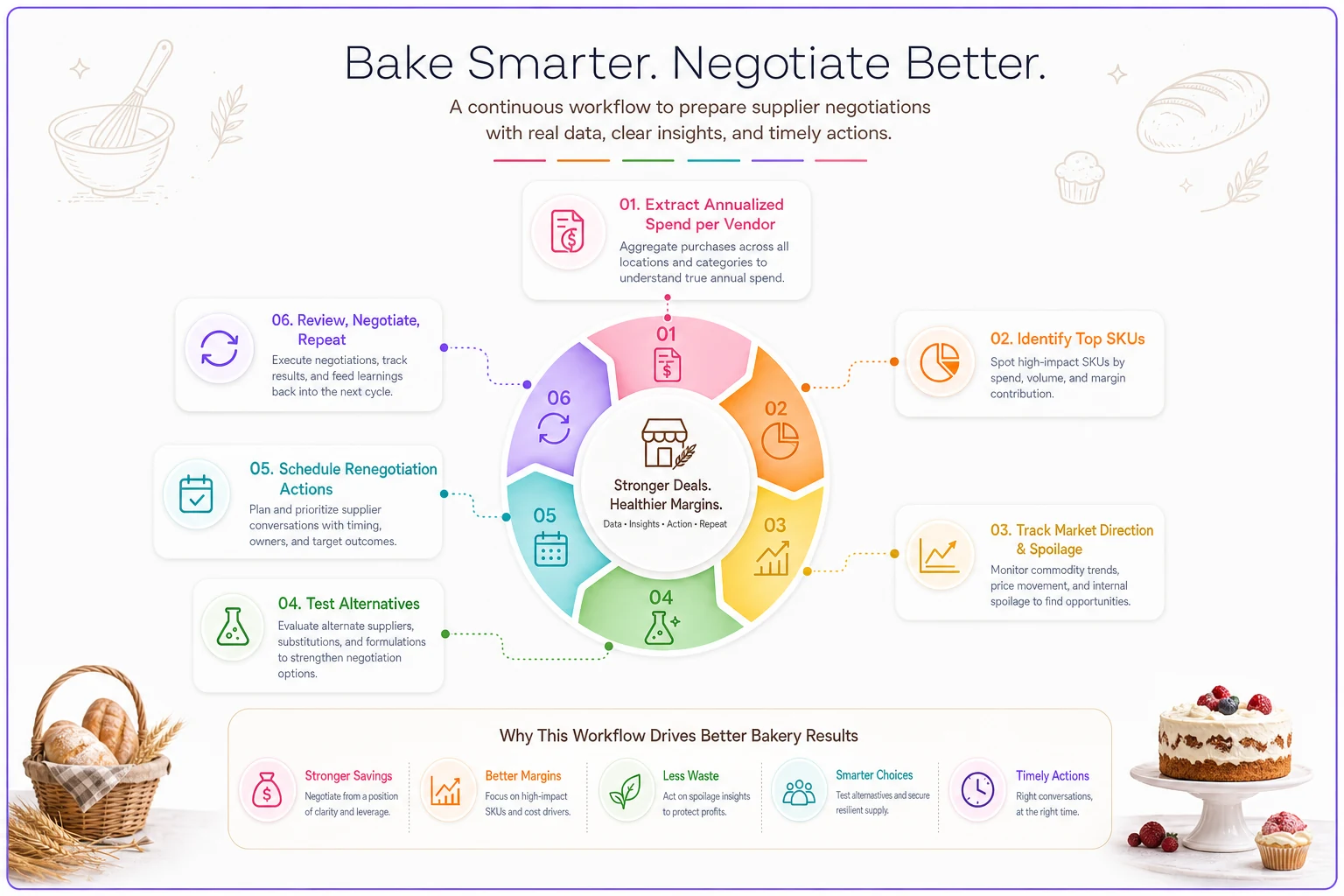
The point isn't the software. It's that negotiation leverage for a small bakery is mostly information leverage. You don't have volume. What you can have is a rep sitting across from someone who knows their numbers cold, has a tested alternative ready, and knows exactly which concession to trade. That combination beats volume more often than you'd expect, and the right operational system is simply what makes it repeatable.
The takeaway worth keeping
Low volume isn't the disqualifier it feels like. Reps have room on accounts that are predictable, easy to serve, and clearly informed. Build the five-point prep, speak in annual numbers, trade the concessions that lower your cost-to-serve, pool where you honestly can, and use the matrix so you stop accepting minimums that quietly generate waste.
Run it as a quarterly habit rather than a panic response, and the few points you claw back on your top three items compound into real margin — the kind that actually shows up at year end.
Run it as a quarterly habit rather than a panic response, and the few points you claw back on your top three items compound into real margin — the kind that actually shows up at year end.