

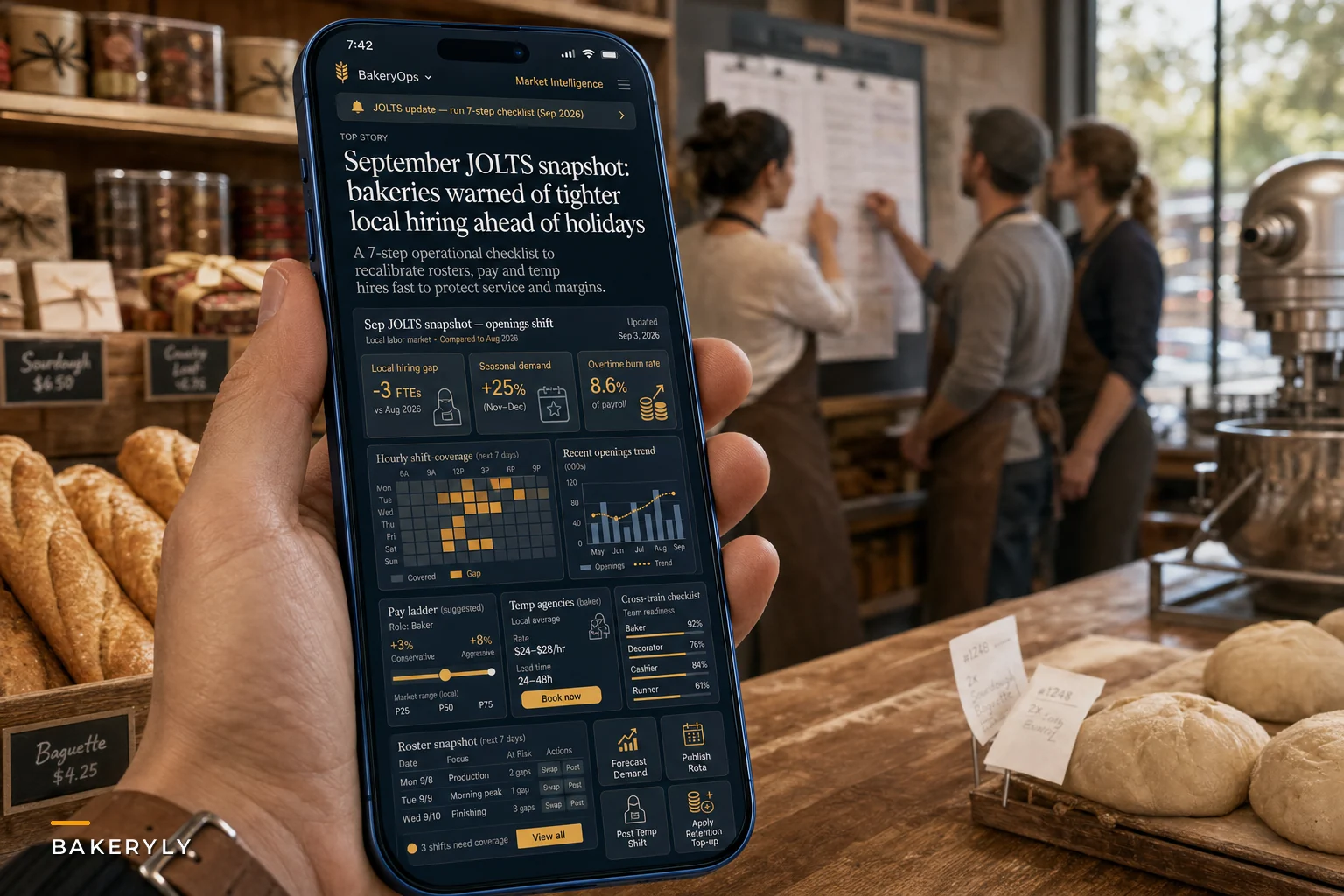

The September JOLTS report landed on November 3, and like most bakery owners, you probably didn't read it. That's fine. You don't need to parse the whole thing. But the direction it points matters right now, because you're about to walk into the one stretch of the year where being two bakers short on a Saturday morning doesn't cost you a little—it costs you the whole holiday order book.
So skip the economics lecture. Here's what you actually do with this.
What the signal is actually telling you
Short version: hiring has cooled, quits have softened in a lot of markets, and job-posting momentum is uneven depending on where you are. The Bureau of Labor Statistics tracks all of this in its monthly JOLTS release, and Indeed's October labor market snapshot shows a market that's loosening in some spots and still sticky in others.
The part that trips people up: a "softer" national labor market does not mean easy hiring for your bakery. National averages hide the fact that early-morning, food-production, weekend-heavy roles sit in the hardest-to-fill corner of the labor pool. When overall hiring slows, generalist retail and warehouse jobs fill first. The 4 a.m. mixer role? Still a grind to recruit for.
The real read for bakeries isn't "labor is getting easier." It's "the market is shifting, and your window to lock in staffing before the holidays is narrowing." Two very different things.
The problem this exposes: most bakeries staff reactively, then pay for it in December
A softer-but-uneven market punishes bakeries that build their holiday rota the way they always do—by eyeballing last year and hoping the same people show up.
In real operations, the failure usually looks like this. A bakery assumes its summer crew rolls straight into Thanksgiving. Then two people give notice in early November (quits don't vanish just because the national number dips), and suddenly you're recruiting for a specialized production role during the exact weeks everyone else is also hiring seasonal help. Recruiting lead time stretches. You overpay for a warm body. That warm body hasn't been cross-trained, so your experienced decorator ends up babysitting instead of producing.
That's the underlying issue the JOLTS signal keeps surfacing: bakeries treat staffing as a hiring problem when it's really a capacity-planning problem. Hiring is just the last, most expensive lever. By the time you're posting a job in mid-November, you've already burned through the cheaper options—shifting existing hours, cross-training, pre-booking returning seasonal staff, adjusting your production calendar to match realistic labor.
A quick way to pressure-test your current plan
Before you touch anything, run your next four Saturdays through these questions. They actually predict whether you'll be short-staffed.
-
If your two most senior production staff both called out on the same peak morning, could you still ship preorders? If no, you have a single-point-of-failure problem, not a headcount problem.
-
How many of your holiday-critical tasks can only be done by one or two people? Count them. That number is your real risk exposure.
-
What's your actual recruiting lead time right now—from posting to a trained, productive hire? If you don't know, assume it's longer than you think. For skilled production roles in a tightening local market, it's often 3–5 weeks.
-
Are your current wages competitive for early-morning work specifically, or just for daytime retail? These are different pay markets.
-
Do you know your labor cost as a percentage of sales by day-part, or only as a monthly blob?
If you can't answer most of these, that's where the work is—not in posting another job ad.
Recalibrate in the right order
The mistake is jumping straight to "we need to hire." Work the cheaper levers first.
-
Re-run your short-term demand forecast against reality, not last year. Pull your actual preorder pace for the last two weeks and compare it to the same point last year. If preorders are tracking 10% ahead, your staffing plan built on last year's volume is already wrong.
-
Map every holiday-critical task to the people who can do it. Not roles—people. You're looking for tasks owned by a single person. Those are your fragile points.
-
Cross-train to remove single points of failure before you recruit. One cross-trained existing employee is worth three panic hires in December. Cheaper, faster, and they already know your SOPs.
-
Lock in returning seasonal staff now with a firm ask. "Are you in for the holidays?" is not a plan. A confirmed start date and confirmed hours is. Do this before competitors pull them away.
-
Decide your pay-ladder moves deliberately, not under pressure. A small, planned bump to your early-morning differential now beats an emergency overpay for a stranger in three weeks.
-
Only then, if gaps remain, recruit—with a realistic lead time baked in. Post for the gap you actually have after steps 1–5, which is almost always smaller than the gap you assumed at the start.
Here's a simple workflow to run through those steps.
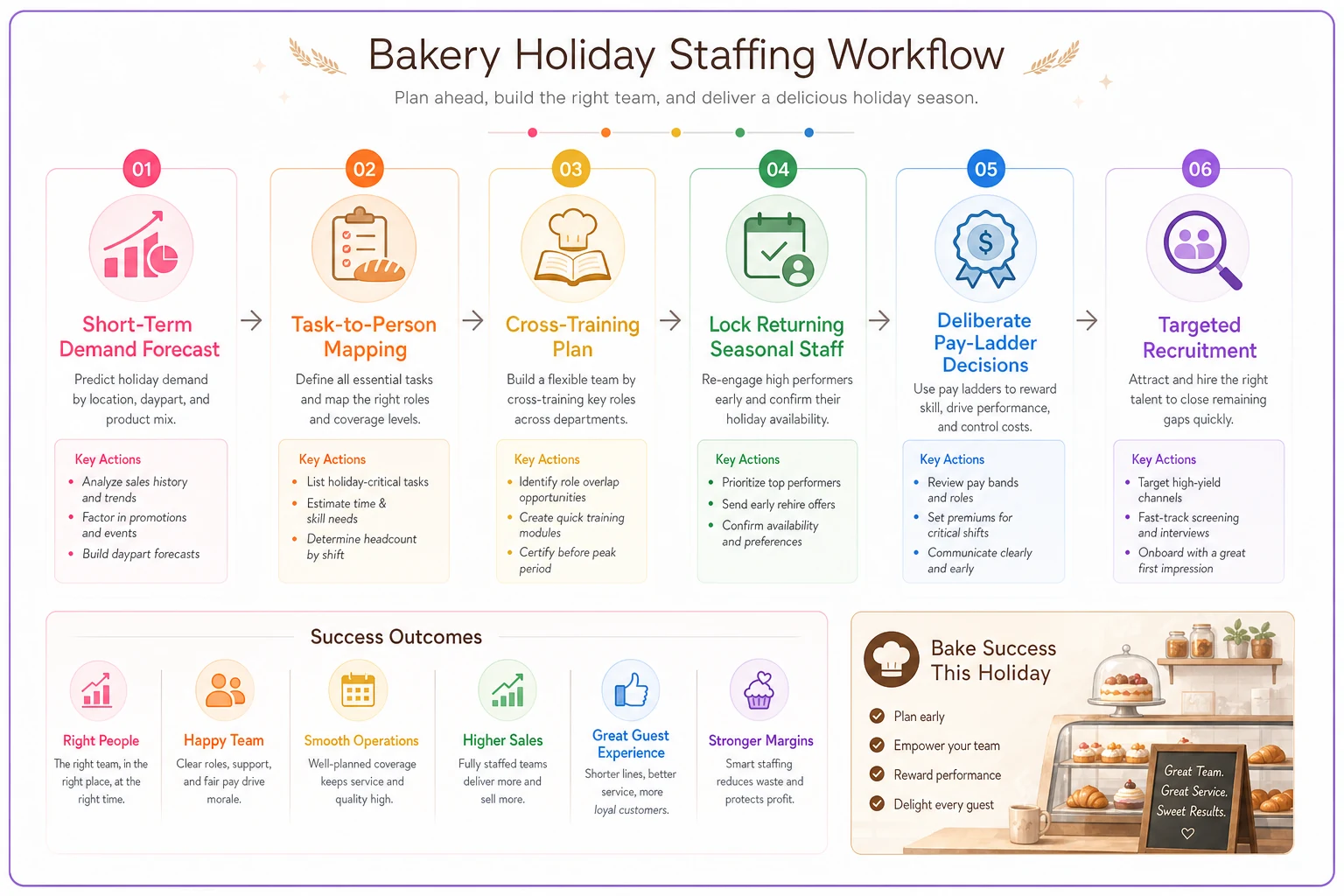
One cross-trained existing employee is worth three panic hires in December.
Hiring is step six, not step one. That ordering alone saves most bakeries more money than any single wage decision.
Cheaper lever vs. expensive lever: where the money actually leaks
The same staffing gap can be closed several ways, and the cost difference is significant.
| Way to close a peak-shift gap | Rough cost impact | Lead time | Risk |
|---|---|---|---|
| Cross-train an existing employee | Low (training hours now) | 1–2 weeks | Low—they know your systems |
| Shift existing staff hours / adjust rota | Minimal | Immediate | Low, if done early |
| Pre-book returning seasonal staff | Low–moderate | Needs commitment now | Medium if you wait too long |
| Planned pay-ladder adjustment | Moderate, predictable | Short | Low if communicated well |
| Emergency recruit during peak | High (overpay + training + errors) | 3–5 weeks | High—unproven, untrained |
| Last-minute overtime to cover gaps | High, recurring | Immediate | Burnout, quality drop, churn |
The pattern is obvious once it's laid out: every lever above "emergency recruit" is cheaper and lower-risk, yet most bakeries skip straight to the bottom two because they didn't plan early enough. The JOLTS signal is basically a reminder to move up this table now, while you still can.
A real scenario
A single-site bakery doing a mix of café walk-ins and holiday preorders went into last November assuming their eight-person team would carry the season. Two staff left in the first week of November. They scrambled, posted a production role, and ended up paying roughly $3–$4 more per hour than their standard rate just to fill it fast—then burned their lead baker's time training someone who quit by mid-December.
The following year they changed one thing: they ran the task-mapping exercise in mid-October and found that three separate holiday-critical jobs—laminating dough, decorating, and morning oven loading—each had only one capable person. They cross-trained two existing part-timers over three weeks, confirmed their returning seasonal staff by the end of October, and adjusted the early-morning differential modestly across the board instead of overpaying one new hire.
The result wasn't dramatic in a flashy way—it just worked. They covered the season without a single emergency hire, overtime dropped noticeably, and the lead baker actually produced instead of training. Labor cost as a share of holiday sales came in a few points lower than the prior year, mostly because they stopped paying the panic premium.
When aggressive hiring actually makes sense—and when it doesn't
Not every bakery should respond to a tightening market the same way.
Aggressive early hiring makes sense when: you're genuinely scaling—new site, major new wholesale account—your task map shows real headcount gaps even after cross-training, and your local market is clearly tight for morning roles. Moving early beats moving cheap in that situation.
It's a bad idea when: your "gap" is really a single-point-of-failure problem that cross-training solves for a fraction of the cost. Hiring a whole new person to cover one task that an existing employee could learn is how bakeries quietly bloat their labor line.
Who should not be rushing to hire at all: bakeries that haven't yet mapped their tasks to people. If you don't know where your actual fragility is, you'll hire for the wrong role and still be exposed on the shift that matters. Figure out the shape of the gap before you spend on filling it.
The deeper fix: staffing decisions need a system, not a season
The reason the same scramble repeats every holiday is that most bakeries rebuild their staffing logic from scratch each time a labor signal shifts. There's no standing structure connecting demand, capacity, cross-training, and pay decisions—so every JOLTS release, every wage shift, every surprise resignation feels like a fresh fire.
The bakeries that handle these shifts calmly have a repeatable way to tie staffing levels to real capacity and a clear pay structure that doesn't get renegotiated under pressure. That's the whole point of building proper labor governance that aligns staffing, pay ladders and capacity—so when a national labor signal moves, you're adjusting a dial on an existing system rather than rebuilding the machine.
Where operational software helps is mostly in making this system visible and fast to re-run. When your demand forecast, your rota, and your by-day-part labor cost all live in one place, recalibrating a staffing plan after a labor-market shift takes an afternoon rather than a week of spreadsheet archaeology. The value isn't the technology—it's that you can respond to a signal like JOLTS while the window is still open, instead of discovering the gap on a Saturday morning with a line out the door.
The bottom line to act on this week
The September JOLTS numbers are a nudge, not an emergency. But the nudge points at a real deadline: your holiday staffing options get more expensive every week you delay. Map your critical tasks to real people, close single points of failure with cross-training first, confirm your returning staff now, make pay decisions deliberately, and keep hiring as the last resort it should be.
Do that, and a softer-but-uneven labor market stops being a threat and becomes what it actually is for a well-run bakery—a chance to lock in your season while everyone else is still panic-posting job ads.