

Most bakeries treat labor as three disconnected problems. Hiring happens when someone quits. Pay raises happen when someone complains or threatens to leave. Productivity is a gut feeling the owner has during the morning rush. And "development" is basically whatever the head baker remembers to teach between batches.
Each of those decisions gets made in isolation, by different people, on different timelines, with no shared logic. That's not a hiring problem or a pay problem — it's a governance problem. Nobody owns the system that links staffing levels to pay progression to actual output to margin.
When those four pieces aren't wired together, you get a specific, predictable failure: labor cost climbs faster than capacity, and you can't explain why. Payroll is up 12% but you're not producing 12% more. You added a person but the line still bottlenecks at proofing. You gave your best decorator a raise and now two others expect one too, with no real way to justify who's actually worth more.
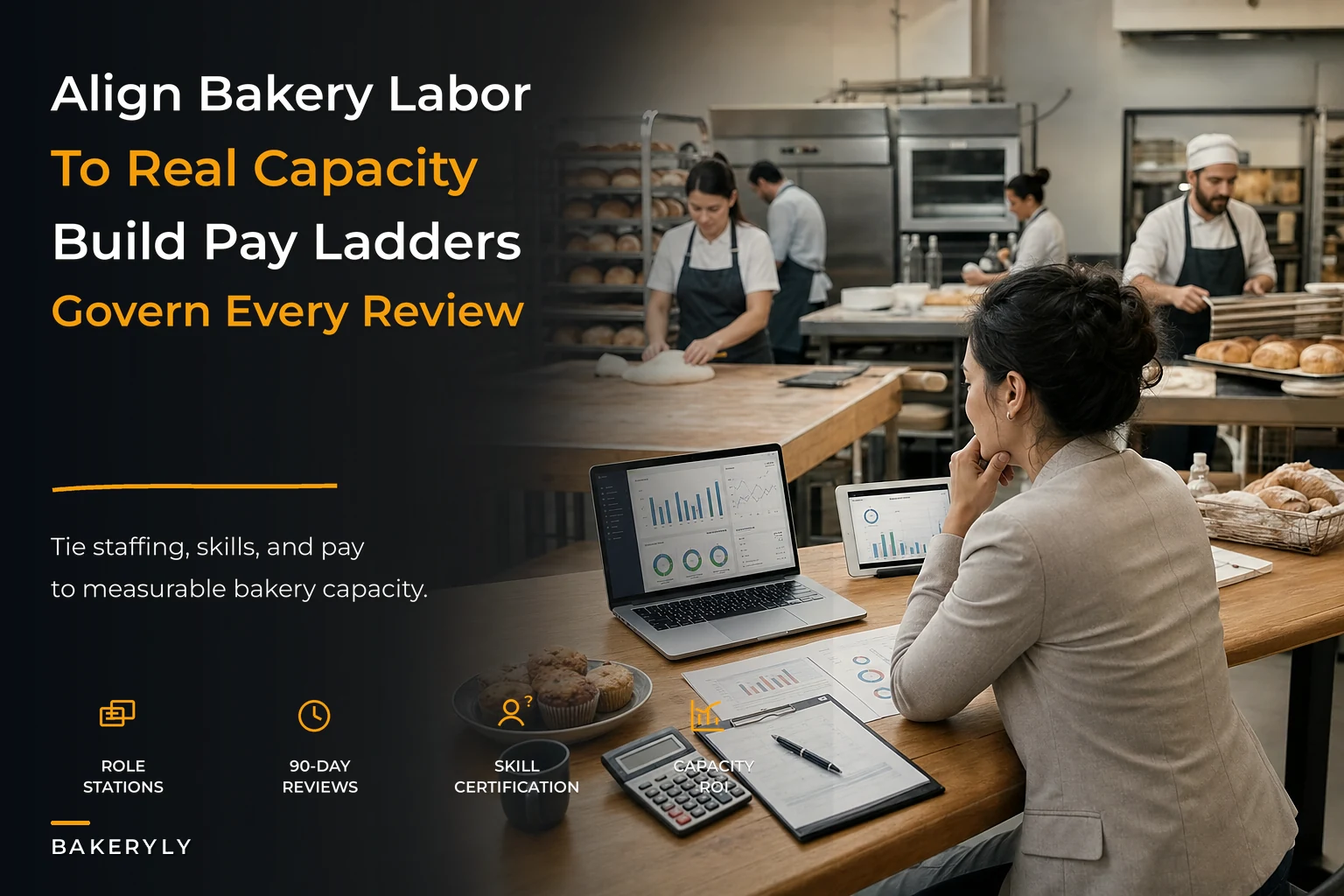
Labor governance in a bakery just means having a defined set of rules for how people enter, advance, get measured, and develop — rules tied directly to capacity and margin, not to who asked loudest. Here's how the pieces connect, and where they break.
The four systems that should be one system
Most owners miss this. Hiring, pay ladders, productivity measurement, and development cadence aren't four separate programs. They're four views of the same underlying question: are we converting labor dollars into capacity at a rate that holds margin?
They chain together like this:
-
You hire to fill a capacity gap at a specific station.
-
The person moves up a pay ladder by earning micro-certifications that prove they can run more stations or hit higher throughput.
-
Productivity KPIs tell you whether that certification translated into real output, not just a checklist they passed.
-
A 90–180 day development cadence is the clock that forces the review — are they progressing toward the capacity you hired them for, or stalling?
When this works, every pay increase corresponds to a measurable increase in what the person can produce or cover. When it doesn't, pay drifts upward on tenure and goodwill while output stays flat. That gap — pay rising faster than productivity — is the single biggest silent margin leak in a growing bakery.
If you want the hiring and micro-cert foundation in detail, we covered the entry-level mechanics in an operator‑first hiring, micro‑cert and pay‑ladder system for bakeries. This article sits one level above that — it's about governing all four pieces together so they don't drift apart.
Why the disconnect happens in almost every bakery
Nobody designs the disconnect. It grows because the bakery grows.
In the early days, the owner is the governance system. You know exactly what everyone can do, who's fast, who's reliable, and whether payroll makes sense because you're standing in the kitchen every morning. Decisions are good because they live in one head.
Then you hit maybe 8–12 staff across two shifts and that stops working. You can't watch the closing shift and morning prep simultaneously. You can't track who earned what skill. Raises start happening in hallway conversations. A new hire's ramp-up depends entirely on which experienced baker happened to be working their first week.
A pattern that shows up repeatedly: a bakery doubles headcount over 18 months, payroll roughly doubles, but output grows maybe 60–70%. The missing 30% is the governance gap. Nobody tracked whether new labor was actually filling capacity gaps or just adding bodies near the bottleneck.
The subtle part is it looks fine week to week. You're never short-staffed in any dramatic way. The erosion is slow. By the time it shows up in the P&L as "labor crept from 28% to 34% of revenue," it's been building for a year.
What breaks at each stage of scale
The failure modes change as you grow. Treating a 5-person bakery's labor system like a 20-person one is a mistake in both directions.
| Stage | Headcount | What breaks | What labor governance needs to do |
|---|---|---|---|
| Owner-run | 3–6 | Nothing yet — owner holds it all | Write down who can do what, even informally |
| First managers | 7–12 | Pay decisions get inconsistent; skills untracked | Formal micro-cert list + pay ladder tied to it |
| Multi-shift | 12–20 | Productivity invisible across shifts; raises drift on tenure | Role-based KPIs + a review cadence |
| Multi-site | 20+ | Each site invents its own rules; cost varies wildly | Standardized governance, site-level dashboards |
The jump that catches people off guard is the move to multi-shift. Suddenly the owner can't observe half the output. A closing baker could be producing at 60% of a morning baker's rate and you'd have no idea, because you're comparing them to nothing. Without role-based productivity visibility, every shift becomes its own private economy.
The staffing side of this — getting the right number of people at the right stations at the right time — connects directly to demand forecasting. If you haven't built that layer, the whole governance structure floats on guesswork. The forecasting-to-rota mechanics are in the demand‑based staffing system for bakeries, and it's worth reading alongside this.
Building the pay ladder so it maps to capacity, not calendar
A pay ladder works when every rung represents a specific, verifiable increase in what someone contributes to capacity. It falls apart when the rungs are just "been here 6 months" or "been here a year."
Think in terms of what stations and throughput a wage unlocks, not time served. A practical structure:
-
Entry rung — can run one station reliably at standard pace (e.g., bench work or counter). Base rate.
-
Micro-cert 1 — certified on a second station and holds target throughput on both. Small bump.
-
Micro-cert 2 — can cover the bottleneck station (usually ovens or decorating) during a surge. Meaningful bump, because this directly protects capacity.
-
Cross-shift lead — certified across 3+ stations and can run a shift handover and triage issues. This is where pay and responsibility step up noticeably.
The governance rule that makes this hold: a rung only counts once the KPI confirms it. Passing a decorating cert doesn't earn the raise. Passing the cert and hitting the decorating throughput target for two consecutive weeks earns it. That single rule is what stops pay from drifting ahead of productivity.
Require two consecutive weeks at target before awarding a pay rung to keep raises tied to real output.
The margin implication is blunt. A decorator who's certified but producing at 70% of target is costing you a certified wage for sub-certified output. Multiply that across a team and you've got your payroll-outrunning-output problem explained in a sentence.
A note on what the KPIs should actually be
-
Production roles units per labor hour by station, batch rework rate, waste attributable to the station.
-
Counter/front transactions per labor hour during peak windows, upsell attach rate, till variance.
-
Shift leads on-time production completion against the day's run-list, handover accuracy, overtime triggered on their shift.
Don't pile in fourteen metrics. One or two per role that genuinely tie to capacity or margin. A dashboard with too many numbers is a dashboard nobody reads.
The 90–180 day cadence: the clock that forces the system to run
A pay ladder and a set of KPIs sitting in a spreadsheet do nothing without a cadence that forces actual review. This is the piece bakeries skip most often, and it's what makes the rest of the system real.
The structure is simple: every staff member gets a review at 90 days, then at 180 days, then settling into a regular rhythm from there — quarterly or biannual depending on your operation. The 90-day check is the early read: are they on track to the capacity you hired them for? The 180-day check is the decision point — certify and advance, hold and coach, or recognize the fit is wrong.
Ninety days is long enough to see real throughput data but early enough to correct a bad ramp before it solidifies. A hire who's stalled at one station at day 90 rarely self-corrects by day 180 without a deliberate plan.
The development cadence does three things for capacity at once:
-
It surfaces stalls early, before someone becomes a permanent single-station cost.
-
It builds a pipeline of people certifying onto bottleneck stations, so you're not scrambling when your one oven-certified baker calls in sick.
-
It gives raises a predictable schedule, which eliminates the hallway-negotiation chaos — everyone knows advancement happens through the cadence, not through asking.
Bakeries that run a real cadence tend to see turnover drop — not because they necessarily pay more, but because people can see the path forward. Ambiguity about advancement drives more exits than the wage itself.
A real scenario: where the margin actually moved
A two-location bakery, roughly 16 staff, was running labor at about 33% of revenue and climbing. Payroll had grown over the previous year while output felt flat. The owner assumed the answer was cutting a shift.
What the numbers showed instead: three staff were paid at their second-cert wage but consistently running at around 70–75% of the throughput target for those stations. Two bottleneck stations — ovens at site one, decorating at site two — had only one certified person each, so every surge created overtime and every absence created chaos.
The fix was governance, not headcount cuts. They tied the next pay rungs to confirmed throughput, put the underperforming certified staff on 90-day coaching plans with clear targets, and prioritized cross-certifying two more people onto each bottleneck station.
Over about five months: labor settled back toward the high-20s as a percent of revenue, surge overtime dropped noticeably as bottleneck coverage improved, and — the part the owner didn't expect — the coaching plans mostly worked. Two of the three underperformers hit target once someone actually defined what target was. Nobody had ever told them.
Most "labor cost problems" in bakeries aren't too many people. They're pay disconnected from measured output, and bottleneck stations with no bench.
When this level of governance actually makes sense
Not every bakery needs formal ladders and review cadences. Be honest about your stage.
This makes sense when:
-
You're past the point where the owner can personally observe everyone's output.
-
You run multiple shifts or multiple sites.
-
Payroll is growing faster than revenue and you can't fully explain it.
-
Raises are happening ad hoc and you feel the inconsistency.
This is a bad idea when:
-
You have 3–4 people and the owner works every shift. Adding formal structure here just creates overhead you don't need yet. Write down who can do what and leave it at that.
-
You're in a seasonal crunch — don't launch a new review cadence the week before holiday production. Build it in a quieter stretch.
Who should not do this yet: any bakery that hasn't nailed down its production flow. If orders, batching, and station assignments are still chaotic, productivity KPIs will measure noise, not performance. Fix the production backbone first — the end‑to‑end bakery production system is the groundwork this sits on. You can't measure output per station if stations aren't clearly defined.
Where the pieces connect in daily operation
When all four systems run together, the daily workflow looks like this.
A new hire starts at the entry rung, assigned to one station based on where the actual capacity gap is. During their first 90 days, their station throughput feeds the role-based dashboard as part of normal production tracking — not a separate reporting task. At the 90-day review, the lead pulls up that dashboard: at target or not? If yes, they start the second micro-cert. If not, a specific coaching plan goes in.
By 180 days, the data decides the raise. Hit the certs and the throughput, move up a rung. Bottleneck-station certs get prioritized in scheduling, so the bench on ovens and decorating keeps growing. Every quarter, the same loop runs, and the owner can look at labor-as-percent-of-revenue by site and trace it to specific people and stations.
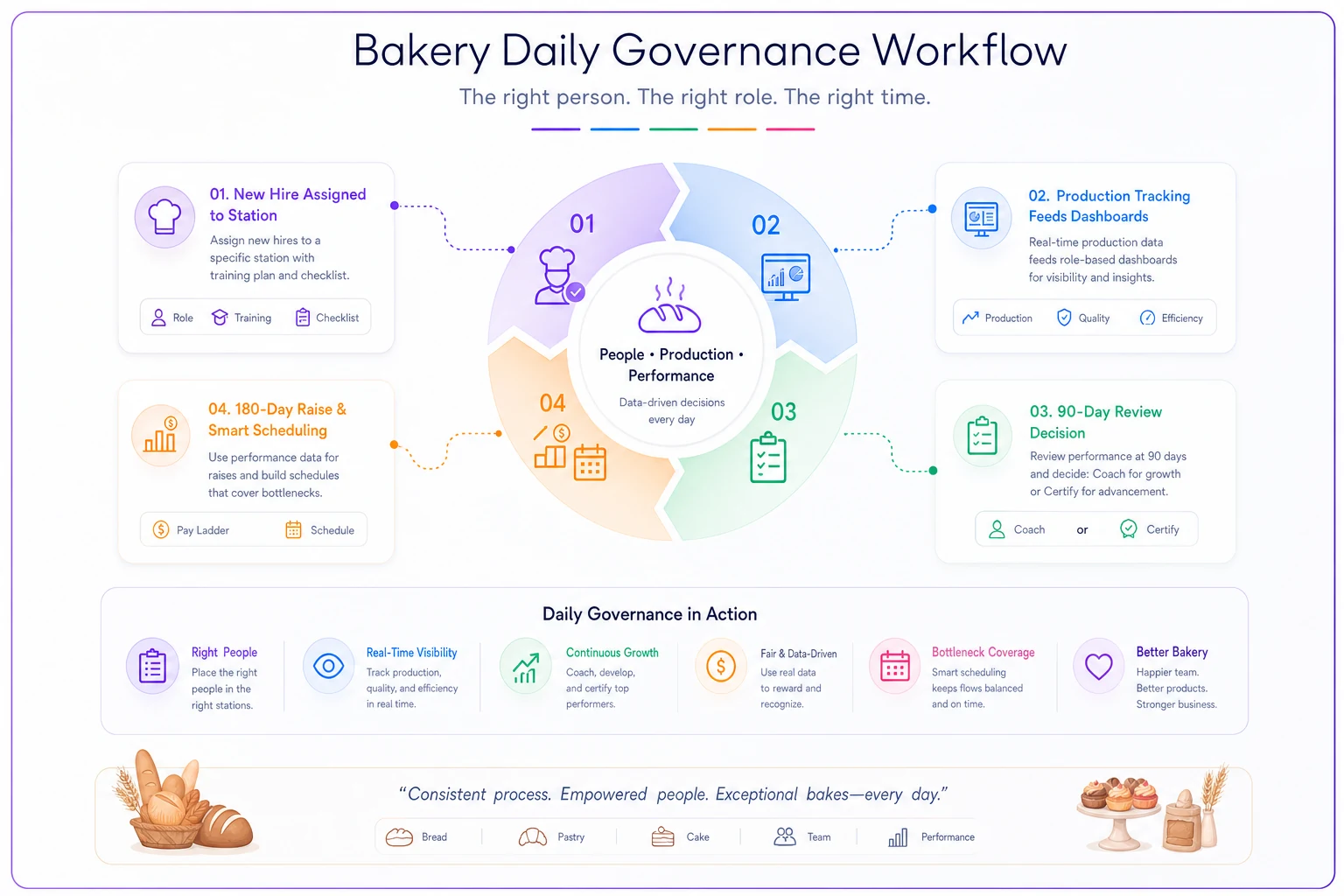
The reason this is hard to sustain on paper is the data layer. Tracking throughput by person by station, mapping it to cert status, flagging who's due for a 90-day review — doing that in a spreadsheet across two shifts and two sites falls apart pretty quickly. An AI-powered operational platform that centralizes production tracking and surfaces role-based dashboards earns its place here: not as a gadget, but as the thing that makes the governance loop actually runnable without the owner holding it all in their head again.
Bottom line for the owner
Labor governance isn't an HR exercise. It's margin control. When hiring fills defined capacity gaps, pay rungs map to confirmed output, KPIs reflect the actual job, and a structured cadence forces the reviews to happen — payroll grows in step with capacity instead of ahead of it.
The disconnect that quietly costs bakeries several margin points isn't bad people or too many hires. It's four labor systems running on four different clocks, owned by nobody. Wire them into one system, give it a cadence, and the question "why is payroll up but output flat?" stops being a mystery — because you'll have the answer in a dashboard instead of a hunch.