


Most bakery owners I talk to don't actually think they have a "hiring system." They have a job post they copy-paste when someone quits, a trial shift, and a gut feeling. Then they wonder why the same problems keep showing up — a solid morning baker leaves after four months, a counter hire never quite gets the register right, every August feels like starting from scratch.
Churn isn't really a hiring problem. It's a system problem — where three separate things (who you hire, how you develop them in the first 90 days, and how pay actually progresses) are completely disconnected from each other. When those three things don't connect, people leave. And in a bakery, where so much knowledge lives in someone's hands and timing, every departure costs more than the recruiting ad.
This post walks through how a bakery hiring and retention system can link scorecards, structured onboarding, and a pay ladder people can actually see themselves climbing — and why that link matters more than any one piece alone.
What turnover actually costs a bakery (and why owners underestimate it)
The visible cost of losing someone is the job ad and the interview time. That's the small part. The real damage is operational.
When an experienced closer leaves, your remaining staff cover extra shifts, get tired, and small mistakes start creeping in — over-proofed batches, a mislabeled allergen tray, a till that doesn't reconcile. A new hire runs slower for weeks. Your morning rush gets sloppier, the line gets longer. Product quality dips slightly, and regulars notice before you do.
A rough way to think about it: replacing a trained production or counter staffer usually runs somewhere between $2,500 and $5,000 once you count recruiting time, trial shifts, the trainer's diverted hours, lower output during ramp-up, and mistakes that slip through. Lose four people in a year at a small shop and you're quietly burning $10k–$18k — often more than the equipment upgrade you keep putting off.
The part most owners miss: a lot of that turnover is predictable. People don't leave randomly. They leave at recognizable pressure points — around week three when onboarding was chaotic, around month four when there's no clear next step, around the one-year mark when pay never moved. If you know where the cliffs are, you can build guardrails.
Why hiring, onboarding, and pay drift apart
In almost every small bakery, these three things grow up separately.
Never miss a bake or delivery again.
Bakeryly helps you schedule, track, and manage every order effortlessly.
- Unified order tracking
- Real-time inventory alerts
- Staff shift management
No credit card required
Hiring happens in a panic, so the bar drops just to get a body on the floor. Onboarding is whatever the person training that day remembers to cover. Pay is set by "what feels fair," negotiated ad hoc, with raises given reactively when someone threatens to quit.
None of that is wrong on its own. The problem is they're never linked. You hire for "seems nice and available," but you never defined what good looks like for the role. You onboard without a checklist, so two hires get wildly different experiences. And because pay isn't tied to any visible skill progression, your best people can't distinguish between staying and leaving — so they leave.
There's also a counterintuitive pattern that shows up in real operations: your most capable people churn faster than your average ones. That feels backwards until you realize the capable ones have options and no obvious reason to stay. No visible ladder means ambition walks out the door.
The three connected parts of the system
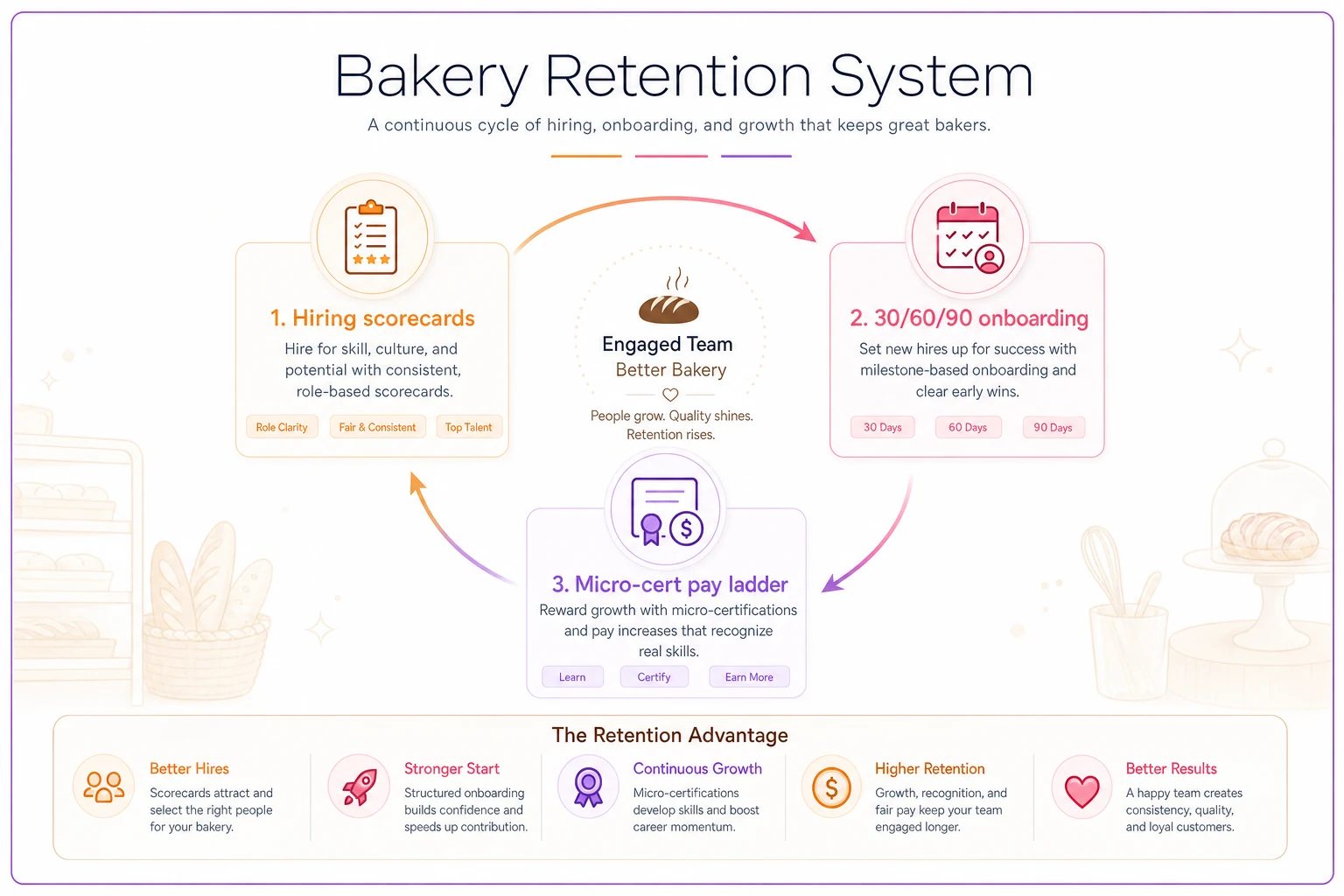
A working retention system has three pieces that feed each other:
-
Hiring scorecards — so you hire against a defined standard, not a vibe.
-
30/60/90 retention tasks — so the first three months are structured, not improvised.
-
Micro-cert ladders tied to pay bands — so people can see exactly how to earn more, and you can measure whether the investment pays off.
The point isn't any single piece. It's that a scorecard tells you what to train, the 30/60/90 plan delivers that training, and the micro-cert ladder rewards it with real pay progression. One loop.
Simple diagram of how those three pieces loop together.
One loop.
Part 1: Hiring scorecards that actually predict success
A scorecard is a written definition of what a successful hire looks like in a role, scored against real criteria instead of "did I like them."
For a bakery, you want two or three scorecards max — usually production, front counter, and maybe shift lead. Each one lists the outcomes you actually care about, not a wishlist of traits.
A production scorecard might weight things like:
-
Consistency under time pressure (can they hit the morning bake window reliably?)
-
Attention to spec (do their batches match, or do they eyeball everything?)
-
Cleanliness and station discipline
-
Coachability during the trial shift
-
Reliability signals (past job tenure, how they handled scheduling questions)
One thing almost nobody does: record the trial shift scores the moment the shift ends. You watch someone for four hours, form an impression, then forget the specifics by the next day. Score them 1–5 on three or four criteria right after, every time. Patterns emerge fast — you start noticing that "fast but sloppy" hires are consistently the ones who churn, while "steady and asks questions" hires stick around.
One mistake to avoid: don't over-weight experience. A candidate with five years at another shop who resists your specs is often a worse fit than a motivated newcomer who follows the recipe closely. Scorecards keep you honest about that, because "years of experience" becomes just one line on a sheet instead of the whole decision.
Part 2: The 30/60/90 retention plan
This is where most retention is won or lost — and it's the cheapest part to fix.
The first 90 days determine whether someone feels competent and wanted, or lost and replaceable. Chaos in week one is the single most predictable cause of early churn. If a new baker's first shift is "here's the mixer, figure it out," the countdown to their exit has already started.
A 30/60/90 plan assigns concrete tasks and check-ins at each stage:
-
First 30 days — competence and belonging - Complete station basics: mixing, shaping, allergen segregation, closing checklist - Shadow two full opening shifts - One 15-minute check-in at day 7 and day 30 ("What's confusing? What's missing?") - Assigned buddy who owns their questions
-
Days 31–60 — independence - Run a station solo during a mid-volume shift - Learn the POS and reconciliation basics (even production staff benefit from this) - First micro-cert attempt (more on that below)
-
Days 61–90 — contribution - Cover a peak shift with light supervision - Cross-train on a second station - 90-day review with a clear read on their next step and pay band
The check-ins matter more than the tasks themselves. A 15-minute conversation at day 7 catches the frustration that would otherwise become a quiet resignation at day 25. This also ties into how your shifts are structured — if your demand-based staffing system is solid, new hires get scheduled alongside strong staff during ramp-up instead of getting thrown into understaffed mornings alone.
Onboarding should also hook into your handover routines. New people absorb the operation faster when shift structure is documented — which is exactly why a one-page shift handover checklist doubles as a training tool. The new hire reads it every shift and internalizes the standard without anyone needing to lecture them.
Part 3: Micro-cert ladders tied to pay bands
This is the piece almost nobody builds, and it's the one that makes retention stick past month six.
A micro-cert is a small, defined skill certification — not a diploma, just a verified "you can do X to standard, signed off by a lead." Each cert unlocks a concrete step on a visible pay ladder. Instead of vague promises, people earn clear progression.
An example ladder for production:
| Band | Certs required | What they can do | Pay range |
|---|---|---|---|
| Trainee | None | Assist, prep, clean | Base ($15–$16) |
| Baker I | Mixing, shaping, allergen SOP | Run one station solo | $16.50–$17.50 |
| Baker II | Baker I + lamination + scaling accuracy | Run two stations, cover peak | $18–$19.50 |
| Lead Baker | Baker II + opening/closing + train others | Own a shift, sign off certs | $20–$23 |
The power is transparency. A Baker I knows exactly what to learn to reach Baker II and what it's worth. Ambition now points inward rather than toward the shop down the street. And because each cert maps to a real operational skill, every extra dollar in pay buys you a measurably more capable person.
This is also where you can start measuring ROI on retention spending — which is what turns this from an HR nicety into a defensible business decision.
Measuring whether retention spending actually pays off
The reason owners hesitate to invest in training and raises is that they can't tell if it's working. So they treat it as pure cost. That's the wrong frame, because retention has a measurable return — you just have to track it.
A simple ROI loop:
-
Track your baseline turnover cost (departures per year × ~$3,500 average replacement cost).
-
Track your investment (extra pay from the ladder + trainer hours for certs).
-
Track turnover after the system runs for two quarters.
-
Compare avoided replacement cost against the investment.
A typical example: a shop losing five people a year spends roughly $17k on churn. They roll out the ladder and 30/60/90 plan, which costs them around $6k–$8k annually in extra pay and training time. Turnover drops to two departures. Avoided cost is about $10k against $7k spent — plus fewer mistakes, faster mornings, and more consistent product. That's a real return you can defend with numbers.
The thing worth sitting with: a $1.50 raise tied to a cert is almost always cheaper than replacing the person. Owners fixate on the raise as a cost and ignore that rehiring costs multiples more.
When this system makes sense (and when it doesn't)
When it makes sense:
-
You have 4+ employees and churn is a recurring problem
-
You're running multiple shifts or planning to
-
Your best people keep leaving for marginally better pay elsewhere
-
You want to grow to a second location and need repeatable standards
When it's overkill:
-
You're a two-person operation where you are the whole team
-
Your staff has been stable for years and everyone knows their role
-
You're in survival mode with cash so tight that any structured raise is impossible this quarter — fix cash flow first, then come back to this
Who should NOT rush this: owners who haven't documented their basic SOPs yet. Micro-certs require a defined standard to certify against. If your recipes and station procedures live only in your head, build that foundation first — otherwise your "certs" are just informal opinions with extra paperwork.
A short real scenario
A neighborhood bakery with around nine staff across two shifts was losing four or five people a year, mostly within the first six months. Mornings were rough because new hires got thrown into the opening rush undertrained, made mistakes, got discouraged, and quit.
They did three things. They built a one-page production scorecard and started scoring every trial shift. They wrote a 30/60/90 plan with day-7 and day-30 check-ins. And they set up a four-band pay ladder with micro-certs for mixing, lamination, and opening/closing.
Within two quarters, early churn dropped from four-to-five annual departures down to roughly one or two. Morning error rates fell because staff were certified before running stations solo. Two employees who'd been "thinking about leaving" instead climbed to Baker II — because for the first time there was a visible reason to stay. The owner spent maybe $7k on the whole thing and stopped bleeding somewhere around $14k–$16k in annual churn costs.
Keeping it running without drowning in admin
The honest challenge with any HR system is that it dies in a spreadsheet. Scorecards get forgotten, 30/60/90 tasks slip when things get busy, and cert progress lives on a whiteboard nobody updates. That's the real reason these systems fail — not because they're wrong, but because tracking them by hand doesn't survive a packed Saturday.
This is where AI-powered operational software earns its place: keeping scorecards, onboarding tasks, cert progress, and pay bands in one connected view, and flagging you when a new hire's day-30 check-in is due or someone's ready for their next cert. The point isn't sophisticated software for its own sake — it's that the system runs consistently instead of depending on you remembering. Automated reminders and a shared dashboard turn a good process into one that actually happens every week, even when the ovens are full and the line is out the door.
Pulling it together
Churn feels like bad luck until you map it. Then you see it's three disconnected functions — hiring, onboarding, and pay — creating predictable exits at predictable moments. Link them: hire against a scorecard, develop with a 30/60/90 plan, reward with a visible micro-cert ladder tied to real pay bands. Measure the return so you can defend the investment.
Do that, and turnover stops being a recurring emergency and starts being something you actually manage. Mornings get smoother, product stays consistent, and people start building careers in your bakery instead of using it as a stepping stone.
Churn feels like bad luck until you map it. Then you see it's three disconnected functions — hiring, onboarding, and pay — creating predictable exits at predictable moments. Link them: hire against a scorecard, develop with a 30/60/90 plan, reward with a visible micro-cert ladder tied to real pay bands. Measure the return so you can defend the investment.
Do that, and turnover stops being a recurring emergency and starts being something you actually manage. Mornings get smoother, product stays consistent, and people start building careers in your bakery instead of using it as a stepping stone.
Ready to elevate your bakery operations?
Join 2,000+ bakeries using Bakeryly to streamline workflows, reduce waste, and delight more customers.