

The morning shift supervisor walks into the bakery at 3:45am, flips on the lights, and faces the same daily mystery: what exactly happened during the evening shift? There's flour dusted across the prep station, a half-written note about "check the proofer," and three different production lists scattered across the office desk. By the time they piece together what needs immediate attention, it's already 4:30am and the croissants should've been in the oven ten minutes ago.
This burns through roughly 25–40 minutes of productive morning time in most multi-shift bakeries. Not because the night crew was careless—there's just no standardized handover system that captures exactly what the incoming shift needs to hit the ground running.
Why verbal handovers and scattered notes fail multi-shift operations
The traditional approach relies on overlapping shifts where the outgoing supervisor briefs the incoming one. Sounds logical until you factor in reality: the night supervisor needs to leave on time, the morning supervisor arrives exactly when production should start, and neither has 20 minutes for a detailed conversation at 4am.
So bakeries default to scattered communication. Text messages about low butter inventory. Sticky notes on equipment that's acting up. A whiteboard with yesterday's special orders that may or may not still be accurate. Maybe an email sent at 11pm that no one checks until 7am.
The information exists somewhere, but it's not centralized, prioritized, or formatted for rapid absorption during the first hour of operations.
What typically happens: the morning crew discovers issues piecemeal. They realize the deck oven's bottom element is running cold only after the first batch of bread comes out pale. They find out about the 60-unit wholesale order due at 6am when the customer calls asking about pickup. They learn the mixer paddle needs tightening when it starts rattling mid-batch.
Each discovery triggers a mini-crisis that disrupts production flow. Across a week, that adds up to roughly 3–4 hours of lost productivity, stressed staff, and inconsistent product.
The laminated one-pager that actually works
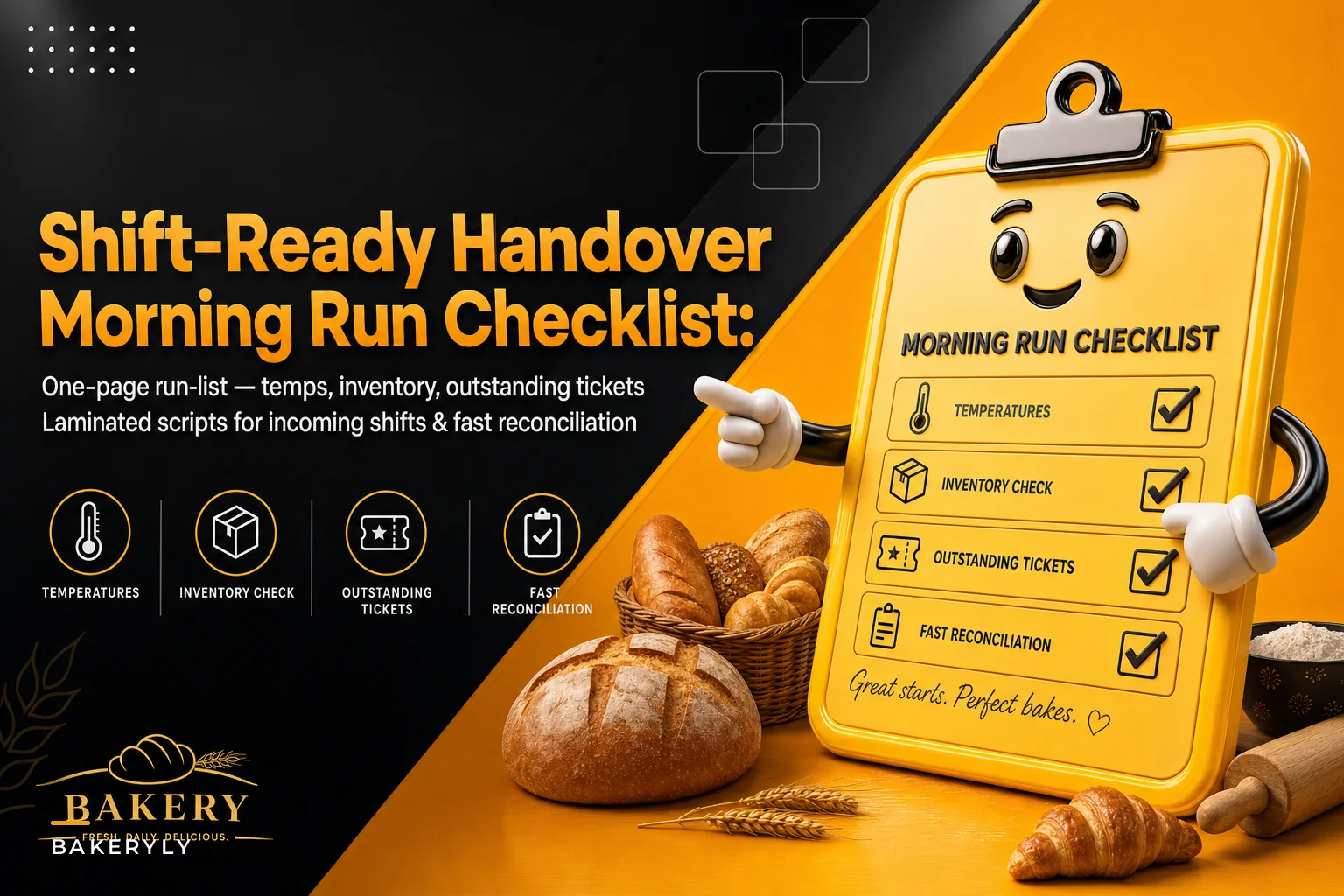
A proper shift handover checklist needs to be scannable in under two minutes and actionable within five. That means organizing information by urgency and impact—not by department or chronology.
The physical format matters more than most operators realize. A laminated 11x17 sheet lives permanently at the production station. The outgoing shift fills it out with dry-erase markers. The incoming shift reviews, acts, and wipes it clean for the next handover. No hunting for papers, no decoding handwriting on wet napkins, no scrolling through message threads.
Here's the layout that works across different bakery configurations:
Top Section: Immediate Action Items
-
Production run-list with start times (what goes in the oven first)
-
Critical temperatures logged (proofer, retarder, freezer)
-
Equipment issues that affect morning production
-
Special orders due before 8am
Middle Section: Inventory Status
-
Items below par level that need same-day ordering
-
Ingredients running low for tomorrow's production
-
Packaging supplies status for morning orders
-
Any items that didn't arrive from yesterday's delivery
Bottom Section: Reconciliation & Notes
-
Cash register starting count
-
Number of items left from previous day
-
Outstanding customer issues or complaints
-
Staff scheduling changes or call-outs
Keep a spare laminated sheet in the office so you can swap one out while the other is being cleaned.
The pre-printed prompts are what actually make this work. Instead of hoping someone remembers to mention the wonky oven door, there's a specific line item: "Equipment issues: ." Instead of assuming everyone knows about the birthday cake order, there's a dedicated space for "Special orders before 8am: ." The blank forces the thought.
Production run-lists that prevent the morning scramble
The production run-list isn't just a task list—it's a time-coded action plan that accounts for proof times, bake times, and cooling requirements. A properly structured run-list tells the morning shift exactly what needs to happen in what order to meet all deadlines.
Consider a typical morning: croissants need 20 minutes in the oven, Danish needs 18, sourdough loaves need 35. But croissants need to be ready for the 6am case refresh, Danish can wait until 6:30am, and sourdough doesn't hit the shelf until 7am. The run-list calculates backwards from those deadlines.
The handover checklist includes not just what to bake, but the exact sequence:
-
4
00am – Pull croissants from retarder, let rest 10 min
-
4
10am – Load croissants into oven #1
-
4
15am – Pull Danish from retarder
-
4
25am – Load Danish into oven #2
-
4
30am – Remove croissants, load sourdough into oven #1
This eliminates the classic mistake of starting sourdough first because it takes longest, only to realize the croissants won't be ready for opening.
The diagram below maps the time-coded sequence visually.
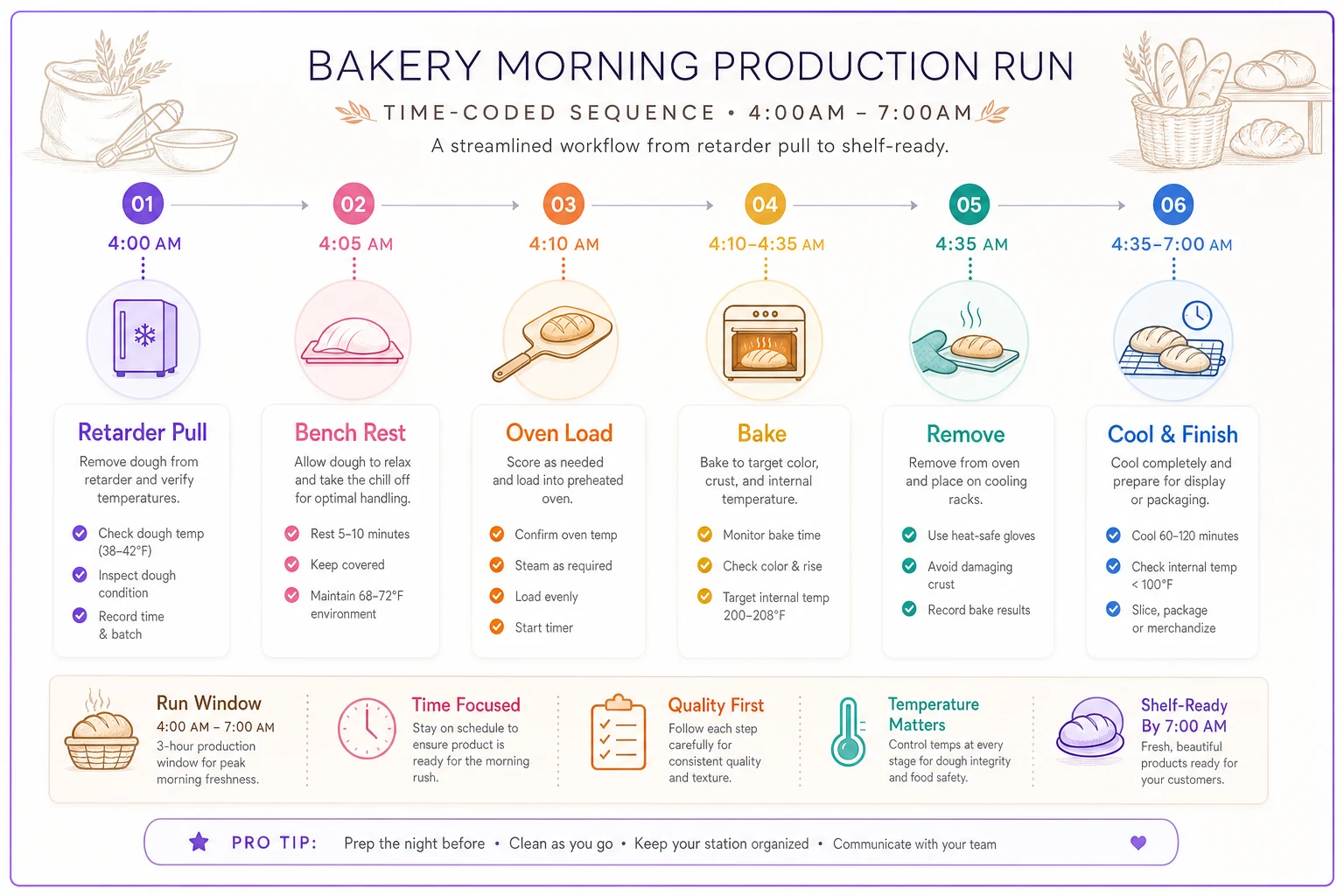
> [GRAPH: Time-coded morning production run sequence — from retarder pull through oven load to shelf-ready, mapped across a 4:00am–7:00am window]
Minimum acceptable states that flag real problems
Temperature logging seems basic until you've dealt with a proofer that slowly crept from 78°F to 85°F overnight, over-proofing everything inside. The handover checklist doesn't just record temperatures—it includes acceptable ranges that trigger specific actions.
| Equipment | Acceptable Range | Action if Outside Range |
|---|---|---|
| Proofer | 76–79°F | If above 80°F: reduce 2 degrees and rotate stock |
| Retarder | 36–38°F | If above 40°F: check door seal and compressor |
| Freezer | -5 to 0°F | If above 5°F: priority maintenance call |
Same principle applies to inventory. Instead of noting "low on bread flour," the checklist uses par levels: "Bread flour: 3 bags remaining (par: 5 bags) – ORDER TODAY." No interpretation needed, the action is obvious.
Outstanding tickets get the same treatment. Rather than "customer complained about dry cake," the entry reads: "Order #447 – refund issued for dry cake, customer expecting fresh replacement today by 2pm." The incoming shift knows exactly what needs to happen and when.
Equipment issues work best when documented this specifically. Vague notes like "mixer is being weird" are useless at 4am. "Mixer #1 paddle loose—hand tighten before use, maintenance scheduled Thursday" is something a person can actually act on.
Scripts that eliminate morning communication gaps
The morning shift supervisor needs to communicate quickly with staff arriving at different times, delivery drivers, and early customers. Pre-written scripts on the handover checklist cut through this fast.
For arriving staff: "Check station 2 for your prep list. Note: mixer #1 paddle is loose—hand tighten before use."
For delivery drivers: "Wholesale orders are on the left rack, labeled by customer. Johnson's Café has a revision—added 6 blueberry muffins to their standard order."
For equipment issues: "Deck oven bottom element running 25° cold—add 3–4 minutes to standard bake times until repair at 10am."
These aren't suggestions—they're the exact words to use. This stops the telephone game where "the oven's a bit off" becomes "don't use the oven" by the third person it passes through.
The reconciliation process that takes five minutes, not thirty
Most bakeries handle shift reconciliation backwards. They count everything, then try to explain discrepancies. The handover checklist flips this by pre-identifying where gaps typically occur.
The checklist includes the previous shift's ending counts for key items:
-
Day-old pastries
24 units
-
Packaged cookies
18 bags
-
Sliced bread loaves
11 units
The morning shift does a quick count of just these items. Discrepancies beyond normal shrinkage—clearly defined on the sheet as 5–8%—trigger a deeper check. Focused, not exhaustive.
Cash reconciliation works the same way. Instead of counting the entire till, the checklist notes: "Evening deposit: $1,847. Till should contain $200 float." Morning shift confirms the float and moves on. If it's off by more than $5, then do a full count.
The "outstanding issues" section prevents customer service failures. When someone calls about a special order that wasn't ready yesterday, the morning shift already knows about it and has a resolution ready.
Real-world implementation at a 2-location operation
A bakery with two locations about three miles apart added this system after their expansion created coordination headaches. Previously, the owner was driving between locations each morning to assess situations and redirect resources. Their handover checklist added a "resource sharing" section:
Location A:
-
Excess
40 par-baked baguettes, 3 pounds butter
-
Needs
vanilla extract, large cake boxes
-
Staff
fully staffed
Location B:
-
Excess
2 gallons vanilla, 50 cake boxes
-
Needs
dinner rolls for 11am order (can substitute 30 baguettes)
-
Staff
decorator called out, need coverage 10am–2pm
The morning managers could coordinate resource swaps without involving ownership at all. The transfer happened during the standard mid-morning delivery run. That one addition to the handover process saved somewhere around 8–10 hours of owner time per week—which is significant when you're running two locations with thin management layers.
Why digital handovers actually slow you down
Several bakeries have tried moving this to tablets or computers. It consistently fails. Flour-covered hands don't work on touchscreens. Logging into systems takes time. Scrolling through forms breaks concentration. Dead batteries create gaps right when you need reliability most.
The laminated sheet with dry-erase markers works because it's immediate, visible, and foolproof. It can get splattered with dough and wiped clean. Multiple people can reference it at once. Zero training beyond "fill in the blanks."
That said, photographing the completed checklist each day creates a useful archive. Those photos can feed into a simple spreadsheet that tracks patterns—which equipment fails repeatedly, which items consistently run low, which shifts have more discrepancies.
This is where AI-powered operational software can add serious value. Instead of manually entering data from photos, modern platforms can scan these images and automatically flag patterns. When the proofer temperature creeps up three days in a row, the system alerts you before it becomes a full breakdown. When bread flour drops below par twice a week, it suggests adjusting your standing order. The physical checklist stays simple—the software handles the pattern recognition in the background.
Common mistakes that break handover systems
Using separate documents for different departments. The decorator has their own checklist, the baker has another, front-of-house has a third. Issues fall through the gaps between them. Everything needs to live on one document that everyone reviews.
Making it too detailed. A 3-page checklist won't get filled out at 10pm when the night shift is exhausted. One page, just the information that affects the next shift's first two hours.
Not enforcing consistent timing. If the checklist sometimes gets filled out at 8pm and sometimes at midnight, the information becomes unreliable. Set a specific time—typically 30 minutes before shift end—and treat it as non-negotiable.
Ignoring it when things are "normal." Filling out the checklist every single shift, even when nothing seems noteworthy, is what makes it valuable when problems do arise. Gaps in the record create confusion about whether nothing happened or someone forgot to document.
Not connecting it to morning priorities. If the checklist doesn't directly determine what the morning shift does first, it's just paperwork. Every item should trigger a specific action or confirmation.
The staffing component most bakeries miss
The handover checklist should integrate with your staffing system to prevent morning chaos. When the evening shift knows someone called out for the morning, they can prep more items to ease the burden. When the morning shift sees that evening will be short-staffed, they can push some tasks earlier.
A simple addition to the checklist:
-
Tomorrow's morning staff
4 (full team)
-
Tomorrow's evening staff
2 (down 1 decorator)
-
Recommended prep
Complete all buttercream roses for tomorrow's orders
This forward-looking element turns the handover from information transfer into actual operational planning. It's a small change but it shifts the mindset—outgoing shifts start thinking about what the next crew needs rather than just what they finished.
Measuring the impact after 30 days
Bakeries using this system consistently report specific improvements:
-
Morning startup time drops from 35–40 minutes to around 15–20 minutes
-
Equipment surprise failures decrease by roughly 60%
-
Customer complaints about missed special orders virtually disappear
-
Staff stress levels noticeably decrease—less scrambling, more clarity
-
Product consistency improves as temperature issues get caught early
The investment? About two hours to design the checklist, $3 for lamination, and maybe $20 for good dry-erase markers. The return shows up immediately and compounds as teams get comfortable with the routine.
One bakery owner mentioned their insurance company nudged their premium down slightly after seeing the temperature logging and equipment check documentation. Not a massive savings, but it covered the setup cost without much effort.
Building your checklist this week
Start by observing one full shift transition without intervening. Note every question asked, every piece of information sought, every surprise discovered. Those observations become your checklist categories.
Then time how long different morning tasks take when information is immediately available versus when the team has to figure things out. That data helps you decide what goes in the "immediate action" section versus "notes."
Draft it on regular paper first. Use it for three shifts, mark what's missing or unnecessary, then create version two. Use that for a week, refine again. Only after testing should you laminate anything.
The checklist will evolve as your operation changes. Seasonal items need different prompts. New equipment adds checkpoint requirements. Plan to revise the master quarterly, but keep the format consistent so the routine stays intact.
Multi-shift bakery operations don't need complex systems or expensive technology to run smoothly. They need clear, consistent information transfer that respects the reality of 4am production demands. A well-designed handover checklist provides exactly that—a reliable bridge between shifts that prevents scrambles, reduces errors, and lets everyone focus on making good product.
The morning supervisor who used to spend 40 minutes piecing together the situation now scans the checklist, confirms a few temperatures, and starts production within 15 minutes of arrival. That recovered time goes straight into product quality and customer service, where it actually matters.