

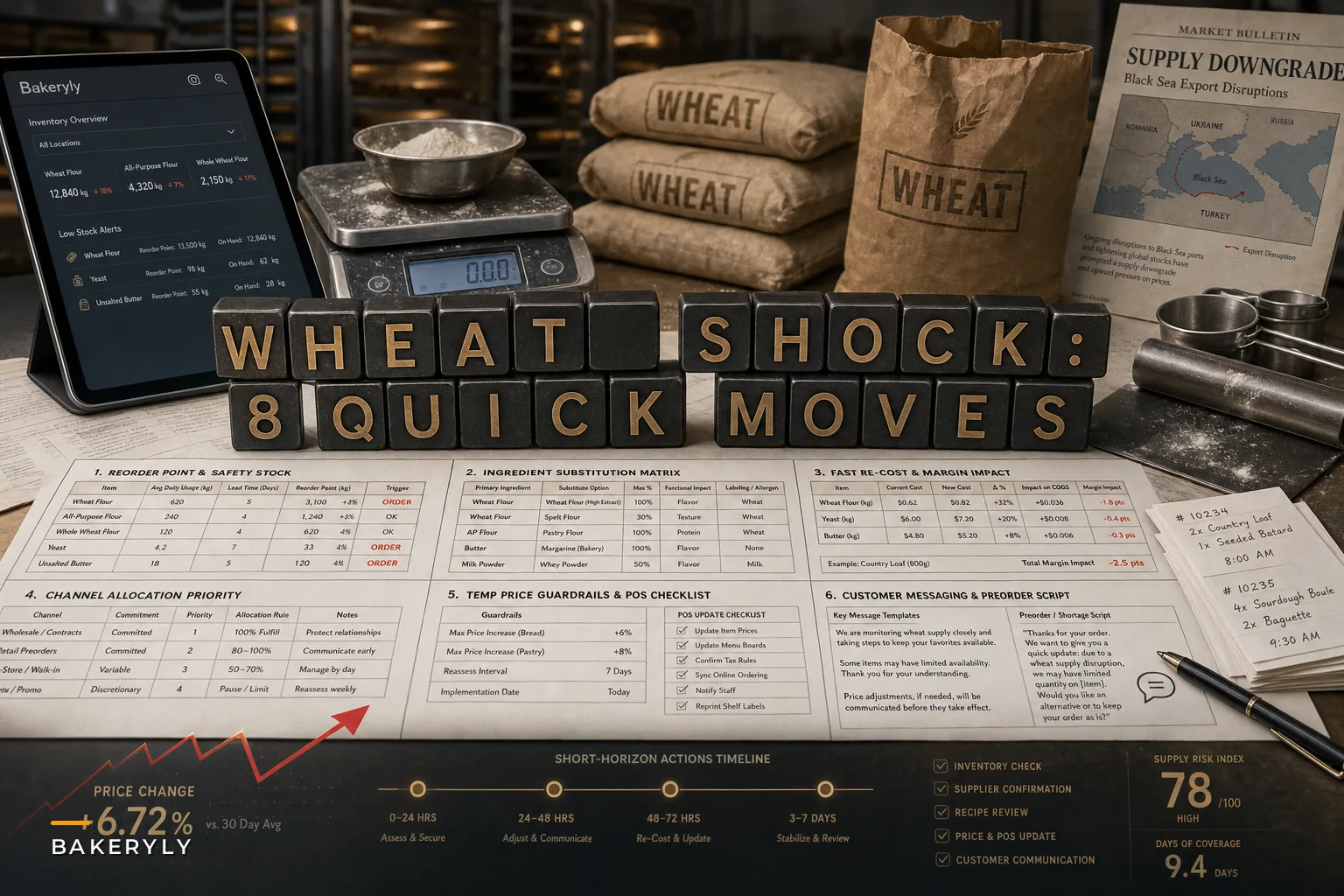

Flour just got more expensive, and it might get slower to arrive too. Over the past couple of weeks in late August 2026, attacks on Black Sea grain infrastructure combined with drought damage have pushed global wheat prices up sharply. Al Jazeera laid out the mix of war and heat driving the price surge, and the USDA's August outlook quietly trimmed its U.S. wheat supply projections — which tends to show up in domestic flour pricing within weeks, not months.
If you run a bakery, you don't need a macro explainer. You need to know what to do before your next bulk order posts at a higher price than last month. So skip the commentary — here are the moves you can run this week, most of them in an afternoon.
First: figure out how exposed you actually are
Before you touch pricing or panic-buy 40 bags of bread flour, get one number: what percentage of your COGS is flour-based, by product line?
Most owners assume it's pretty uniform across the menu. It isn't. A plain baguette might be 60–70% flour cost. A loaded fruit tart might be 12%. That difference decides everything about how you respond, because a 20% flour price jump does very different damage to those two products.
Worth sketching this out on paper before you do anything else:
| Product line | Flour % of COGS | Sensitivity to flour spike | Priority for action |
|---|---|---|---|
| Sandwich loaves / baguettes | High (55–70%) | Severe | Reprice or resize first |
| Croissants / laminated | Medium (30–40%) | Moderate | Watch butter too |
| Cookies / bars | Medium-low (20–30%) | Manageable | Absorb short-term |
| Cakes / decorated | Low (10–20%) | Minor | Leave alone |
| Specialty / gluten-free | Varies wildly | Depends on flour blend | Check separately |
The pattern that catches most owners off guard: your highest-volume, lowest-margin bread lines are almost always your biggest exposure — and they're also the ones customers watch most closely on price. That tension is the whole problem in one row.
Move 1: Lock your reorder points before the lead times move
The cost spike gets the headlines, but lead-time stretch is what actually breaks fulfillment. When shipping gets disrupted, your supplier's "two-day delivery" quietly becomes four or five days, and nobody tells you until you're already short.
Never miss a bake or delivery again.
Bakeryly helps you schedule, track, and manage every order effortlessly.
- Unified order tracking
- Real-time inventory alerts
- Staff shift management
No credit card required
Pull your last three flour orders and check the actual gap between order date and delivery. If it's creeping at all, bump your reorder point now.
A rough rule that holds up in practice: if your normal lead time is 3 days and you're seeing signs it could double, set your reorder trigger at (worst-case lead time × daily usage) + one safety day. For a shop burning through six 25kg bags a week, that's roughly a full extra order's worth of buffer sitting in the back. Feels like overkill until the week your truck doesn't show.
Move 2: Split your order, don't just enlarge it
The instinct during a shock is to buy big — lock in today's price on a massive order. Sometimes smart, often a trap.
Two problems. You're betting your cash on prices not falling further, and flour spikes driven by shipping disruptions can unwind fast when routes reopen. On top of that, a mountain of flour sitting in a humid back room degrades, and now you've traded a cost problem for a waste problem.
-
Buy enough to cover your longest realistic lead-time gap, plus a modest buffer
-
Split the rest across two suppliers if you can, even if the second one costs a bit more per bag
-
Keep one order small and fast-turning so you're not fully committed to one price point
Paying a little more per bag to have a second source that can actually deliver is cheap insurance during a supply wobble. This is the same logic behind building a proper risk-weighted vendor diversification system — a shock like this just forces you to do quickly what you should've done calmly months ago.
Move 3: Reprice the bread, not the pastries
When costs jump, the lazy move is an across-the-board price increase. Customers notice broad increases immediately and resent them. A surgical one they rarely track.
Go back to your exposure table. The bread lines with 60%+ flour cost are where a spike genuinely hurts — that's where a small, defensible increase makes sense. A $4.50 loaf going to $4.75 is a 5.5% bump that covers a real flour increase and barely registers at the counter.
When this is a bad idea: if you raised bread prices in the last 60 days already. Two increases in one quarter reads as instability. In that case, look at resizing instead.
Move 4: Quietly resize instead of repricing where it fits
Resizing is the underrated tool. A 400g loaf becoming a 380g loaf is a 5% cost recovery that most customers won't notice, especially if the price holds. Same idea applies to cutting a roll from 90g to 85g of dough.
This only works within limits — shrink too far and regulars catch on, and it can feel dishonest if the change is obvious. Use it on products where the size isn't a headline feature, and never on anything you market by weight or count.
The operational catch people miss: if you resize, you have to update your batch math and yield expectations everywhere, or your production counts drift and you end up short on trays. A 5% dough reduction per unit means more units per batch — great, but only if your morning run-list actually reflects it.
Move 5: Pause the flour-heavy promos
Look at what's running right now. If you've got a buy-one-get-one on baguettes or a discounted bulk-bread deal, that promotion is actively bleeding margin at exactly the wrong moment.
Pausing a promo isn't a price increase — it's just stopping a discount — so it draws far less customer heat than raising a sticker price. It's the fastest margin protection available and costs you nothing but the promotion itself.
Shift promotional energy toward low-flour, higher-margin items instead. Push the cakes, the decorated stuff, coffee-and-pastry pairings. You're steering demand toward what's still profitable while the flour situation works itself out.
Move 6: Get real inventory visibility, because guessing gets expensive now
A shock like this exposes the underlying problem most bakeries have: nobody actually knows the flour position at any given moment. They know roughly. "We've got a few bags left." That's fine when supply is boring and predictable. It's dangerous when lead times are stretching and prices are moving week to week.
In normal times, a fuzzy count costs you a little waste. During a disruption, it costs you a whole production run — you think you're covered, you're not, and you're calling three suppliers at 6am while orders sit unfilled.
The fix isn't complicated, it just requires consistency:
-
Count flour stock at a fixed time — end of every production day works well
-
Log it against the day's usage so you see burn rate, not just a static number
-
Set a hard reorder trigger tied to that burn rate and current lead times
-
Review the trigger weekly while volatility is high, not monthly
This is one place where operational software genuinely earns its keep. When usage and stock counts live in one system instead of a clipboard and someone's memory, the reorder trigger can fire automatically — and you stop making blind buying decisions during the exact window when blind decisions are most costly.
Here's a quick visual of an inventory-check workflow.
Count flour stock at the same time every day to keep your burn-rate math consistent.
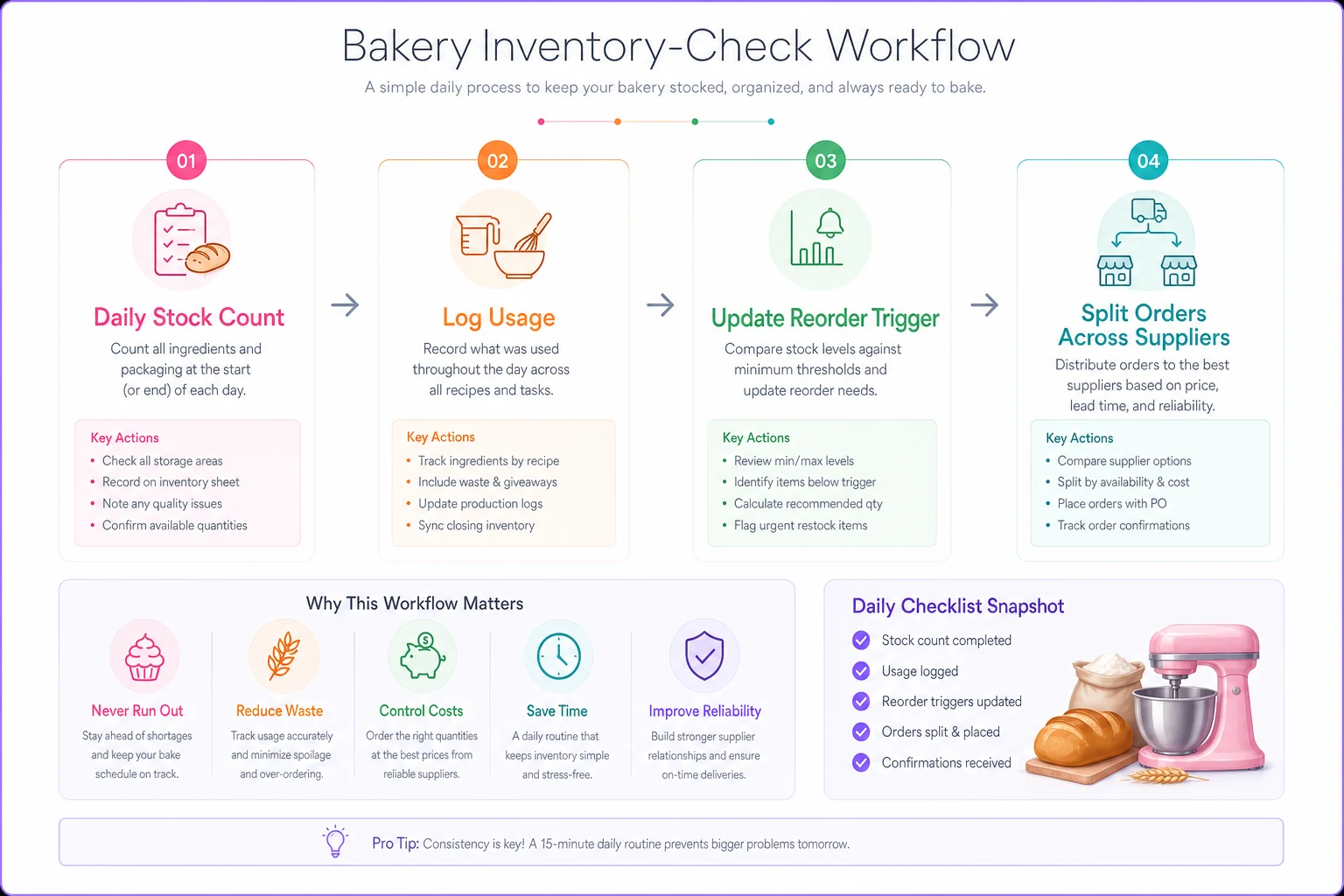
The point isn't automation for its own sake. It's that a supply shock removes your margin for guessing, and centralized inventory visibility removes the guessing.
Move 7: Set customer-facing order rules before you overpromise
If flour delivery slips and you've already committed to large custom or wholesale orders on tight timelines, you've got a fulfillment problem on top of a cost problem.
Add a short buffer to lead times on flour-heavy custom orders this week. If you normally quote 48 hours on a big bread order, quote 72. Nobody's upset by an order arriving on time with a slightly longer promise. Everybody's upset when it's late with no warning.
For wholesale accounts especially, a quick heads-up email — "we're watching some supply volatility and here's how we're protecting your orders" — buys a lot of goodwill. Most accounts have seen the wheat headlines already; a proactive note reads as competence rather than an excuse.
Move 8: Line up your substitution plan before you need it
You may not need to swap flours at all. But knowing you could changes how you negotiate and how calmly you operate under pressure.
-
Which blends you can substitute without wrecking texture (bread flour swaps are risky; some AP substitutions work fine)
-
Which suppliers carry an equivalent you'd actually accept in a pinch
-
What the labeling and allergen implications are if you change a blend
The mistake is treating substitution as a same-day emergency call. Validate a backup flour now — bake a test batch, confirm the crumb holds, document the result — so if you're forced into it, you're executing a tested plan rather than gambling on a live production run.
A quick real scenario
A single-site neighborhood bakery — bread-forward, roughly 200 loaves a day plus pastries — got hit with a flour quote about 18% higher than the prior month, with the supplier hinting at delivery delays.
Instead of a blanket price hike, the owner mapped exposure first. Bread was around 62% flour cost; pastries and cakes were well under 25%. So they nudged loaf prices up about 5%, resized two high-volume rolls by roughly 6% of dough weight, paused a running baguette promo, and split their next order between their main supplier and a secondary one they'd previously only used for specialty flour. The net effect wasn't dramatic — and that's exactly the point. Margin on the bread lines held roughly steady instead of collapsing, no orders got missed, and customers didn't revolt because most of the moves were invisible at the counter. Total time to plan and execute: about a day and a half, spread across two people.
What to actually do this week
If you only run a few of these, start here:
-
Map flour exposure by product line — everything else depends on it
-
Bump reorder points to match stretched lead times before you run short
-
Reprice or resize your highest-flour bread and leave low-flour items alone
-
Pause flour-heavy promos — fastest margin protection available
-
Add a lead-time buffer on big custom and wholesale orders
-
Track flour counts daily so buying decisions stop being guesses
The wheat spike itself will pass — these usually do, and the USDA outlook may look different in a month. But what it reveals about your operation won't fix itself. If a two-week price move can scramble your margins and your production plan, the real gap is visibility and pre-planned response, not flour.
The bakeries that handle this well aren't the ones with the biggest stockpile. They're the ones who already know their exposure by product, already have a second supplier warmed up, and can reprice one line surgically instead of panicking across the whole menu. Build that muscle now while the pressure's on, and the next shock — wheat, butter, eggs, whatever comes next — becomes a Tuesday afternoon adjustment instead of a fire drill.
Ready to elevate your bakery operations?
Join 2,000+ bakeries using Bakeryly to streamline workflows, reduce waste, and delight more customers.