

Most bakeries don't fail because they lose a supplier. They fail because they lose the wrong one at the wrong time with nothing behind it. A flour vendor going sideways in February is annoying. A single-source specialty chocolate supplier going quiet three days before your Valentine's pre-orders ship is a different category of problem entirely.
Supplier risk doesn't feel urgent until it's an emergency. Everything runs fine for months. Deliveries show up. Prices creep but stay livable. Then one link snaps — a co-packer changes minimums, a distributor drops a SKU, a regional shortage hits butter — and suddenly you're calling five numbers at 6am while the ovens sit half-loaded.
The point of bakery vendor diversification isn't to have a backup for everything. That's expensive and honestly impossible for a small shop. The point is knowing exactly which ingredients deserve a backup and having those backups pre-qualified before you need them. That's what a risk-weighted supplier map does.
Why "just get a second supplier" is bad advice
The generic version of this advice — always dual-source — sounds responsible and falls apart the moment you run the numbers.
Dual-sourcing everything means smaller orders across more vendors, which kills your volume discounts. More relationships to manage, more invoices, more delivery windows to coordinate. And for a lot of specialty ingredients, a second qualified supplier either doesn't exist locally or has minimums that don't make sense at your volume.
What you actually find across small bakeries is uneven exposure. Twelve ingredients that any distributor can drop-ship tomorrow, and three that only one supplier in your region carries at a quality you'll put your name on. Those three are where all the real risk lives. The mistake is spending equal energy protecting all fifteen instead of building a fortress around the three that can shut down production.
The first job isn't diversification. It's triage.
Step one: build the risk-weighted supplier map
You're scoring each ingredient on two axes — how badly a disruption hurts, and how likely disruption is. Simple enough, but most owners never write it down, so it lives as vague anxiety instead of a plan.
Here's the scoring framework to start with:
| Factor | Low risk (1) | Medium risk (2) | High risk (3) |
|---|---|---|---|
| Number of qualified suppliers | 3+ | 2 | 1 |
| Substitutability in recipe | Swaps cleanly | Swaps with tweaks | Defines the product |
| Price volatility (12 mo) | Stable | Some swings | Wild swings |
| Lead time | Same/next day | 2–4 days | A week+ |
| Revenue exposure | Minor SKUs | Mid SKUs | Signature/high-margin |
Score each ingredient across all five rows, add it up, and you get a rough risk weight. AP flour probably lands low — plenty of suppliers, swaps cleanly, short lead times. A specific 66% couverture that anchors your best-selling tart lands high on almost every row.
A typical small bakery scores 20-odd ingredients and finds maybe four that break into the high-risk tier — a specialty chocolate, a cultured European butter, a specific gluten-free flour blend, seasonal fruit purées from one regional distributor. That's your real list. Everything else rides on normal ordering.
This connects directly to the vendor scorecard work in your procurement cadence. If you've already built out supplier scorecards from a proper procurement system, the reliability data feeds straight into the likelihood side of this map. Don't rebuild it — reuse it.
Use this simple workflow to move from scoring to action.
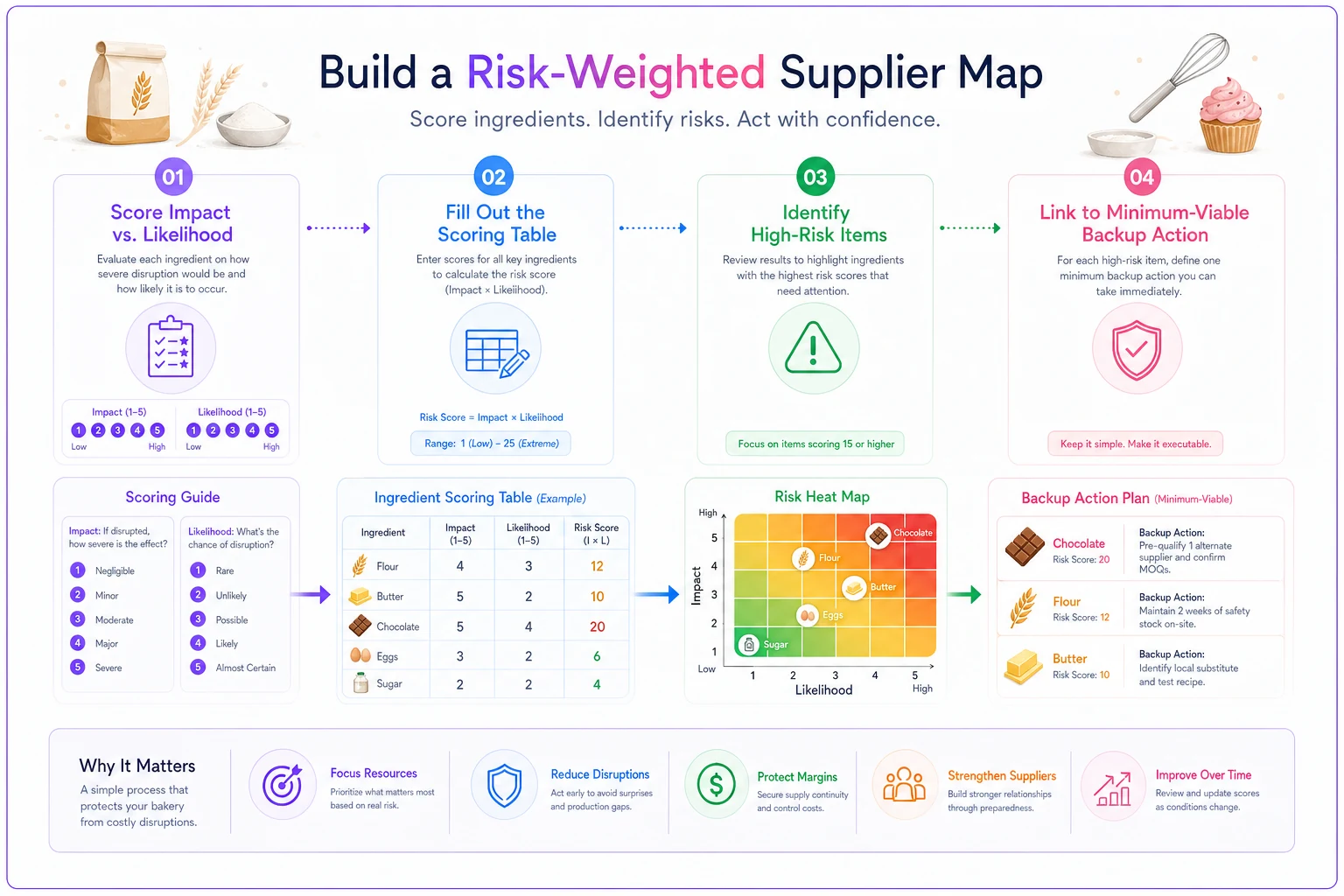
Follow the steps in the visual to move from scoring to concrete backup decisions.
Step two: the minimum-viable backup list
Once you know your high-risk ingredients, you don't need a full second supply chain. You need a minimum-viable backup for each — the smallest amount of pre-work that gets you operational if the primary source vanishes.
For each high-risk ingredient, a minimum-viable backup means you've already answered:
-
Who's the alternate source? Named vendor, contact, account number if possible.
-
Have we tested their product in the actual recipe? Not "it looks similar" — actually baked with it.
-
What's their real lead time and minimum order? Confirmed, not assumed.
-
What's the price delta? So you know your margin hit in advance.
-
Is there a labeling or allergen change? Especially for anything customers scan for.
Keep a single-page backup list with exact test notes and contact details so any team member can activate a backup quickly.
The critical word is tested. The most common failure here is a backup supplier who exists on paper but whose product behaves differently in your recipe. A different butter with a slightly lower fat percentage will change your laminated dough. A substitute chocolate with different viscosity will wreck your enrobing line. Finding that out mid-crisis is the worst possible time.
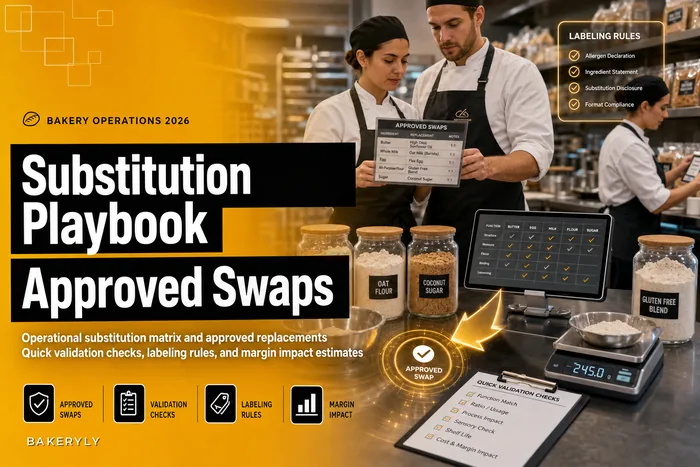
This is where your emergency substitution playbook does the heavy lifting. The backup list tells you who to call; the substitution playbook tells you how the product changes and what validation checks to run before it hits the display case. Two halves of the same defense.
A minimum-viable backup list for a small bakery might be one page. Four high-risk ingredients, one pre-qualified alternate each, tested and documented. That's it. That single page is worth more than a binder full of supplier contacts nobody's ever actually called.
Step three: pooling and co-op tactics for the stuff you can't backup alone
Some ingredients you simply can't dual-source at your volume. Minimums are too high, or the quality tier only comes from one importer. This is where pooling with other bakeries changes the math.
Three or four small bakeries that aren't direct competitors combine orders to hit a distributor's minimum or unlock better pricing on a shared high-risk ingredient. You're not merging businesses — just coordinating purchase volume.
Where it actually works:
-
Specialty imports — couverture, specific flours, European dairy — where minimums are brutal for one shop but manageable across four.
-
Seasonal spikes — everyone needs the same pumpkin purée or peppermint in Q4, and pooled orders lock supply before shortages hit.
-
Emergency mutual aid — a loose agreement that if your primary source fails, a pool member will spot you 20kg to bridge until your own order lands.
That last one is underrated. A small network of two or three trusted bakeries within driving distance is functionally a backup supplier you didn't have to formally set up. When butter got tight in some regions, the shops that came out cleanest were often the ones who could text a peer and grab a case to cover a weekend.
Keep it small. Pooling among three shops is manageable. Pooling among nine turns into a part-time logistics job nobody signed up for.
Step four: quick substitution contracts
Most bakeries skip this part entirely. A backup supplier who "can probably help" is not a backup. You want something closer to a standing arrangement — even an informal one — that turns a panic call into a routine order.
A quick substitution contract doesn't need lawyers. For a small bakery it can be a short written understanding with an alternate vendor covering:
-
Guaranteed availability window — they'll hold or fulfill a set quantity within a set lead time if you activate the arrangement.
-
Locked or capped price — at minimum a "won't exceed X% over list" so you're not gouged during a shortage everyone's feeling.
-
Minimum you commit to — vendors prioritize accounts that occasionally buy from them, so a small standing order keeps you a real customer, not a stranger calling in a crisis.
-
Activation trigger — you define what flips the arrangement on so there's no ambiguity when you call.
Point three is the buried insight. A backup supplier you never order from will not prioritize you when everyone's scrambling for the same thing. The bakeries that actually get their emergency order filled are the ones who've been a small, steady, low-friction account all along. Buy a little from your backups on purpose. Treat it as an insurance premium.
When this system is overkill — and when it's not enough
When a full risk map makes sense: you have signature products built on hard-to-source ingredients, you're doing meaningful pre-order or wholesale volume, or you've already been burned once by a supplier disappearing. If losing one ingredient would take down 15%+ of revenue, build the map.
When it's overkill: if you're running a tiny shop on a handful of commodity ingredients any grocery distributor carries, a formal weighted map is more process than payoff. A short "here's who I call if X fails" list is plenty.
Who should NOT pour energy into pooling: shops with wildly different quality standards than their potential pool partners. If you'll only use one specific couverture and your pool partner will accept a cheaper tier, coordinated buying creates conflict, not savings. Pool only where your specs genuinely overlap.
A real scenario
A single-location bakery doing roughly $40k–$45k a month had one signature product — a filled brioche — anchored on a specific cultured butter from one regional distributor. That SKU drove a meaningful chunk of weekend traffic.
When their distributor dropped the line with about a week's notice, they scrambled. They tried a substitute butter mid-week with no prior testing, the lamination came out wrong, and they pulled the product for a full weekend rather than sell something off-spec. Somewhere around $2k–$3k in lost sales plus a batch of wasted dough, and a handful of regulars who came specifically for that brioche left empty-handed.
Afterward they built the map. Four high-risk ingredients identified, butter obviously at the top. They pre-qualified and tested two alternates, documented the exact lamination tweak each one required, and set up a small standing order with one of them to stay an active account. They also joined a loose three-shop pool for specialty dairy.
The next disruption — a delivery delay, not a discontinuation — was a non-event. They activated the backup, ran the known recipe adjustment, and the product never left the case. No lost weekend, no wasted batch. The whole system took maybe half a day to set up and a couple of test bakes to validate.
How the pieces connect
The reason this works as a system rather than a checklist is that each piece feeds the next. The risk map tells you where to focus. The minimum-viable backup list turns that focus into pre-qualified, tested alternatives. Pooling covers the ingredients you can't reasonably backup alone. And substitution contracts make sure your backups actually pick up the phone when you need them.
Miss any one piece and the chain has a gap. A great map with untested backups still fails at 6am. Tested backups with no standing relationship get deprioritized during a real shortage. Good contracts on the wrong ingredients waste effort where you had no real exposure.
The bakeries that ride out supplier shocks cleanly aren't lucky and they're not over-insured. They did the triage, wrote it down, and tested it once — before they needed it. Supplier risk is manageable the moment you stop treating every ingredient as equal and start protecting the three or four that can actually take your menu down.