

Running out of a key ingredient mid-production is nothing like planning substitutions during recipe development. The pressure, the time constraints, the complete lack of testing—everything stacks up when you're making real-time calls that affect hundreds of products already promised to customers.
Most bakeries handle this through pure instinct. The head baker makes a gut call, maybe checks with whoever's around, and hopes the texture holds up. Sometimes it works. Often you end up with flat croissants, dense cakes, or that weird aftertaste that makes regulars ask "did you change something?"
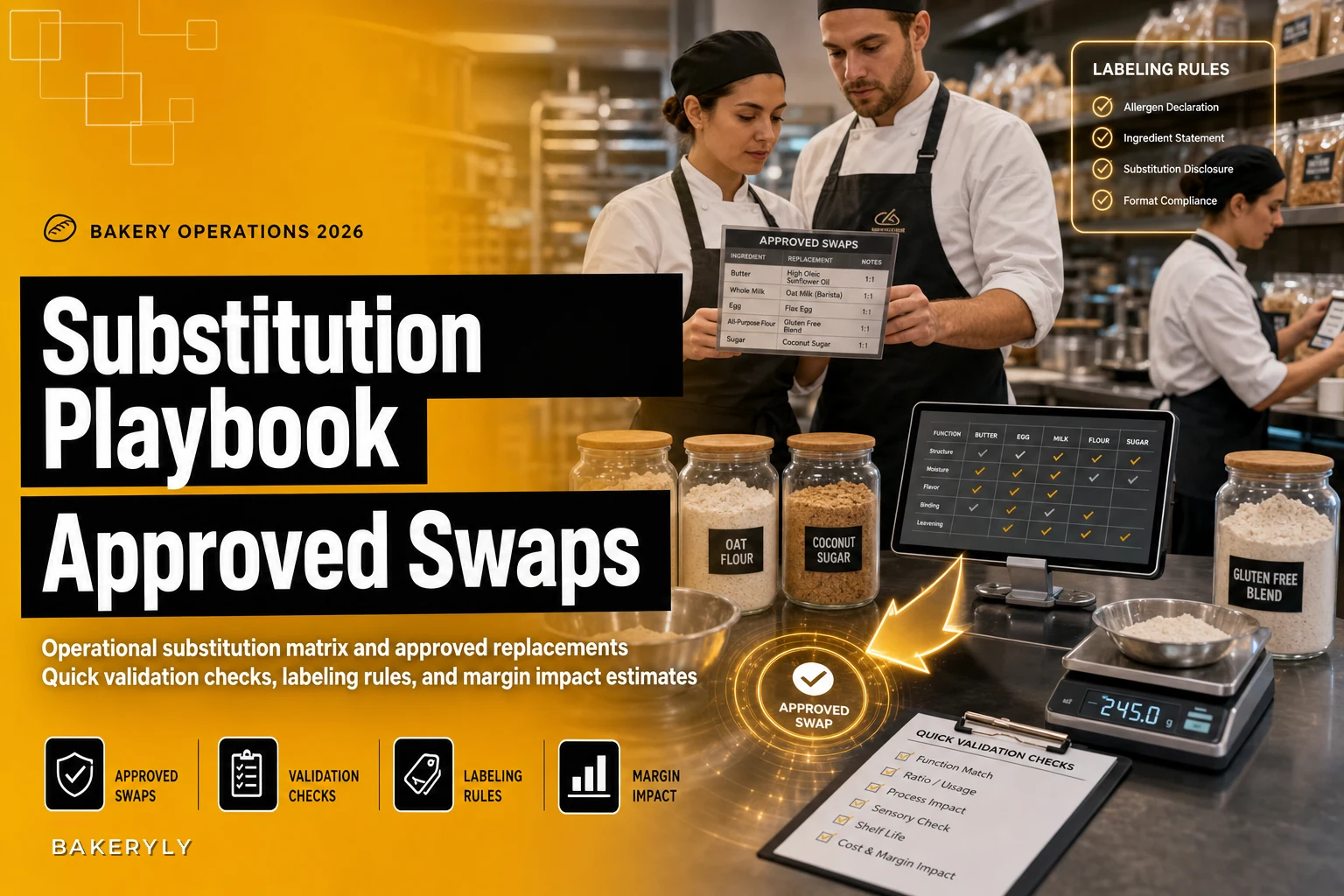
The actual operational challenge isn't knowing that oil can sometimes replace butter. It's having a system that tells your 4am shift leader exactly which substitutions work for which products, how to adjust quantities, what to check before committing, and what to tell customers who might notice the difference.
Building your substitution matrix: pre-approved swaps that actually work
A substitution matrix isn't about listing every conceivable ingredient swap. It's about documenting which substitutions your specific recipes can handle without falling apart. The matrix needs three layers: direct swaps requiring no adjustment, ratio-adjusted swaps that need calculation, and conditional swaps that only work for certain product types.
Start with your highest-risk ingredients—the ones that would stop production cold if they ran out. For most bakeries that's butter, eggs, milk, and your primary flours. Then work through specialty ingredients that touch multiple products.
Butter Substitutions (by product type)
| Original | Substitute | Ratio | Products OK | Products Never | Texture Impact | Validation Check |
|---|---|---|---|---|---|---|
| Butter (laminated) | Margarine (high-fat) | 1:1 | Danish, quick puff | Croissants, true puff | 15% less flaky | Test single batch first |
| Butter (creaming) | Oil + milk powder | 0.8:1 + 2% powder | Cookies, quick breads | Pound cake, buttercream | Slightly denser | Check spread on test cookie |
| Butter (melted) | Neutral oil | 0.75:1 | Muffins, brownies | Scones, biscuits | More moist, less structure | Reduce by 5% first batch |
The key is specificity. "Butter to oil" means nothing when your morning shift is staring at empty butter boxes. They need to know that chocolate chip cookies can handle straight oil at 75% ratio, but snickerdoodles will spread into puddles with the same swap.
Track your failed substitutions too. Document when you tried coconut oil in laminated dough and ended up with cardboard croissants. Those failures become your "never again" column—just as valuable as the successes.
Quick validation checks that prevent disasters
The validation check is what separates a decent substitution from a batch headed for the trash. These aren't complicated tests—they're 30-second checks that catch problems before you've committed 50 pounds of dough.
For texture substitutions, run a spread test. Take a golf-ball-sized piece of your adjusted dough, bake it on a separate sheet for 5 minutes, and check how it spreads. If your cookies are spreading 40% wider than normal, you know to add flour to the full batch before it's too late. That tiny test saves entire production runs.
For laminated doughs with fat substitutions, do a window test after your first fold. Stretch a small corner piece until it's translucent. If it tears immediately instead of stretching, your fat substitute isn't building proper layers. Better to find out after one fold than after three hours of laminating.
Flavor validation needs to happen at room temperature. Most substitutions taste fine hot but reveal problems as they cool. Pull a test piece, let it come down to room temp, then taste. Margarine might seem totally fine at 180°F but leave a waxy coating at 70°F.
Run your spread and window tests simultaneously on tiny samples to save time during a crisis.
Your validation checks also need abort thresholds. If the spread test shows 50% more spread than normal, stop. Don't try to fix it by adding more flour—you'll get tough, dry products. Some substitutions simply don't work, and knowing when to pivot to a completely different product saves more money than forcing a bad swap.
The allergen and labeling problem
Substitutions create labeling chaos that most bakeries don't catch until a customer has a reaction. Your normal chocolate chip cookies don't contain soy. But that margarine you subbed for butter? Probably full of soy lecithin. Now you've got mislabeled products on the shelf that could trigger serious allergies.
Build your substitution matrix with allergen changes flagged clearly. Every approved substitution needs a corresponding label change documented alongside it. When your morning crew makes an emergency swap, they need to know immediately which labels need updating and which allergen warnings to add.
Workflow matters here. You can't expect a 4am baker to memorize every allergen in every substitute ingredient. Create substitution cards that attach to your production sheets. When someone pulls the margarine substitution card, it already includes "ADD SOY WARNING" in bold text. No guesswork.
For operations using AI-powered management platforms, this is where automated allergen tracking becomes genuinely useful. The system can flag allergen changes the moment you log a substitution and generate updated labels before products hit the case.
Your front-of-house team needs clear communication too. A simple substitution note at the register—"Today's croissants: margarine instead of butter (contains soy)"—prevents counter staff from giving wrong information to customers with allergies.
Calculating margin impact before you commit
Emergency substitutions usually cost more than your standard ingredients. That premium butter substitute might save your croissant production, but at what damage to your margins? You need rough margin calculations built into your substitution decision-making before you commit.
A real example: standard butter at $3.20/pound, the only available substitute is European-style butter at $5.80/pound. Your croissants use around 0.25 pounds of butter each, with a normal margin of $2.40 per unit. The substitution adds $0.65 to your cost and drops your margin to $1.75—a 27% hit.
But it gets more nuanced. If you don't make those croissants, you lose the entire contribution margin. Making them with expensive substitutes still contributes $1.75 per unit toward your fixed costs—rent, insurance, morning labor you're paying regardless.
A simple decision framework:
-
Margin hit under 15%
Substitute without hesitation
-
Margin hit 15–30%
Substitute for pre-orders only
-
Margin hit 30–50%
Substitute only for high-value customers
-
Margin hit over 50%
Look for alternative products to offer instead
The specific thresholds will vary by operation. The point is having clear cutoffs that remove emotional decision-making when you're stressed about empty shelves.
Creating your morning shift substitution protocol
The substitution playbook only works if your team can execute it at 3am without calling you. That means clear protocols designed for tired people making fast decisions under pressure.
Structure it as a decision tree, not a manual. Start at the discovery point: "Missing ingredient found during prep." Branch based on timing. Before 4am, you might have time to check other locations or call suppliers. After 5am, you're in pure substitution mode.
Here's a quick workflow diagram to pin to your station.
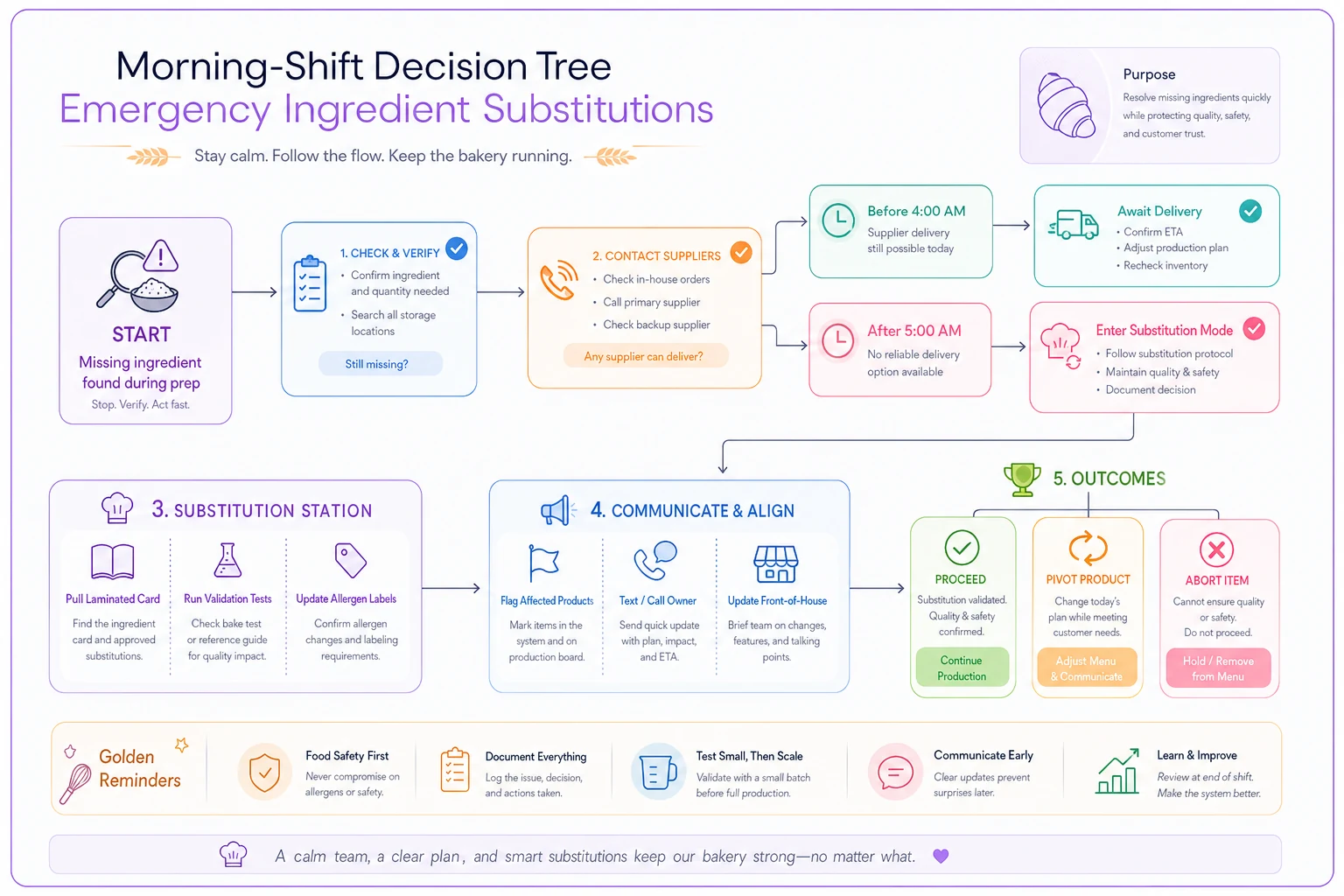
Your substitution station needs physical organization. A binder with laminated substitution cards at your main prep station. Each card covers one ingredient: all approved substitutions, required adjustments, validation tests, allergen changes. Laminate them. Flour-covered hands at 4am don't mix well with paper.
Communication matters too. When a substitution happens, the morning lead logs it in the production book, flags affected products with orange tags, updates the allergen board, and texts the owner with products affected and rough margin impact. Each step prevents a bigger problem downstream—customer complaints, allergen incidents, margin surprises.
Testing substitutions during slow periods
The middle of a morning rush is the worst time to discover that coconut oil makes your muffins taste like sunscreen. Your substitution matrix needs to be built through deliberate testing during slower periods, not desperate experimentation during crises.
Schedule substitution testing on your slowest production day. Run small batches—a couple dozen cookies instead of 20 dozen. Document everything: exact ratios, mixing time adjustments, temperature changes, final product quality. You're not trying to develop new recipes. You're mapping what actually works when you're desperate.
Test worst-case scenarios on purpose. What happens when you're out of eggs and milk simultaneously? Can you produce anything sellable? These extreme substitutions might yield lower-quality products, but a denser muffin beats no muffin at all.
Test partial substitutions too. Maybe 100% oil destroys your cookies, but 50/50 oil and butter works fine and stretches your supply through a shortage. These hybrid solutions often save the day during partial delivery failures.
Track substitution performance over time. That margarine substitution might work fine in January and fail completely in July humidity. Seasonal factors, supplier formula changes, and even flour protein variations affect how substitutions perform. Your matrix needs regular updates based on real production results.
Why digital tracking beats paper logs
Paper substitution logs get lost, damaged, or ignored. They don't connect to your costing system, can't generate reports, and won't remind you that the last time you tried this substitution, half the batch went in the trash.
Digital tracking—even a shared spreadsheet—builds substitution intelligence over time. You can see that every margarine substitution during summer months correlates with complaint spikes. Or that your oat milk substitution only holds up with one specific brand that maintains consistency when heated.
The real value comes from connecting substitution tracking to other operational data. When you can see that butterless croissants have a noticeably higher return rate, or that egg-free muffins sit hours longer in the case before selling, you're making informed decisions instead of guessing.
More advanced bakery management platforms can predict substitution impacts before you commit. By analyzing historical substitution data, integrated with your demand forecasting, the system can flag things like "based on your last three margarine substitutions, expect lower sell-through on affected items today."
The customer conversation: transparency without panic
Regulars notice substitutions, especially in products they buy every week. Your cream cheese danish suddenly tastes different and they will ask. Having a clear communication approach prevents speculation and keeps trust intact.
Train counter staff with specific language. Not "we ran out of ingredients," which sounds chaotic, but "we're using European butter today instead of our usual supply—you might notice a slightly richer flavor." Frame substitutions as intentional when possible, even when they were emergency decisions.
For substitutions that noticeably affect taste or texture, consider proactive disclosure. A small sign that says "Today's croissants made with premium margarine due to supply delays—same flaky layers, slightly different finish" manages expectations before the first bite.
Price adjustments need careful handling. If a substitution significantly increases your costs and you need to bump the price, be direct. "Temporary price adjustment due to premium ingredient substitution" works better than a silent increase that makes customers feel misled.
And occasionally, emergency substitutions accidentally improve things. When you discover that coconut oil makes your brownies noticeably more moist, that's worth noting. Track customer feedback on substitutions—sometimes the emergency fix becomes the new standard.
Building supplier redundancy to minimize substitution chaos
The best substitution is one you never have to make. Supplier redundancy costs more upfront but saves serious operational headaches when deliveries fail. This doesn't mean maintaining five butter suppliers—it means strategic backup planning for your critical ingredients.
Map ingredient criticality first. Which ingredients halt production entirely if missing? Which affect the most products? These are your redundancy priorities.
For critical ingredients, keep a relationship with at least one backup supplier even if you rarely order from them. Place small monthly orders to keep the account active. When your primary supplier's truck breaks down at 2am, you need a phone number that actually gets answered.
Don't overlook non-traditional backup sources. That restaurant supply store open at 4am might charge 30% more, but they'll save your Saturday production. A commercial grocery account might not carry your exact spec, but their butter works in emergencies. These aren't your primary channels—just knowing they exist and having accounts already set up removes panic from the equation.
Storage capacity is also worth investing in. If you can hold an extra week of butter and eggs, you've bought yourself time to find a proper substitution instead of a desperate one. The carrying cost of extra inventory is almost always less than the margin hit from emergency premium sourcing.
Who should NOT attempt complex substitutions
Not every bakery should attempt every substitution. Your operational complexity, skill level, and risk tolerance determine what makes sense for your situation.
Single-product bakeries—just croissants, just bagels, just one signature cookie—probably shouldn't risk complex substitutions at all. Your customers come for consistency in that one thing. Running out is better than damaging your core product's reputation with a failed swap.
New bakeries in their first year should stick to simple, tested substitutions only. You're still establishing your baseline quality. Adding substitution variables makes it nearly impossible to diagnose what's working and what isn't.
High-end artisan bakeries with premium pricing need to be especially careful. Your customers pay for specific ingredients and techniques. Swapping Plugra butter for commodity butter might save money but quietly erodes the premium position you've worked to build.
If you don't have dedicated quality control processes or experienced bakers who can adjust on the fly, limit substitutions to direct 1:1 swaps only. Complex ratio substitutions require real-time judgment. Without that, they create more problems than they solve.
Making substitution decisions under pressure
When you discover a missing ingredient, work through this sequence rather than making panic calls that cause problems later.
First, verify the actual shortage. Check all storage areas including freezers and secondary locations. Confirm the ingredient wasn't moved or mislabeled. Five minutes here prevents unnecessary substitutions.
Second, assess your committed production. What's already promised? What can be delayed? What alternative products could fill the gap? Sometimes shifting your production schedule eliminates the substitution entirely.
Third, calculate the real cost of not producing versus substituting. Include customer disappointment, lost sales, and reputation damage—not just ingredient costs. A $50 ingredient premium might protect a $500 wholesale order.
Fourth, if you're substituting, use your pre-tested matrix. This isn't the time for experimentation. Stick with substitutions you've validated, even if they're not ideal.
Finally, document everything immediately. What you substituted, why, what quantity, which products, and what communication went out. That becomes your operational reference for next time.
The difference between emergency fixes and permanent changes
Emergency substitutions sometimes reveal genuinely better approaches. Greek yogurt instead of sour cream in your coffee cake might actually improve the product. But don't confuse one successful crisis fix with a permanent strategy.
Test emergency substitutions properly before making them permanent. What worked once under pressure might fail under normal conditions or different seasonal variables. That margarine substitution that worked in winter might behave very differently in summer heat.
Think through the full operational impact before making anything permanent. Your emergency oat milk substitution might work great for the product but require new supplier relationships, different storage, and updated allergen protocols. The product improvement might not justify the added operational complexity.
Customer communication needs to shift too. Temporary substitutions can be explained as supply chain issues. Permanent changes need to be positioned as intentional improvements.
Price implications matter as well. If your emergency substitution costs less and performs well, you've found a margin improvement. If it costs more, you need to decide whether the quality difference justifies a price increase or whether you'll absorb the hit.
Turning your substitution playbook into competitive advantage
Most bakeries treat substitutions as problems to avoid. A sophisticated substitution playbook flips that—it becomes an operational advantage that lets you maintain production when competitors shut down.
Substitution capability becomes a selling point for wholesale accounts. When you can guarantee delivery even during ingredient shortages because you have tested, validated swaps ready to execute, you become a more reliable partner than bakeries that simply go dark.
The knowledge you build through substitution testing also improves your overall ingredient understanding. Knowing exactly what each ingredient contributes to your products makes you better at recipe development, troubleshooting quality issues, and cost optimization even when you're not in crisis mode.
A mature substitution system also opens up opportunistic purchasing. When you spot quality margarine at half price, you know exactly which products can use it without quality loss. That purchasing flexibility can meaningfully improve margins over time.
Building and maintaining a substitution playbook takes real effort. But the operational resilience it creates pays off every time a delivery fails, a supplier has issues, or prices spike unexpectedly. Bakeries that survive supply disruptions usually aren't luckier than the ones that don't—they're just more prepared.