

Most bakeries throw out somewhere between 8-12% of their daily production. For a typical neighborhood bakery, that's roughly $400 to $1,800 worth of product hitting the dumpster every week. The frustrating part? A lot of that "waste" could become profitable inventory with the right operational setup.
The problem isn't creativity. Bakery owners already know about bread pudding and croutons. The real issue is turning those ideas into repeatable, traceable, food-safe operations that actually generate margin instead of just moving waste from one loss category to another.
Why repurposing fails (and it's not about recipes)
A bakery producing around 600 items a day typically generates 50-70 pieces of day-old inventory. Without a real system, that surplus creates a cascade of problems that sneak up on you.
The inventory becomes invisible. Day-old items get shoved into speed racks, tucked behind fresh product, or dumped into bins with no documentation. By Thursday when someone finally decides to make bread pudding, half the brioche from Monday has already been tossed because nobody tracked it. The other half might be borderline—stored properly? When did it actually come off the floor?
Then there's pricing chaos. A baker turns leftover croissants into almond cream croissants but nobody actually knows what that product costs. The original croissant was $0.85 to make. Add almond cream, labor for twice-baking, new packaging—now you're sitting at $1.40 in cost but selling for $2.50 because "it's made from leftovers." That's a 44% margin on something that should be running at 65%.
Safety documentation gets ugly during health inspections too. An inspector asks about the chocolate bread pudding: "When were these originally produced? How long were they held? What's your temperature log for the custard base?" Without clear tracking, you're digging through production sheets trying to piece together a timeline on the spot.
The hidden profit in systematic repurposing
When bakeries build proper surplus management, the numbers shift. That 8-12% waste rate drops to 3-5%. More importantly, what was pure loss becomes a revenue stream pulling 40-55% margins.
A mid-sized bakery doing $35k weekly can typically generate an extra $2,800-$3,500 per month from systematic repurposing. But the operational benefits go beyond just revenue. Predictable surplus SKUs reduce production stress—bakers know what happens to unsold items instead of making panicked decisions at closing. Kitchen staff can prep bread pudding base on slower Tuesday afternoons instead of scrambling during Saturday morning chaos.
Labor efficiency improves too. Training new staff gets straightforward when there's a clear decision tree: sourdough becomes breadcrumbs after day one, croissants become twice-baked pastries, muffins become trifle components. No more lengthy end-of-day debates about what to do with leftovers.
Building your surplus conversion system
Step 1: Map your waste streams
Before touching any recipes, you need visibility into what you're actually generating. Track surplus for two full weeks—not just quantities, but timing, condition, and storage capacity.
-
How many units typically remain unsold
-
Which days generate the most surplus
-
Current storage limitations
-
Shelf stability at room temp vs refrigeration
Most bakeries discover patterns they never noticed. Danish pastries pile up on Tuesdays. Sourdough accumulates on Sundays. Baguettes rarely make it past noon. These patterns are what determine your repurposing menu.
Step 2: Create your conversion matrix
Not every leftover works for every application. Build a clear matrix that matches surplus items to their best secondary uses based on texture, moisture content, and structural integrity.
| Original Product | Day 1-2 Options | Day 3-4 Options | Max Hold Time | Storage Method |
|---|---|---|---|---|
| Croissants | Twice-baked, sandwich base | Bread pudding, streusel | 4 days | Sealed container, room temp |
| Sourdough | French toast, croutons | Breadcrumbs, stuffing base | 7 days | Paper bag, cool dry storage |
| Danish/Sweet pastries | Trifle layers, parfait base | Cake crumbs for truffles | 3 days | Refrigerated, sealed |
| Muffins | Bread pudding chunks | Crumb topping | 3 days | Sealed container, room temp |
| Baguettes | Crostini, bruschetta | Breadcrumbs, gazpacho | 5 days | Paper bag, room temp |
The key is matching degradation timelines to applications. Croissants lose their flake but retain butter content—perfect for twice-baking. Sourdough goes rock-hard but holds structure—ideal for breadcrumbs.
Step 3: Implement tracking and dating
Every surplus item needs a born-on date and a conversion deadline. This doesn't have to be complicated—a simple sticker system works fine. But it has to be consistent and visible.
Yellow sticker: Day 1 (still sellable at discount) Orange sticker: Day 2-3 (conversion only) Red sticker: Day 4+ (evaluate for safety)
Train your team on a clear decision tree. When applying stickers at close, staff should simultaneously log quantities in your tracking system. This creates the data trail for both safety compliance and margin analysis.
Color-code stickers and require simultaneous logging when applying them to prevent skipped entries.
That tracking also feeds into production planning. If you're consistently generating 30 day-old croissants on Sundays, Monday's prep list should already include almond cream for twice-baking. That's the shift from reactive scrambling to proactive production scheduling.
A quick visual of the surplus-to-SKU workflow:
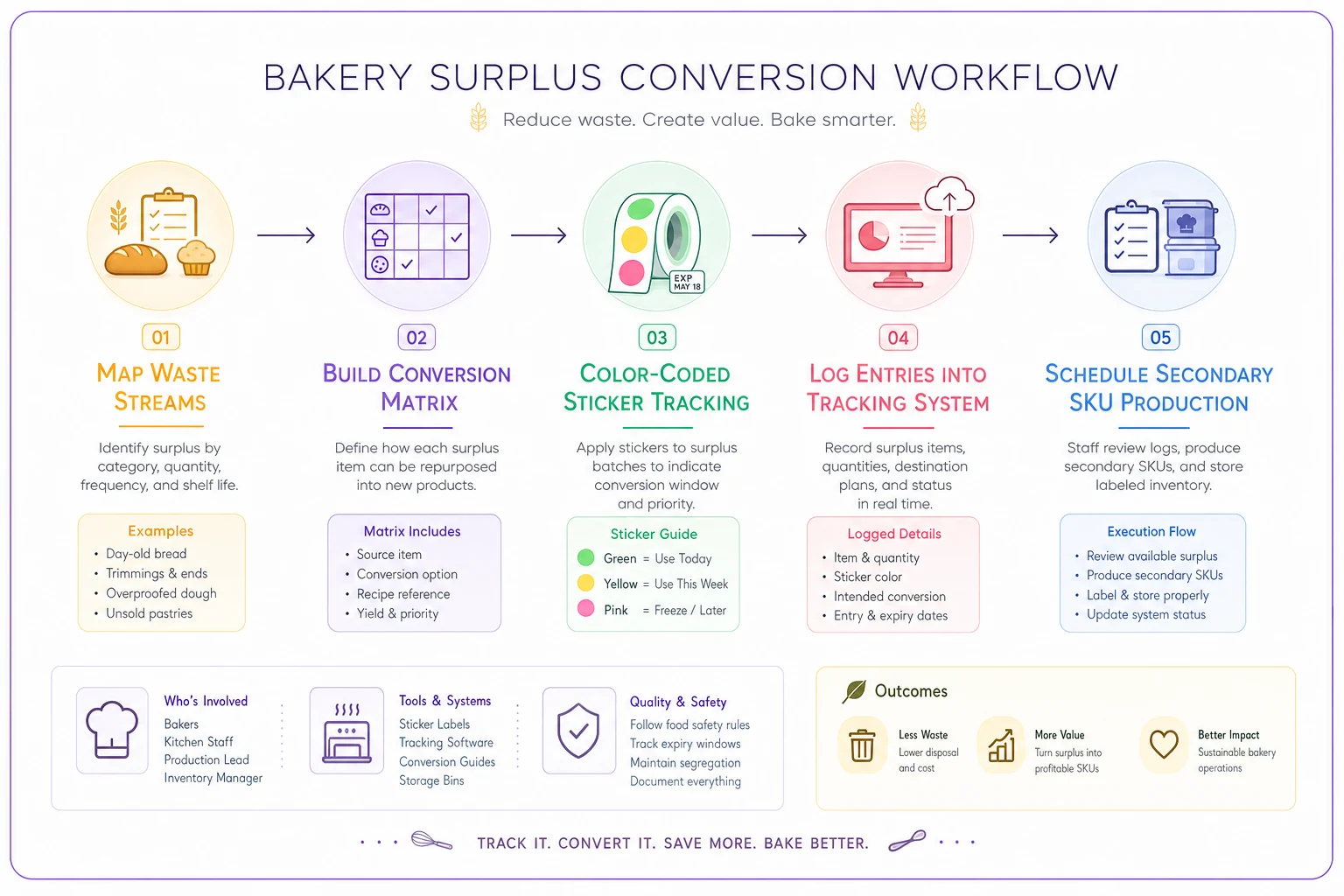
This illustrates mapping, matrix, tracking, and scheduling working together so surplus items flow predictably into secondary SKUs.
Step 4: Develop your secondary SKU recipes
The gap between successful and failed repurposing programs comes down to standardized, scalable recipes. You're not creating artisanal one-offs—you're building repeatable products with consistent quality and known margins.
Universal bread pudding base (handles all pastries, sweet breads, and stale muffins):
-
2 pounds mixed day-old pastries, cubed
-
6 cups dairy mixture (milk/cream blend)
-
8 eggs
-
1.5 cups sugar
-
Flavor additions based on available pastry mix
This base works whether you have leftover cinnamon rolls, danish, or plain brioche. Maintain the ratio regardless of pastry type.
Savory bread crumb mixture (uses all hard breads):
-
Day-old baguettes, sourdough, or dinner rolls
-
Rough grind for stuffing/coating
-
Fine grind for binding/topping
-
Season in batches
Italian herbs, everything bagel, plain
Twice-baked pastry standard (croissants, turnovers):
-
Slice day-old pastry horizontally
-
Fill with almond cream, chocolate, or savory spreads
-
Re-bake at 325°F until crispy
-
Same packaging as fresh pastries
These aren't just recipes—they're production standards. Your team should be able to execute them without much thought, the same way they handle regular production.
Step 5: Price for actual profit
Most bakeries underprice repurposed goods because "they're made from leftovers." That thinking destroys margins and quietly devalues your products.
-
Original croissant
$0.85
-
Almond cream
$0.40
-
8 minutes labor @ $18/hour
$2.40
-
New label/packaging
$0.15
-
Total cost
$3.80
-
Minimum selling price (50% margin)
$7.60
That's higher than your regular croissant. It should be—it requires more labor, more ingredients, and delivers a distinct product. Customers pay for value, not your cost basis.
Safety protocols that actually work
Food safety with repurposed goods isn't complicated, but it requires more documentation than primary products. Health inspectors focus on time-temperature abuse and traceability. Your system needs to answer three questions instantly:
-
When was the original product made?
-
How was it stored between primary and secondary use?
-
What kill step eliminates potential contamination?
Create a simple one-page flow chart for each conversion product. Include holding temps, maximum days, and the critical control point (usually re-baking temperature). Post these in your prep area. During inspections, you can point to documented processes instead of explaining things verbally and hoping it lands.
For products involving custards or creams, use a two-signature system. One person makes the base and logs the temperature. Another verifies before using. This redundancy prevents the "I thought someone else checked it" situations that cause violations.
Keep a dedicated surplus log separate from your regular production records. Each entry should include:
-
Original production date
-
Transfer to surplus date/time
-
Storage location and method
-
Conversion date and product created
-
Final disposition
Seems like overkill until an inspector asks about the bread pudding you're selling. With proper logs, it's a 30-second conversation. Without them, you're piecing together a story.
The scheduling integration challenge
The hardest part of systematic repurposing isn't the recipes or food safety—it's integrating secondary production into your existing schedule without disrupting fresh product flow.
Most bakeries try to squeeze repurposing into dead periods. Tuesday afternoon seems slow, so that's when someone makes bread pudding. But Tuesday's surplus won't be ready until Wednesday. Meanwhile, Sunday's big surplus sits deteriorating because nobody has bandwidth during Monday morning rush.
-
Monday 2-4pm
Process weekend pastry surplus
-
Wednesday 10am-noon
Breadcrumb production from accumulated breads
-
Friday 3-5pm
Prep bread pudding for weekend sales
This scheduling also needs to account for scaling considerations specific to batch sizes. Making 12 portions of bread pudding takes nearly the same time as making 48. Plan batches based on accumulated surplus, not just yesterday's leftovers.
Assign specific team members to own secondary production. Not as their only responsibility, but as a defined one. When everyone's responsible, nobody's responsible. When Sarah owns Tuesday bread pudding production, it gets done consistently.
Setting up margin tracking that reveals true performance
Without proper tracking, repurposed goods become a feel-good story with unknown impact. You need visibility into actual margins, not just waste reduction.
Conversion rate: Percentage of surplus successfully converted vs thrown away
-
Target
70-80% of day-old inventory
-
Below 50% indicates process problems
-
Above 85% might mean overproducing secondary items
Secondary margin: Actual profit margin on repurposed goods
-
Include ALL costs, not just ingredients
-
Should be 45-60% for most items
-
Below 40% means repricing or discontinuing
Cannibalization rate: How much secondary sales reduce primary sales
-
Track week-over-week sales of affected categories
-
Some crossover is fine
-
If fresh pastry sales drop 20%, you're self-competing
Build a simple weekly scorecard. Compare waste weights before and after implementing the program. Track secondary SKU sales separately from primary products. Most importantly, watch whether total margin dollars are increasing, not just waste percentages.
-
Previous waste
$960 (12%)
-
Current waste
$320 (4%)
-
Secondary sales
$420
-
Net improvement
$1,060 in revenue with $480 in margin
That works out to roughly $25k in additional annual margin from systematic repurposing.
When repurposing becomes a distraction
Not every bakery should be building elaborate repurposing programs. The economics only work at certain volumes and waste patterns.
Skip systematic repurposing if:
-
Daily production is under 200 items
-
Waste is consistently below 5%
-
Storage space for holding surplus is limited
-
It's a single-person operation without prep support
-
The menu is extremely limited (3-5 items total)
In those cases, simpler solutions make more sense. Donate day-old items. Offer steep staff discounts. Create one signature product like breadcrumbs that handles everything. Don't build complex systems for marginal problems.
The opposite issue exists too—some bakeries go repurposing-obsessed. They spin up 15 different secondary SKUs, confuse customers, and complicate operations. Stick to 3-5 well-executed conversions that cover 80% of your surplus. Execution beats variety every time.
Technology and systematic improvement
Modern bakery management platforms can turn surplus tracking from a manual headache into something that mostly runs itself. AI-powered systems can predict surplus patterns based on weather, local events, and historical sales data, and automatically surface conversion recommendations based on what's aging in inventory.
More practically, these platforms create accountability. When the system flags that 40 croissants need processing by end-of-day, someone acts on it. When margin reports show bread pudding running at 30%, you investigate immediately rather than discovering it three weeks later. When health inspectors request documentation, it's all accessible in one place.
The integration between primary and secondary production becomes tighter too. Morning production plans already account for expected surplus. Prep lists automatically include ingredients for planned conversions. Safety logs capture temperatures without manual entry. That kind of operational coordination is what turns occasional repurposing into a genuine revenue stream.
Making it actually happen
The difference between bakeries that successfully repurpose and those that don't isn't creativity. It's execution. Start small—pick your highest-volume waste item and build one conversion product around it. Document every step. Train your team thoroughly. Price for real margin.
Once that first product runs smoothly for a month, add a second. Build gradually rather than launching an ambitious program that overwhelms your operation. Each success creates buy-in for the next one.
Track from day one. You need baseline waste data to prove the program is working. When you can show your team that repurposing added $3k to last month's bottom line, they'll protect the process and look for ways to improve it.
Treat secondary products with the same respect as primary ones. They're not "leftover experiments"—they're planned SKUs with target margins, quality standards, and repeat customers. Some of your best-selling items might eventually trace back to a repurposing idea that stuck.
The bakeries doing this well aren't doing anything magical. They've built boring, repeatable systems that turn inevitable surplus into predictable profit. In a business with razor-thin margins, that systematic approach to repurposing unsold bakery goods can be the difference between struggling and actually getting ahead.