

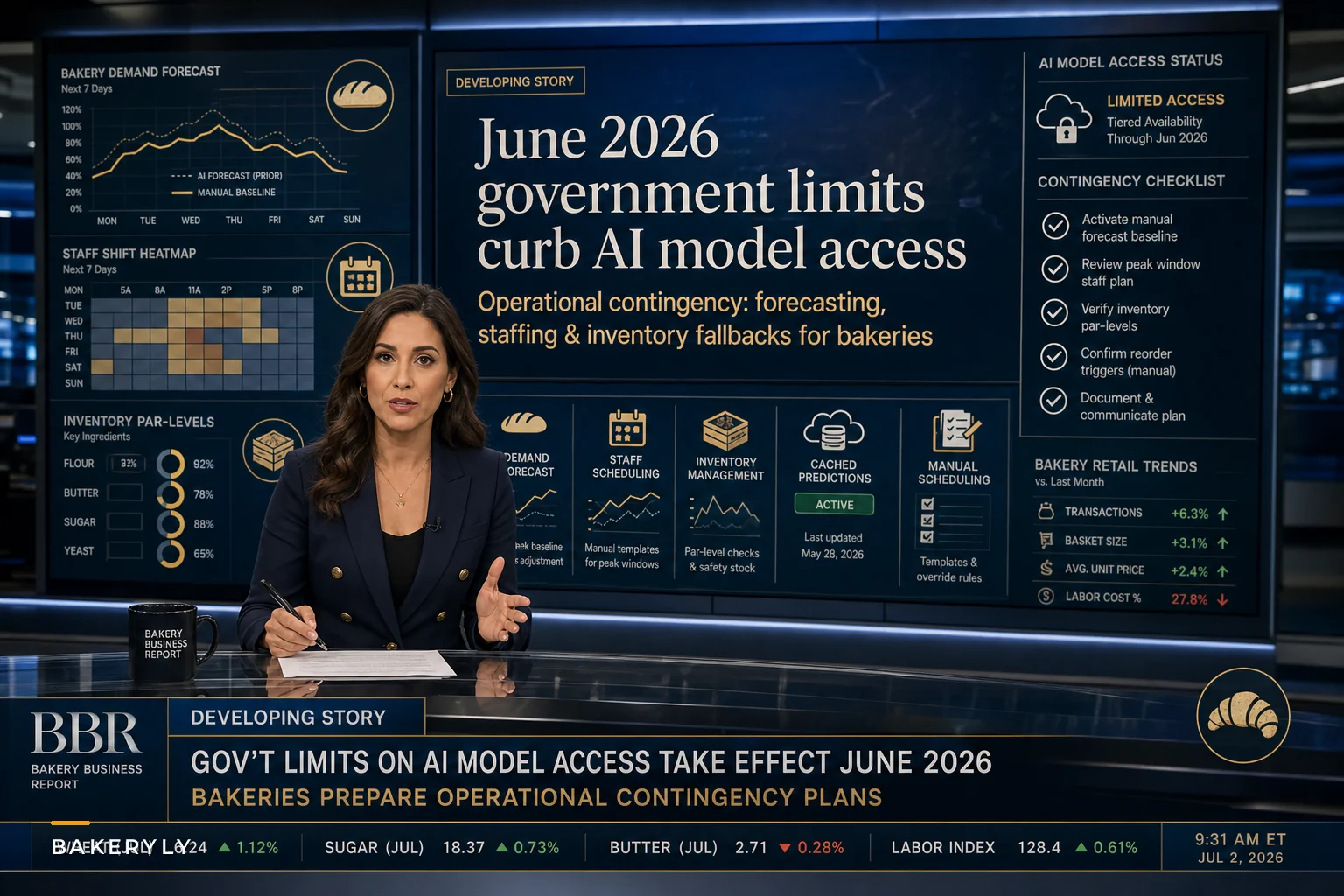

Last week, OpenAI started restricting access to its newest models—the ones powering countless bakery management platforms—to what they're calling "trusted partners" after government requests. CNBC reported that this isn't just OpenAI either; Anthropic and other providers face similar curbs. https://www.cnbc.com/2026/06/26/openai-limits-new-ai-models-to-trusted-partners-request-us-government.html is the original report link referenced in the article text but the contextual link above remains the primary citation here for readers wanting the source details and timeline for the restrictions discussed below. (Preserve the CNBC and TechCrunch context in the article.) For bakeries running forecasting and scheduling through platforms dependent on these models, this creates an immediate operational question: what happens when your vendor's AI access gets throttled, delayed, or repriced overnight?
The problem runs deeper than technical hiccups. Many bakery platforms built their value proposition around advanced AI predictions—demand curves, optimal batch sizes, staff scheduling algorithms. Strip away that AI model access, and you can be left with expensive spreadsheets and degraded operational guidance.
The cascade effect of degraded forecasting
A bakery in Portland experienced this when their inventory platform silently downgraded its model. Predicted flour needs doubled for a typical Tuesday; staffing and wholesale picks had already been scheduled off the inflated forecast. The platform functioned as designed—it just lost the model that encoded seasonal patterns, weather impacts, and local events.
-
Morning production quantities lose precision compared with AI-driven, context-aware forecasts
-
Staff scheduling reverts to basic coverage without product-mix nuance
-
Ingredient ordering drops forward-looking intelligence and leans on simple averages
Small numeric differences scale: 47 vs 50 croissants seems minor until it compounds across SKUs and days. These shifts quietly raise food cost and lower labor efficiency over weeks.
Why vendor transparency disappeared
Vendors are scrambling because premium model access is expensive and suddenly unstable. Platforms face three blunt choices when access is restricted or repriced.
-
Absorb the increased model cost (usually unsustainable for the vendor)
-
Pass the cost on to customers (relationship and retention risk)
-
Quietly downgrade to cheaper models and market it as an efficiency improvement
The risk is gradual quality degradation—accuracy slipping from the low 90s to the high 70s, staffing estimates off by one person per shift, inventory recommendations running 10–15% high. These degradations compound before owners notice.
Building forecast resilience without the AI crutch
Don't abandon AI—use it—but prepare parallel, non-AI systems that can take over when model quality drops. Start with simple, human-interpretable baselines and a small set of rules you can apply quickly.
Production baselines: track actual production quantities for each day type (regular Tuesday, farmer's market Saturday, holiday Sunday). Build rules like: "Tuesday = base production +10% if sunny, +25% if university event, -15% if raining." These rules won't match AI precision but will keep operations functional.
Staffing fallbacks: maintain manual override templates tied to clear triggers. Document coverage that actually worked for scenarios (for example, "$3,000 Saturday requires 4 morning bakers, 2 decorators, 3 counter staff"). When scheduling AI fails, use last month's similar days as your guide.
This links directly to building demand-based staffing systems that balance AI optimization with practical fallbacks—see demand-based staffing systems for a full workflow.
The Monday morning scramble scenario
Platforms typically generate Monday's production schedule Sunday night by combining weekend sales, weather, events, and historical Mondays. If forecasting becomes unavailable and the system applies default quantities, you can end up guessing across products, staff, and wholesale commitments.
With parallel tracking you can fall back to a simple baseline: "Regular Monday = 85 croissants, 40 Danish, 120 dinner rolls. Rainy modifier: -20% pastries, +10% comfort items." Combine that baseline with recent similar-day staffing to land an 80–90% workable schedule instead of chaos.
Vendor lock-in reality check
Most bakeries can't switch platforms quickly—data, POS integrations, and staff training create real lock-in. That makes documenting critical numbers outside any vendor platform essential.
-
Average daily production by SKU and day type
-
Actual staff coverage that worked for different revenue levels
-
Ingredient consumption rates per dozen/batch/unit
-
Waste percentages by product category and day
-
Update these records monthly
The emerging two-tier system
Bakeries are splitting into two groups: AI-dependent operations that put everything into the platform, and AI-enhanced operations that use AI but maintain manual backups. The latter can switch to manual baselines when models degrade and keep operating with minimal disruption.
Practical detection methods
Platforms rarely announce model downgrades. Watch operational metrics to detect quality drops early so you can activate fallbacks before problems cascade.
-
Track forecast variance weekly; spikes indicate a backend change
-
Watch suggestion granularity—advanced models give uneven specific counts; degraded models round or produce ranges
-
Look for missing interaction effects (weather, events, product mix) in recommendations
Operating through the uncertainty window
Expect more volatility in the next 6–12 months as providers and regulators settle on rules. Don't wait for stability—build operational resilience now.
-
Lock in any SLAs your vendor offers around accuracy and notification
-
Add contract language requiring advance notice (for example, 72 hours) before model downgrades
-
Cache or export critical predictions weekly to preserve the original forecasts for mid-week failures
The workflow documentation exercise
Identify your three most critical AI-powered workflows—demand forecasting, staff scheduling, inventory ordering—and document what the AI does versus your manual fallback.
Demand forecasting — AI predicts tomorrow's quantities by SKU by hour. You decide whether to override for special circumstances. Manual fallback: last Tuesday's actuals +/- known adjustments.
Staff scheduling — AI suggests optimal coverage based on predicted demand. You adjust for employee preferences and availability. Manual fallback: standard templates by revenue tier.
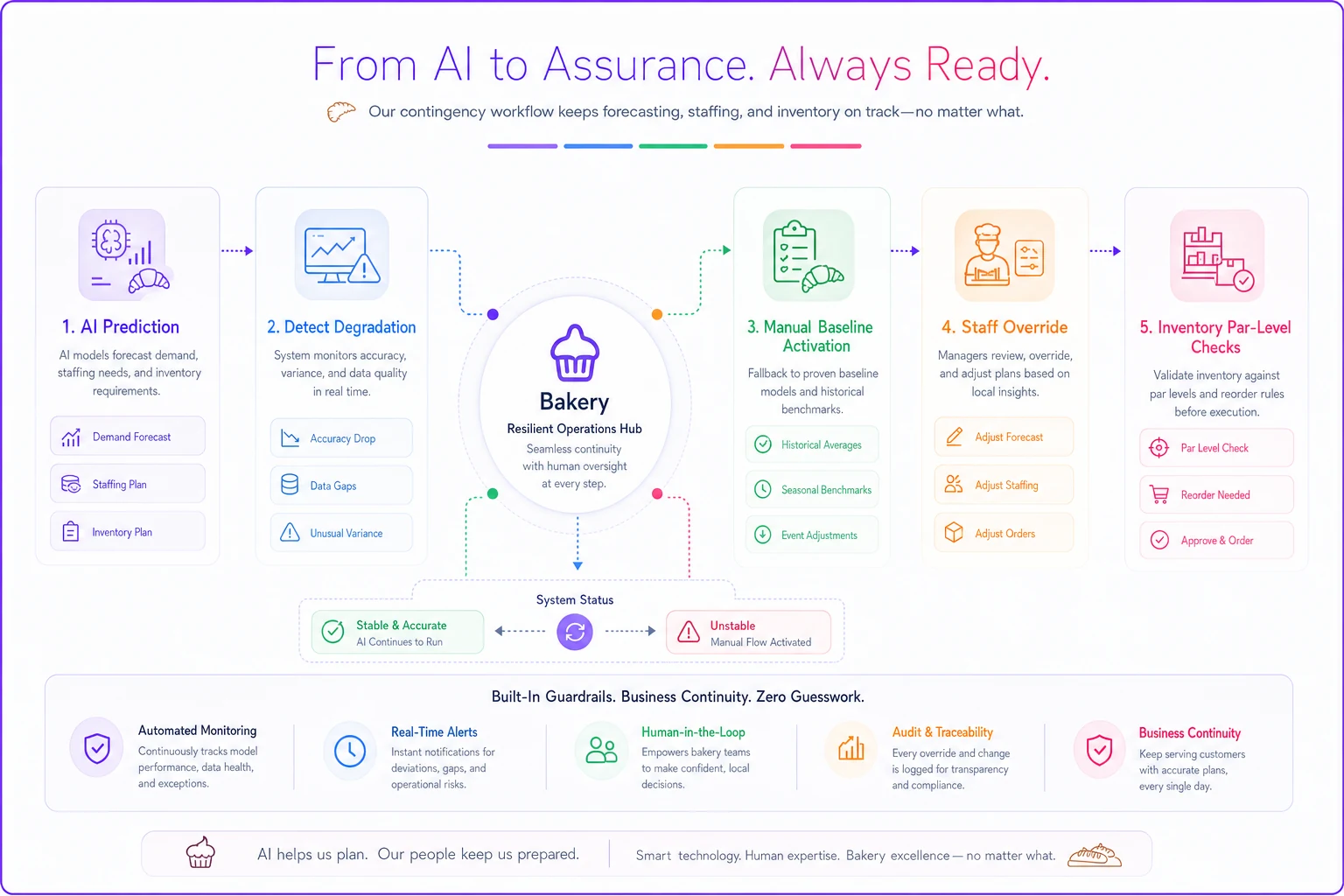
Inventory — AI calculates ingredient needs for the next 3–5 days. You approve orders above thresholds. Manual fallback: par levels plus known wholesale orders.
This documentation is your emergency playbook when AI components fail; practice switching to it periodically so staff know the steps.
Moving forward with realistic expectations
AI won't disappear, but access may be uneven. Build hybrids that use AI when reliable and fall back gracefully to simple rules and documented baselines when it isn't.
Platforms that implement graceful degradation (falling from GPT-5 to GPT-4 to basic algorithms without breaking) will be able to charge for reliability. When negotiating with vendors, ask specific contingency questions about model changes, data export, and notice periods.
What actually works: the minimum viable tracking
Bakeries that recover fastest keep a very small, updated spreadsheet outside the platform. Five numbers are enough to operate for short windows without AI.
-
Yesterday's actual production and waste by category
-
Today's staffing levels and whether coverage worked
-
Tomorrow's known orders and events
-
Current week's ingredient consumption rates
-
Last week's total revenue and customer count
Update these daily in a basic spreadsheet; they'll let you operate for a week without AI assistance.
Forecast outputs & quantile schema
Wherever possible, ask platforms to provide probabilistic forecasts (P10, P50, P90) per SKU × location and a short execution note. Use three operational horizons: Intraday, Next-day, Short planning.
| Horizon | P10 (conservative) | P50 (baseline) | P90 (aggressive) |
|---|---|---|---|
| Intraday | Minimum run for high‑spoilage or high‑cost items | Default production and staffing | Buffer bake for staples or confirmed orders |
| Next‑day | Conservative ordering / protect long‑lead items | Standard day plan: dough prep, batch counts | Prep extra dough or add a second bake window |
| Short planning | Tight purchasing for scarce/expensive SKUs | Weekly inventory & staffing plan | Scenario planning for promotions or holidays |
Track quantile coverage and recalibrate regularly; probabilistic outputs are standard practice—see the probabilistic forecasting guide for technical reference: https://skforecast.org/0.12.1/user_guides/probabilistic-forecasting
Data inputs & cadence
Design your data model and cadence so that critical signals survive vendor model changes. Separate required historical fields from recommended real-time feeds.
-
date
-
sku_id
-
location_id
-
sold_quantity
-
price
-
promo_flag
-
on_hand
-
stockouts/stockout_timestamps
-
inbound_receipts
-
leadtimeannotation
-
event_calendar
-
POS sales stream (real‑time)
-
Committed orders
-
Current inventory levels
-
Oven capacity/utilization
-
Walk‑in and catering bookings
-
Local events
-
Weather
Prioritize real-time or near-real-time for sales and inventory; daily batches are acceptable for supplier and order feeds. See Bakeryly how‑tos for related workflows: bake cycles, portioning & yields, ordering cadence.
AI tools materially improve bakery operations, but model access can become unstable. Treat AI as an optimization layer, not the foundation of your operation: document baseline metrics outside any vendor, train staff on manual fallbacks, and negotiate vendor agreements that include transparency and notice.
When evaluating platforms or renegotiating contracts, ask: What happens if your primary AI provider restricts access? Can we export our historical data and predictions? How much notice do we get before model changes? Own your baseline operations even if you rent the optimization layer.