

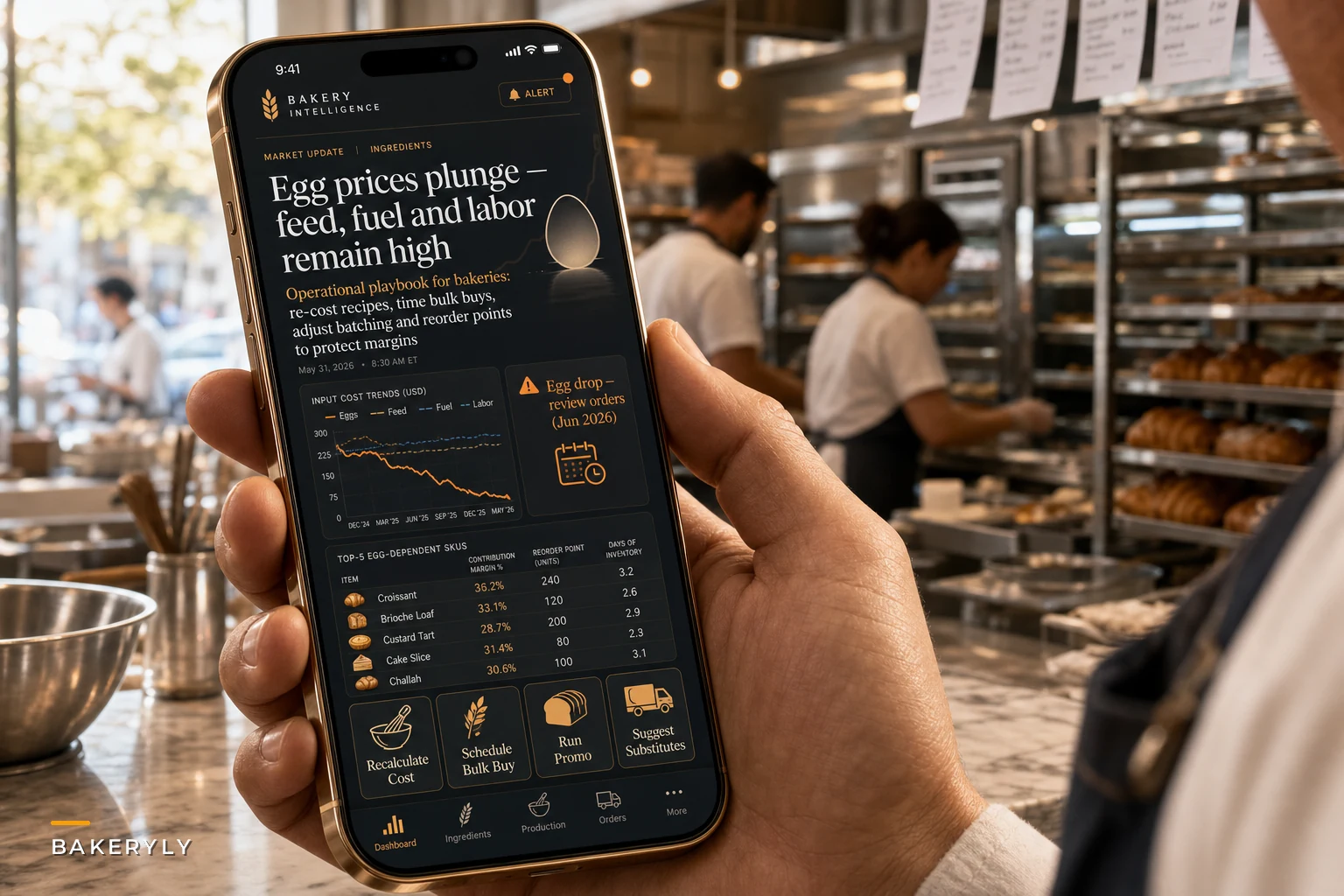

Yesterday morning, a bakery owner in Houston texted me a screenshot of her egg invoice. The price had dropped 61% from January. "Should I buy ten cases?" she asked. The answer wasn't as simple as she expected.
CNBC reported last week that egg prices have crashed due to oversupply after last year's avian flu shortages. Great news for bakeries, right? Not exactly. While eggs plummet, flour costs are up 8%, butter jumped 12% last quarter, and your commercial rent just increased again.
This is ingredient cost volatility at its most frustrating—one input drops dramatically while everything else keeps climbing. Most bakeries respond by either doing nothing (missing the opportunity) or overreacting (buying too much, adjusting prices wrong, or worse—redesigning their entire menu around cheap eggs).
The re-costing trap most bakeries fall into right now
When egg prices drop this fast, the instinct is to immediately recalculate every recipe cost. Makes sense. Except most bakeries get the execution completely backwards.
They start by updating their recipe cards, plugging in the new egg price, celebrating the improved margins on quiche and croissants. Then they consider lowering prices to grab market share. Maybe they promote egg-heavy items harder. All logical moves that miss the actual problem.
Your egg costs didn't drop in isolation. They dropped while your delivery fees went up, your mixer repair bill doubled, and three other ingredients got more expensive. The real question isn't "what's my new food cost on Danish pastries?" It's "which products actually became more profitable relative to my whole operation?"
A small bakery in Portland learned this lesson last month. They saw egg prices drop and immediately promoted their breakfast sandwiches—$2 off all week. Sales jumped 40%. They felt brilliant until they realized those sandwiches use expensive bacon that had increased 15%, plus specialty cheese that went up 20%. Their promotion actually lost money on every sale because they only re-costed the eggs, not the full recipe.
The smarter approach starts with segmentation. Pull your top 20 items by revenue. Calculate not just the new food cost, but the new contribution margin after factoring in current labor costs, packaging changes, and overhead allocation. You'll find that only 4-5 items genuinely became more profitable in any meaningful way.
Why bulk-buying eggs now might destroy your cash flow
Every bakery owner seeing these prices has the same thought: stock up while it's cheap. The math seems obvious. If eggs are down 60% and you use 30 dozen per week, buying three months' worth saves serious money.
Never miss a bake or delivery again.
Bakeryly helps you schedule, track, and manage every order effortlessly.
- Unified order tracking
- Real-time inventory alerts
- Staff shift management
No credit card required
Except eggs aren't flour. They expire. They need refrigeration. And more importantly, tying up $3,000 in egg inventory means you can't buy that discounted flour your supplier just offered, or take advantage of the butter deal next month.
Cash flow beats cost savings every time in small bakeries. You're not Panera with unlimited working capital.
What actually works: extend your order cycle slightly but don't go crazy. If you normally order eggs twice weekly, maybe shift to weekly with a 20% buffer. This captures some savings without destroying your storage capacity or cash position. Set a hard rule—never more than 3 weeks of egg inventory, regardless of price.
Set a hard three-week maximum for egg inventory to protect cash flow.
The refrigeration factor alone kills most bulk-buy strategies. A standard reach-in cooler holds maybe 15-20 cases of eggs max if you remove everything else. Your walk-in? Already packed with tomorrow's butter, milk, and prep. Unless you're planning to rent a refrigerated truck for overflow storage (spoiler: terrible idea), your physical capacity limits you anyway.
The production schedule adjustment nobody talks about
Cheap eggs create a specific operational problem: the urge to overproduce egg-heavy items. It's Wednesday, eggs are cheap, so why not make extra frittatas for the case? Because Thursday's frittatas compete with Thursday's fresh items.
The production schedule that worked when eggs cost $8/dozen breaks down when they cost $2. Not because of the cost, but because of the psychology. Your morning baker sees cheap eggs and makes 40 breakfast burritos instead of 25. By 2pm, you're discounting or tossing 15 burritos. The "savings" from cheap eggs just became waste.
You need disciplined production tied to demand patterns, not input costs. That means your morning prep list stays exactly the same whether eggs cost $2 or $20. The savings come from margin improvement on what you actually sell, not from producing more because ingredients are cheap.
One bakery in Denver kept their core production steady but added a "market special" slot—one extra egg-based item made only when they had confirmed catering orders or advance purchases. This let them capitalize on low egg prices without creating waste.
Repricing strategies that actually protect margins
Uncomfortable truth about sudden ingredient cost drops: you probably shouldn't lower your menu prices at all.
Customers didn't see your egg invoice. They have no idea eggs dropped 60%. What they do know is that everything else keeps getting more expensive—gas, groceries, rent. If you suddenly drop your quiche from $8 to $6, they don't think "wow, transparent pricing!" They think "something's wrong with the quiche."
Better play is selective promotion, not repricing. Keep your menu prices stable. Use the improved margins to fund limited promotions that drive traffic without training customers to expect permanent discounts.
Maybe Tuesday becomes "Breakfast Pastry Day" with $1 off egg-based items. Maybe you bundle a discounted quiche with a full-price coffee and salad. The key is temporary, strategic promotions that you can end when egg prices inevitably rise again.
A bakery in Austin kept menu prices flat but introduced a "Baker's Dozen Breakfast Box"—13 items for the price of 12, mix and match from egg-heavy options. It drove bulk purchases without touching base prices. When eggs went back up eight weeks later, they quietly discontinued the box. No customer complaints, no margin erosion.
Building triggers into your cost tracking (without drowning in spreadsheets)
Most bakeries track food cost percentage monthly. By the time you see egg prices shifted your margins, you've already missed weeks of opportunity or danger.
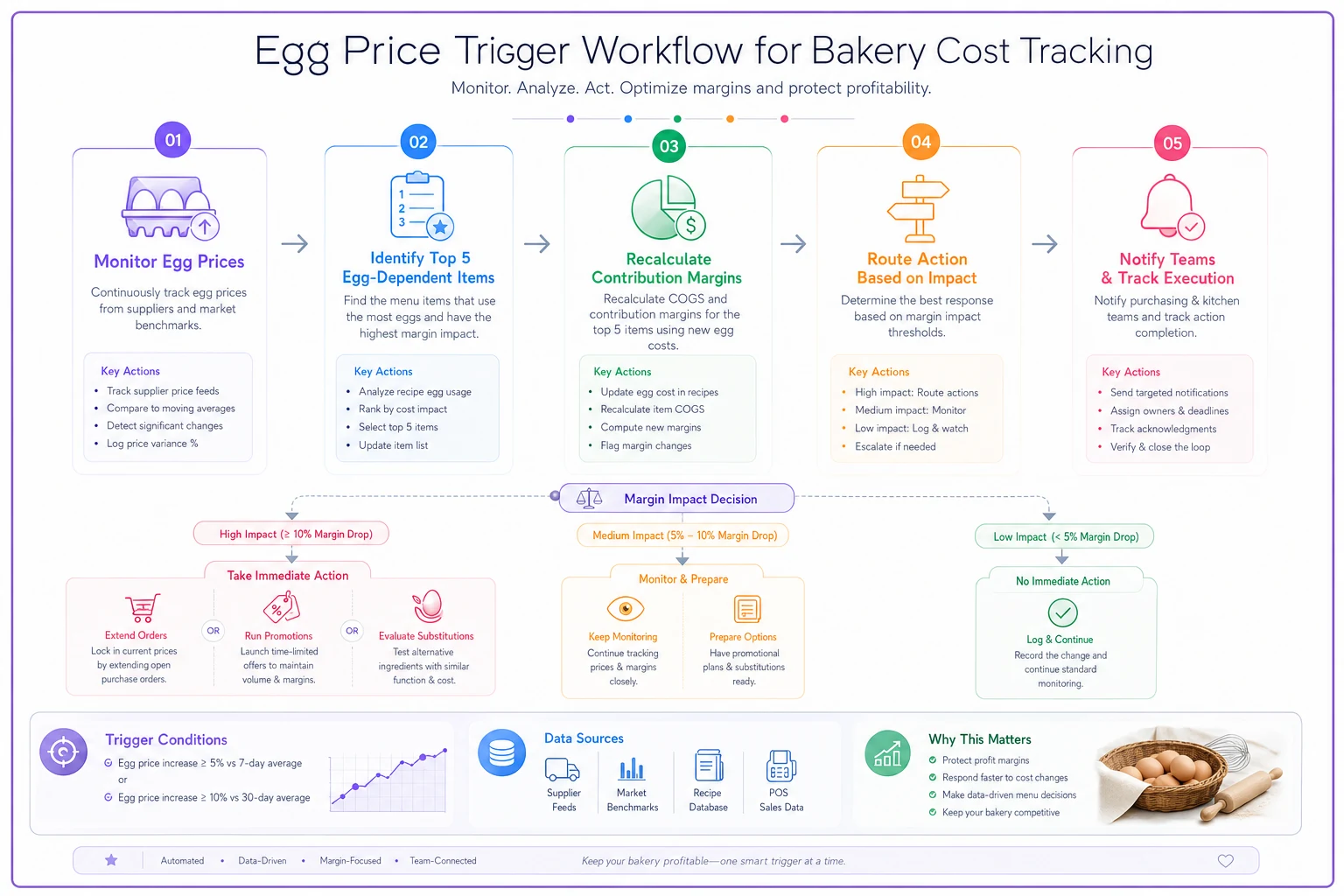
A simple trigger system works better. Pick your five most egg-dependent items. Set a threshold—if eggs move more than 25% in either direction, you recalculate those five items within 48 hours. Not your whole menu, just those five.
Here's a simple trigger-to-action workflow you can adopt.
-
Eggs up 25%
Review portion sizes on breakfast sandwiches
-
Eggs down 25%
Consider temporary promotion on quiche
-
Eggs up 40%
Evaluate substitution options (egg whites, powders)
-
Eggs down 40%
Test demand for new egg-forward special
Link these triggers to your KPI reporting system so they're part of your regular operational rhythm, not another thing to remember.
A real bakery's response to last month's egg volatility
A 4-location bakery group in Phoenix when egg prices crashed last month:
Day 1: Owner sees the price drop, gets excited, tells the kitchen manager to "order extra." Kitchen manager orders 50 cases instead of the usual 20.
Day 3: They realize they have nowhere to store 50 cases. They shuffle inventory, stack eggs in the prep kitchen, accidentally let some sit at room temp too long. Health inspector shows up for routine inspection (terrible timing). Near miss on a violation.
Day 7: Owner decides to capitalize on cheap eggs with a promotion—half-price breakfast until 10am. Lines out the door. Kitchen can't keep up. Quality drops. Regular customers annoyed by wait times. Yelp reviews take a hit.
Day 14: They've burned through the excess eggs but created customer expectation for cheap breakfast. When they end the promotion, morning sales drop 30%. Customers feel baited.
Day 21: Egg prices start creeping back up. They're stuck between raising prices (angry customers) or eating the margin loss. They choose margin loss.
Day 30: Monthly P&L shows food cost up 2% despite "cheap" eggs because they wasted inventory, over-portioned during the rush, and lost discipline on other ingredients while focused on eggs.
This happens when you react to ingredient volatility without a plan.
The operational adjustments that actually matter
Forget the egg prices for a second. The real issue is that ingredient cost volatility is accelerating across the board. Eggs today, butter tomorrow, flour next month. You need systems that handle volatility, not knee-jerk reactions to each price swing.
Start with purchasing discipline. Create a simple matrix: normal price range, action if below range, action if above range. For eggs, maybe that's $3-5 normal, below $3 you extend orders by one cycle, above $5 you review portions. Nothing dramatic, just small systematic adjustments.
Then fix your production planning. Your prep lists should be demand-driven, not cost-driven. Cheap ingredients don't change customer traffic patterns. Thursday still needs 30 Danish, not 50 just because eggs are cheap.
Next is waste tracking at the item level. When ingredients get cheap, waste typically increases. Track it daily, not weekly. A simple tally sheet by the trash can—what got tossed and why. You'll spot the overproduction immediately.
| Cost Change | Purchasing Adjustment | Production Response | Waste Prevention |
|---|---|---|---|
| Eggs down 30% | Extend order cycle to weekly | Maintain normal prep volumes | Daily waste tracking |
| Eggs up 40% | Consider portion reduction | Review substitution options | Monitor overuse closely |
| Any ingredient >25% change | Recalculate top 5 affected items | Adjust menu positioning only | Staff training on portions |
Scheduling considerations matter too. When input costs drop significantly, you might need less labor, not more. If your food cost improved 5% on certain items, you don't need to drive extra volume to hit margin targets. You can run lighter shifts and bank the savings instead of chasing revenue.
Consider inventory turns carefully. Cheap eggs make you want to increase inventory. But higher inventory means higher waste risk, more storage cost, more counting time.
Communication with staff matters. When prices swing wildly, rumors fly. "Eggs are cheap so we must be struggling." "Owner's buying tons of eggs, layoffs coming." Clear, simple communication: "Egg prices dropped temporarily. We're buying smart, not hoarding. Focus on quality and waste reduction."
When to actually change your menu mix
The temptation with cheap eggs is to add new egg-forward items. Frittata special! Egg salad sandwiches! Breakfast all day!
Stop. Menu additions when ingredients get cheap is usually a mistake.
New items need training. Your staff just learned to make them consistently, now eggs spike again and you're stuck with unprofitable items customers expect. Or you discontinue them and look flaky.
Temporary items work better than permanent additions. If you must capitalize on cheap eggs, run a special for 2-3 weeks maximum. Make it clear it's limited time. When eggs rise, it naturally disappears.
Better play is pushing existing egg items harder through merchandising, not menu changes. Move the quiche to eye level in the case. Add a "Fresh Today" sign to breakfast sandwiches. Train staff to suggest egg items specifically. Same menu, better sales mix.
If you do add items, make them modular. A "Protein Power Box" that happens to include hard-boiled eggs when they're cheap, but could switch to cheese or nuts when eggs spike. Flexibility built in from day one.
The technology that makes rapid re-costing possible
Manually recalculating recipe costs every time eggs swing 40% is exhausting. AI-powered operational software makes a massive difference.
Instead of spending hours with spreadsheets, you update one ingredient price and instantly see the impact across every recipe. The system flags which items crossed profitability thresholds. It suggests which promotions make sense given current margins.
More importantly, it prevents the overreaction problem. When you see eggs drop 60%, the software shows you that your overall food cost only improved 2% because eggs are just one input. It keeps you grounded in total operational reality.
The automation handles the tedious parts—calculating new margins, comparing to historical ranges, flagging unusual patterns. You focus on decisions: should we promote this item? Should we extend orders? Should we adjust portions?
Some operations have automated triggers built right into their purchasing systems. Egg prices drop below threshold, system automatically suggests order quantities based on storage capacity and historical waste patterns.
Moving forward with ingredient volatility as the new normal
Egg prices will bounce back up. They always do. And when they do, something else will crash—maybe butter, maybe flour, maybe sugar. This volatility isn't going away.
The bakeries that thrive don't chase every price swing. They build stable operations that can absorb and benefit from volatility without disrupting their core business. That means disciplined purchasing, consistent production, strategic pricing, and systematic tracking.
Stop treating ingredient cost changes as surprises requiring heroic responses. Start treating them as normal variations requiring standard procedures. Eggs down 60%? Check the trigger, execute the plan, monitor the results. No drama, no panic buying, no menu overhauls.
Your customers come for consistency—consistent quality, consistent availability, consistent experience. Ingredient costs swinging wildly in the background shouldn't change what happens in the front. Use the margin improvements to strengthen your business, not to create chaos chasing temporary opportunities.
The bakeries still thriving in five years won't be the ones that bought 100 cases when eggs hit $2. They'll be the ones that built systems to handle whatever ingredient volatility comes next, capturing opportunities without compromising operations.
Ready to elevate your bakery operations?
Join 2,000+ bakeries using Bakeryly to streamline workflows, reduce waste, and delight more customers.