


Most bakeries don't fail at technology because they picked the wrong software. They fail because they bought everything at once, dumped it on a team already slammed during the morning rush, and had no idea who owned the data flowing between systems. Six months later there's a POS that half the staff bypasses, an inventory module nobody updates, and a spreadsheet graveyard that still runs the actual business.
The problem isn't the tools. It's the order you turn them on, and whether anyone is actually responsible for the numbers underneath. A real bakery tech adoption roadmap isn't a shopping list — it's a sequence, a data structure, and an ownership map that grows with you.
This is the part almost nobody gets right, so here's how the whole thing connects, where it usually breaks, and how to phase it so each layer pays for itself before you add the next one.
Why bakeries buy technology in the wrong order
The typical bakery buys reactively. Something hurts, they buy a tool to make it stop hurting. Line out the door? Buy a fancier POS. Running out of butter mid-week? Buy an inventory app. Front-of-house chaos? Buy a scheduling tool.
Each purchase makes sense in isolation. Together they create a mess, because none of them share a common language. Your POS calls it "Sourdough Loaf." Your inventory app calls it "SD-LG." Your production sheet calls it "big sour." Now you can't answer a basic question — how much flour does one week of loaf sales actually consume — without a human sitting there translating between three systems.
The pain isn't the individual tools. It's the gaps between them. And those gaps get worse as you grow. At one location with two staff, the owner holds all the translation in their head. Add a second location and a few more SKUs, and that mental model collapses. Nobody else knows that "big sour" and "SD-LG" are the same thing.
So before you sequence any software, you need to solve the thing sitting underneath all of it: your data taxonomy.
Start with the boring part: a data taxonomy that everything plugs into
This is the least exciting section of this article and the most important. Skip it, and everything downstream inherits the mess.
-
Products — the finished thing you sell (a croissant, a birthday cake, a dozen bagels)
-
Ingredients / raw materials — flour, butter, eggs, chocolate
-
Recipes / builds — the link between products and ingredients (how much of each raw material a product consumes)
-
Channels — where a sale happens (walk-in, online pickup, wholesale, catering)
The rule that saves you months of pain later: every product gets one canonical ID, and every system references that ID. Not the display name. The ID.
A simple structure looks like this:
| Object | Canonical ID | Display name | Category | Unit |
|---|---|---|---|---|
| Product | PRD-0142 | Sourdough Loaf (Large) | Bread | each |
| Product | PRD-0143 | Sourdough Loaf (Small) | Bread | each |
| Ingredient | ING-0031 | Bread Flour | Dry goods | kg |
| Recipe link | RCP-0142 | Large Sour → 0.55kg flour | — | — |
You don't need software to build this. A shared spreadsheet works fine at the start. What matters is that this becomes the single source of truth, and every tool you adopt later maps back to it. When your POS, inventory, and production system all speak in PRD-0142, the translation problem disappears — and so does most of the manual reconciliation work eating your evenings.
One mistake worth flagging: people over-engineer this on day one. You don't need 14 attributes per product. Start with ID, name, category, unit, and channel eligibility. You can always add fields. You can't easily un-tangle a taxonomy that already has 400 SKUs living in it.
The phased sequence: POS → inventory → SOPs → analytics
The order matters because each phase generates the clean data the next phase depends on. Skip ahead and you're building on sand.
[GRAPH: phased-tech-adoption-sequence] Phase 1: POS cleanup → Phase 2: Inventory tied to sales → Phase 3: SOPs grounded in real data → Phase 4: Analytics that drive decisions
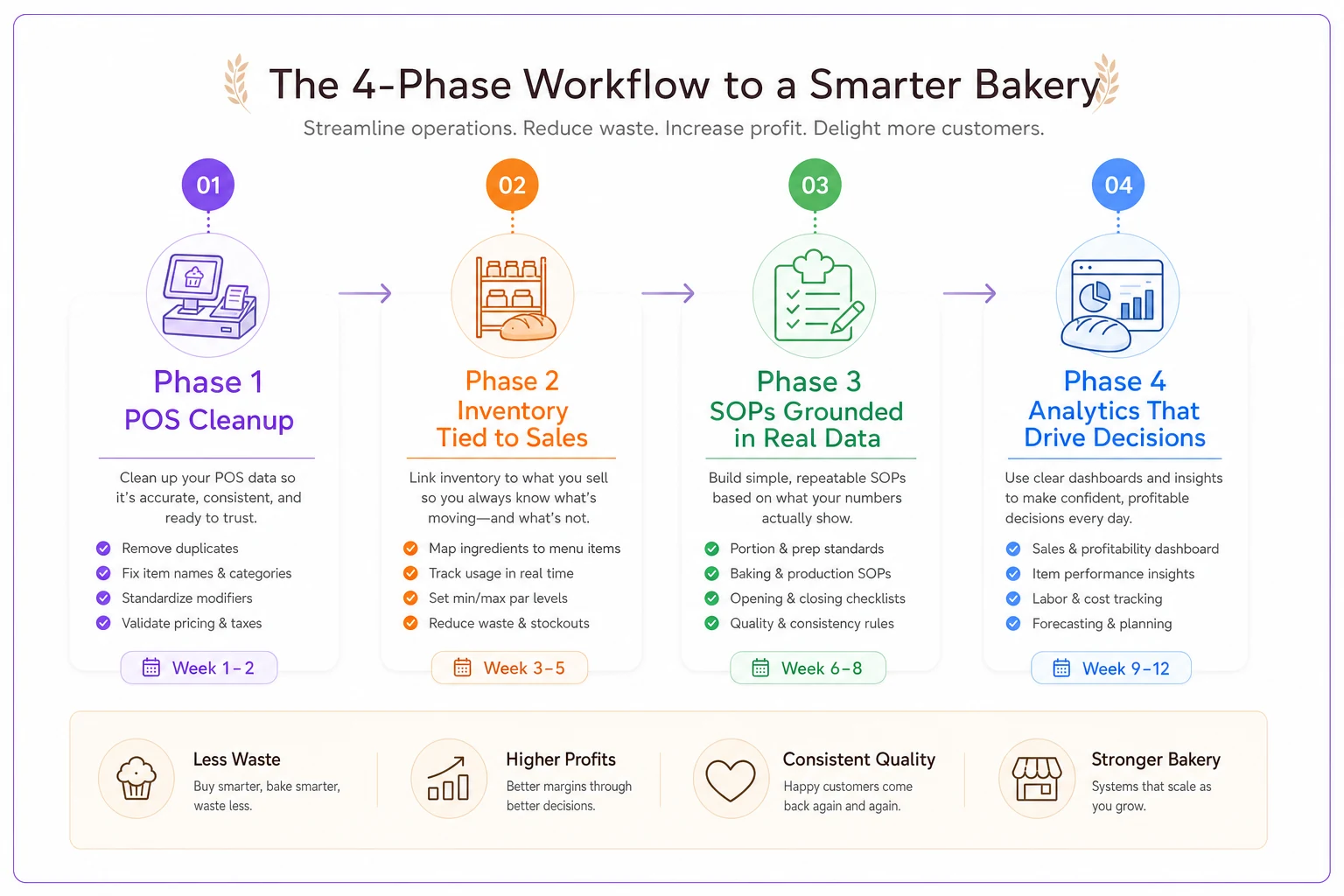
Phase 1 — POS as the data foundation (weeks 1–4)
Your POS isn't just a cash register. It captures what sold, when, through which channel. That's the raw signal everything else runs on. If that data is dirty — miscategorized items, "misc" buttons everywhere, modifiers that map to nothing — every downstream decision inherits that noise.
-
Map every POS button to a canonical product ID from your taxonomy.
-
Kill the generic "misc sale" and "open item" buttons, or restrict them to a manager.
-
Set up channel tags so a wholesale sale and a walk-in sale are distinguishable in the export.
-
Confirm the POS can export a clean daily transaction file (CSV or via API).
The ROI here is mostly about preventing bad decisions. When your item-level sales are clean, you stop guessing which SKUs actually move. Don't rush to analytics yet — right now you're just making sure the faucet runs clear water.
Phase 2 — Inventory that ties back to sales (weeks 5–10)
Now that sales data is clean and mapped to recipes, inventory becomes tractable. The key connection: sales × recipe = theoretical ingredient usage. Compare that to actual usage and the gap tells you your waste, theft, or over-portioning.
Before Phase 1, you couldn't do this — the data was too messy. After it, the calculation is almost automatic. A typical small bakery discovers in the first month that theoretical vs. actual butter usage is off by 8–12%, which usually points to over-portioning at the bench, not theft. That's a fixable, measurable leak.
This is also where simple automation earns its keep for the first time. A basic workflow that reads the daily POS export, multiplies by recipe quantities, and decrements an inventory count removes a nightly manual chore that most owners hate doing — and therefore skip. That's the real reason inventory systems fail. Not complexity. The daily manual burden nobody sustains.
Phase 3 — SOPs built on top of real data (weeks 11–16)
By now you know what sells and what it consumes. Only at this point do written procedures actually make sense, because they're grounded in reality instead of guesswork. Your prep lists come from actual demand patterns. Your par levels come from measured usage, not vibes.
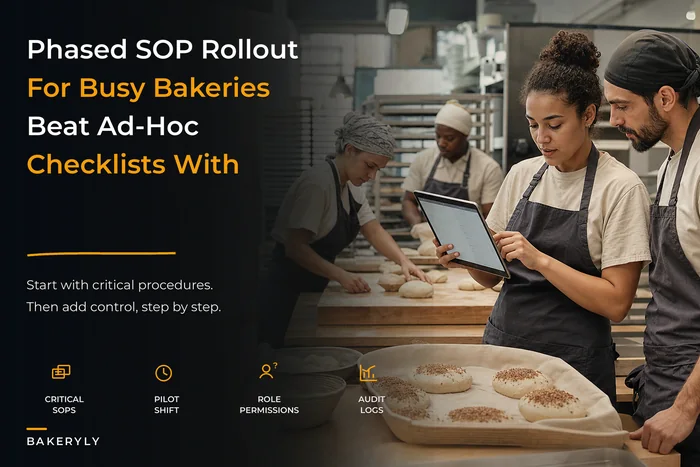
This is a good moment to look at the case for why phased, digital SOPs beat the ad-hoc laminated-card approach — there's a detailed rollout and governance argument in why phased digital SOPs beat ad-hoc checklists for small bakeries. The short version: SOPs that pull from live data stay accurate, while static checklists rot the moment your menu changes.
Write SOPs before you have clean sales and inventory data, and you're documenting your assumptions. Write them after, and you're documenting what actually works.
Phase 4 — Analytics that drive weekly decisions (weeks 17+)
Analytics is last on purpose. Dashboards built on dirty data are worse than no dashboards — they give people false confidence. Only after the first three phases do your numbers actually mean something.
The goal isn't pretty charts. It's a short weekly rhythm where a handful of metrics actually change what you do next week — production quantities, order sizes, staffing. The trap most bakeries fall into is building elaborate reports nobody reads. A lightweight pipeline that turns raw sales into a few weekly decisions is far more valuable, and there's a practical build for that in how to build a lightweight data pipeline that turns sales into weekly bakery decisions.
Who owns what: the ownership model small teams forget
Sequencing tools is half the job. The other half is deciding who is responsible for each layer of data staying clean. Systems don't maintain themselves, and "everyone owns it" reliably means nobody does.
-
Product/recipe taxonomy — usually the owner or head baker. This person approves new SKUs and retires old ones. Nothing enters the system without going through them.
-
POS accuracy — the front-of-house lead. They own button mapping and make sure staff aren't hammering the "misc" key.
-
Inventory counts — a shift lead who does the weekly reconciliation and flags the theoretical-vs-actual gaps.
-
Reporting rhythm — the owner or manager who reviews the weekly numbers and actually decides something based on them.
This looks like overhead. It isn't. The alternative is the far more expensive scenario where a new product gets added to the POS under a random name, never gets a recipe link, and quietly breaks your inventory math for three months before anyone notices the flour orders are wrong.
One thing worth naming: the ownership model has to survive turnover. If your only "person who understands the taxonomy" quits, and it all lived in their head, you're back to square one. Ownership means the role owns it, and the documentation is good enough that a replacement can pick it up. That's the difference between a system and a lucky arrangement.
Low-code automation checkpoints (and where NOT to automate)
Automation belongs at the seams between phases — the handoffs where humans currently do boring translation work. But there's a right time for each one, and automating too early just cements a bad process.
Natural checkpoints, in order:
-
After Phase 1 Auto-export daily POS sales to a shared sheet. (Removes manual downloads.)
-
After Phase 2 Auto-calculate theoretical ingredient usage from sales × recipe. (Removes nightly math.)
-
After Phase 2 Trigger reorder alerts when inventory drops below par. (Prevents the mid-week butter panic.)
-
After Phase 3 Auto-generate the next day's prep list from demand forecast. (Removes guesswork from morning setup.)
-
After Phase 4 Auto-assemble the weekly decision report. (Removes the Sunday-night spreadsheet ritual.)
All of these sit on top of the taxonomy. That's why the naming work comes first — automation is only as reliable as the IDs it references. This is where AI-assisted operational tools genuinely help small teams: not by replacing judgment, but by handling the repetitive translation and reconciliation that owners otherwise do at 10pm. The forecast, the usage math, the reorder flags — those are exactly the kind of pattern-heavy chores worth handing off once your data is clean enough to trust.
Where NOT to automate: anything involving quality judgment, customer relationships, or exceptions. Don't automate custom-order pricing. Don't automate supplier negotiation. Don't automate the decision to pull a batch that looks off. Automation handles the predictable middle; humans handle the edges. Bakeries that automate the edges too early end up with rigid systems that break every time something unusual happens — which, in a kitchen, is constantly.
A real scenario: two-location bakery, phased over a quarter
A small two-site bakery — one café, one production kitchen — was running on a decent POS, a separate inventory app, and roughly six spreadsheets. Every week they lost hours reconciling what sold against what got used, and their flour and butter orders were consistently off. Waste was hovering somewhere around 9–11% of ingredient cost, mostly from over-ordering perishables they couldn't move in time.
They didn't buy anything new for the first month. They just built the taxonomy — gave every product a canonical ID, mapped the POS buttons, linked the recipes. Tedious, unglamorous, about two weeks of evening work.
Phase 2 connected sales to inventory. The theoretical-vs-actual comparison immediately showed butter usage running about 10% high — over-portioning at the bench, not theft. Fixing the portioning and tightening reorder points pulled ingredient waste down to the 5–6% range over the following two months.
By Phase 4, the weekly report took the manager around fifteen minutes to review instead of the couple of hours the old reconciliation used to eat. Nothing dramatic. No overnight transformation. The leaks closed, ordering got predictable, and the owner stopped doing math at midnight.
That's usually what a working roadmap actually looks like — quiet, cumulative, and mostly unspectacular.
When this phased approach makes sense — and when it doesn't
When it makes sense: you have real SKU complexity (30+ products), more than one sales channel, or a second location on the horizon. The taxonomy-first sequence pays off precisely because coordination gets harder as you scale. If reconciliation already eats your evenings, you're the target case.
When it's overkill: a single-location bakery with eight core products and one owner doing everything. If you can hold the whole operation in your head, an elaborate data governance model is premature. Do a light version — consistent naming, a clean POS — and skip the rest until growth forces it.
Who should NOT do this: anyone trying to run all four phases in one month. The whole point is that each phase produces the clean data the next one needs. Compress the timeline and you're back to the original problem — everything on at once, nobody owning anything, a taxonomy full of half-mapped SKUs. Rushed adoption is the exact failure this roadmap exists to prevent.
The through-line
Most bakery technology fails not because of bad software or bad staff, but because the pieces get bought in the wrong order, plugged into inconsistent data, with no one responsible for keeping the numbers honest.
A phased roadmap fixes the system, not the individual tools — clean data first, then each layer built on the one below it, each with a named owner, automation added only where the handoffs are genuinely repetitive. Do it in this order and every phase pays for the next. Do it all at once and you'll spend the next year untangling the mess, which is the exact thing you bought the technology to avoid.
Most bakery technology fails not because of bad software or bad staff, but because the pieces get bought in the wrong order, plugged into inconsistent data, with no one responsible for keeping the numbers honest.
A phased roadmap fixes the system, not the individual tools — clean data first, then each layer built on the one below it, each with a named owner, automation added only where the handoffs are genuinely repetitive. Do it in this order and every phase pays for the next. Do it all at once and you'll spend the next year untangling the mess, which is the exact thing you bought the technology to avoid.