

Most bakery owners have a mental library of procedures. Mix croissants this way. Proof sourdough at that temperature. Clean the sheeter between dough types. The knowledge exists—scattered across heads, notebooks, and laminated sheets taped to walls.
But knowledge isn't execution. Your morning shift lead knows the croissant folding sequence cold. The afternoon baker who covers when she's sick? Not so much. Those laminated sheets get splattered with flour and become unreadable. The notebook with temperature logs disappears into someone's apron pocket. Digital SOPs for bakeries aren't really about documenting what you already know. They're about building a system where every shift, every person, every task runs the same way regardless of who's working or what chaos the day throws at you.
Why traditional bakery documentation falls apart
Small bakeries almost always start with handwritten recipes and verbal training. Works fine when you have three employees who've been with you for years. Falls apart completely when you're running two shifts with rotating staff and weekend coverage.
The progression usually looks like this: owner demonstrates everything personally, then creates some recipe cards, maybe types up cleaning procedures, eventually ends up with a binder somewhere containing documents printed at different times—half of them outdated.
What plays out in daily operations? Experienced staff ignore the documentation because they already know what to do. New staff can't find what they need when they need it. Different shifts develop their own methods. Quality drifts. Waste creeps up. Customer complaints about inconsistency start appearing.
The breaking point usually hits around 8–12 employees. That's when verbal knowledge transfer stops working, when you can't personally supervise every shift, when the gap between your best and worst days becomes obvious to customers.
The phased approach that actually works
Forget trying to document everything at once. Too many bakeries spend months building comprehensive manuals that nobody ends up using. The approach that actually sticks starts small and builds momentum through early wins.
Phase 1: Identify your critical three
Pick three procedures that cause the most problems when done wrong. Not the most complex ones—the ones that hurt most when they fail. For most bakeries, this means:
Opening procedures that affect the entire day when missed. Oven preheating, proof box setup, checking overnight fermentation. One skipped step here cascades through everything.
Product handling that directly impacts safety or quality. Temperature logging for refrigeration, allergen cleaning between products, date marking systems. These are non-negotiables from both a regulatory and customer trust standpoint.
Closing procedures that set up the next day. Overnight dough starts, equipment cleaning that prevents morning delays, inventory counts for ordering. These create the real handoff between shifts.
Start with procedures that hurt most when they fail.
Phase 2: Digital capture that matches workflow
The format matters less than accessibility. A Google Doc on a tablet beats a perfect manual locked on the office computer. But serious digital SOPs bakery systems go beyond simple documents.
Your morning mixer needs to check dough hydration levels? Put a QR code on the mixer that links directly to that SOP. Include photos of what proper gluten development looks like. Add a simple checklist they can tick off on their phone.
Build in versioning from day one. When you adjust proofing times for summer heat, everyone needs the update immediately. Digital systems push changes instantly. That printed manual from January still says 90 minutes when you actually need 75.
Phase 3: Permissions and accountability
Not everyone needs edit access to everything. Shift leads can update daily production schedules. Only managers change food safety procedures. The owner alone modifies recipes.
Audit trails matter more than most people realize. Who checked off the freezer temperature log? When? If a health inspector asks about Tuesday's cooling logs, you need actual answers—not a guess.
This isn't about surveillance. It's about patterns. If closing procedures consistently take 90 minutes on weekdays but 45 on weekends, something is different. Maybe the weekend crew skips steps. Maybe the weekday crew does unnecessary work. The data tells you where to look.
Bakery-specific implementation challenges
The shift handover problem
Bakeries run on overlapping shifts with minimal overlap time. Morning crew starts at 4 AM, afternoon arrives at noon, morning leaves at 1 PM. That one-hour window needs to transfer everything: what sold out, what's in progress, what equipment acted up, special orders coming.
Traditional handover relies on verbal communication during the busiest part of the sales day. Digital SOPs bakery systems fix this with structured handoff templates. Not essays—quick fields: doughs started (with times), products running low, equipment issues, customer complaints, anything unusual.
The afternoon shift checks the digital handoff before they arrive. Questions get handled during the overlap hour instead of discovered two hours later when the morning crew is long gone.
Traceability without drowning in paperwork
Every batch needs tracking. Which flour lot went into those sandwich loaves? When did that buttercream get made? If someone calls about an allergic reaction, you need answers fast.
Paper logs work until they don't. They get wet, lost, misfiled. Someone forgets to write the lot number. Handwriting becomes illegible. The health inspector wants three months of records and you're digging through boxes.
Digital systems capture this automatically when integrated into your actual workflow. Scan the flour bag barcode when you open it. The system knows which recipes used that flour based on production schedules. Customer complaint comes in? A few clicks shows every ingredient in their purchase.
Quick audit readiness
Health inspections happen without warning. Digital SOPs bakery platforms make both planned and surprise audits manageable.
Inspector wants to see allergen cleaning procedures? Pull them up instantly. Prove they're being followed? Show completion logs with timestamps. Demonstrate temperature control? Generate a report of all readings for the past month.
More valuable though—internal audits actually become feasible. Ten minutes every Monday reviewing the previous week's critical control points. Spot trends before they become problems. Notice that cooling times are creeping up before product quality takes a hit.
Building the rollout schedule
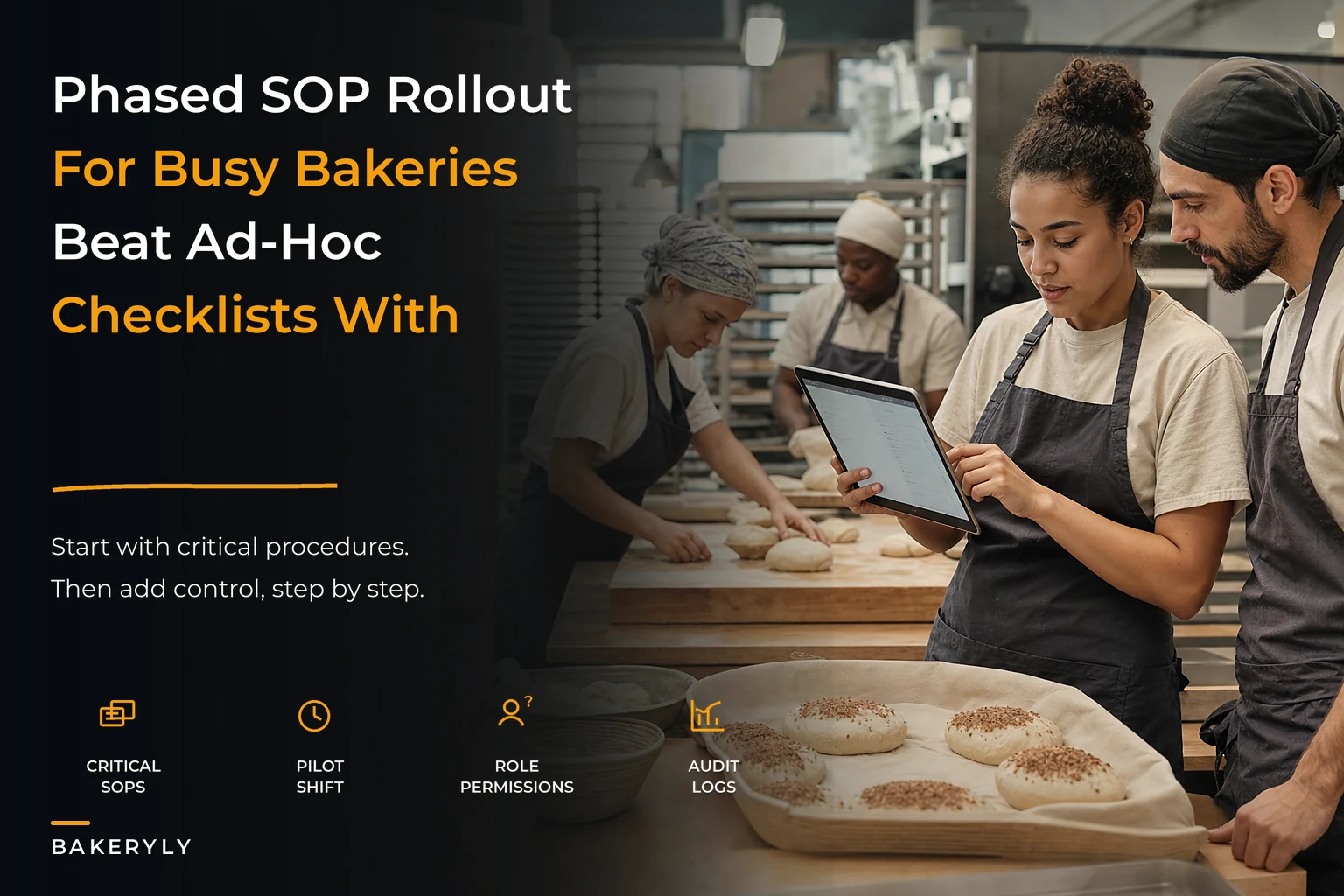
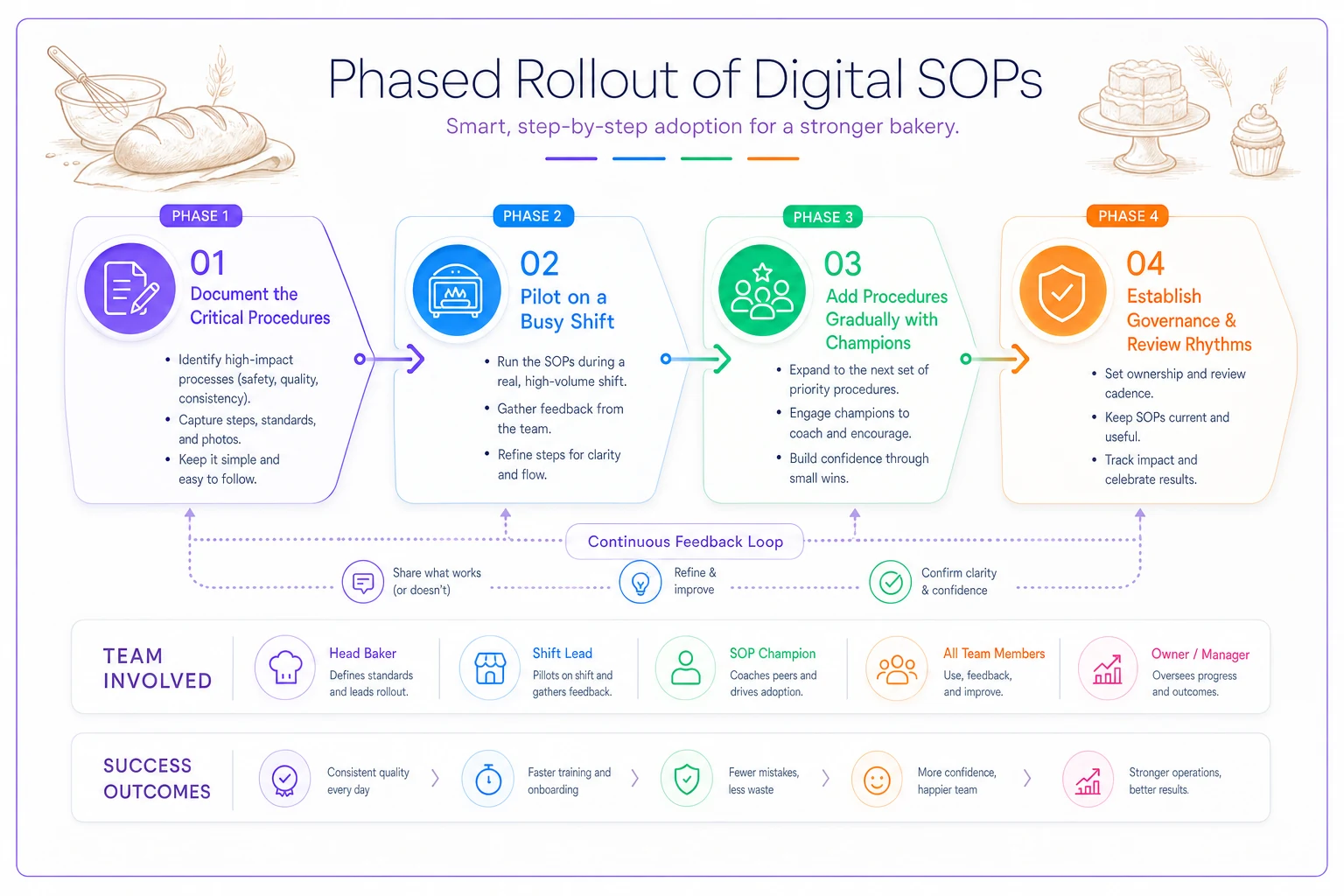
Rolling this out in phases is the only way it actually sticks. Trying to flip the whole operation to digital at once almost always fails—too much friction, too many people confused at the same time. The schedule below is what tends to work for bakeries in the 6–20 employee range.
Here's a simple phased schedule that tends to work for bakeries.
-
Phase 1 (Weeks 1–2)
Document critical three procedures → test with senior and new staff
-
Phase 2 (Weeks 3–4)
Pilot on one busy shift → identify friction points
-
Phase 3 (Weeks 5–8)
Add one procedure per week → assign champions per role
-
Phase 4 (Weeks 9–12)
Establish governance rules, review rhythms, approval chains
Weeks 1–2: Foundation setting
Start with your three critical procedures. Don't write novels—clear steps with photos where helpful. Test them yourself first, then have your most experienced staff try them, then your newest hire.
The newest person's feedback matters most. They don't have background knowledge to fill gaps. If they can't follow the SOP successfully, it needs work.
Weeks 3–4: Pilot program
Run one shift on digital SOPs. Not the easiest shift—a typical busy morning. Watch what breaks. What takes too long? What gets skipped? Where do people revert to old habits?
Common issues: not enough devices, WiFi dead zones, and interface confusion from too many clicks to find things. Fix these before expanding.
Weeks 5–8: Gradual expansion
Add one procedure per week. Focus on adoption over documentation. Five procedures everyone actually follows beats fifty that get ignored.
Each addition needs a champion—usually whoever does that task best. They help refine the SOP, train others, and provide social proof that this isn't just management's latest idea.
Weeks 9–12: Governance establishment
By now, patterns emerge. Which SOPs need frequent updates? Who should approve changes? How do you handle emergency modifications?
Simple rules: safety procedures need manager approval, recipe adjustments need testing documentation, equipment procedures can be updated by qualified operators. Getting this agreed on early avoids a lot of friction later.
Training templates for bakery teams
Skip generic training. Your decorators don't need briefings on bread mixing. Target training to actual roles.
| Role | Training Focus |
|---|---|
| Shift leads | Updating production schedules, reviewing completion logs, escalation procedures, shift-level audits |
| Production staff | Accessing SOPs from stations, marking tasks complete, reporting unclear instructions, understanding version updates |
| New hires | Basic navigation, finding role-specific procedures, mandatory vs. recommended steps, who to ask when confused |
Keep training sessions under 20 minutes. Do them at the actual workstation, not in an office. Practice the real workflow, not hypothetical scenarios.
The technology integration path
Modern bakery operations naturally generate data. Your production system tracks batch sizes and timing. Your staffing system shows who's working when. Digital SOPs bakery platforms tie these together.
When integrated properly, the system knows that Jane started the sourdough batch at 5:47 AM following SOP-BREAD-017 revision 3. If quality issues surface later, you can trace exactly what procedure was followed, by whom, and when.
This integration also surfaces patterns you'd never catch manually. If the standard proofing SOP consistently produces under-proofed product on humid days, that shows up in the data. You update the SOP with humidity-based adjustments, push it to all devices, and the fix is live immediately—not buried in a conversation someone might have next Tuesday.
AI automation adds another layer here. It can flag completion patterns that look off—if certain steps consistently take longer than allocated, either the time estimate is wrong or there's a training gap worth addressing. Either way, you're finding out from data rather than a customer complaint.
Measuring what matters
These are the metrics worth tracking as you roll things out. Not all of them matter equally in the first few weeks, but they tell a coherent story by month three.
| Metric | What It Tells You |
|---|---|
| Adoption rate | % of procedures completed digitally vs. on paper or from memory |
| Consistency improvement | Variation in product weights, bake times, and customer complaints before vs. after |
| Time savings per shift | Reduction in searching, clarification, and missed steps (typically 5–10 min/shift by month 3) |
| Audit performance | Health inspection scores, customer quality complaint volume |
Adoption rate tells you if the system is actually being used. Expect somewhere around 30% in week one and north of 80% by week twelve—though that timeline shifts depending on team size and how many procedures you're rolling out at once.
Consistency improvements show the real value. Compare product weights, bake times, and customer complaints before and after. Even a modest reduction in variation justifies the effort.
Time savings come slowly, then feel obvious. Initial implementation takes longer as people learn. By month three, digital checklists typically save somewhere between 5–10 minutes per shift through eliminated searching and clarification. Multiply that across all shifts and it adds up. Audit performance provides the hardest ROI—health inspection scores improve, customer quality complaints drop, and those outcomes translate directly to retained business and reduced risk.
Common resistance points and solutions
"We've always done it this way" comes up constantly. Don't fight tradition—frame digital SOPs as protecting and preserving the bakery's methods, not replacing them.
"Too complicated for our team" assumes a level of tech difficulty that isn't really there. Modern platforms work like social media apps. If your team uses Instagram, they can use digital SOPs.
"Another system to manage" usually reflects past frustrations with overcomplicated software. The right platform integrates with existing workflows rather than adding new ones. Scanning a QR code takes less effort than hunting for a binder.
"What if the internet goes down" is a fair concern but manageable. Systems cache critical procedures locally. Tablets store recent versions offline. Paper backups exist for real emergencies. But honestly—when did you last run a full shift with zero internet, no phones, no digital tools at all?
The governance framework that sticks
Keep rules lightweight but clear. Heavy governance kills adoption. Three principles cover most situations:
-
Change authority matches impact. Recipe changes need owner approval. Temperature logging procedures need manager approval. Cleaning sequence updates need shift lead approval. Everyone knows their lane.
-
Updates propagate immediately. No waiting for monthly meetings to push critical changes. If something needs fixing today, it gets fixed today.
-
Documentation without burden. Every change logs automatically—who, what, when, why. But nobody writes reports. The system captures this through normal usage.
Build review rhythms that fit bakery operations. Weekly shift lead meetings review the past week's logs. Monthly manager reviews examine trends. Quarterly owner reviews assess the system itself.
When digital SOPs actually become transformative
The shift happens around month four or so. Instead of asking "how do we do this?" people start asking "what does the SOP say?" Instead of quality varying by who's working, it stabilizes regardless of staff.
New hire onboarding drops from weeks to days. They can follow procedures immediately with digital guidance. Experienced staff stop hoarding knowledge because the system captures and shares it naturally.
More importantly, you stop fighting fires and start preventing them. That freezer that fails every few months? The logs show temperature creeping up weeks before failure. That product that sometimes comes out wrong? SOP completion data shows exactly which step gets skipped when things get rushed.
Beyond compliance to competitive advantage
Digital SOPs for bakeries start as a compliance tool but can genuinely become a differentiation strategy. When every product comes out consistently, customers notice. When new products roll out smoothly because procedures transfer clearly, growth becomes less chaotic.
Small bakeries often compete against chains with sophisticated systems. Digital SOPs level that playing field without requiring a corporate IT budget. You can match their consistency while keeping the artisanal quality that makes your place worth visiting—and you can adapt faster because your governance structure stays lightweight.
The bakeries still standing five years from now probably won't be the ones with the best recipes. Good recipes are everywhere. They'll be the ones executing consistently, improving systematically, and scaling without losing what made them good in the first place.
The question isn't really whether to digitize your procedures—it's whether to do it now while you have time to phase it properly, or later when some crisis forces your hand.