

Most bakeries market like they have unlimited ovens. The Instagram post goes up, the email blast fires, someone reposts the seasonal special — and by Thursday afternoon you've got 40 orders for a cake your team can only produce 25 of before the weekend rush eats the proof box space.
The problem isn't the marketing. The marketing worked. That's exactly what makes it dangerous.
When you look at the calendar in most small bakeries, marketing and production live in two completely different worlds. Marketing runs on a "post when we remember" rhythm, driven by whatever holiday is coming up or what looked good that morning. Production runs on a fixed capacity ceiling that barely moves — same ovens, same mixers, same number of hands at 4am. Nobody has drawn a line connecting the two.
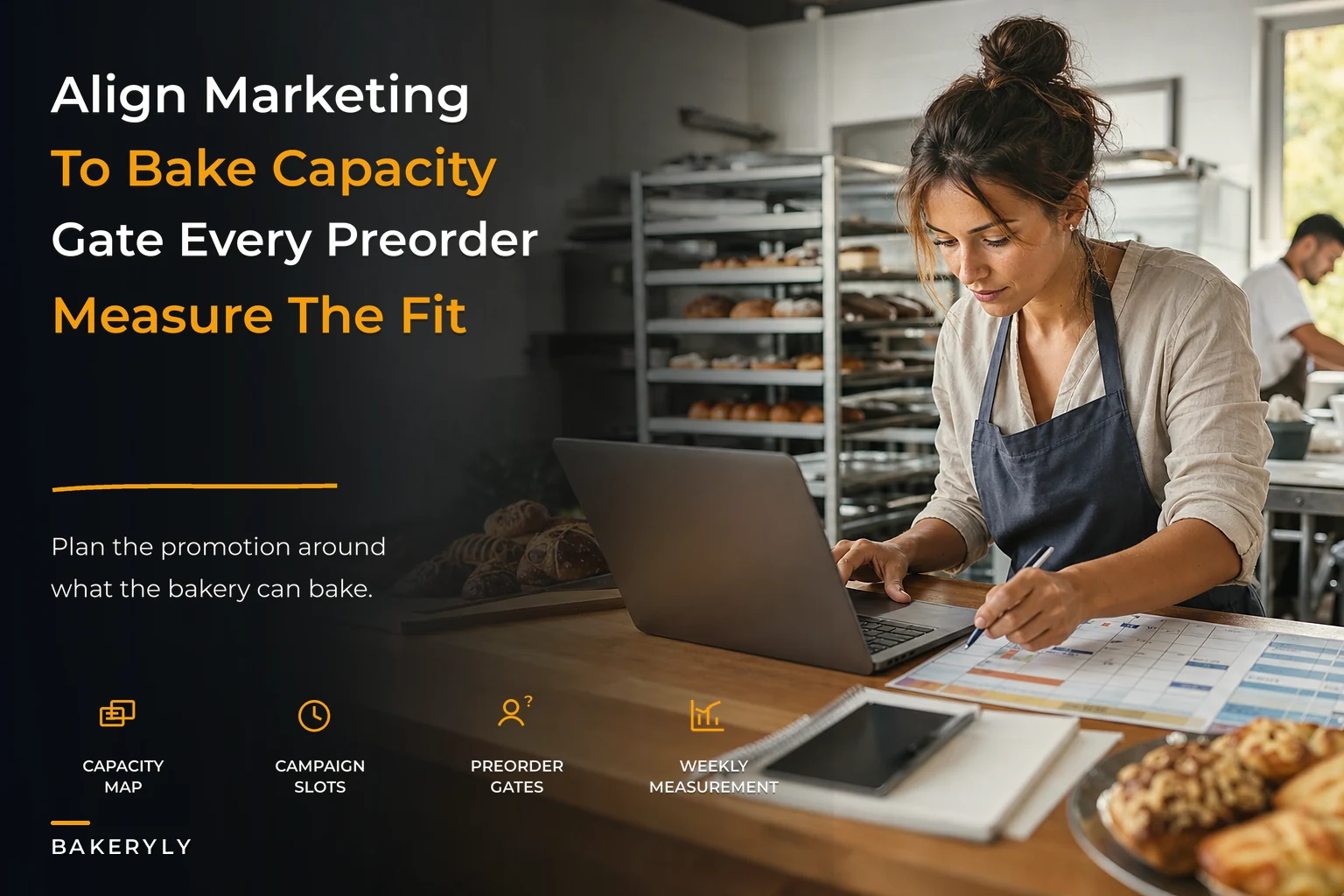
This piece is about drawing that line. The goal of proper bakery marketing production alignment isn't to market less. It's to make sure every promise you push out the door has a production slot already reserved behind it, so demand lands where you have room to catch it.
The gap that opens between a promo and a proof box
Here's a pattern that shows up constantly in bakeries hitting a growth wall: the marketing calendar and the production calendar were never the same document.
A typical example looks like this. A café-bakery doing maybe $18k–$22k a month decides to lean into fall. They plan a pumpkin cruffin, a maple loaf, and a "build your own box" for pickup. Marketing gets excited and stacks all three launches into the same two weeks because — fair enough — that's when the fall energy peaks.
But those three products share equipment. The cruffin ties up the lamination bench and the proof box. The maple loaf needs the same deck oven space during the same morning window. The box program pulls a decorator off custom orders. On paper, three products. In practice, one shared bottleneck getting hit from three directions at once.
Nobody modeled that. So the launches all land, sales look great for nine days, and then things fall apart: the cruffin sells out by 8:30 every morning (lost revenue), the maple loaf gets rushed and the crumb suffers (quality complaints), and two custom cake orders slip because the decorator got pulled — a much more expensive problem than the promo ever earned.
The marketing was a success by every metric marketing cares about. It was a failure by every metric the kitchen cares about. That disconnect is the whole ballgame.
What actually breaks as you scale
At low volume you can absorb misalignment through heroics. Someone stays late, someone comes in early, and the mismatch between what you promised and what you can bake gets papered over by unpaid effort. Survivable at one location doing modest numbers.
Never miss a bake or delivery again.
Bakeryly helps you schedule, track, and manage every order effortlessly.
- Unified order tracking
- Real-time inventory alerts
- Staff shift management
No credit card required
-
When custom and retail share the same team. The moment a promo pulls skilled labor off high-margin custom work, your marketing is actively cannibalizing your best revenue. Most owners never see this because the promo revenue is visible and the lost custom order is invisible.
-
When you add a second channel. Online preorders, wholesale, and walk-in each pull from the same production capacity but arrive on different clocks. A promo that spikes online orders can quietly starve your wholesale commitments, and wholesale is the account you actually can't afford to miss.
-
When you add a second location. Now "we'll just bake more" requires knowing which site has slack on which day, and nobody's tracking that at the promo-planning stage.
The underlying issue is that marketing decisions get made without a real number for available capacity on the specific days the demand will land. "We can probably handle it" is not a number. And "probably" is where margin goes to die.
The core idea: market against reserved capacity, not against hope
The fix is structural, not motivational. You don't need your marketing team to be more careful. You need the marketing calendar to physically reference production capacity before anything gets scheduled.
-
A calendarized marketing plan built on top of a capacity map, not next to it.
-
Preorder gating that caps demand at what you've actually reserved, with cutoffs that respect production lead times.
-
A measurement cadence that tells you whether your capacity assumptions were right, so next month's plan gets sharper instead of just louder.
Step one: build the capacity map first
Before a single promo goes on the calendar, you need a plain-language map of what your production line can produce per day by constraint — not by product, by constraint. Ovens, lamination bench, decorator hours, proof box slots. These are the things that actually run out.
| Constraint | Daily capacity (units/hours) | Typically consumed by baseline | Slack available for promos |
|---|---|---|---|
| Deck oven (morning window) | ~14 bake loads | ~10 loads | ~4 loads |
| Lamination bench | ~600 laminated units | ~400 | ~200 |
| Decorator hours | ~16 hrs | ~11 hrs | ~5 hrs |
| Proof box slots | 12 racks | 9 | 3 |
The point of this table isn't precision to the decimal. It's to make the ceiling visible. Once you can see that you have roughly 4 spare oven loads and 5 decorator hours on a normal Wednesday, your marketing calendar suddenly has real edges. You stop planning three lamination-heavy launches in the same week because you can see that the bench only has 200 spare units and each product wants 120.
The mistake people make here is mapping capacity by finished product ("we can make 200 croissants"). That falls apart the second two products share a step. Map the shared steps, and the conflicts reveal themselves.
Step two: layer the marketing calendar on top
Now the marketing plan gets built against that map. Every promo gets tagged with which constraint it consumes and how much. When you drop a launch onto a week, you're not just picking a date — you're spending a specific amount of a specific constraint.
This is where the calendar starts protecting you automatically. If the pumpkin cruffin eats 150 lamination units and the maple loaf eats 80, and your slack is 200, those two can't both launch hard in the same week. One moves. The decision gets made in planning, calmly, instead of at 6am on a Saturday, frantically.
-
Launch date and end date
-
Primary constraint consumed
-
Estimated units to reserve
-
Preorder cutoff date/time
-
Channel(s) it runs on
The teams that do this well treat the marketing calendar and the production plan as one artifact with two views, not two files that occasionally get compared. This connects directly to how a full end-to-end production system moves orders through batching and into production — the marketing calendar is really just the front door of that same pipeline.
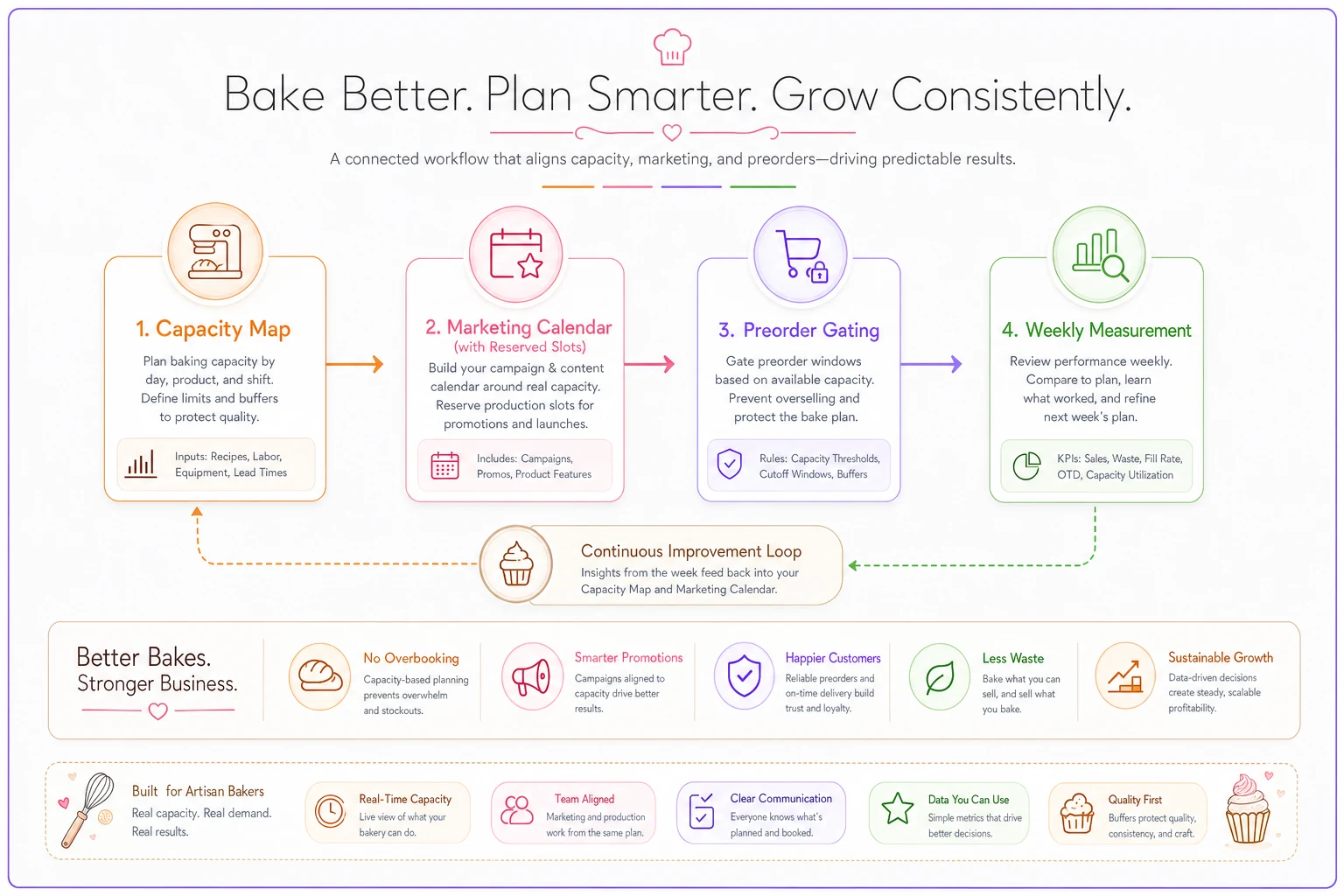
A quick visual of the workflow follows.
Step three: gate the preorders
Marketing against capacity only holds if demand can't overshoot the reservation. That's what preorder gating does. You publish the promo with a hard cap and a cutoff, and when the cap is hit, ordering closes.
-
Cap to reserved capacity, not to hoped-for capacity. If you reserved 60 cruffins for preorder, sell 60 slots — not 90 because "some people won't show." Overselling perishables is how you turn a marketing win into a refund pile.
-
Set cutoffs off your longest lead-time step, plus a buffer. If lamination needs to start the night before, the preorder cutoff is not "midnight before pickup." It needs to be early enough that your production plan is locked before the mixer turns on. A cruffin preorder that closes Thursday 6pm for Saturday pickup gives the kitchen a real, final number to bake to.
Put the preorder cutoff clearly in all channel headers so early buyers see the deadline before they click through.
The subtle payoff here: gating gives you clean production numbers. Instead of forecasting demand and hoping, you're baking to a closed count. Waste drops, sell-outs become intentional, and your morning crew stops guessing.
Step four: measure on a cadence tied to capacity, not vanity
Most bakeries measure marketing with reach and engagement. Useful for social, useless for production. The metrics that matter for bakery marketing production alignment are the ones that tell you whether your capacity bets were right.
-
Sell-through vs. reserved — did you sell the 60 you reserved, or 38? Reserving too much is quiet waste; reserving too little is left-on-the-table revenue.
-
Cutoff fill rate — how full was the cap by the cutoff? Consistently hitting 100% early means you under-reserved and could push harder next time.
-
Constraint utilization on promo days — did the shared bottleneck stay under its ceiling, or did the promo force overtime and quality shortcuts?
-
Spillover damage — did any promo delay custom or wholesale work? Almost nobody tracks this, and it's usually the most expensive number on the board.
The cadence matters more than the sophistication. A rough number reviewed every week beats a beautiful dashboard reviewed every quarter. You're trying to make next month's calendar smarter, and that only happens if last week's results are still fresh when you plan.
Templates and examples you can actually copy
A preorder promo brief (one card per launch)
``
PROMO: Maple Pecan Loaf — Fall Preorder
Run window: Oct 7–Oct 26 (pickup Sat only)
Primary constraint: Deck oven (morning) — 2 loads/Sat
Reserved capacity: 48 loaves/Sat
Preorder cutoff: Thursday 6:00pm
Channels: email + online store + in-store card
Cap logic: close at 48, waitlist opens
Measurement: sell-through, cutoff fill %, oven util on Sat
``
Photo / shot list for the launch
-
Hero shot — single loaf, cut, crumb visible, natural window light. This is the email header and the store thumbnail.
-
Context shot — the loaf on a real table with coffee. Signals "this is your weekend."
-
Process shot — hands scoring or the maple glaze going on. Builds trust and reads as authentic, not stock.
-
Cutoff-reminder shot — a plain graphic or reused hero with "Preorder closes Thursday 6pm" text overlay. This is the shot that actually protects your production number by driving orders before the cutoff.
Copy templates that respect the gate
Launch email subject: "Maple pecan loaf is back — Saturday pickup, limited batch"
Body (short version): > Our fall maple pecan loaf returns this Saturday. We're baking a limited batch each week, so preorder to lock yours in. Orders close Thursday at 6pm — after that, whatever's left goes to the counter Saturday morning (and it usually doesn't last).
Cutoff-day reminder: > Last call — maple pecan preorders close at 6pm today for Saturday pickup. A few slots left.
Notice what the copy does operationally: it makes the cutoff a feature, not an apology. "Limited batch" and "usually doesn't last" convert the constraint into demand pressure that lands before your production number locks — which is exactly when you need it.
A real scenario: the fall the numbers finally matched
A single-location bakery-café, roughly $20k/month, kept blowing up its own weekends every fall. Three seasonal items, all launched in the same stretch, all fighting for the lamination bench and one decorator. The visible result was strong seasonal sales. The invisible result was two or three slipped custom cake orders each month and a steady trickle of sold-out disappointment.
They rebuilt the fall plan around a capacity map. Lamination slack was about 200 units a day; the decorator had maybe 5 spare hours. So the three launches got staggered across the calendar instead of stacked — cruffin one fortnight, loaf the next, box program on a separate weekly cadence. Each got a reserved cap and a Thursday cutoff.
The changes that followed were undramatic but real: preorder sell-through settled around the high 80s to low 90s percent (versus wild over- and under-baking before), custom orders stopped slipping during promo weeks, and Saturday morning overtime dropped noticeably because the crew baked to a closed number instead of guessing. Seasonal revenue was about the same on paper — but the margin behind it was cleaner, because they weren't refunding sold-out preorders or eating the cost of a delayed wedding cake.
The lesson wasn't "market less." It was "market in a sequence your ovens can actually keep up with."
When this system makes sense — and when it doesn't
It makes sense when you have shared production constraints (one lamination bench, one decorator, a fixed oven window), more than one sales channel, or a history of promos causing sold-outs, quality dips, or slipped custom work. If any of those sound familiar, the calendar-plus-capacity approach pays for itself fast.
It's overkill when you're a very small operation with a single product line, plenty of oven slack, and demand that never brushes your ceiling. If you genuinely cannot sell out, gating just adds friction. Don't build machinery for a bottleneck you don't have.
Who should hold off for now: brand-new bakeries still figuring out what people want. You need a few months of baseline sales before your capacity map means anything, and premature gating can suppress the very demand you're trying to learn from. Get your baseline first, then layer this on.
Where lightweight tooling helps — and where it doesn't
You can run all of this on a shared spreadsheet and a printed calendar, and plenty of bakeries do exactly that at first. The manual version breaks in two spots: keeping the capacity map current as recipes and staffing shift, and enforcing preorder caps in real time across channels without someone constantly refreshing order counts.
That's the point where an operational platform that connects your preorder counts to your production plan starts earning its keep — closing a cap automatically when the reserved number is hit, flagging when two scheduled promos are about to collide on the same constraint, and rolling last week's sell-through into next week's planning view. The value isn't the software doing anything clever. It's removing the manual reconciliation that quietly fails on your busiest weeks — which are, of course, exactly the weeks you can't afford a mistake.
If you're refining the demand-shaping side of this — how price and display nudge which products sell before the cutoff — it pairs well with structured front-of-house pricing and display experiments, so your gated products are also the ones your merchandising is actively pushing.
Pulling it together
The bakeries that grow without burning out their teams aren't the ones with the flashiest marketing. They're the ones where every promise on the marketing calendar has a production slot already holding its place. Capacity map first. Marketing calendar built on top. Preorders gated to what you reserved. Results reviewed weekly so the next plan is sharper, not just louder.
Get those four pieces working together and the classic fall meltdown — great sales, wrecked kitchen — stops happening. You'll still sell out sometimes. But you'll be selling out on purpose, with custom orders untouched and the crew leaving on time. That's what real bakery marketing production alignment looks like in practice: not marketing that shouts louder, but marketing your ovens can actually keep up with.
The bakeries that grow without burning out their teams aren't the ones with the flashiest marketing. They're the ones where every promise on the marketing calendar has a production slot already holding its place. Capacity map first. Marketing calendar built on top. Preorders gated to what you reserved. Results reviewed weekly so the next plan is sharper, not just louder.
Get those four pieces working together and the classic fall meltdown — great sales, wrecked kitchen — stops happening. You'll still sell out sometimes. But you'll be selling out on purpose, with custom orders untouched and the crew leaving on time. That's what real bakery marketing production alignment looks like in practice: not marketing that shouts louder, but marketing your ovens can actually keep up with.
Ready to elevate your bakery operations?
Join 2,000+ bakeries using Bakeryly to streamline workflows, reduce waste, and delight more customers.