

Most bakery cold-chain problems don't look like cold-chain problems. They look like a soggy croissant tray at 8:40am, a mousse cake that "sweated" on the counter before pickup, or a walk-in suddenly running at 44°F because someone stacked six sheet pans in front of the evaporator fan during the morning rush.
The refrigeration didn't fail. The sequencing failed. Things went into cold storage in the wrong order, at the wrong time, in the wrong spot — and the physical layout of the cold chain got overwhelmed by the flow of the shift.
This post is narrowly about that: bakery cold chain staging built around time-coded staging maps and load plans tied to your actual service windows. Not food-safety theory. Not a HACCP rewrite. Just the operational choreography of moving product through intake → staging → pickup without blowing your temperatures or your morning.
The specific failure: everything hits the walk-in at once
Here's the pattern that shows up constantly in shops doing $8k–$15k weeks with a single walk-in and one reach-in. Overnight bake finishes around 4:30–5:00am. At the same time, the AM decorator is pulling buttercream cakes to stage for a 9am corporate pickup. The mousse and entremet orders from yesterday need to come out of the blast area and into holding. Dairy delivery lands around 6. And someone's cramming proofing racks wherever they fit. For about a 90-minute window, your cold storage is doing four incompatible jobs at once:
-
Pulling down hot-adjacent product
-
Holding finished decorated goods at display-stable temp
-
Storing raw incoming ingredients
-
Buffering pickup orders that need to leave cold and arrive cold
The walk-in wasn't sized for four simultaneous jobs. It was sized for storage. So when you open that door fifteen times in twenty minutes and pack the airflow paths with sheet pans, the internal temperature climbs, recovery lags, and the stuff that's most temperature-sensitive — Italian meringue buttercream, cream cheese frostings, anything gelatin-set — is exactly what's sitting closest to the door because it went in last.
That's the whole problem in one sentence: the most fragile product gets the worst position at the worst time.
Why "just put it in the fridge" quietly breaks down
A few things compound here, and none of them are obvious until you actually map them out.
Never miss a bake or delivery again.
Bakeryly helps you schedule, track, and manage every order effortlessly.
- Unified order tracking
- Real-time inventory alerts
- Staff shift management
No credit card required
Airflow, not just temperature. A walk-in holding a solid 38°F on the thermometer can still have a warm pocket near the door and a dead zone behind a stacked rack. Product doesn't care what the display says; it cares about the air actually touching it. Blocking the evaporator with a proofing rack creates a warm shadow that a wall thermometer never sees.
Door-open recovery. Every open costs you. In a small under-counter reach-in, a 30-second open during a busy pull can take several minutes to recover. Stack ten opens in a rush and you're running warm for a solid chunk of the morning.
Thermal mass fighting itself. Warm-ish product — say, a cake that came out of decorating at room temp — put next to something already cold and stable will steal cold from its neighbor. You've effectively turned your finished-goods holding into a slow blast chiller. A bad one.
SKU life is short and uneven. A pain au chocolat staged cold and pulled to a proofer has a different clock than a gelatin mousse that can never warm past a certain point without slumping. Treating them both as "refrigerated goods" flattens real differences that matter a lot at 8am.
Cold storage in a small bakery isn't one resource. It's several competing resources sharing one box, and the fight between them peaks precisely during your tightest service window.
The fix: a time-coded staging map
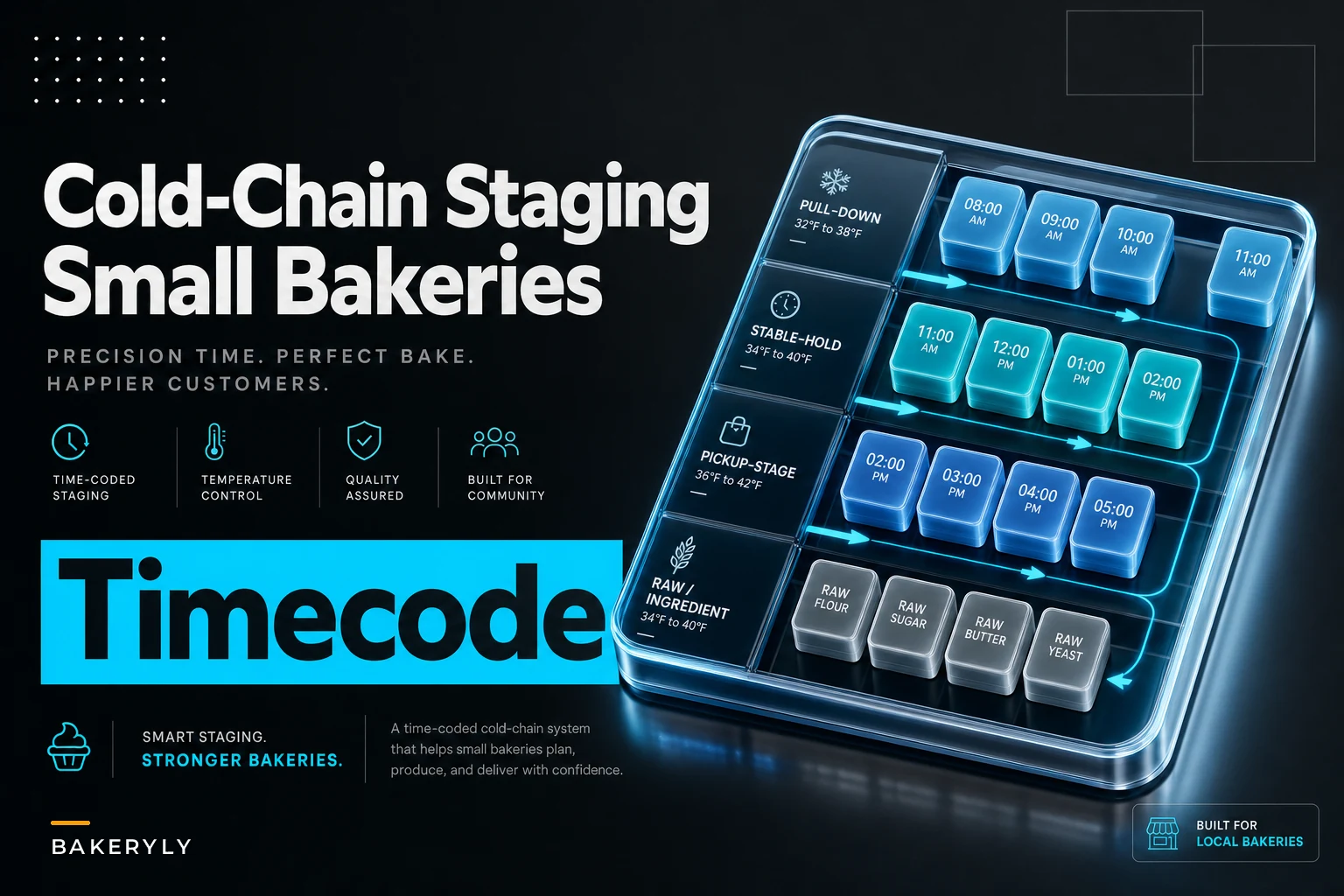
More refrigeration doesn't solve this. A staging map does — a physical diagram of your cold storage with zones assigned by function and time, not just by shelf.
-
Assigning fixed zones to fixed jobs (spatial)
-
Assigning time blocks to those zones so conflicting jobs never peak together (temporal)
Step 1: Zone your cold storage by function
Walk your walk-in and reach-ins and draw them. Then assign every shelf and section to one of these roles:
-
Pull-down zone — nearest the evaporator, coldest, best airflow. For product that needs to lose heat fast (recently decorated cakes, anything room-warm going cold).
-
Stable-hold zone — mid-box, steady air, away from the door. For finished decorated goods that are already cold and just need to stay put.
-
Pickup-stage zone — nearest the door, but only used in a tight window right before pickup. Everything here is already at temp and boxed.
-
Raw/ingredient zone — separate, ideally a different unit, never mixed with finished goods.
The move most shops get wrong: the door-adjacent shelf should hold the least sensitive thing for most of the day, and only become the pickup-stage zone in the final 20–30 minutes before an order leaves. Sensitive stuff lives deep and cold until the last possible moment.
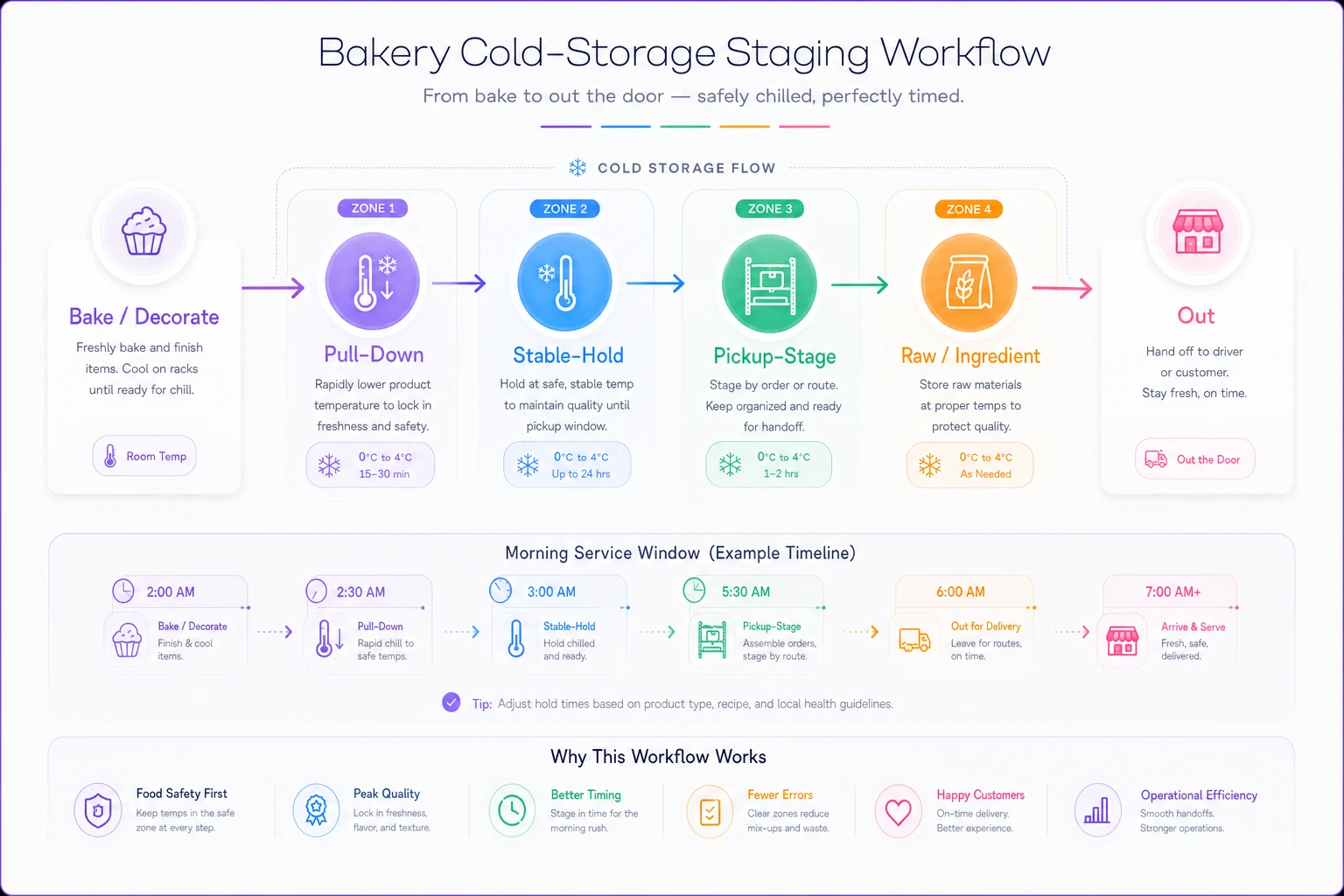
Here's a quick visual of how zones and time blocks interact.
Step 2: Time-code the zones to your service windows
Overlay time. Pick your real pickup windows and work backward. A simplified map for a shop with a 9am corporate pickup and 10am retail open might look like this:
| Time block | Pull-down zone | Stable-hold zone | Pickup-stage zone (door) |
|---|---|---|---|
| 4:30–6:00 | Overnight decorated cakes cooling | Yesterday's mousse orders | Empty / raw buffer |
| 6:00–7:30 | AM buttercream cakes pulling down | Corporate cakes holding | Empty |
| 7:30–8:45 | Cleared | Retail case product staging | Corporate order moves in, boxed |
| 8:45–9:15 | — | Retail product | Corporate pickup pulls from here |
| 9:15–10:00 | Next batch | Retail case refills | Cleared, wiped |
The point of the table isn't the exact times — yours will differ. It's that the door zone is empty when the pull-down zone is busy, and only fills in the final window. You've de-conflicted the two jobs that were previously fighting during the same 90 minutes.
The load plan: sequence of pans, not just placement
Placement tells you where. The load plan tells you in what order and how much at once. This is what protects airflow.
-
Load coldest-recovery items first, single layer, spaced. Recently decorated cakes go into the pull-down zone with gaps between pans so air moves. No stacking in this zone, ever.
-
Never block the evaporator face. Keep at least a hand's-width clearance in front of the fan. If a rack has to go somewhere, it goes to the wall, not the fan.
-
Batch your door-opens. Instead of opening for each individual pull, stage a rolling cart outside the box, do one open to load or pull three or four things, close. Cut fifteen opens down to four or five.
-
Move stable product deep, fragile product deeper. Anything gelatin-set or buttercream-covered goes to the coldest stable air, farthest from the door swing.
-
Stage pickups last and boxed. Boxing before it hits the door zone means the pickup move is a grab-and-go, not a rummage that holds the door open for an extra 45 seconds.
In plain terms, product flows like this: bake/decorate → pull-down (deep, cold, spaced) → stable-hold (deep, steady) → pickup-stage (door, boxed, last minute) → out. Fragile SKUs spend the maximum time in cold, stable air and the minimum time near the door.
Temp-check cadence tied to production windows
Random spot-checks miss the moments that matter. Tie your checks to the events that stress the system, not the clock alone.
-
Baseline check at start of shift, before any pulling — confirms overnight recovery.
-
Post-load check right after the heavy AM load-in — this is the moment the box is most stressed. If you're going to run warm, it's now.
-
Pre-pickup check on the pickup-stage zone, 15 minutes before the order leaves — confirms it's actually at temp before it goes out the door.
-
Post-rush check after the morning wave clears — confirms recovery.
Log the number, the zone, and who checked. Four tied-to-event checks beat eight random ones because they land on the moments the system is most likely to fail. If your post-load check is consistently 3–5 degrees warmer than baseline, your load plan is overwhelmed — you're loading too much too fast, blocking airflow, or both.
This connects directly to equipment reliability. A box that recovers slowly might be a load-plan problem or an early sign of a failing unit, and the two look similar until you rule one out. A steady preventative maintenance schedule gives you the baseline recovery numbers to tell the difference. If recovery suddenly worsens with the same load discipline you've run for months, that's mechanical, not procedural.
A real scenario
A single-location bakery-café doing roughly $11k–$13k weeks, one walk-in and two reach-ins, had a recurring problem: about two mornings a week, a corporate buttercream order would arrive at pickup with a slightly "wept" or softened finish. Not spoiled — just visibly not right. A couple of complaints a month, an occasional remake, and a growing worry about losing the account entirely.
When they mapped it, the cause was obvious. The corporate cakes were being finished around 7am and left in the door-adjacent reach-in — the exact spot getting hammered with door-opens as the AM crew pulled case product for the 10am open. That shelf was running several degrees warm through the whole 7–9 window.
The fix was purely sequencing. Finished corporate cakes moved to the deep stable-hold shelf of the walk-in until 8:45. The reach-in door shelf stayed empty until then. The order got boxed, then moved to the door zone only in the final 15 minutes. They added a pre-pickup temp check on that zone.
The weeping mostly stopped within the first couple of weeks. Remakes on corporate orders dropped to maybe one a month, usually for unrelated reasons. No new equipment, no new fridge — just a staging map and a load order.
When this makes sense — and when it doesn't
Worth building if:
-
You run tight, clustered pickup windows (corporate AM, catering, subscription pickups)
-
You have one or two cold units doing multiple jobs simultaneously
-
You produce anything temperature-fragile
buttercream, mousse, gelatin sets, cream fillings, laminated dough
Probably overkill if:
-
You have generous, dedicated cold storage with separate units per function already
-
Your product is forgiving — mostly enriched breads, dense bars, shelf-stable items
-
Your pickups are spread evenly across the day with no real clustering
A very small operation with one reach-in and low volume probably doesn't have the conflict this solves. The problem only appears when multiple cold-chain jobs collide in time. No collision, no need for a map.
Making the map stick
A staging map that lives in someone's head disappears the day they call in sick. Two things keep it alive.
First, laminate it and post it on the box. The zones, the time blocks, the load order — physically on the door. This pairs naturally with the kind of shift-level discipline described in an on-the-day triage playbook: when things go sideways, people default to whatever's written down and visible, not to memory.
Laminate the map and attach a dry-erase marker so staff can mark temporary adjustments during surges without defacing the master copy.
Second, assign the temp-check log to a role, not a person. "The opening decorator does the post-load check" survives staff turnover in a way that "Marcus does it" never will.
The reason this whole approach works isn't sophistication — it's that it treats your cold storage as what it actually is during the rush: a few contested resources fighting over one box. Once you separate those jobs in space and stagger them in time, the fights stop, the temperatures hold, and the fragile product spends its life exactly where it should — deep, cold, and undisturbed until the moment it walks out the door.
Ready to elevate your bakery operations?
Join 2,000+ bakeries using Bakeryly to streamline workflows, reduce waste, and delight more customers.