

Your mixer dies at 6am on Saturday. You've got 47 pre-orders due by noon, a line forming at the counter, and your lead baker just called to say the proofing cabinet's running cold.
The bakery day-of incident playbook that actually works
Three years watching bakery operations crack under pressure taught me one thing: the pattern's always the same. Equipment failure or an unexpected surge hits, everyone scrambles, and by closing you've got angry customers, wasted product, and exhausted staff who swear they're quitting tomorrow.
The bakeries that survive these days without total chaos all have one thing in common—a physical, laminated checklist that lives at each station. Not buried in a binder. Not on someone's phone. Right there, under the counter, ready to grab when things go sideways.
Building your triage priority matrix
Your bakery day-of incident playbook starts with accepting something uncomfortable: you can't save everything, so you better know what to save first.
Most bakeries handle incidents based on whoever's yelling loudest. The wholesale client threatening to cancel. The birthday cake customer having a meltdown at the counter. Your own anxiety about Yelp reviews. That reactive approach almost guarantees you'll make the wrong call.
Here's the priority matrix that keeps you operational:
Priority Level 1: Health & Safety Blockers
-
Anything that could cause injury (broken equipment with exposed parts, gas leaks, electrical issues)
-
Temperature violations that risk food safety
-
Allergen cross-contamination risks
Priority Level 2: Contractual Obligations
-
Wholesale orders with penalty clauses
-
Pre-paid custom orders over $75
-
Standing orders for regular commercial clients
Priority Level 3: Recovery Possible
-
Walk-in customers (can offer alternatives)
-
Standard pre-orders under $75 (can offer credit/refund)
-
Display case items (can substitute similar products)
Priority Level 4: Profit Protection
-
High-margin specialty items
-
Items with expensive ingredients already prepped
-
Products that can be frozen and sold later
What makes this actually work is assigning specific team members to each priority level during an incident. Your most experienced person handles Levels 1 and 2. Everyone else works Levels 3 and 4. No overlap, no confusion, no stepping on each other.
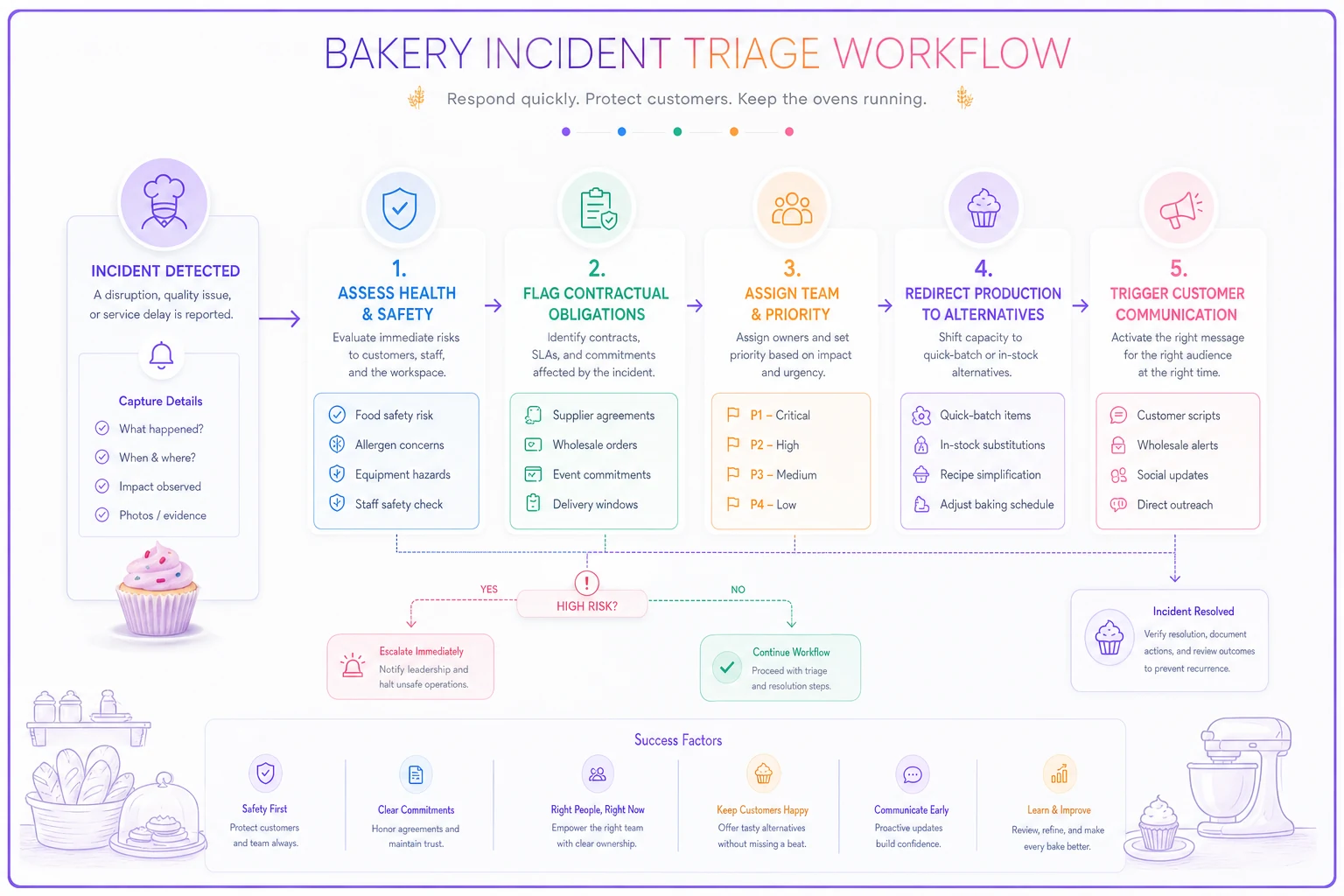
A simple workflow visual is an easy thing to pin up at the station so the team can follow steps without thinking.
Quick-batching alternatives when production breaks
When your deck oven goes down mid-shift, you need immediate alternatives that don't require a complete production overhaul. This is where quick-batching saves you.
Instead of trying to maintain your normal production flow with broken equipment, you shift to emergency batching mode. Group products by:
-
Temperature requirements (everything that needs 350°F goes together)
-
Equipment needs (all mixer-dependent items in one batch)
-
Finishing time (items that can sit vs. must-serve-fresh)
A bakery I worked with had their convection oven fail during their busiest Saturday in December. Instead of panicking, they switched immediately to their quick-batch protocol:
-
Moved all bread production to their remaining deck oven
-
Shifted pastries to their small countertop convection unit
-
Converted planned croissants to faster-baking Danish (same dough, different shape)
-
Pushed cookies to their backup home ovens in the break room
They filled around 89% of their orders that day. Not perfect, but way better than the total meltdown that usually happens in that situation.
The key is having these alternatives mapped out before disaster strikes. Your quick-batch alternatives sheet should list each product category, minimum equipment needed,
| Product Category | Minimum Equipment | Acceptable Substitution | Time Adjustment |
|---|---|---|---|
| Breads | Deck oven | Focaccia or flatbread | +10–20 min |
| Pastries | Countertop convection | Danish instead of croissant | −5 min |
| Cookies | Any oven | Bar cookies instead of drop | −3 min |
| Cakes | Standard convection | Sheet cake instead of layered | −15 min |
acceptable substitutions, and time adjustments required.
The reschedule decision matrix that prevents rage-quits
Not everything can be saved. The sooner you accept that, the sooner you can make smart rescheduling decisions that keep customers from going nuclear.
Your reschedule matrix needs three components.
Component 1: Time sensitivity scoring
-
Birthday cakes for today
10
-
Wholesale morning delivery
9
-
Pre-ordered dinner rolls
7
-
Weekly bread subscription
4
-
Frozen cookie dough order
2
Component 2: Customer lifetime value check
-
New customer
Protect at all costs
-
Regular (weekly)
Strong preference to fulfill
-
Occasional (monthly)
Standard handling
-
One-time large order
Evaluate case-by-case
Component 3: Remake complexity
-
Under 30 minutes
Attempt same-day recovery
-
30–90 minutes
Offer next-day with discount
-
Over 90 minutes
Full reschedule with compensation
When everything feels urgent, this framework stops you from making emotional decisions that tank customer relationships.
Communication scripts that defuse customer meltdowns
The difference between an understanding customer and a screaming one-star review often comes down to the first 30 seconds of the conversation. Your team needs exact scripts, not general guidelines.
For equipment failure situations:
"We've had an equipment failure this morning that's affecting some orders. I can see you had [specific item] ordered. I can either substitute with [specific alternative] right now, or priority-remake yours for tomorrow morning with 20% off your next order. Which would work better for you?"
For ingredient shortage:
"Our supplier had a delivery issue with [ingredient], which affects your [product]. I can make it with [substitution]—it'll taste nearly identical but I wanted to check for any allergies first. Or I can remake it Tuesday with the original ingredients plus a free pastry for the inconvenience."
For time delays:
"Your order is going to be about [specific time] late due to unusual volume this morning. If that doesn't work, I can refund immediately and throw in a free coffee for wasting your time. Otherwise, I'll text you the moment it's ready."
Notice what these scripts do: they lead with the actual problem, offer specific alternatives instead of vague promises, give the customer control over the solution, and include concrete compensation rather than "we'll make it right."
Train your team to deliver these word-for-word. When stress is high, nobody improvises well. The script removes thinking from the equation.
Operational software that handles triage automatically
The laminated checklist works well on its own, but modern bakery operations software can take your incident response further. Instead of manually tracking priorities and customer communications during chaos, AI-powered operational platforms can automatically trigger your triage protocols the moment something goes wrong.
When equipment fails or surges hit, the software can immediately flag affected orders by priority level, generate reschedule options based on your matrix, send customer notifications using your pre-approved scripts, and document everything for post-incident review—while your team stays focused on actually fixing the problem rather than managing phone calls and spreadsheets.
The production management systems that connect directly to your incident protocols are especially useful here, because when production breaks down, customer communication can happen automatically without anyone having to remember to do it.
The post-incident protocol everyone skips
Most bakeries handle the crisis, close up, and never talk about it again. Three months later the same disaster hits and everyone scrambles the exact same way.
Your post-incident protocol needs to happen within 24 hours, while details are still fresh.
Immediate documentation (same day):
-
What failed and when
-
Which products were affected
-
How many orders were impacted
-
What alternatives were used
-
Which customers complained
Team debrief (next day):
-
What worked from the playbook
-
What didn't work
-
What wasn't in the playbook but should be
-
Who handled what well
-
Where communication broke down
Playbook updates (within 48 hours):
-
Add new scenarios encountered
-
Adjust priority levels based on outcomes
-
Update scripts based on customer responses
-
Revise quick-batch alternatives that failed
-
Document equipment-specific workarounds that succeeded
One bakery I know turned their disaster days into their biggest operational improvements. Their oven failure in March taught them to pre-stage backup equipment connections. Their Mother's Day surge revealed they needed clearer handoff protocols between morning and afternoon shifts. Each incident made their playbook a little stronger.
Making the playbook actually stick
A beautiful playbook that nobody uses is worthless. The physical format matters more than most people think.
Your bakery day-of incident playbook needs to be laminated (flour-covered hands destroy paper), stationed at each work area rather than centralized, color-coded by priority (red for critical, yellow for standard), updated quarterly so outdated info doesn't trip anyone up, and practiced monthly so the response becomes muscle memory.
The practice runs are what separate functional playbooks from wall decoration. Once a month, throw a fake crisis at your team. "The mixer just died. Go." Time how long it takes them to grab the checklist, identify priorities, and start executing alternatives.
Time your monthly drills and log results to track improvement.
Drills reveal gaps fast. Maybe your scripts don't cover wholesale clients properly. Maybe your quick-batch alternatives assume equipment you don't actually have. Maybe your newest hire has never even seen the playbook.
Real bakery, real results
A 2,400-square-foot bakery in Austin implemented this exact triage system after their third equipment failure in six months nearly cost them their biggest wholesale account.
Before the playbook: each incident averaged 31 customer complaints, around $1,900 in refunds, and at least one staff member quitting within the week.
After three months with the laminated playbook, their next major incident—a convection oven failure on a Saturday—resulted in 7 complaints, $340 in refunds, and zero staff turnover. They saved 73% of their orders that day using quick-batch alternatives, and their communication scripts prevented any contract cancellations.
The owner said the biggest change wasn't the operational efficiency. It was team confidence. "Everyone knew exactly what to do. No panic, no yelling, just execution."
The incidents you haven't planned for
Your playbook will never cover everything, but it should cover the scenarios that actually kill bakeries:
-
Power outage during morning production
-
Refrigeration failure overnight
-
Mixer breakdown mid-batch
-
Oven failure during peak hours
-
Proofer malfunction affecting timing
-
Water supply issues
-
Key ingredient contamination
-
Staffing shortage from illness
-
POS system crash during rush
-
Delivery vehicle breakdown
For each scenario, you need immediate safety checks, a customer impact assessment, alternative production paths, communication triggers, and recovery timelines. One page per scenario is plenty. But that page needs to be specific to your bakery, your equipment, your customer base—not generic advice lifted from somewhere else.
Why simple beats sophisticated
Bakeries fail during incidents because they overcomplicate the response. They try to save everything, communicate perfectly with everyone, and maintain normal quality standards while the operation is falling apart.
The laminated playbook works because it forces simplicity. No logging into systems. No searching through documents. No calling the owner for permission. Grab it, read it, execute.
When disaster hits at 5am on a holiday weekend, muscle memory is all you've got.
Making peace with imperfection
The hardest part of incident response isn't the operational challenge—it's accepting that some customers will be unhappy no matter what you do.
Your playbook's job isn't to achieve perfection. It's to minimize damage, preserve key relationships, and keep your team functional enough to open tomorrow. A bakery that handles incidents at 75% effectiveness consistently will outlast one that alternates between 95% success and complete meltdown.
Each incident teaches you something. Each playbook iteration gets a little better. Each drill builds more confidence. The goal isn't to prevent all problems—it's to handle them without destroying your business or your sanity.
That laminated sheet under your counter isn't just an emergency tool. It's the difference between a bad day and a business-ending disaster.
The investment that pays for itself
Building your complete bakery day-of incident playbook takes roughly 8–12 hours upfront. Laminating costs maybe $20. Monthly training runs eat up an hour.
Compare that to the cost of one botched Saturday. Lost revenue, refunds, overtime to fix mistakes, customer acquisition costs to replace angry defectors—easily $2,000–$5,000 for a small bakery.
It pays for itself the first time you actually use it. More than that, it transforms incidents from team-destroying nightmares into manageable operational problems. Your best employees stop quitting after bad days. Customer relationships survive the occasional failure. Your reputation recovers quickly instead of spiraling on social media.
Start with Saturday morning scenarios
Don't try to build the complete playbook overnight. Start with your highest-risk scenario—probably Saturday morning equipment failure.
Map out exactly what happens if your main oven dies at 6am on your busiest day. Who does what? What gets saved? What gets sacrificed? How do customers find out? Laminate that single page and put it under the counter. Run one drill with your team. See what breaks. Fix it. Run it again.
Once Saturday morning feels bulletproof, add your next nightmare scenario. Build the playbook one incident at a time, each one making your bakery slightly more resilient.
The bakeries that survive long-term aren't the ones that never have problems. They're the ones that handle problems without falling apart.