
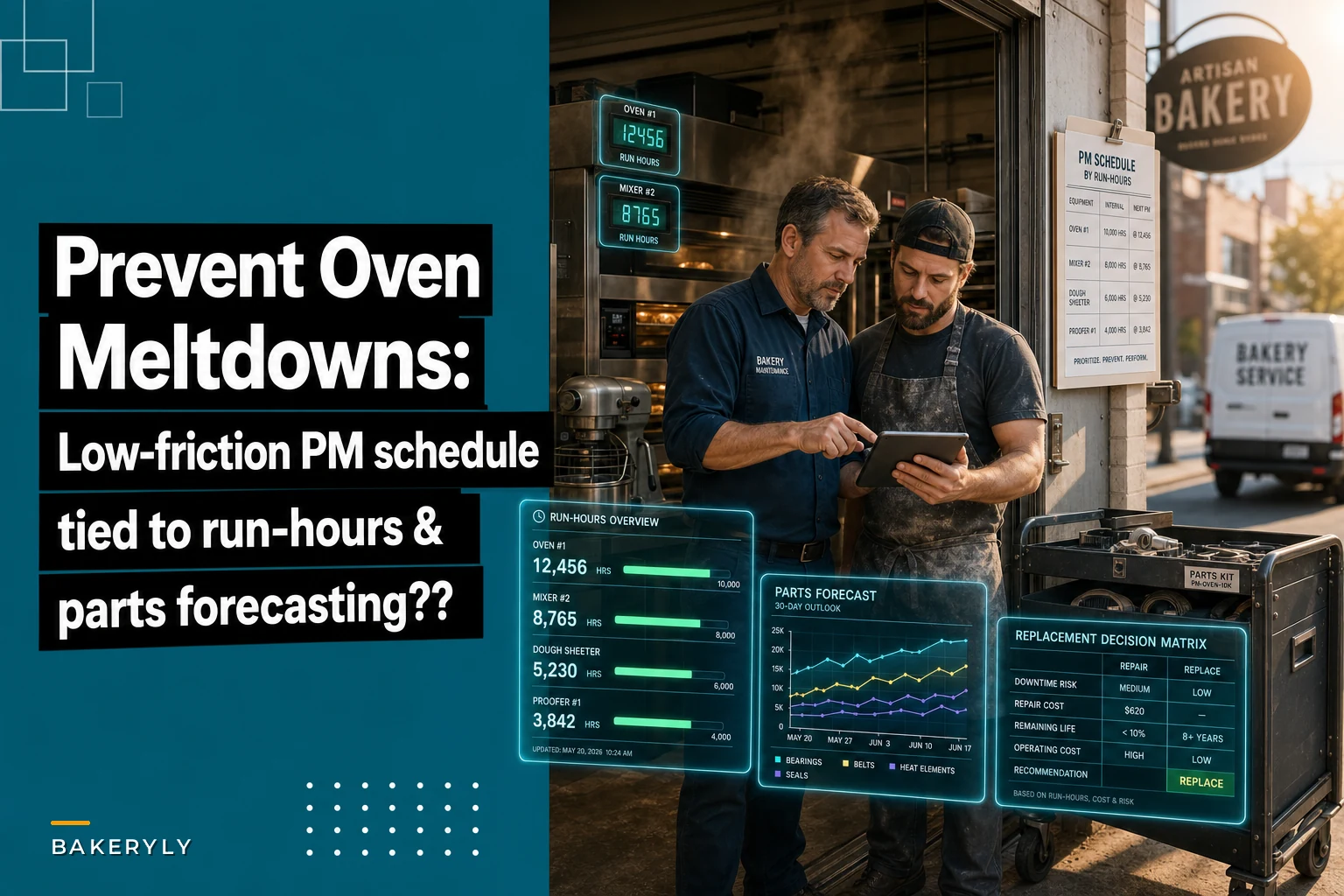

Most bakery equipment preventive maintenance schedules fall apart within two months. Not because owners don't care about their equipment, but because the traditional approach—monthly checklists tacked to the wall, service contracts that miss critical wear patterns, generic manufacturer recommendations—completely ignores how bakeries actually operate.
The real problem isn't tracking maintenance. It's that conventional systems treat all equipment the same, ignore actual usage patterns, and create so much administrative friction that busy bakers just stop following them. Equipment slowly degrades until something catastrophic happens during your busiest periods.
The pattern I've seen across bakeries of all sizes is consistent: equipment failures cluster around peak production, maintenance gets skipped when staff is stretched thin, and nobody tracks the actual economics of repair-versus-replace decisions. The result is emergency repairs that cost three to four times more than preventive work, production disruptions that tank revenue, and equipment limping along at 60% efficiency for months.
Why traditional maintenance schedules fail in bakeries
Bakery equipment faces stress patterns that generic maintenance schedules completely miss. Your deck oven runs 14 hours straight during holiday weeks but might sit idle on slow Mondays in January. Your spiral mixer handles 400 pounds of bagel dough every morning but only 50 pounds of cookie dough in the afternoon. Your proof box humidity swings wildly between summer and winter, affecting seals and heating elements differently each season.
Standard maintenance approaches—the ones equipment dealers hand you with a new oven—assume steady, predictable usage. They tell you to check door seals monthly, clean burners quarterly, replace gaskets annually. But these intervals mean nothing when your actual usage varies by 300% between seasons.
The administrative burden makes things worse. Tracking maintenance across a dozen pieces of equipment, each with different service intervals and part requirements, becomes a full-time job nobody has time for. So maintenance goes reactive: fix things when they break, hope nothing fails during busy periods, keep fingers crossed that your 12-year-old sheeter makes it through one more holiday season.
Here's what typically plays out: the retarder starts making weird noises in October. You know it needs attention, but you're slammed with wholesale holiday orders. By December 15th, it fails completely. Now you're calling every refrigeration tech within 50 miles, offering double rates for emergency service, while croissant production grinds to a halt. The repair that would've cost $400 in September now runs $1,800, plus the revenue hit from three days of limited output.
Building a run-hour tracking system that actually works
Run-hour tracking transforms maintenance from guesswork into something you can actually plan around—but only if you design it for bakery reality. Forget fancy IoT sensors or complex spreadsheets. Those fail within weeks. Build something so simple your newest baker can maintain it without thinking.
Start with equipment categories based on criticality and usage patterns:
Category A: Production-critical, high-use
-
Deck ovens
-
Rack ovens
-
Spiral mixers
-
Sheeters
-
Proof boxes
Category B: Important but flexible
-
Planetary mixers
-
Dividers
-
Depositors
-
Slicers
Category C: Support equipment
-
Refrigeration units
-
Display cases
-
Dishwashers
-
Small mixers
For Category A equipment, install basic hour meters—the $30 mechanical ones work fine. Mount them somewhere visible and make reading them part of the closing routine. Every night, whoever closes logs the hours on a simple sheet next to each machine. Takes 30 seconds per unit.
Category B gets weekly logs. Pick a consistent day—usually Sunday night or Monday morning when things are slower. Estimate runtime based on production records. If you ran 12 batches of bread through the divider this week at roughly 10 minutes per batch, that's 2 hours of runtime. Close enough for maintenance planning.
Category C gets monthly checks tied to existing routines. When you do month-end inventory, check equipment condition. When you deep-clean display cases, note any issues. Piggyback on work you're already doing.
Here's what this looks like for a typical deck oven:
| Runtime Hours | Check/Service | Who Does It | Time Required |
|---|---|---|---|
| Every 100 hours | Clean burner jets, check door seals | Your team | 20 minutes |
| Every 500 hours | Replace door gaskets, calibrate thermostat | Your team or tech | 45 minutes |
| Every 1,500 hours | Deep clean combustion chamber, replace igniter | Service tech | 2-3 hours |
| Every 4,000 hours | Major service: all gaskets, thermocouples, safety valves | Service tech | 4-6 hours |
Notice how this differs from "monthly" or "quarterly" schedules. During your busy season, you might hit 100 hours in 10 days. During slow periods, it might take three weeks. The maintenance follows actual wear, not calendar dates.
Mount hour meters where they're visible from the usual closing position and add the reading to the closing checklist so it's never skipped.
Below is a simple workflow diagram illustrating how hour meters feed nightly logs into a weekly review that triggers parts orders and schedules maintenance.
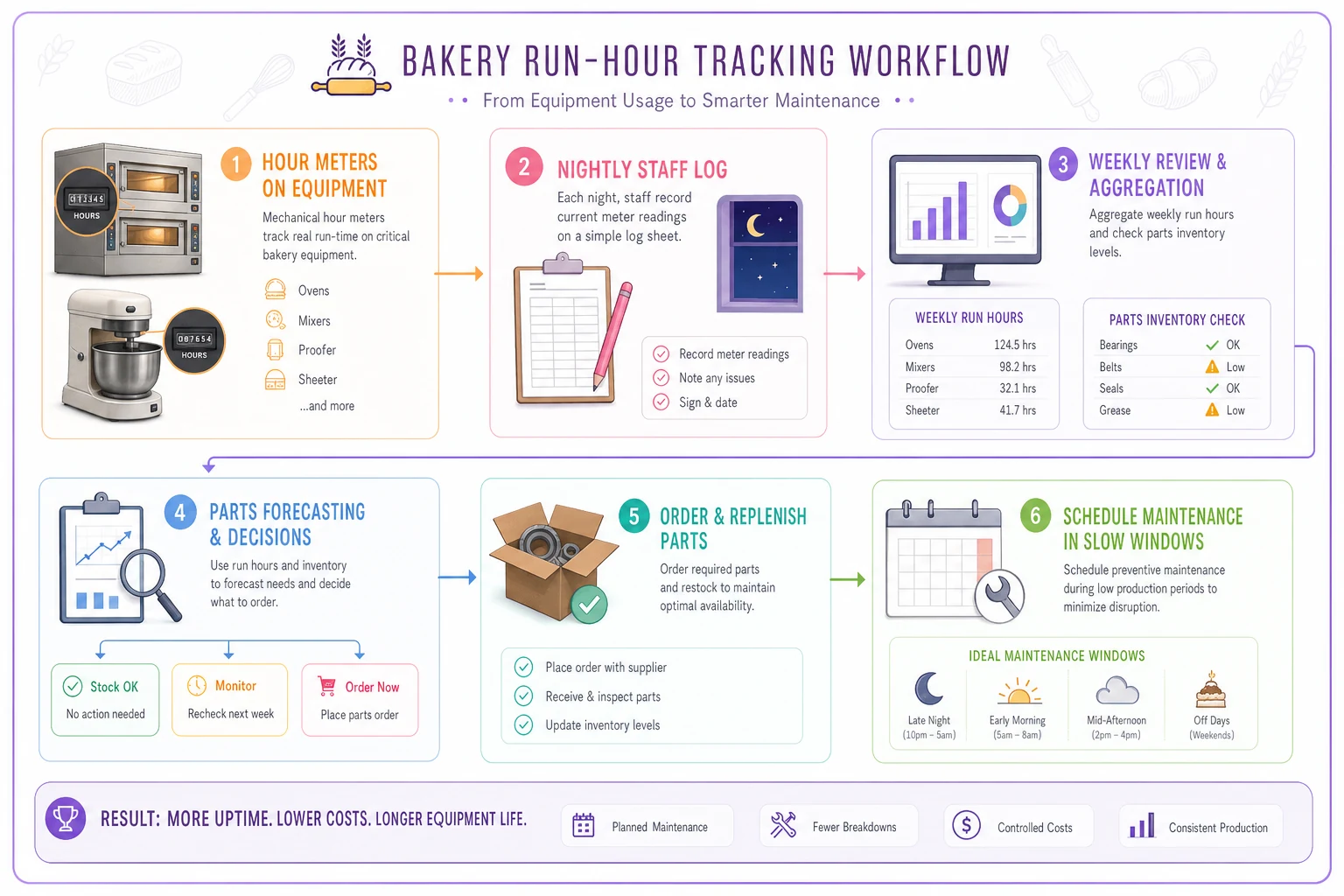
Keep the system simple enough that the newest team member can follow it without extra training.
Parts forecasting that prevents the scramble
Every bakery has been through this: a critical part fails, you call the supplier, they're out of stock, and it'll take 7-10 days to arrive from the manufacturer. Meanwhile you're jerry-rigging solutions with duct tape and hope.
Smart parts forecasting eliminates most of that. Track three things for each piece of equipment: failure patterns, lead times, and carrying costs.
For each Category A machine, identify the parts that fail predictably:
-
Door gaskets (every 6-12 months depending on use)
-
Mixing bowl scrapers (every 3-4 months)
-
Proof box door seals (every 8-10 months)
-
Oven igniters (every 18-24 months)
Then identify the parts that fail randomly but stop production:
-
Mixer safety switches
-
Oven thermocouples
-
Sheeter belts
-
Proofer heating elements
For predictable-failure parts, order replacements when you're about 60% through their typical lifespan. Door gaskets lasting 10 months? Order new ones at month six. That gives you buffer for delivery delays and unexpected early failures.
For random-failure parts that stop production, keep one on hand if the part costs less than one day's lost profit. A $200 thermocouple seems expensive to stock—until you lose $800 in sales waiting for one to ship.
On-hand stock (kept in labeled bins):
-
Common gaskets and seals
-
Frequently replaced wear parts
-
Critical sensors and switches under $300
Quick-order list (supplier info ready):
-
Expensive parts you won't stock
-
Items with reliable 24-hour delivery
-
Parts covered under service contracts
Relationship backup:
-
Local bakeries with similar equipment
-
Equipment dealers who loan parts
-
Service techs who stock common items
One bakery tracked their parts spending for a year and found they'd spent over $4,000 on emergency overnight shipping alone—the actual parts totaled around $8,600. By keeping roughly $2,000 worth of critical parts on hand, they eliminated almost all emergency shipping costs and cut equipment downtime by about 70%.
The small-capex replacement matrix
The hardest equipment decisions aren't really about maintenance—they're about knowing when to stop throwing money at something that's past its prime. That 15-year-old deck oven might still technically work, but if it's costing $500 monthly in repairs and burning 40% more gas than a modern unit, the math changes fast.
Build a replacement decision matrix based on four factors:
1. Repair cost trajectory
Plot monthly repair costs over the past year. If costs are climbing steadily, you're approaching the replacement threshold. A rough rule: when monthly repair costs exceed 50% of the monthly payment on a new unit, start seriously considering the switch.
2. Production impact
Track how equipment issues affect output. That sheeter might only need $200 monthly in repairs, but if it's running at 60% speed and limiting your croissant production, the hidden cost is substantial. The math: (optimal output - actual output) × profit margin = hidden monthly cost.
3. Energy efficiency
Older equipment often uses 40-60% more energy than modern equivalents. A new rack oven might cost $18,000, but if it saves $400 monthly in gas, the timeline starts making sense. Factor in utility rebates too—many programs offer $2,000-5,000 for energy-efficient equipment upgrades.
4. Opportunity cost
What could you produce with better equipment? If a new depositor lets you add filled donuts to your menu and generate an extra $3,000 monthly, that changes the entire calculation.
| Factor | Old Oven Reality | New Oven Projection |
|---|---|---|
| Monthly repairs | $450-600 average | $50 (warranty period) |
| Energy cost | $1,100/month | $750/month |
| Production capacity | 80 loaves/hour | 120 loaves/hour |
| Product quality | Uneven baking, 5% reject rate | Consistent baking, 1% reject rate |
| Monthly payment | $0 (owned) | $420 (60-month lease) |
Total monthly cost of keeping old oven: $1,700 (repairs + energy + lost production) Total monthly cost of new oven: $1,220 (payment + energy + minimal repairs)
The new oven pays for itself through operational savings alone, before any consideration of increased capacity or quality improvements.
Making it sustainable: the weekly 15-minute review
Complex maintenance systems fail because they require too much ongoing effort. Design a 15-minute weekly review instead—something that keeps everything on track without becoming its own burden.
Every Monday morning (or your slowest day), run through this:
Minutes 1-5: Runtime check
-
Log hour meters for Category A equipment
-
Note anything approaching a service interval
-
Flag equipment making unusual noises or behaving differently
Minutes 6-10: Parts inventory
-
Quick visual check of parts bins
-
Note anything running low
-
Add items to the weekly supply order
Minutes 11-15: Schedule coordination
-
Check next week's production schedule against maintenance needs
-
Book service calls during planned slow periods
-
Coordinate maintenance with deep cleaning schedules
This simple review prevents most equipment crises. You catch problems early, order parts before you need them, and schedule maintenance when it won't disrupt production.
The key is assigning clear ownership. Don't just say "someone should check equipment"—make it as specific as your production scheduling system. Whoever opens on Mondays owns the equipment review. It goes on the same checklist as checking ingredient inventory or reviewing the week's orders.
Integrating maintenance with production planning
Equipment maintenance can't exist in isolation from your production schedule. The best time to service your deck oven isn't based on the calendar—it's when you have a natural production gap.
Smart bakeries link maintenance windows to their existing operational rhythms. If you already track demand patterns for staffing decisions, use that same data for maintenance planning. Those predictably slow Tuesday afternoons in January? Perfect for oven calibration. The week after Easter when orders always drop? Ideal for major service work.
Build maintenance into your production planning cycles:
Daily maintenance windows:
-
Last 30 minutes of shifts for basic cleaning
-
Equipment cool-down periods for quick inspections
-
Changeover times between product runs for component checks
Weekly maintenance blocks:
-
Monday morning for parts inventory
-
Deep clean schedules that include maintenance tasks
-
End-of-week equipment assessments during closing
Monthly maintenance planning:
-
Review next month's production forecast
-
Identify natural slow periods
-
Pre-book service calls for those windows
-
Order parts based on upcoming service needs
One bakery structured this well. They noticed wholesale orders reliably dipped the second week of each month, so they designated that Tuesday as their standing maintenance window—scheduling all non-emergency service calls for that recurring slot. Equipment downtime dropped by around 80% because problems got addressed before they became emergencies.
When automation makes sense (and when it doesn't)
Not every maintenance task benefits from automation or fancy tracking systems. Simple mechanical hour meters beat digital IoT sensors for most bakery equipment. They don't need wifi, can't be hacked, don't require software updates, and cost $30 instead of $300. They work in flour-dusty environments and don't care about temperature swings.
Where operational software genuinely helps is in the coordination layer—tracking service history, managing parts inventory, scheduling maintenance windows, and flagging when equipment approaches service intervals. AI-powered platforms can monitor runtime data, automatically generate work orders when service is due, track parts inventory levels, and coordinate maintenance schedules with your production calendar. That kind of automation removes the administrative burden that causes most maintenance programs to collapse.
But don't over-automate. A $5,000 predictive maintenance system for a $3,000 mixer makes no sense. Reserve automation for where it solves real friction: tracking maintenance across multiple units, coordinating service calls with production schedules, managing parts inventory, and generating replacement forecasts based on actual equipment performance.
Real-world implementation
A bakery in Austin implemented this system about 18 months ago. They had eight major pieces of equipment averaging 11 years old, spending roughly $2,200 monthly on emergency repairs.
Their implementation timeline:
Week 1-2: Installed hour meters, created equipment categories, built initial tracking sheets.
Week 3-4: Catalogued historical repair data, identified common failure parts, established baseline runtimes.
Month 2: Set up parts inventory system, built relationships with backup suppliers, scheduled first preventive service calls.
Month 3: Integrated maintenance windows with production schedules, assigned ownership for weekly reviews, refined tracking based on actual usage.
Months 4-6: Adjusted service intervals based on runtime data, optimized parts inventory levels, made their first equipment replacement decision.
Results after one year:
-
Emergency repairs dropped from $2,200 to around $400 monthly
-
Equipment downtime reduced from 35 hours to 8 hours monthly
-
Saved $3,500 on rush shipping charges
-
Increased production capacity 15% through better equipment performance
-
Made a data-driven decision to replace their deck oven, with ROI achieved in 11 months
The most significant change wasn't the cost savings—it was the operational confidence. They stopped dreading equipment failures during busy periods. Their team knew exactly when maintenance would happen and could plan around it.
The economic reality of preventive maintenance
Preventive maintenance costs money upfront, and that's a real consideration for bakeries operating on tight margins. How do you justify spending $500 on prevention when you're not sure you'll have a problem?
The math becomes clear when you track the true cost of equipment failures—not just the repair bill, but everything it triggers:
-
Lost production during downtime
-
Rush charges for emergency service
-
Overnight shipping for parts
-
Staff overtime to catch up on missed production
-
Customer disappointment from stockouts
-
Stress and burnout from constant crisis management
A single oven failure during peak season can easily cost $5,000-8,000 in combined direct costs and lost revenue. Preventive maintenance might run $2,000 annually for that same oven. Once you factor in the full impact, the ROI becomes hard to argue with.
Beyond crisis prevention, well-maintained equipment operates more efficiently, uses less energy, produces more consistent results, and lasts years longer. A sheeter running at peak efficiency produces noticeably more units per hour than one limping along with worn components. Over a year, that efficiency gap can translate into meaningful additional production capacity.
Bakery equipment preventive maintenance isn't about following generic manufacturer schedules or implementing complex tracking systems. It's about building something low-friction that matches your actual operations, tracks real usage patterns, and fits into workflows you already have.
The approach outlined here—runtime tracking, smart parts forecasting, data-driven replacement decisions—turns maintenance from a source of stress into something that actually gives you a competitive edge. When your equipment runs reliably, your team can focus on what matters: producing great products and serving customers.
Start small. Pick your most critical piece of equipment, install a simple hour meter, and begin tracking runtime. Build from there as you see results. Within six months, you'll wonder how you managed without it.
The bakeries that thrive long-term aren't necessarily the ones with the newest equipment—they're the ones that keep what they have running efficiently through smart, systematic maintenance. Your 10-year-old deck oven can run like new if you maintain it properly. More importantly, it won't fail three days before Thanksgiving.