

A refund request on a $6 croissant and a refund request on a $380 custom cake should never follow the same process. But in most bakeries they do — because there's no process at all. Someone complains, a staff member panics, and money leaves the till before anyone asks a single question.
The core problem with a bakery refund policy for perishable goods is that you can't inspect the product after the fact. The cake is eaten. The box is in the trash. The customer's word is often all you have. That asymmetry is exactly what gets exploited, and it's also what turns legitimate complaints into margin-draining chaos when staff don't know how to respond.
This playbook isn't about being stingy. It's about making refund decisions consistent, fast, and tied to evidence — so the honest customer gets taken care of in thirty seconds and the serial "the bread was stale" caller gets handled without draining your profit.
Why perishable refunds are a different animal
Most retail refund advice assumes the item can be returned, inspected, restocked, or resold. None of that applies to a loaf of sourdough or a tray of macarons. Three things make perishables uniquely painful:
You can't verify the claim. By the time someone says the tart was soggy, there's no tart. Your only proof is what the customer describes and whatever they can show you.
The product has near-zero salvage value. A returned sweater goes back on the rack. A returned cake goes in the bin. So every refund is a near-total loss — ingredients, labor, oven time, packaging, all gone.
Emotion runs high. Cakes show up at birthdays, weddings, and funerals. A cracked tier at a wedding isn't a $200 problem to the customer — it's a ruined memory problem. That emotional weight pushes staff toward over-refunding just to make the discomfort stop.
What we've seen across a lot of bakery operations is that the absence of a decision structure costs more than any individual refund. Staff improvise. One cashier comps everything. Another argues with customers and tanks the review score. The owner only finds out when the monthly numbers look off. A single consistent policy fixes the variance.
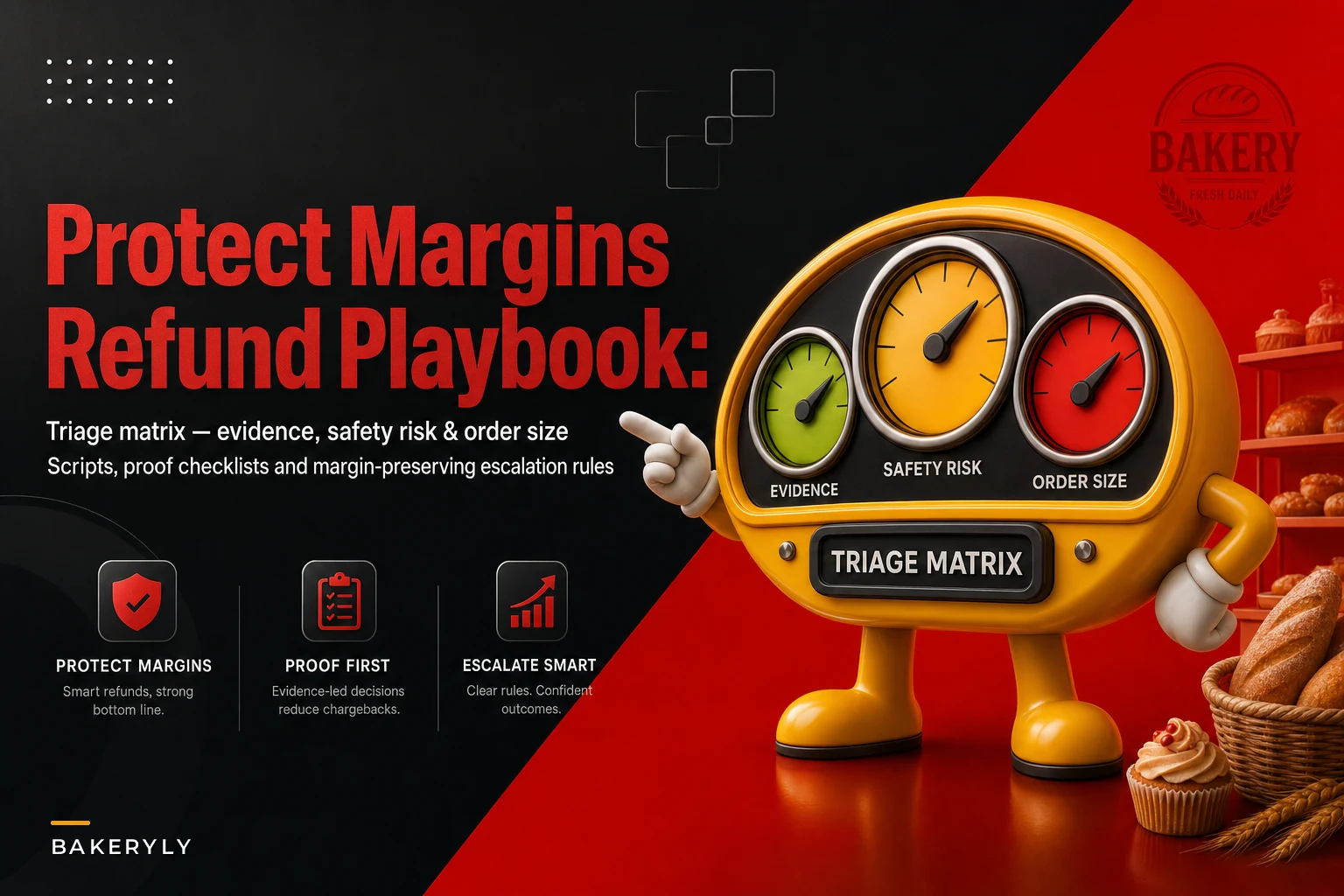
The triage matrix: three axes that decide everything
Every refund request can be scored on three things before you decide what to do. Three quick questions — that's it.
-
Evidence level — How much proof does the customer have? (Photo, the product itself, order details, nothing.)
-
Health/safety risk — Is this a taste complaint, or a "someone could get sick" complaint? (Foreign object, allergen error, spoilage.)
-
Order size — Is this a $4 single item, a $40 dozen, or a $400+ custom/catering order?
Here's how those three axes combine into a default action. This is the laminated card your front counter should have.
| Scenario | Evidence | Safety risk | Order size | Default action |
|---|---|---|---|---|
| Single item, taste complaint | Low/none | None | <$15 | Immediate remake or refund, no proof needed |
| Dozen/box, quality issue | Medium (photo) | None | $15–$75 | Remake offered first; refund if remake declined |
| Custom cake, cosmetic flaw | Photo required | None | $75–$400 | Partial refund or remake; manager sign-off |
| Any order, foreign object | Hold product/photo | High | Any | Full refund + incident log + follow-up call |
| Any order, allergen error | Photo + order record | Critical | Any | Full refund, escalate immediately, document |
| Large catering, "whole order bad" | Photo of full order | Varies | $200+ | Manager only; no instant refund; investigate |
The logic underneath: low-value, low-risk complaints get resolved instantly because arguing costs more than the item. High-risk complaints get resolved generously and documented, because safety trumps margin every time. Large orders get a pause and a manager, because that's where the real money and the real fraud both live.
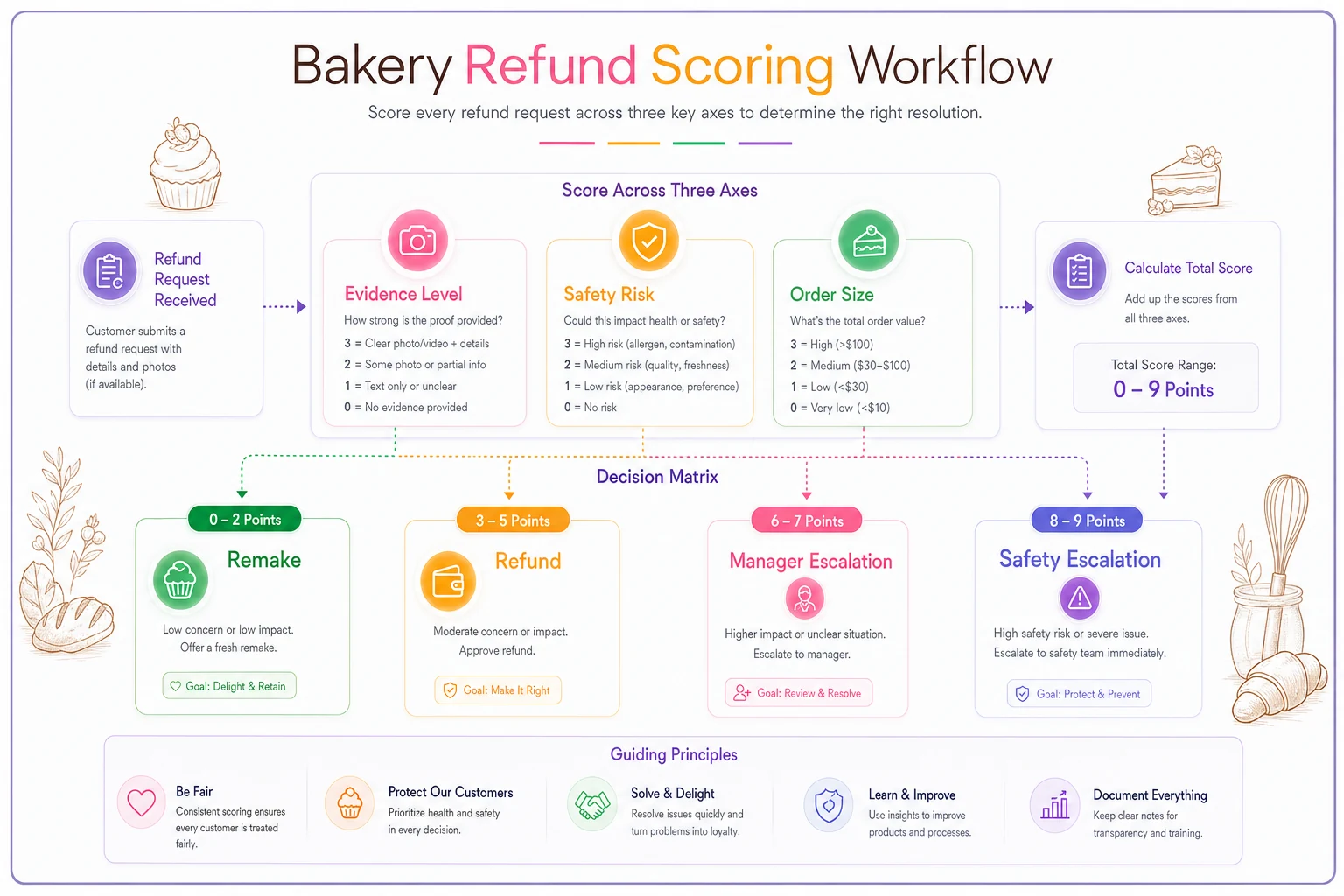
A simple visual helps staff see the branches fast so they don't panic at the counter.
The counter-intuitive part: comp the small stuff faster
Owners often want to tighten up on the little refunds. That's backwards. A $5 muffin refund that takes two minutes of back-and-forth has already cost you more in labor and goodwill than the muffin. Worse, if it happens in front of a line of customers, you've just advertised that your bakery argues with people over pastry.
-
Custom orders refunded in full for a cosmetic issue that a partial would have covered
-
Catering complaints refunded without anyone checking the actual order record
-
Repeat "customers" who've figured out your staff folds instantly
-
Full refunds given when a remake would have cost a fraction and kept the customer
So the policy is deliberately lopsided: fast and generous at the bottom, slow and evidence-based at the top.
Proof requirements that don't make customers hate you
Asking for proof is where most bakeries get it wrong. Demand a photo for a $4 cookie and you look petty. Fail to ask for a photo on a $350 cake and you're flying blind.
-
Under ~$15 No proof. Take the word, fix it, move on.
-
$15–$75 A photo if they have one — framed as "so we can tell the kitchen what went wrong," not as an accusation.
-
$75–$400 (custom) Photo required before any refund. Reference the order number and the design approval on file.
-
Safety claims (any size) Ask them to keep the product if possible, and photograph it. This protects them and you.
-
$200+ catering Photo of the full delivery, plus the signed delivery or pickup record.
The framing matters more than the requirement. "Can you send a quick photo so our baker can see what happened? We want to make this right" lands completely differently than "We need proof before we can refund you." Same ask, opposite reaction.
Scripts your staff can actually use
The reason staff over-refund is that they don't have words for the in-between. They know how to say "sure, here's your money back" and they know how to say "no" badly. They don't have a script for "let me take care of this and protect the business." Give them one.
Small item, taste complaint: > "I'm really sorry that wasn't up to standard — let me grab you a fresh one right now, or refund it, whatever's easier for you."
Quality issue on a box/dozen: > "That shouldn't have happened. I'd love to remake these for you — can I have them ready by [time]? If that doesn't work, I'll refund them."
Custom cake, cosmetic complaint: > "I'm sorry the finish wasn't what you expected. Could you send me a quick photo? Once I see it I can sort out a partial refund or a remake with my manager right away."
Foreign object / safety: > "I'm so sorry — thank you for telling me. Your safety matters most. I'm refunding this in full now, and I'd like to note exactly what happened so this doesn't repeat. Are you okay?"
Suspected large-order fraud / "everything was terrible": > "I want to get this fully resolved for you. Because it's a large order, my manager handles these directly — can I get a photo of the order and have them call you within the hour?"
That last script does something important: it doesn't refuse, it routes. The customer feels heard, and nobody at the counter is authorized to hand over $200 on the spot.
Margin-preserving escalation rules
Escalation isn't about making customers wait — it's about matching the decision to the person who should own the risk.
-
Counter staff can approve remakes and refunds up to ~$15 with no sign-off.
-
Shift lead approves $15–$75 and all remakes on larger orders.
-
Manager/owner approves any single refund over ~$75, all custom-order refunds, and anything flagged safety-critical.
-
Safety-critical claims bypass the dollar ladder entirely — refund immediately, then escalate for documentation and follow-up regardless of order size.
One hard rule that saves real money: remake before refund on anything above the small-item threshold, unless safety is involved or the customer explicitly refuses. A remake costs you ingredients and labor. A refund costs you the full retail price and the customer relationship. The remake is almost always cheaper and usually leaves the customer happier.
One more pattern worth watching: repeat requesters. If the same name or number shows up with a third complaint in a short window, that's a manager conversation, not a fourth free refund. A simple note in the order system — "two prior comps this quarter" — turns a blind spot into a decision.
A real scenario
A mid-size bakery doing roughly $40k–$45k a month in mixed retail and custom orders was bleeding on refunds without realizing how much. No policy, cashiers comping freely, custom cakes refunded in full over small cosmetic flaws. Their refund line was running somewhere around 2.5–3% of revenue — call it $1,000–$1,300 a month walking out the door, most of it avoidable.
They put in a version of this matrix. Laminated card at the counter, scripts taped inside the register drawer, a hard rule that custom-order refunds needed a photo and a manager. Within about two months the refund line dropped to roughly 1%. The biggest change wasn't denying people — it was the remake-first rule on custom orders and the photo requirement on anything over $75. Full refunds on cakes nearly disappeared; partials and remakes took their place. Review scores actually went up, because customers got a confident, consistent response instead of either an argument or a pushover. Net, they kept around $700–$900 a month that used to vanish.
The daily/weekly workflow
A matrix only works if it feeds back into something. Here's the loop that keeps it honest:
-
At the moment of complaint Staff scores the request on the three axes, follows the matrix, logs it (order number, reason, action, amount).
-
End of shift Shift lead reviews any refunds over the small threshold during handover.
-
Weekly Owner pulls the refund log and looks for patterns — a specific SKU getting flagged repeatedly, a repeat requester, a particular delivery window generating complaints.
-
Monthly Refund total as a % of revenue gets tracked against target (aim under ~1.5%).
That weekly pattern-scan is where the real value is. If chocolate ganache tarts generate four complaints in a week, that's not a refund problem — it's a recipe or cold-chain problem showing up at the counter. The refund log becomes an early-warning system for production issues you'd otherwise miss.
If you're already running an on-the-day triage playbook for surges and equipment failures, the refund matrix slots in right beside it as another laminated decision card — same philosophy, different failure mode. And when a remake request comes in, don't forget that the salvage side matters too: the original returned item is a loss, but the surplus you didn't sell can still be recovered through the approach in turning surplus into profitable SKUs.
Where software quietly helps
You can run this entire system on a laminated card and a notebook — and plenty of bakeries should start exactly there. But once your volume grows, the manual version has one weak point: the log. Handwritten refund notes get skipped during a rush, which means the weekly pattern-scan has holes and the repeat-requester flag never fires.
Tie the refund note to the original order ID so weekly scans reliably surface repeat requesters and problematic SKUs.
This is where an order management or operational platform earns its keep. When a refund is tied to the original order record, the system already knows the order size — so it can surface the right proof requirement and escalation tier automatically — and it can flag a customer who's requested multiple comps, keeping the log complete without anyone remembering to write it down. The decision still belongs to a human. The matrix just gets enforced consistently instead of depending on who's working the counter that day.
That's the realistic role here: not replacing judgment, just making sure the structure you designed actually runs the same way on a chaotic Saturday as it does on a slow Tuesday.
When this matrix is overkill — and when it isn't
When a lighter version makes sense: If you're a tiny operation doing mostly walk-up retail with few custom orders, you don't need six tiers. You need two rules — comp small stuff instantly, and have the owner handle anything over $50. That's it.
When you need the full version: The moment custom cakes, catering, or delivery becomes a meaningful share of revenue, the full matrix pays for itself. That's where the big-dollar refunds and the fraud both concentrate, and where inconsistent staff decisions do the most damage.
Who should not do this: Don't build a rigid refund wall if your complaint volume is already tiny and your margins are healthy. Over-engineering a process for three refunds a month just slows down the good customers and makes your counter feel like a returns desk. The matrix is for bakeries where refunds have become a pattern, not an occasional one-off.
The goal of a smart bakery refund policy for perishable goods isn't to say no more often. It's to make the yes faster where it should be instant, make the big decisions deliberate where real money is at stake, and make sure that every refund — generous or not — leaves a trail you can learn from. Handle the $5 muffin in thirty seconds, slow down on the $350 cake, and never let a safety claim wait. Get those three things right and refunds stop being a leak and start being just another part of running a tight kitchen.