

Most bakery delivery problems don't happen in the oven, the packing station, or even the van. They happen in the final ninety seconds — when a driver hands a box of macarons to a receptionist who signs without looking, walks it into a back office, and nobody opens it until 3pm when the client's event is already falling apart.
By then you have no way to prove the tarts left your kitchen intact. The client says three were cracked. Your driver swears they were fine. And because there's no timestamped photo, no signature tied to a delivery window, no refusal record — you eat the redo, the refund, or the relationship. Sometimes all three.
This is a proof-of-delivery problem, and for fragile bakery SKUs it's more expensive than it looks. A cracked entremet isn't a $6 loss — it's the corporate account that would've ordered every month for two years, gone. What follows is an operator-ready SOP: driver checks, packaging handoff, photo and proof-of-delivery rules, refusal scripts, and a 5-step same-day dispute flow built specifically for delicate product.
Why fragile deliveries break at handoff (and it's rarely the driver)
The instinct is to blame the driver or the road. In practice, the failure almost always starts before the box ever gets loaded.
-
No handoff standard exists. The driver decides on the spot how much to explain, photograph, or verify. Some are meticulous. Most are trying to make eight more stops before noon.
-
The receiver isn't the client. For B2B deliveries — offices, hotels, event venues — whoever accepts the box has no idea what's inside or how fragile it is. They sign to make the driver leave.
-
Damage is invisible at delivery. A collapsed mousse cake or a hairline crack in a chocolate showpiece doesn't show through the box. It only reveals itself hours later, when the timeline is muddy and nobody remembers exactly what happened.
-
There's no proof anchor. Without a photo tied to a timestamp and location, every dispute becomes your word against theirs. And "the customer is always right" quietly means you always pay.
The core issue: fragile bakery product needs a bakery proof of delivery SOP that captures condition at the moment of handoff, before the box leaves anyone's sight. Everything below is built around that anchor.
What a tight handoff actually protects
Before the templates, it helps to be clear on what you're actually defending against. A tight handoff SOP protects you from four specific losses:
Never miss a bake or delivery again.
Bakeryly helps you schedule, track, and manage every order effortlessly.
- Unified order tracking
- Real-time inventory alerts
- Staff shift management
No credit card required
| Loss type | How it happens without an SOP | What the SOP prevents |
|---|---|---|
| Redo cost | Client claims damage hours later, you rebake and redeliver | Timestamped photo proves intact handoff |
| Refund erosion | "Just refund it to keep them happy" becomes routine | Evidence lets you resolve without automatic refund |
| Wrong-recipient loss | Box left with someone who wasn't authorized | POA (proof of acceptance) names the receiver |
| Relationship damage | Dispute turns into blame, client feels unheard | Same-day resolution flow keeps trust intact |
None of these require complex tech. They require discipline at one moment and a record that survives the argument.
The driver pre-departure check (before the van moves)
Damage that happens in transit usually starts before departure — an unsecured stack, a box wedged against the wheel well, a warm cabin slowly softening ganache. The pre-departure check is a 60-second ritual, not a paperwork exercise.
-
Confirm each box matches the run sheet (SKU, quantity, client, address)
-
Verify fragile SKUs are on the top layer, never stacked under heavier product
-
Check that boxes are flat-seated — no leaning, no overhang off the tray edge
-
Confirm cold-chain items are in the cooler bag, not the open cabin
-
Photograph the loaded, secured van interior (one wide shot — this is your "left the kitchen intact" baseline)
-
Note departure time on the run sheet
Make the loaded-van photo part of the driver's exit routine so it's never skipped under time pressure.
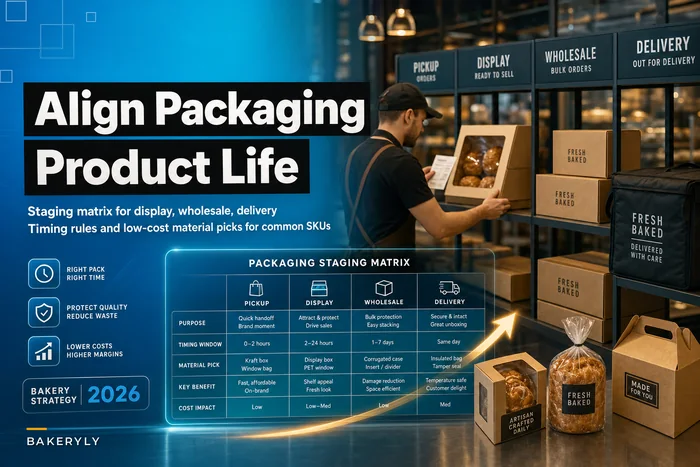
That single loaded-van photo does more work than people expect. In a dispute, it establishes that product was properly secured and intact at the start of the route. If your packaging is already matched to the product's fragility, this step is fast — and if it isn't, that's a separate problem worth reading about in why packaging should follow product life, because no handoff SOP can save product that was boxed wrong to begin with.
The handoff sequence: the 90 seconds that matter
This is the heart of the SOP. Every fragile delivery follows the same four-beat handoff, no exceptions.
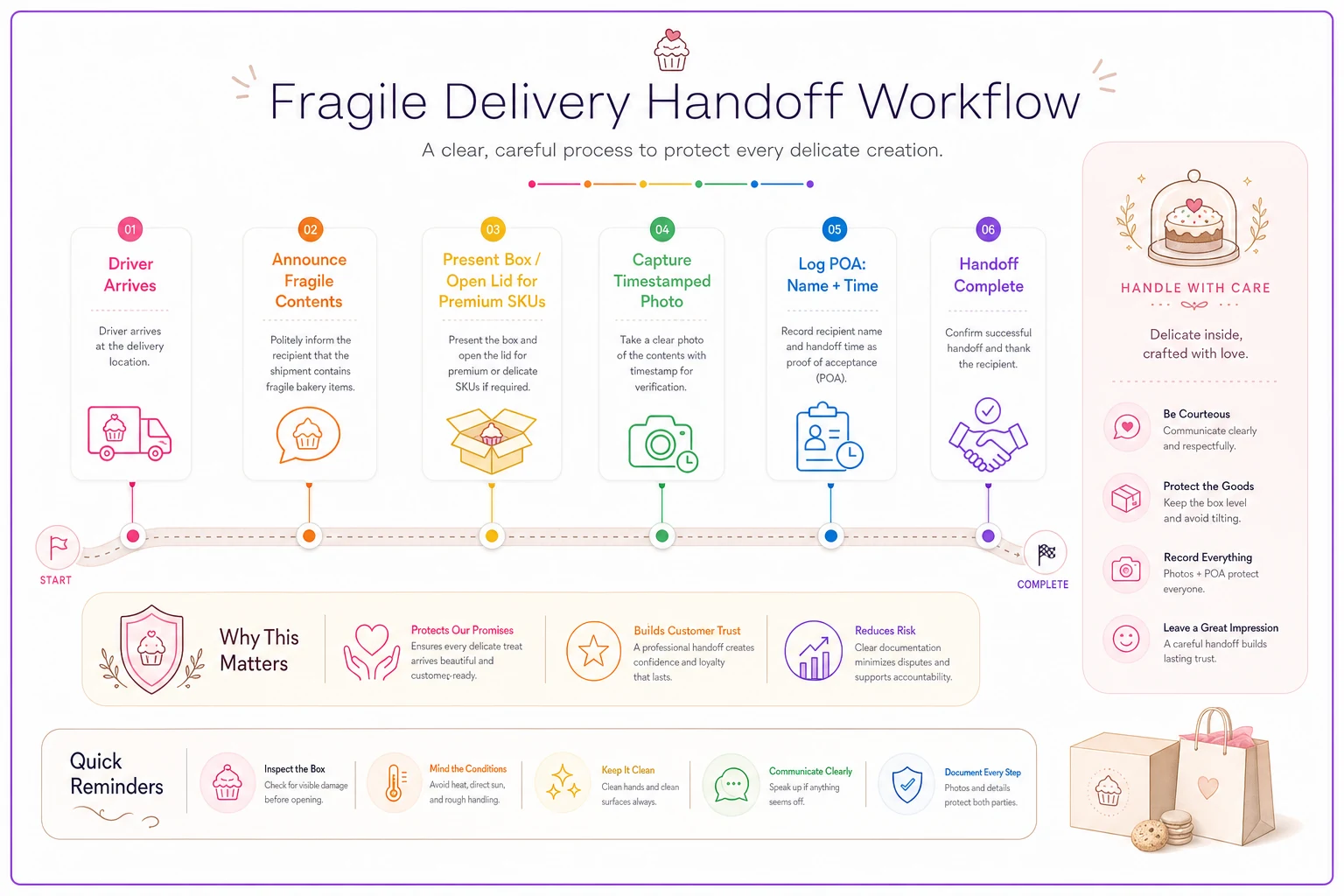
A quick visual like this helps drivers memorize the steps and keeps the ceremony consistent across the team.
-
Announce the fragile contents. The driver says, out loud
"This is a fragile order — decorated cakes inside. Please handle flat and keep upright." This isn't just politeness; it shifts the receiver's attention and puts the warning on record.
-
Present, don't just drop. The driver keeps the box level and visible. For high-value SKUs — custom cakes, showpieces, tiered orders — open the box lid and let the receiver see the intact product before it changes hands.
-
Capture the proof. One photo of the product (lid open for premium orders, sealed box with label for standard runs), one photo showing the delivery location or reception desk. Both auto-timestamped.
-
Log proof of acceptance (POA). Signature or name of the person accepting, plus the time. If they won't sign, that gets noted — and it triggers the refusal script below.
The "present, don't just drop" beat matters more than it sounds. For a $180 tiered cake, a five-second lid-open confirmation in front of the receiver kills most "it arrived damaged" disputes before they start. The receiver saw it. It's photographed. The argument largely evaporates.
For everyday runs — a dozen croissants to an office — you don't open the box. Sealed-box photo plus timestamp plus name is enough. Match the ceremony to the value.
Timestamped photos and POA: what to actually capture
Photos only protect you if they carry the right metadata and show the right things. Loose phone snaps in a driver's camera roll are nearly useless in a dispute — there's no easy way to prove when they were taken or which order they belong to.
-
Timestamp (automatic, not typed by the driver)
-
The product or sealed labeled box — the thing being handed over
-
The delivery context — desk, doorway, reception, or the receiver holding it
-
Order reference tied to the photo so it's findable in seconds later
Proof of acceptance (POA) fields:
-
Name of person accepting
-
Time of acceptance
-
Delivery address confirmed
-
Condition note if applicable ("receiver confirmed intact on open" for premium orders)
The practical failure here is fragmentation. Drivers photograph on personal phones, signatures go on paper run sheets, and when a dispute lands three hours later nobody can pull the record together fast enough for it to matter. Keeping the photo, timestamp, POA, and order reference attached to the same order is what turns scattered evidence into a fast resolution.
This is where an AI-assisted operations platform genuinely earns its keep — the driver captures once, and the photo, timestamp, location, and signature all bind to the order automatically, so the full delivery record is one tap away when a client calls. That said, the discipline matters more than the tool. Even a shared folder named by order number beats scattered camera rolls.
Refusal scripts: when the receiver won't sign or won't accept
Refusals and hesitation are where drivers freeze, because there's no script. They either stand awkwardly, leave the box anyway, or take it back without documenting why. All three create problems.
Give drivers three short, memorized scripts:
Scenario A — Receiver won't sign but will accept: > "No problem, I don't need a signature — can I just get your first name and note the time you took delivery? It's how we confirm your order arrived safely." Then photograph the receiver holding the box or the box on their desk. Name + photo + timestamp = valid POA even without a signature.
Scenario B — No authorized person available: > "I have a fragile order for [client] and no one's here to receive it safely. I'm going to hold it and contact the kitchen to arrange a redelivery, rather than leave it unattended." Fragile product should never be left unattended at a door. A box sitting on a step in the heat for two hours is a guaranteed loss with no defense. Holding and rescheduling is almost always cheaper than the redo.
Scenario C — Receiver claims visible damage on arrival: > "I understand — let's document it together right now. I'll photograph exactly what you're seeing so we can sort this out for you today." This one matters most. On-the-spot documentation with the receiver participating turns a potential dispute into a same-day resolution, and it makes the client feel handled rather than dismissed.
The 5-step same-day dispute flow
When a damage claim comes in — and it will — speed is everything. A dispute answered within the same service window rarely becomes a lost account. One that drags into next week almost always does.
-
Log the claim immediately with a timestamp. Capture what the client says is wrong, which SKUs, and when they opened the box. The gap between delivery time and "opened at 3pm" is often the whole story.
-
Pull the delivery record. Loaded-van photo, handoff photo, timestamp, POA name. This takes seconds if the record is attached to the order. You're looking to answer: did it leave intact, and was it accepted intact?
-
Compare and decide the responsibility bucket. Three outcomes
(a) evidence shows intact handoff → likely post-delivery mishandling on the client's side; (b) no clear evidence → shared or goodwill resolution; (c) evidence shows a problem at handoff → your responsibility, resolve fast.
-
Offer the resolution within the same day. Redeliver, credit, or partial refund based on the bucket — decided by evidence, not by whoever complains loudest. Same-day contact matters more than the specific remedy.
-
Log the root cause for the weekly review. Was it packaging? Route order? A specific driver skipping the handoff sequence? A recurring receiver at one address? Patterns only show up if you record causes, not just outcomes.
The step most bakeries skip is #5. Without it, you resolve the same cracked-cake dispute at the same downtown hotel every month and never figure out why — which might be something as simple as that venue's reception leaving boxes near a heater.
A real scenario: what changed for a mid-size bakery
A bakery running roughly 40–60 delivery orders a week — heavy on custom cakes and macaron boxes for corporate clients — was losing somewhere around $600–$900 a month to damage disputes. Almost all automatic refunds, because they had no way to prove condition at handoff. Drivers signed paper sheets, took no photos, and by the time a client complained the trail was cold.
They rolled out the handoff sequence and the loaded-van photo first, then the same-day dispute flow. Nothing fancy — a phone photo routine and a strict "present the box, get a name, note the time" rule for anything over $50.
Within about two months, disputes didn't disappear, but their character changed. Roughly two-thirds of new claims were resolved without a refund, because the evidence showed intact handoff and the client's own team had mishandled it after acceptance. The premium lid-open confirmation on custom cakes basically ended damage claims on their highest-value SKUs. Monthly damage losses dropped to somewhere around $150–$250. More importantly, two corporate accounts that had been quietly drifting stayed — because the same-day resolution made them feel like someone actually cared.
The number that mattered wasn't the refund savings. It was the retained accounts.
When this level of rigor makes sense — and when it's overkill
Not every delivery needs the full ceremony. For forcing lid-open confirmation on a bulk bread wholesale drop just slows your driver down and annoys the loading dock.
-
The SKU is fragile and high-value (custom cakes, showpieces, tiered orders, decorated desserts)
-
The client is B2B and the receiver isn't the end user
-
The account is worth more than a single order (recurring corporate, event venues, hotels)
Lighter version is fine when:
-
Standard product to a repeat individual customer who accepts directly
-
Low-value, low-fragility SKUs where a sealed-box photo covers you
A small operation doing five deliveries a week to regulars who've never disputed anything doesn't need a museum-grade chain-of-custody. Start with just the timestamped photo and a name. Add the rest when volume or a bad dispute forces it.
The mistake goes both ways. Some bakeries have no proof discipline at all. Others run full ceremony on a $9 muffin order. Match the rigor to the risk.
Where this connects to the rest of your delivery operation
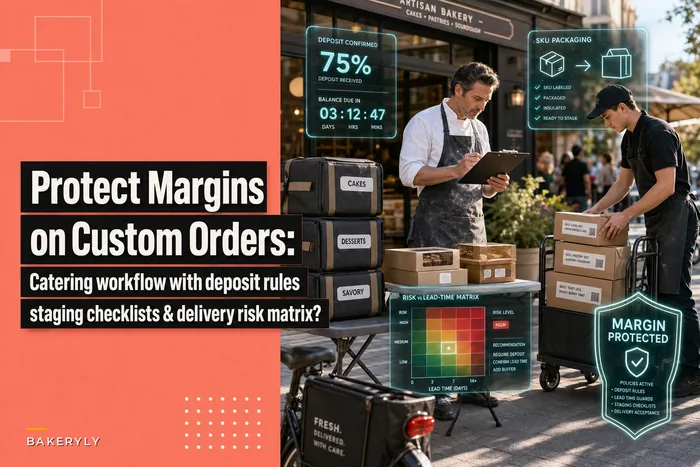
Handoff is one link in a chain. If your custom and catering orders don't have deposit rules and staging checklists behind them, a clean handoff still can't save a job that was set up to fail — the margin protection work in protecting margins on custom orders sits right upstream of everything here. And as covered earlier, no proof-of-delivery SOP compensates for product that was boxed wrong in the first place; packaging that follows product life is the foundation the whole handoff stands on.
Treat these as one system: box it right, load it right, hand it off with proof, resolve disputes with evidence the same day. The handoff SOP is the piece most bakeries are missing — and it's the cheapest one to fix.
If you do nothing else this week, install the handoff sequence for fragile orders over $50: announce the contents, present the box, capture one timestamped photo, log a name and time. That single habit does more to protect your delivery revenue than most packaging upgrades or route changes.
The disputes won't stop coming. But with a real record attached to every order, you stop paying for damage you didn't cause — and you keep the accounts that would've walked over a cracked cake and a shrug. For fragile bakery product, the money isn't lost in transit. It's lost in the two minutes nobody was watching. Build the SOP that watches for you.
Ready to elevate your bakery operations?
Join 2,000+ bakeries using Bakeryly to streamline workflows, reduce waste, and delight more customers.