

Custom catering orders look profitable on paper. A $600 wedding cake, corporate breakfast platters for 75 people, holiday cookie towers at $450 each. The margins seem solid until you actually track what happens between order placement and delivery.
Most bakeries lose money on catering without realizing it. Not because the pricing is wrong, but because the workflow bleeds cash through timing gaps, rushed production, forgotten deposits, and the occasional delivery disaster.
The real killer isn't the obvious stuff. It's the accumulation of small operational failures that compound into margin erosion. A 48-hour notice order that forces overtime. A forgotten deposit that leaves you chasing payment after the fact. Special packaging requirements discovered the morning of delivery. Transport damage that requires a full remake.
Why catering workflows fail at protecting margins
Most catering operations run on whatever system evolved organically. Someone takes the order, writes it down somewhere, hopefully remembers to collect a deposit, and then scrambles when the delivery date approaches.
This creates predictable failure points. Orders get accepted with impossible timelines because nobody checked production capacity. Deposits get waived for "good customers" who later dispute final charges. Special requirements surface too late. Staging happens haphazardly. Delivery becomes an adventure.
The core issue is treating catering like scaled-up regular orders instead of recognizing it as a completely different operational animal. Catering requires coordinated handoffs between sales, production, staging, and delivery — each one either a margin protection point or a profit leak.
Small bakeries often resist creating formal catering workflows because they seem unnecessarily complex for maybe 8-12 orders a month. But those 8-12 orders might represent 20-30% of monthly profit. One botched wedding cake or corporate event can wipe out a full week of retail margin.
Deposit rules that actually protect cash flow
Deposits serve two purposes: cash flow protection and commitment validation. Most bakeries get both wrong.
The standard 50% deposit sounds reasonable until you realize it doesn't account for order risk profiles. A $200 birthday cake for next Saturday carries very different risk than a $1,500 wedding dessert table booked three months out. Same deposit percentage, completely different cash flow implications.
Build deposit rules around three factors: lead time, order value, and customer history.
Orders under 5 days out require 100% prepayment, no exceptions. Orders 5-14 days out need 75% down. Beyond two weeks, 50% works — but only for established customers with clean payment history.
New catering customers prepay 100% for first orders under $500, or 75% for anything larger. This filters out people who place ambitious orders they can't actually afford. Corporate accounts wanting net terms need credit applications and purchase orders before the order even gets discussed.
These percentages flex based on complexity. Custom design work, specialty ingredients, or unusual delivery requirements bump the deposit up one tier. A standard sheet cake for pickup might take 50% deposit at two weeks out. The same cake with custom fondant work and a 6am delivery window needs 75%.
Collection method matters too. Credit card deposits process immediately and create transaction records. Checks need five business days to clear before production begins. Cash requires signed receipts with order details. Payment apps work, but use a business account with clear transaction descriptions.
Never start production without cleared deposit funds.
That "really good customer" who promises to bring the deposit tomorrow will somehow forget until pickup day — then dispute the rush charge you're forced to add.
Lead time requirements based on actual production capacity
Lead time rules protect both margins and sanity. But generic "72 hour notice" policies ignore how bakery production actually works.
Map lead times to your real production schedule, not arbitrary minimums. If you bake sandwich bread Monday, Wednesday, and Friday, catering orders needing fresh bread have to align with those days plus staging time. A Tuesday delivery means Monday production, which means orders need to close by Thursday afternoon to allow ingredient ordering.
A workable lead time matrix looks something like this:
| Order Type | Minimum Lead Time |
|---|---|
| Standard items (using regular production) | 3 days |
| Standard items (requiring a dedicated batch) | 5 days |
| Custom decorating, simple | 5 days |
| Custom decorating, complex | 7–10 days |
| Specialty ingredients required | 7+ days |
| Orders over $500 | 7 days minimum |
| Orders over $1,000 | 10 days minimum |
These minimums assume normal capacity. During peak seasons — graduation, holidays, wedding season — add 2-3 days to everything. Better to lose an order than accept one you'll fulfill poorly.
Rush orders get different rules entirely. Anything under minimum lead time triggers a 35% rush charge, paid upfront, with signed acknowledgment that quality may differ. Most customers balk at the premium, which is somewhat the point. The ones who proceed are genuinely desperate and willing to pay for the disruption.
Some orders you simply cannot accept regardless of what's offered. A 200-person wedding cake for tomorrow won't happen no matter what they'll pay. Having the discipline to say no protects your reputation more than any single order's revenue.
SKU-specific packaging requirements that prevent disasters
Packaging for catering isn't just about protection — it's about arriving in sellable condition. A perfectly baked item that shows up damaged or degraded might as well not have been made.
Document packaging requirements by product type and delivery method. Sheet cakes need rigid bottom support and corner protection. Cupcakes require individual wells and anti-tipping frameworks. Breakfast pastries need ventilation to prevent condensation. Bread products need different packaging for same-day versus next-day delivery.
Transport method changes everything. Customer pickup allows simpler packaging since you control the handoff. Third-party delivery requires significantly more protection because drivers treat food boxes like regular packages. Your own van falls somewhere between, depending on route complexity and driver training.
A packaging checklist for each SKU category:
Cakes/Tortes:
-
Base board rated for 2x cake weight
-
Minimum 2-inch clearance on all sides
-
Central dowel for anything over 10 inches
-
Corner guards for rectangular shapes
-
Temperature control for buttercream/ganache
-
Anti-slip mat between base and box
Individual pastries:
-
Item separation (paper or plastic dividers)
-
Stack height limits (usually 2-3 layers max)
-
Moisture control packets for humid conditions
-
Visible fill level markers on outside
-
Fragile stickers on four sides
Bread products:
-
Breathable wrap for crusty items
-
Sealed packaging for soft items
-
Maximum stack weight to prevent crushing
-
Temperature maintenance above 60°F
-
Clear "this side up" indicators
Price packaging into your catering quotes. A $300 order might need $25 worth of specialty packaging for safe delivery. That's 8% of order value that disappears quietly if you don't account for it upfront.
Staging checklists that catch problems before they become crises
Staging is where catering orders succeed or fall apart. Rushed staging creates mistakes that compound during delivery. Proper staging catches issues while you can still fix them.
The night before delivery, every catering order needs a systematic review.
Order verification:
-
Customer name matches payment method
-
Delivery address exists and is accessible
-
Contact phone number has been confirmed
-
Order contents match written confirmation
-
Special instructions are actually feasible
-
Pickup/delivery time aligns with customer availability
Product inspection:
-
All items present and counted
-
Decoration matches approved design
-
Text spelling triple-checked
-
Allergen labels attached
-
Temperature requirements noted
-
Shelf life allows for the full delivery window
Packaging validation:
-
Structural integrity tested
-
Labels facing outward
-
Fragile markings visible
-
Invoice attached in a waterproof sleeve
-
Care instructions included
-
Return packaging marked if applicable
This seems like overkill until you deliver a "Happy Birthday Sarah" cake to Sara, or show up at a "delivery to rear entrance" address that has no rear entrance, or realize mid-unload the customer wanted 6 dozen cupcakes, not 6 cupcakes for a dozen people.
Staging happens in a designated area, not wherever there's space. Catering orders get dedicated rack space with clear labels. Never mix staged catering with regular inventory. The number of times someone accidentally sells tomorrow's catering desserts to a walk-in customer is genuinely alarming.
Delivery acceptance protocols that prevent payment disputes
The delivery moment is where preparation meets reality. Without clear acceptance protocols, even a perfect order can turn into a payment dispute.
Every delivery needs three confirmations: right location, right order, acceptable condition. Miss any one and you're vulnerable.
Train delivery staff on the acceptance sequence:
-
Confirm recipient identity before unloading anything
-
Have recipient inspect packaging before opening
-
Open packaging together, confirming contents
-
Note any concerns immediately in writing
-
Get signature with timestamp
-
Photo document the delivered state
-
Send confirmation text or email within one hour
For corporate deliveries, identify the authorized recipient beforehand. The random person in the lobby isn't authorized to accept a $400 catering order. Get names, titles, and direct phone numbers during order placement.
High-value orders need enhanced protocols. Video the unboxing with customer permission. Count items aloud together. Have them initial each line item on the invoice. It feels excessive until it prevents a $1,500 chargeback.
Build standard responses for common delivery issues. Customer not present? Call, text, wait 10 minutes, then return with product and full payment due. Wrong delivery address? Correction fee plus mileage if it's reasonable, otherwise return with full payment due. Customer claims damage that wasn't noted during inspection? Refer to the signed acceptance form.
The risk/lead-time matrix that identifies problem orders before acceptance
Not all catering orders carry equal risk. A repeat customer ordering their usual monthly breakfast spread is a fundamentally different situation than a first-time customer wanting an elaborate dessert table for 200 guests.
Score orders across five risk factors:
| Risk Factor | Scenario | Points |
|---|---|---|
| Customer risk | New customer | 3 |
| Previous orders with issues | 2 | |
| Good history but long gap since last order | 1 | |
| Regular customer with clean history | 0 | |
| Complexity risk | Custom design work | 3 |
| Modifications to standard items | 2 | |
| Large quantity of a single item | 1 | |
| Standard menu items | 0 | |
| Delivery risk | Unknown venue or complex delivery | 3 |
| Tight timeline or specific delivery window | 2 | |
| Third-party delivery required | 1 | |
| Customer pickup | 0 | |
| Financial risk | Order over $1,000 | 3 |
| Order $500–$1,000 | 2 | |
| Order $250–$500 | 1 | |
| Order under $250 | 0 | |
| Timeline risk | Less than minimum lead time | 3 |
| Right at minimum lead time | 2 | |
| Within comfortable range | 1 | |
| Plenty of notice | 0 |
Orders scoring 10+ need senior approval, 100% prepayment, and signed terms acknowledging the risks involved. Orders scoring 7-9 require standard high-risk protocols. Anything under 7 follows normal procedures.
This matrix feels paranoid until it saves you from accepting an impossible order. That new customer wanting 500 custom cupcakes delivered to three locations tomorrow morning for their IPO celebration? That's a 15-point situation that no amount of money justifies accepting.
How margin protection compounds through systematic workflows
A proper catering workflow does more than prevent disasters. It actively protects and builds margins through operational efficiency.
When every order follows the same process, you spend less time on administration and troubleshooting. Clear deposit rules mean no more chasing payments. Defined lead times prevent rushed production and overtime costs. Proper staging eliminates remake waste. Solid delivery protocols prevent disputes and chargebacks.
The compound effect adds up faster than most people expect. A bakery doing 10 catering orders monthly might save 15 hours of administrative chaos, prevent two rush situations, eliminate one complete remake, and avoid one payment dispute. That's easily $1,500-2,000 in protected margin from workflow improvement alone — and that's a conservative estimate.
Your production system already handles regular items efficiently, and catering should be an extension of that rather than a disruption to it. There's a psychological benefit too — when you know every catering order will follow a predictable path, you can accept more orders confidently instead of quietly dreading each one.
Regular customers notice the professionalism. Corporate accounts especially value consistency over flexibility. They'd rather know you need 7 days notice than wonder every time whether their last-minute request will somehow work out.
The technology layer that makes workflows sustainable
Manual catering workflows work until they don't. The breaking point usually arrives somewhere around 15-20 catering orders monthly, when tracking everything in notebooks and spreadsheets becomes genuinely untenable.
Smart bakeries implement operational software before reaching that point. The right platform automates the repetitive parts while maintaining flexibility for custom orders. Automated deposit calculation and payment processing removes the awkward payment conversation. Built-in lead time rules prevent accidentally accepting impossible orders. Digital staging checklists mean nothing gets missed in the pre-delivery rush.
The real value comes from integration. When your catering workflow connects to wholesale and cafe production systems, you get real capacity visibility. The system knows whether accepting a large catering order will compromise your retail availability, and automatically adjusts production schedules and ingredient orders accordingly.
AI-powered operational platforms take this further by learning from your order patterns over time — flagging which order types tend to cause problems, suggesting better delivery routes, and surfacing customers with dispute histories before you commit. None of this replaces judgment. But it creates a framework where good decisions become automatic and bad ones become harder to make accidentally.
Delivery documentation happens through mobile apps. Risk scoring runs in the background. The software enforces the rules you set and surfaces issues before they turn into real problems.
Building your catering workflow step by step
Start with deposits and lead times. These create immediate margin protection without requiring complex systems. Define your rules, document them clearly, and hold the line regardless of pressure.
Next, implement staging checklists. Even a paper checklist dramatically reduces delivery problems. Run it for a month, note what keeps getting missed, and refine from there.
Add the packaging matrix once staging is working smoothly. Document what works for each product type, price it properly, and build packaging prep into your production timeline.
Finally, layer in delivery protocols and the risk scoring. These feel bureaucratic until they prevent your first major dispute.
The implementation order matters more than people expect:
-
Define deposit rules and enforce 100% prepayment for short lead times
-
Build your lead time matrix against your actual production schedule
-
Run paper staging checklists for every order for at least four weeks
-
Document packaging requirements per SKU and price them into quotes
-
Train delivery staff on the acceptance sequence and dispute responses
-
Add the risk scoring matrix and start flagging high-risk orders before acceptance
-
Evaluate operational software once manual systems are working consistently
The complete workflow doesn't need to launch all at once. Incremental implementation lets you refine each component and train staff without overwhelming anyone. Within three months, catering stops being a chaotic scramble and starts running predictably.
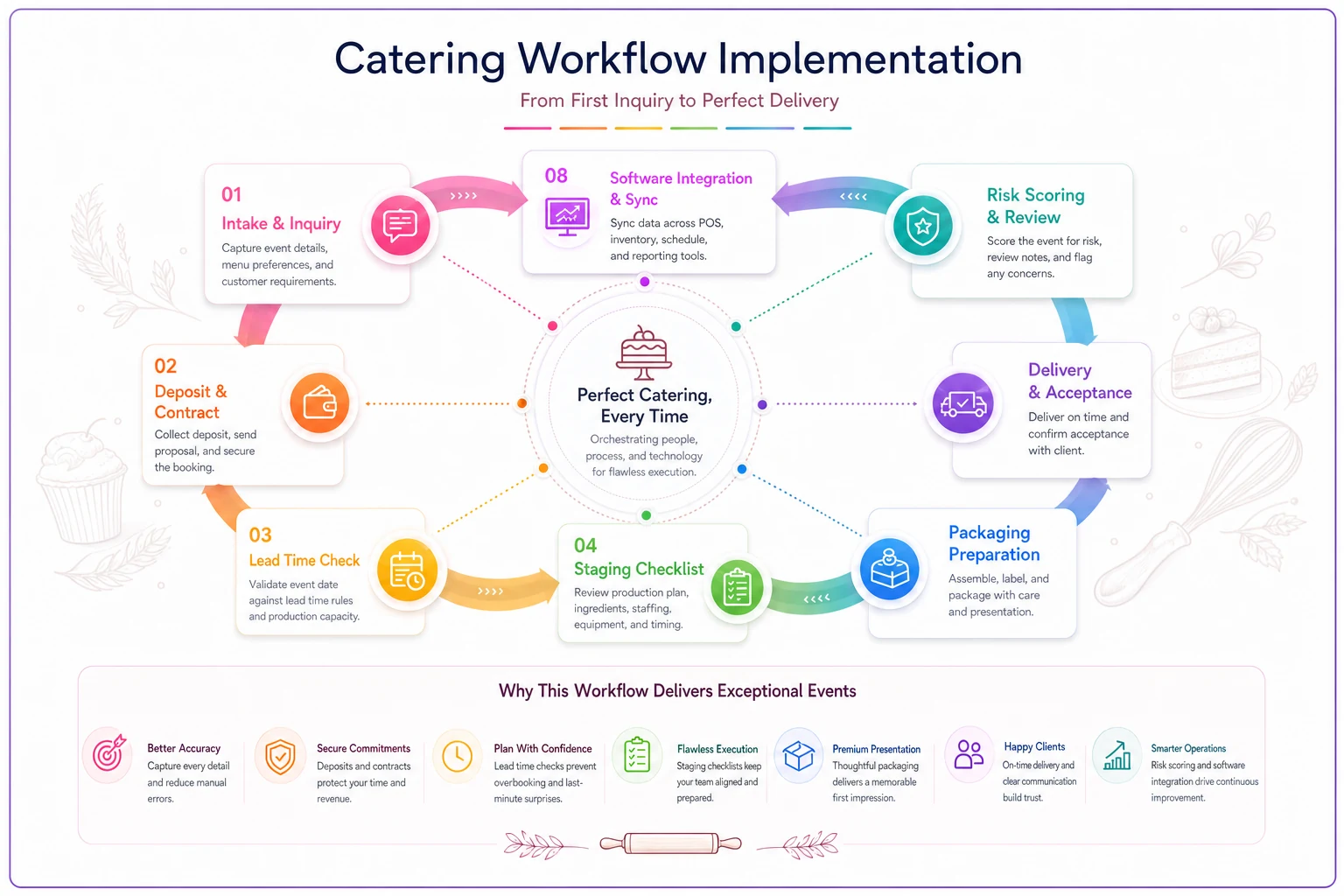
Catering orders amplify whatever operational strengths or weaknesses you already have. Solid workflows translate into premium pricing power. Weak workflows compound into reputation damage and margin erosion. Most bakeries already know this on some level, yet continue hoping their casual approach will somehow improve on its own.
Your catering operation is either protecting margins or bleeding them. There's no middle ground with custom orders. The systematic approach outlined here might feel like overkill at your current volume, but that's exactly what enables profitable scaling when volume grows. Start with the basics, build consistently, and catering stops being an operational burden and starts being a genuine competitive advantage.
Your catering operation is either protecting margins or bleeding them. There's no middle ground with custom orders. The systematic approach outlined here might feel like overkill at your current volume, but that's exactly what enables profitable scaling when volume grows. Start with the basics, build consistently, and catering stops being an operational burden and starts being a genuine competitive advantage.