

Most bakeries treat packaging like it's one-size-fits-all. A croissant gets the same clear plastic clamshell whether it's heading to a grocery store shelf, sitting in your display case, or going out for catering delivery. This bleeds money through damaged products and stale returns.
The real problem isn't finding cheaper packaging. It's that bakeries package for the wrong timeline, wrong environment, and wrong handling conditions. Your wholesale orders sit on shelves for 48 hours while your cafe items turn over in 6 hours, yet both probably use identical packaging.
After watching a bakery throw out 40 pounds of perfectly good muffins because their wholesale partner returned them as "stale" after 36 hours, the pattern became clear. Same muffins sold fine in their cafe all day. The difference? Those wholesale muffins sat in individual plastic containers that trapped moisture and accelerated staleness. Meanwhile, their cafe muffins stayed fresh in an open display case with proper airflow.
The three-environment breakdown nobody teaches you
Each sales channel creates completely different product stress. Your danish doesn't care that it tastes amazing if the packaging lets it arrive at its destination looking like it went through a blender.
Display case environment: Products here face constant temperature changes from opening doors, customer breathing, and lighting heat. They need breathability more than protection. Most damage happens from condensation buildup when you overpackage. The timeline runs 4-12 hours max before items either sell or get marked down.
Wholesale/retail shelf: These items face the longest exposure to oxygen and humidity shifts. They sit untouched for 24-72 hours, handled multiple times during transport and shelving. The packaging needs to block moisture exchange while preventing the product from moving around inside. Every bump during delivery creates micro-damage that shows up as crumbs and broken edges by day two.
Delivery and catering: Speed and stacking become your enemies here. Drivers stack boxes, bags slide around in cars, and customers expect Instagram-worthy presentation after 45 minutes of transport. The packaging needs structural integrity plus presentation value, but only for a few hours total.
The fundamental mistake? Bakeries choose packaging based on cost-per-unit instead of failure rate by channel. A $0.15 cheaper box that creates 8% more damage on wholesale orders costs you way more than spending the extra fifteen cents.
Building your packaging-by-product matrix
Map every SKU against its primary sales channel and expected shelf life.
Never miss a bake or delivery again.
Bakeryly helps you schedule, track, and manage every order effortlessly.
- Unified order tracking
- Real-time inventory alerts
- Staff shift management
No credit card required
Start with your top 20 items. List them vertically, then create columns for:
-
Primary sales channel (cafe, wholesale, delivery)
-
Expected time to consumption
-
Transport stress level (low/medium/high)
-
Moisture sensitivity
-
Structural fragility
Now you can see patterns. Your crusty breads going to wholesale need different protection than the same breads in your cafe. Laminated pastries for delivery need rigid support that cafe items never require.
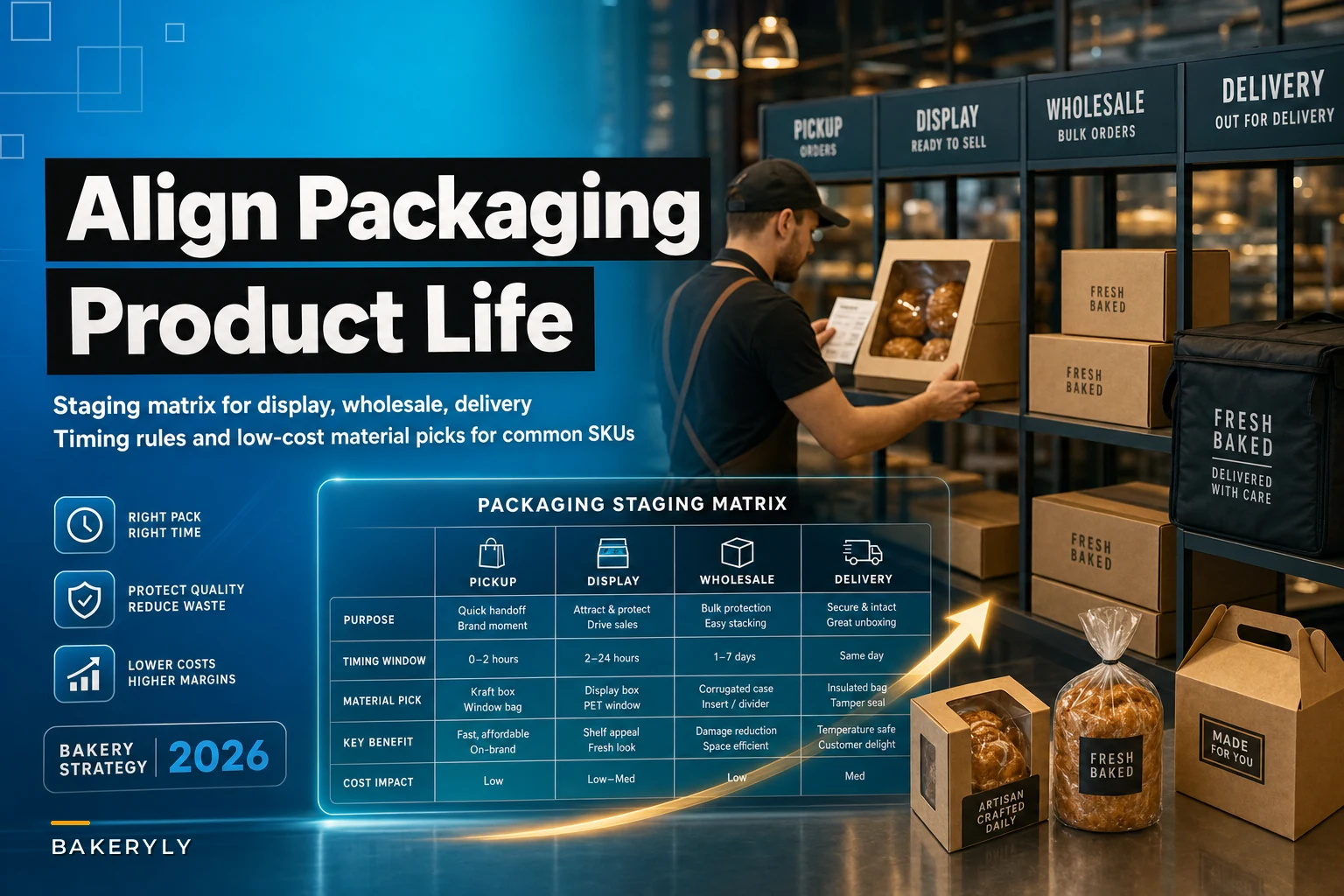
| Product Type | Cafe Display | Wholesale Shelf | Delivery/Catering |
|---|---|---|---|
| Croissants | Paper-lined tray, no individual wrap | Modified atmosphere bag, cushioned tray | Individual compartment box with window |
| Muffins | Open basket or minimal dome | Sealed clamshell with anti-fog coating | Stackable boxes with dividers |
| Artisan breads | Paper bags or unwrapped | Micro-perforated bags with twist tie | Paper bags inside rigid boxes |
| Decorated cakes | Refrigerated case, no packaging | Clear rigid container with lock tabs | Multi-point support boxes with separate frosting protection |
| Cookies | Stacked in jars or trays | Flow-wrapped or sealed pouches | Compartmented trays with clear lids |
Notice how the same muffin needs three different approaches? That's not overcomplication - it's matching the solution to the actual problem each channel creates.
Staging rules that prevent the morning scramble
The chaos usually starts around 5 AM. Your wholesale orders need packaging while your cafe's still setting up, delivery orders start coming in, and everybody's grabbing whatever packaging they can find. This creates expensive mistakes like putting cafe items in wholesale packaging or using delivery boxes for products staying in-house.
Pack wholesale first near the loading door to avoid morning mix-ups and preserve specialized materials.
Set up physical staging zones for each channel. Wholesale gets packed near your loading door. Cafe items stay near the display cases. Delivery orders get assembled in a separate area with their specific packaging supplies. Sounds basic, but most bakeries mix everything together and wonder why they run out of the wrong supplies at the worst times.
Create cut-off times that match your packaging availability. If you know wholesale orders need special moisture-barrier bags that take longer to seal, those items get packaged first, before your team gets pulled into morning retail rush. When you coordinate this with your order batching system, the packaging naturally follows production flow instead of creating bottlenecks.
Here's a simple staging workflow to follow.
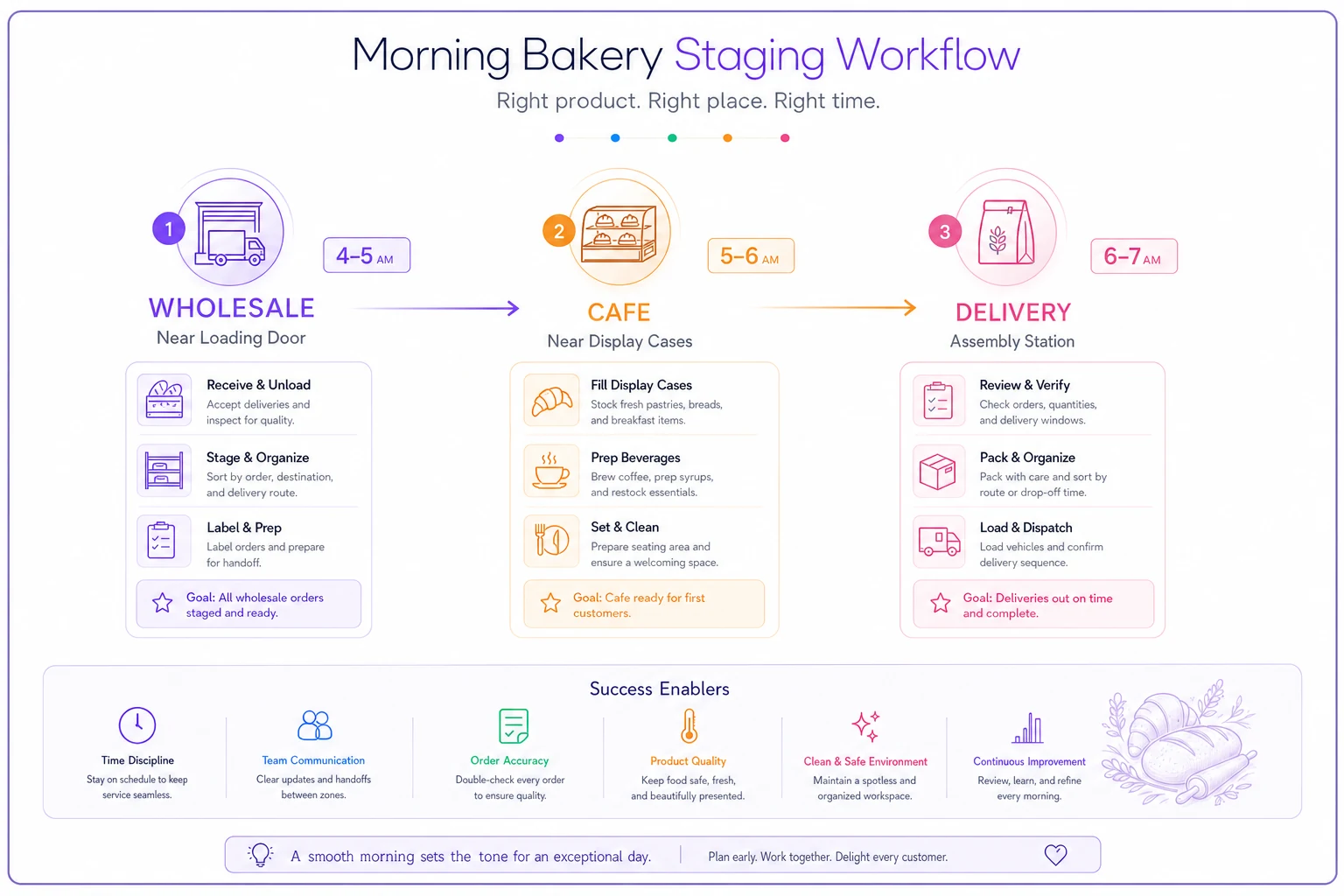
Your packaging staging should run like this:
-
4 AM - 5 AM
Wholesale items packaged and staged by delivery route
-
5 AM - 6 AM
Cafe display items plated and covered, ready for case loading
-
6 AM - 7 AM
First wave of delivery/pickup orders assembled
-
7 AM onward
Rolling assembly of custom orders using dedicated station
The timing matters because moisture migration accelerates once products cool. Package too early and condensation ruins texture. Package too late and products dry out or absorb humidity. Each product category has an optimal packaging window that you'll learn through testing, but most bakeries never track this.
Material costs vs damage costs: the math nobody does
Everyone obsesses over saving pennies on packaging without calculating what damage actually costs. A typical small bakery loses 3-5% of wholesale revenue to damage claims and another 2-3% to products that don't sell because they look unappealing after transport.
Say you do $8,000 weekly in wholesale. That's roughly $400-650 lost to preventable damage each week. Better packaging that costs an extra $50 weekly pays for itself eight times over.
The cheap clamshells everyone uses for muffins? They create condensation that makes tops soggy within 6 hours. Spending an extra $0.08 per unit on vented containers maintains texture for 48+ hours. On 200 muffins weekly, that's $16 extra cost to prevent losing 15-20 units to quality complaints.
Your delivery items face different economics. Customers paying $85 for a dozen custom cupcakes expect perfect presentation. One damaged order costs you the sale plus reputation damage. Investing $2.50 in proper individual cupcake inserts prevents the sliding and tipping that ruins decorations.
What smart packaging actually costs for common items:
-
Basic croissants
$0.12 (paper sleeve) vs $0.31 (rigid compartment)
-
Decorated cupcakes
$0.18 (basic box) vs $0.44 (individual wells)
-
Artisan loaves
$0.08 (paper bag) vs $0.22 (micro-perforated + window)
-
Layer cakes
$0.75 (basic box) vs $1.85 (multi-point suspension system)
The price difference seems huge until you calculate failure rates. Basic packaging fails 8-12% of the time during wholesale delivery. Better packaging drops this below 2%. On $30,000 monthly wholesale, that gap represents $1,800-$2,400 in prevented losses.
Low-cost alternatives that actually work
You don't need expensive packaging to solve most problems. Some of the best solutions cost almost nothing extra when you understand the physics of what's failing.
Paper coffee filters between stacked cookies prevent them from sticking without adding plastic. Costs about $0.003 per separator. Parchment paper strips around the inside edge of boxes stop frosting from hitting walls during transport. A roll lasts months.
For wholesale breads, double-bagging with the inner bag perforated solves moisture migration without expensive specialized bags. Punch 8-10 holes with a standard hole punch. The inner bag manages humidity while the outer provides structure. Total added cost: $0.04 per loaf.
Corrugated cardboard dividers cut from boxes you're already recycling create custom compartments for mixed pastry boxes. No purchasing required, just 30 seconds of cutting. These work better than molded plastic inserts for odd-shaped items.
The secret to delivery stability? Twisted paper towels at pressure points. Sounds ridiculous but works better than foam inserts for preventing movement. Roll paper towels into snakes, position them where products touch packaging edges. Stops 90% of sliding damage.
The pickup timing problem everyone ignores
Timing mismatches destroy more products than bad packaging. Wholesale partners showing up 90 minutes late means your products sit packaged longer than planned. Customers grabbing orders 3 hours early creates different problems.
Map out realistic pickup windows based on actual behavior, not scheduled times. If your main wholesale account consistently arrives between 7:15-7:45 AM despite a 6:30 AM scheduled pickup, package those items accordingly. Build in that extra hour of packaged time when selecting materials.
Some bakeries started using a "package-on-pickup" system for chronic early birds. Products stay in holding containers until the customer actually arrives. Takes an extra 3 minutes to box everything, but prevents items from sitting packaged for hours unnecessarily.
This connects directly to your production scheduling - when you know realistic pickup patterns, you can adjust production timing to minimize the gap between baking and packaging.
Common packaging mistakes that accelerate staleness
Sealing too tight: Crusty breads need to breathe. Airtight packaging turns crispy crust into leather within hours. Use micro-perforated bags or leave ends partially open.
Wrong temperature packaging: Packaging items while still warm creates condensation disasters. But waiting too long lets moisture escape completely. Most items package best at 75-80°F, barely warm to touch.
Size mismatches: Products rattling around in oversized containers get damaged from movement. Containers too small create pressure damage. Your packaging should leave about 1/4 inch clearance on all sides.
Material moisture conflicts: Putting high-moisture items like fresh fruit tarts in non-breathable plastic creates water buildup that ruins pastry within 2 hours. Paper or perforated materials handle moisture migration better.
Stacking incompatible textures: Crispy items stored above or below moist products pick up humidity through the packaging. Keep your storage zones separated by moisture content, not just product type.
Testing your matrix with actual shelf life data
Theory means nothing without testing. Track actual shelf life by packaging type, not what suppliers claim. Set up a simple test grid with the same product in different packaging options.
Take six of your best-selling items. Package them three ways - your current method, a cheaper alternative, and a premium option. Check them at 6, 12, 24, and 48-hour marks. Document texture changes, appearance degradation, and moisture levels.
Most bakeries discover their assumptions are completely wrong. That expensive biodegradable packaging might actually accelerate staleness. The cheap paper bags might preserve texture better than plastic clamshells.
Keep a failure log for two weeks. Every damaged item, stale return, or customer complaint gets documented with packaging type, channel, and time-to-failure. Patterns emerge quickly. You'll see that certain packaging fails consistently at the 30-hour mark, or specific products always get damaged during afternoon deliveries.
This data drives better decisions than any packaging salesperson's claims. When you know your chocolate croissants maintain quality for 18 hours in perforated bags but only 8 hours in sealed containers, the choice becomes obvious.
Building your final packaging matrix
Pull everything together into a working system. Create a simple reference chart your team can actually use during the morning rush.
List products down the left side, grouped by category (laminated, cake, bread, cookies). Across the top, show channels and timing (Cafe 0-6hrs, Wholesale 24-48hrs, Delivery 2-4hrs). In each cell, specify exact packaging with any special notes.
Print this, laminate it, and hang it at every packaging station. No more guessing or grabbing whatever's closest. Everyone knows that Danish going wholesale get individually flow-wrapped, while cafe Danish stay unwrapped on lined trays.
Update monthly based on failure data and seasonal changes. Summer humidity requires different approaches than winter dry air. Products that sold fine in March might need different packaging by July.
Your packaging costs will probably increase 10-15% initially. But damage losses drop 60-80% when you match packaging to actual use conditions. The net result puts money back in your pocket while reducing customer complaints.
The bakeries that get this right stop treating packaging as an afterthought. They build it into their cost structure and production flow from the start. When packaging matches product life cycles, shelf life extends naturally, wholesale partners stop complaining, and your delivery orders arrive looking professionally presented instead of hastily thrown together.
Getting serious about packaging classification doesn't mean overspending on premium materials. It means understanding what each channel actually demands and building systems that deliver exactly that. Nothing more, nothing less.
Small operational improvements compound over time. When your packaging system stops creating daily fires, your team focuses on production quality instead of damage control. That's when bakeries start scaling effectively - not through working harder, but by eliminating the friction that makes growth painful.
Ready to elevate your bakery operations?
Join 2,000+ bakeries using Bakeryly to streamline workflows, reduce waste, and delight more customers.