

Most bakeries don't ruin product texture because they froze it. They ruin it because they treated every SKU the same way — same freezer, same wrap, same thaw time, same "it'll be fine." Then a laminated croissant comes out gummy, a sponge cake weeps, and a sourdough loaf develops that stale chew that no customer complains about but quietly stops reordering.
Freeze-and-finish is one of the few levers that actually lets a small bakery absorb demand spikes without hiring a night shift or doubling oven time. But it only works when the decision is made per SKU, with real validation behind it — not as a blanket "we freeze on Mondays" policy. That's the part almost every bakery skips, and it's what separates a freezer that protects margin from one that slowly erodes your reputation.
This isn't a general "should you freeze" article. It's a decision framework for sorting your catalog SKU by SKU, the validation tests that tell you whether a freeze point actually holds up, the thaw SOPs that keep texture intact, and the labeling structure that keeps everything from turning into a guessing game at 4am.
Start with the freeze point, not the product
The first mistake is thinking about whether to freeze a product. The better question is at what stage in production you freeze it — because the same croissant can be frozen as raw dough, as shaped-and-proofed dough, as par-baked, or fully finished. Each of those behaves completely differently coming back out.
A rough pattern that holds across most catalogs:
-
Freezing earlier in the process (raw dough, shaped pieces) tends to preserve finished texture better but demands more labor and equipment on the finish side — proofing space, oven time, timing discipline.
-
Freezing later (par-baked or fully finished) saves finish-day labor but is where texture damage shows up most, especially in anything laminated, custard-based, or high-moisture.
The products that cause the most trouble are ones where owners assume the convenient freeze point is fine. Par-baking a baguette and finishing it later works beautifully. Par-baking a brioche bun and expecting the same result usually ends in a dense, slightly damp crumb that nobody can quite name but everybody notices.
The unit of decision isn't "the croissant." It's "the croissant, frozen at the shaped-and-proofed stage." That's your SKU-level freeze point, and everything else gets built around it.
The freeze/finish decision matrix
For each SKU, you're scoring a few things and landing on one recommended freeze stage. Build this once per product and it becomes a reference you can hand to any shift lead.
Never miss a bake or delivery again.
Bakeryly helps you schedule, track, and manage every order effortlessly.
- Unified order tracking
- Real-time inventory alerts
- Staff shift management
No credit card required
| SKU | Best freeze stage | Texture risk (1–5) | Finish labor | Max freezer days | Validation status |
|---|---|---|---|---|---|
| Butter croissant | Shaped + part-proofed | 4 | High | 21 | Passed |
| Baguette | Par-baked | 2 | Low | 30 | Passed |
| Brioche bun | Raw shaped dough | 3 | Medium | 14 | Passed |
| Chocolate chip cookie | Portioned raw dough | 1 | Low | 45 | Passed |
| Vanilla sponge layer | Fully baked, unfilled | 2 | Low | 30 | Passed |
| Custard danish | Do not freeze finished | 5 | — | — | Failed |
| Sourdough boule | Par-baked | 3 | Medium | 21 | Conditional |
A few things worth noting about how to actually use this:
Texture risk and freezer days are not the same axis. A cookie dough can sit for six weeks and finish perfectly. A par-baked sourdough might be structurally fine at day 30 but lose crust quality somewhere around three weeks. The "max freezer days" column is a texture limit, not a food-safety limit — those are two different numbers, and you want the stricter one to win.
"Conditional" is a real status, not a cop-out. Some SKUs freeze well if a specific condition holds — a sourdough that's fine frozen par-baked but only if it's blast-chilled first, or a sponge that holds up unfilled but not once it's got buttercream on it. Write the condition down. The conditional row is where most texture failures hide.
The custard danish row is the important one. Every catalog has products that simply shouldn't be frozen past a certain stage, and the matrix's real job is giving you permission to say no. Freezing a finished custard item and thawing it is how you get weeping, grainy filling and a soggy base. If a SKU fails validation, it fails — freeze the components separately or make it fresh.
Validation tests: how you actually know
This is where most bakeries wave their hands. They freeze something, it looks okay, they move on. But "looks okay" and "holds up through a full freeze cycle, a realistic thaw, and three hours on the shelf" are very different standards.
A validation test doesn't need a lab. It needs to be structured and honest. Here's a simple protocol:
-
Bake a fresh control batch the same day. This is your baseline — the texture you're trying to match.
-
Freeze a test batch at the proposed freeze stage, using your actual wrap and actual freezer, not some careful special version.
-
Hold it for the proposed max freezer days, not one day. Texture damage is cumulative; a one-day test tells you almost nothing.
-
Thaw and finish using the exact SOP a morning crew would follow, including realistic timing pressure.
-
Blind-compare fresh vs. frozen-finished with two or three people, scoring crumb, crust, moisture, and mouthfeel.
-
Re-test at the shelf-life edge — taste it again two to three hours after finishing, because some frozen products start fine and fall apart fast once they're out.
The most useful habit here is testing at the limit, not the convenience point. Anyone can freeze a croissant overnight and have it turn out fine. The real question is whether it survives day 18 in a freezer that gets opened forty times a shift. That's the number you're actually relying on during a demand spike, so that's what you validate.
Run this before any SKU gets a "Passed" status in the matrix. If you haven't tested it to the limit, its real status is "assumed" — and assumed is how you end up apologizing to a wholesale account.
Thawing SOPs are where texture lives or dies
You can freeze perfectly and still wreck the product on the way out. Thawing is the most under-documented step in almost every bakery, usually living in one person's head. When that person's off, texture quality swings.
The failure patterns are pretty predictable:
-
Thawing too fast (room temp when it should be refrigerated) causes condensation, which is why laminated products go soggy and cookie dough spreads wrong.
-
Thawing too slow or skipping the retard causes uneven proofing in frozen dough — the outside is ready, the center isn't.
-
Finishing from frozen when the product needed a thaw, or thawing something that should have gone straight into the oven — common with par-baked items.
Each freeze SKU needs a written thaw path, and it should be specific. Not "thaw overnight." More like:
-
Croissants (shaped/part-proofed) Move from freezer to proofer-retard overnight, roughly 8–12 hours, then proof to finish before baking. Never room-temp thaw — the butter sweats.
-
Par-baked baguettes Finish directly from frozen, no thaw, straight into a hot oven. Thawing first makes the crust leathery.
-
Sponge layers Thaw wrapped in the fridge for about 4–6 hours before filling. Unwrapping too early invites surface condensation.
Put the thaw instruction code (like "T2") on both the label and the daily finish sheet so crews don't have to hunt for the SOP at 4am.
Thaw-from-frozen and thaw-first are opposite instructions for different products, and crews mix them up constantly when there's no per-SKU reference. The baguette that should go in frozen gets left out "to thaw," and now the crust is wrong. Writing the thaw path alongside the recipe closes that gap.
Labeling rules that survive a 4am shift
A freezer full of white-wrapped product with no clear labels is a slow-motion disaster. By week three, nobody's sure what's what, FIFO breaks down, and something gets used two weeks past its texture limit.
A workable freezer label needs five things:
-
SKU name and freeze stage (e.g., "Croissant – shaped/proofed," not just "Croissant")
-
Freeze date
-
Texture-limit use-by date (the one from your matrix, usually stricter than food safety)
-
Thaw instruction code (a short code that maps to the thaw SOP — "T2 = fridge overnight")
-
Batch/lot number for traceability
The texture-limit date is the one people forget to print, and it's the one that matters most for quality. Food-safety dates are often weeks out; your texture window might be half that. If the label only shows the safety date, your crew will happily use a croissant that's technically safe and noticeably worse.
The thaw instruction code is a small detail that saves a lot of grief. A crew member shouldn't have to hunt down the SOP binder at 4am — the label itself says "T2," and T2 means something exact. It turns tribal knowledge into something printed on the package.
Traceability: linking the freeze to the finish
Once you're freezing meaningful volume, you need to connect a finished product back to the batch it came from and the freeze cycle it went through. This matters for two reasons: if a customer reports an off product, you need to know which frozen lot it came from, and if a freeze point starts underperforming, you want to catch the pattern before it spreads across your whole catalog.
A simple traceability record ties together:
-
Production batch → which raw batch was made and when
-
Freeze lot → when it went in, at what stage, which freezer unit
-
Finish event → when it was thawed and finished, by whom, and against which SOP version
This is the same discipline that makes an end-to-end production system hold together — every stage leaves a record the next stage can reference, so nothing floats free. When freeze-and-finish bolts onto that, the freeze lot just becomes another tracked stage between batching and finishing.
In practice, most small bakeries run this with a simple lot-number scheme on freezer labels that matches their production log. The point isn't fancy software. The point is that when something goes wrong on a Tuesday, you can figure out within a few minutes whether it was a bad batch, a freeze point overstaying its limit, or a thaw SOP that got skipped. Without that link, every problem looks like a mystery and gets "fixed" by freezing less — which defeats the whole purpose.
A real scenario: the Saturday surge
A two-location cafe-bakery was getting hammered on weekend mornings — pastry case empty by 9:30, a line out the door, and a kitchen that couldn't bake laminated product fast enough during the rush. They'd been baking everything fresh each morning, which capped output at whatever the oven and one baker could produce before open.
They didn't want to add overnight labor. So they built a freeze-and-finish plan, but only for SKUs that validated cleanly. Croissants went to the shaped-and-proofed freeze stage. Baguettes went par-baked. Cookies went to portioned frozen dough. The custard-filled items stayed fresh-only — the filling just didn't survive the freeze cycle.
After validation and written thaw SOPs, their Saturday finished-pastry capacity went up roughly 40% without any new morning hours. The blind taste tests actually mattered here: two SKUs they'd assumed would freeze fine failed, and finding that out in a controlled test rather than the pastry case saved them the slow bleed of disappointed regulars.
The number that surprised them wasn't the capacity gain — it was waste. Because frozen dough could be finished to demand rather than baked on a guess, end-of-day pastry waste dropped noticeably. Freezing to a known finish point gave them a buffer that fresh-only baking never could, which also tied into their work on turning surplus into profitable SKUs — less surplus to deal with in the first place.
When this makes sense — and when it doesn't
Freeze-and-finish is not a universal win. It's a tool for specific situations.
When it makes sense:
-
You have predictable demand spikes you can't staff your way out of — weekends, holidays, wholesale orders.
-
A meaningful chunk of your catalog validates well frozen
most yeasted doughs, par-bake breads, cookie doughs, unfilled sponges.
-
You have freezer capacity that's actually stable, not a residential unit that cycles temperature every time someone grabs butter.
When it's a bad idea:
-
Your freezer can't hold a steady temp. Freeze-thaw cycling from an unreliable unit destroys texture faster than anything, and no SOP fixes bad equipment.
-
Your catalog leans heavily on custard, cream, fresh fruit, or high-moisture fillings — exactly the products that fail validation most often.
-
You can't commit to the validation and labeling discipline. Freezing without the matrix and SOPs just moves your quality problems into the future and makes them harder to trace.
Who should hold off: any bakery still fighting basic production consistency. If fresh product quality swings day to day, freezing will amplify that inconsistency, not smooth it out. Get the fresh process stable first, then freeze from a known-good baseline.
Pulling it together
The whole system comes down to refusing to treat freezing as one decision. It's dozens of small decisions — one per SKU, each with its own freeze stage, validated limit, thaw path, and label.
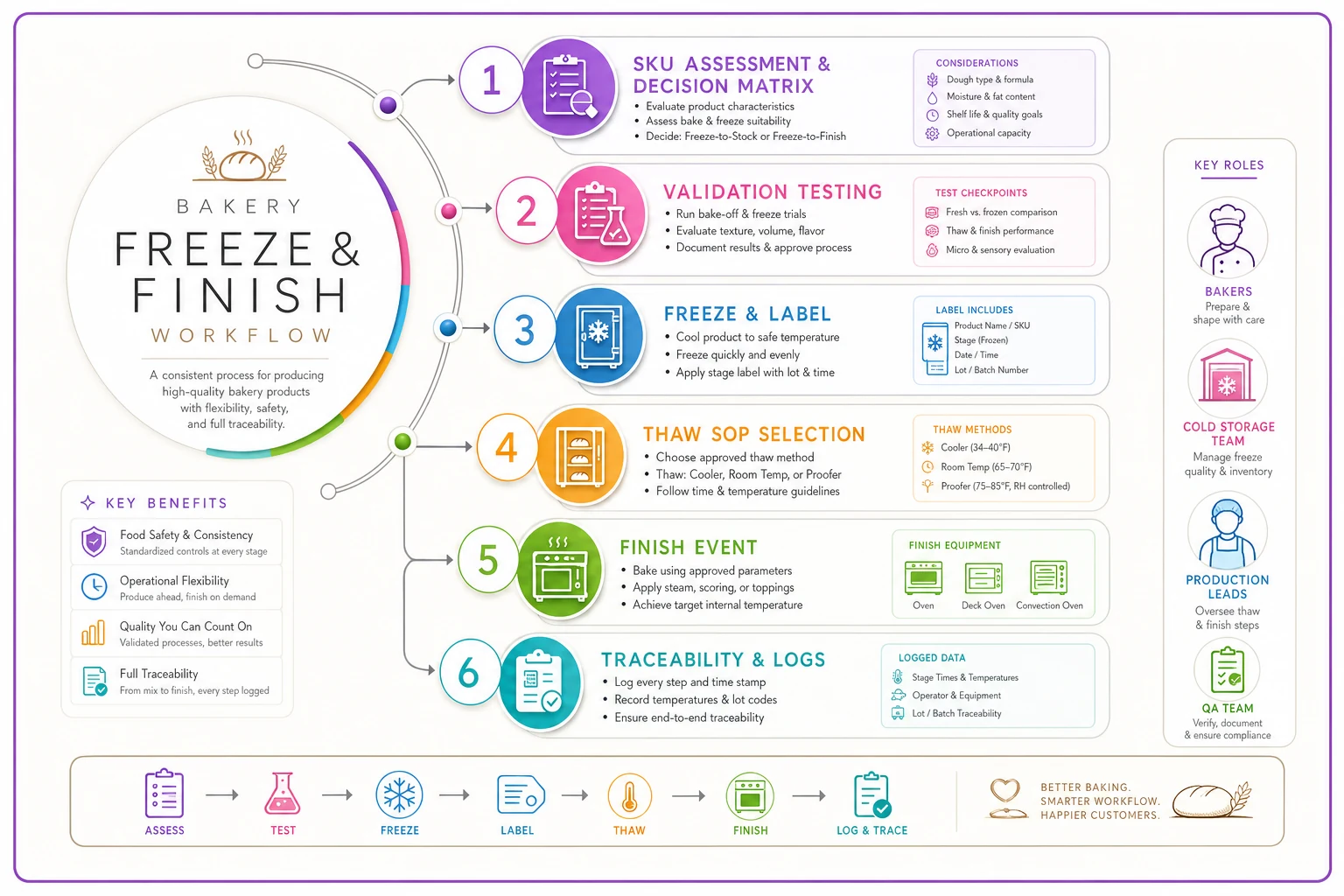
Build the matrix once. Validate to the limit, not the convenient point. Write thaw SOPs specific enough that a new hire can't guess wrong. Label with the texture date and the thaw code. Keep a traceability link from batch to freeze lot to finish.
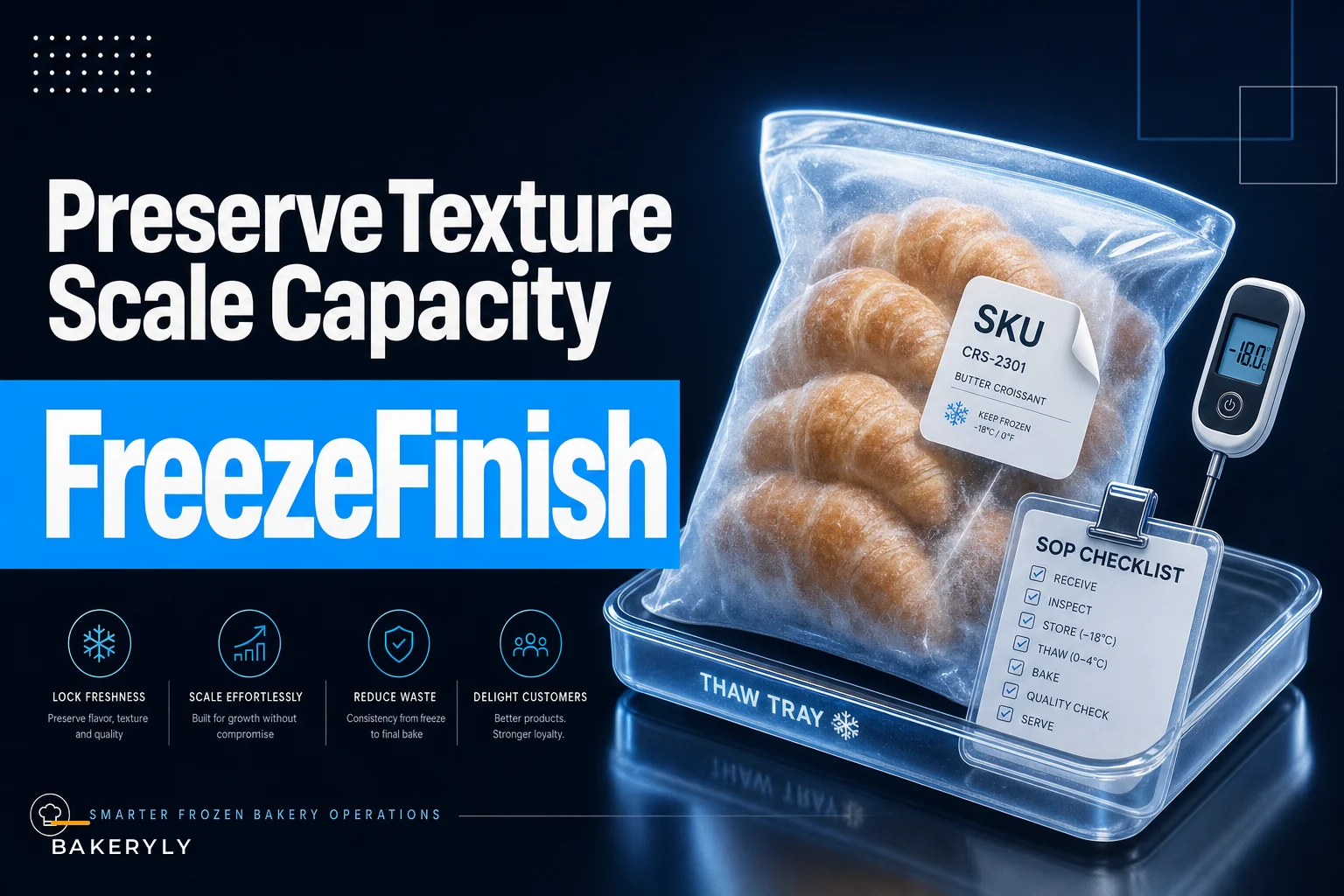
Here's a quick visual workflow for the freeze-and-finish process.
The bakeries that get burned are the ones that froze on intuition and discovered the texture damage three weeks later in a customer's hands. Do the work up front, and the freezer stops being a quiet risk and starts being what it should be — the thing that lets you handle a surge without wrecking the product people came in for.
The bakeries that get burned are the ones that froze on intuition and discovered the texture damage three weeks later in a customer's hands. Do the work up front, and the freezer stops being a quiet risk and starts being what it should be — the thing that lets you handle a surge without wrecking the product people came in for.
Ready to elevate your bakery operations?
Join 2,000+ bakeries using Bakeryly to streamline workflows, reduce waste, and delight more customers.