

Most bakeries don't have a product problem. They have a product graveyard problem.
Walk into almost any bakery that's been open more than three years and you'll find the evidence: a laminated menu with four items nobody orders, a freezer with pre-portioned dough for a croissant variation that "seemed like a good idea last spring," and a display case where two SKUs quietly cannibalize each other while the owner argues about which one to cut. Nobody remembers why half these products exist. Nobody has a clean way to decide whether they should keep existing.
The reason isn't laziness. It's that most bakeries treat new products as creative decisions and old products as emotional ones. A new item gets launched because someone got excited. An old item stays because pulling it feels like admitting failure. Neither decision runs through a repeatable process, so the menu just accumulates — like sediment.
A bakery SKU lifecycle system fixes this by treating every product as something that moves through defined stages, each with an explicit gate it has to pass before it advances. Intake. Experiment. Shelf-life validation. Pack rules. And — the part everyone skips — retirement. When you wire those gates to your actual menu-engineering numbers and your cost-to-scale reality, you stop guessing and start managing a portfolio.
Here's how the whole thing connects, where it breaks, and what changes as you grow.
Why the "menu" is actually a pipeline (and why nobody treats it like one)
Your menu isn't a list. It's the output of a pipeline that's constantly feeding new candidates in one end and (ideally) pushing dead weight out the other.
-
A couple of raw ideas nobody has costed yet
-
One or two things in limited testing
-
Something that passed testing but hasn't survived a full shelf-life and packaging review
-
Your stable core line that pays the bills
-
And at least one item on the retirement watchlist
When this pipeline works, the menu stays lean and every product earns its shelf space. When it doesn't — which is most of the time — you get two predictable failures at once. New ideas either never launch (because launching is chaotic and risky) or they launch too fast and blow up production. Meanwhile old products never die.
The root cause is that these decisions happen in different rooms. Product development happens at the bench. Costing happens in a spreadsheet the owner opens quarterly. Packaging decisions happen when the current box order runs low. Retirement happens... never, or during a panic. Nothing connects.
A stage-gated system forces all of it into one flow with one rule: nothing advances without passing a gate, and every gate has numbers attached.
The five gates, and what each one actually checks
Five stages, five gates. Each gate is a yes/no decision backed by a specific threshold — not a vibe.
Never miss a bake or delivery again.
Bakeryly helps you schedule, track, and manage every order effortlessly.
- Unified order tracking
- Real-time inventory alerts
- Staff shift management
No credit card required
| Stage | What happens here | The gate (what must be true to advance) |
|---|---|---|
| 1. Intake | Idea gets logged, roughly costed, and screened for fit | Passes strategic fit + hits target theoretical margin on paper |
| 2. Experiment | Limited production run, real sales test | Meets sample-size + performance threshold vs. control |
| 3. Shelf-life validation | Tested across real storage/display conditions | Holds quality across the freshness window it will actually live in |
| 4. Pack rules | Packaging, labeling, and handling defined and costed | Pack cost + failure rate within limits for its channels |
| 5. Retirement criteria | Live SKU monitored against menu-engineering metrics | Falls below retirement thresholds → sunset |
The gates are the whole point. Without them, "stages" are just labels you slap on stuff after the fact. With them, you have a system that says no on your behalf so you don't have to relitigate every decision emotionally.
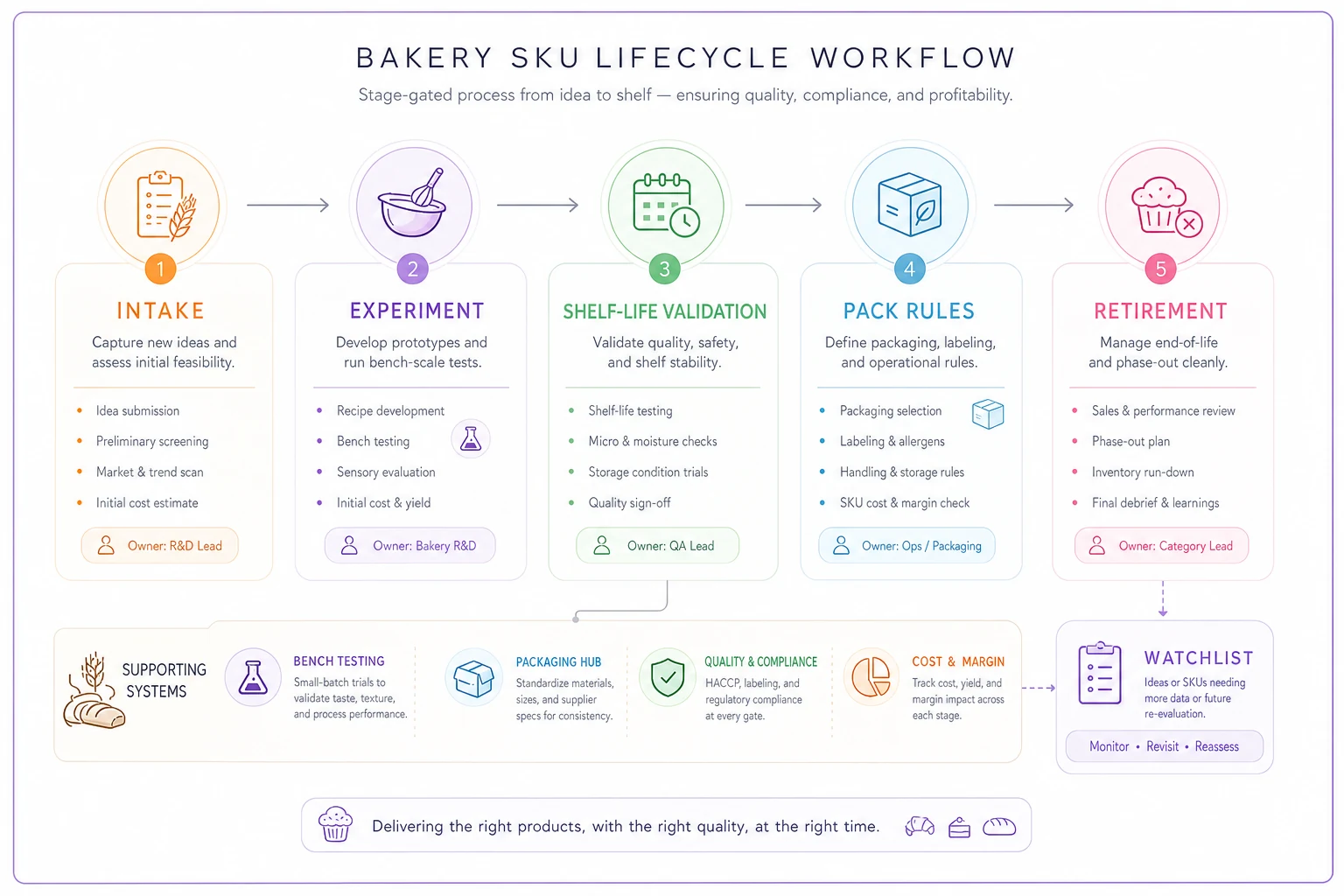
A visual like this makes handoffs and responsibilities obvious without adding bureaucracy.
Gate 1 — Intake: kill bad ideas before they cost you anything
Gate 1 — Intake: kill bad ideas before they cost you anything
Intake is the cheapest place to say no, and almost nobody uses it. Every idea should get logged with the same minimal information: what it is, why it exists (which existing product does it complement or replace?), a back-of-envelope cost, and a target margin.
The screening question that saves the most money isn't "will people like this?" It's "what does this cannibalize?" A new almond danish that steals sales from your existing almond croissant isn't growth — it's churn inside your own case, with added SKU complexity.
A realistic intake threshold looks like: theoretical food-cost under roughly 30–34%, no direct cannibalization of a top-quartile seller, and uses at least 70% ingredients you already stock. That last one matters more than people realize. A "great" new product that adds three single-use ingredients to your inventory drags down your whole operation's efficiency.
Most ideas should die here. If more than a third of your intake ideas are passing to Experiment, your intake bar is too low.
Gate 2 — Experiment: prove it with real numbers, not a good Saturday
Gate 2 — Experiment: prove it with real numbers, not a good Saturday
This is where discipline usually collapses. Someone bakes a test batch, it sells out, and everyone declares victory. One good Saturday is not a signal. It's noise.
The experiment gate needs an actual protocol — a defined test window, a control to compare against, and a minimum number of units sold before you're allowed to conclude anything. If you've built a proper repeatable menu-engineering system, this gate plugs directly into it. Sample sizes, seasonal adjustments, and decision rules already live there — the SKU pipeline just borrows those rules to make the pass/fail call.
A typical experiment gate: the item has to move a minimum unit volume over a two-to-three week window and clear a contribution-margin threshold, comparing apples to apples against whatever it's displacing in the case. If it only sells when you put it front-and-center on the counter, that's not a winning product — that's a merchandising loan you'll have to keep repaying.
The mistake that comes up constantly: testing a new product during a promotion or a holiday spike. You'll get numbers, but they're contaminated. Test during a normal week or you're just fooling yourself.
Gate 3 — Shelf-life validation: the gate that quietly protects your brand
Gate 3 — Shelf-life validation: the gate that quietly protects your brand
The one people forget until it burns them. A product can pass intake and experiment beautifully and still be operationally toxic — because it doesn't hold up.
Shelf-life validation checks whether the product survives the actual conditions it's going to live in: your display case at counter temperature, your pickup window, your delivery times, refrigerated overnight if it's a pre-order item. A filled pastry that's gorgeous at 8 a.m. and weeping at noon is a customer-complaint machine and a waste generator.
You validate against the real freshness window, not the ideal one. If a product is sold for same-day pickup up to 6 hours out, it has to hold quality for 6 hours in your worst-case case temperature — not fresh out of the oven.
This gate connects tightly to scaling too. A recipe that holds perfectly at test-batch size can fall apart when you scale it up, because texture, moisture, and structure change with volume. Before you validate shelf life at scale, make sure the recipe even survives the scale-up — the common mistakes and yield-control checks around scaling recipes are exactly the failure points that show up here. A croissant that's flaky in a batch of 20 and dense in a batch of 200 will fail shelf-life validation for reasons that have nothing to do with the ingredients.
Gate 4 — Pack rules: where margin quietly disappears
Gate 4 — Pack rules: where margin quietly disappears
By the time a product reaches this gate, everyone's already emotionally attached. Which is exactly why packaging gets under-scrutinized. Packaging decisions can flip a profitable product into a losing one, especially across delivery and pickup channels where fragility and materials cost real money.
The pack rules gate defines: what it ships in, how it's labeled (allergens, dates), how it's handled at each channel, and — critically — what the packaging costs and what its failure rate is. A delicate item with a 4–5% breakage rate on delivery isn't a delivery product, full stop. Either it gets a different pack solution or it stays pickup-and-display only.
A useful threshold: total pack cost shouldn't exceed a set percentage of the item's price (many bakeries land somewhere in the 6–10% range depending on channel), and the damage/complaint rate on its riskiest channel has to stay under a defined ceiling. If it can't clear both, you either constrain which channels it's sold in, or it doesn't advance.
Worth noting: some products should pass this gate with restrictions. "Approved for display and pickup, not delivery" is a perfectly valid outcome. Forcing every product into every channel is how bakeries end up with delivery bags full of crushed meringue.
Gate 5 — Retirement: the discipline nobody has
Gate 5 — Retirement: the discipline nobody has
Products don't get to live forever just because they were once popular. The retirement gate is a standing review — it runs on a cadence (monthly or quarterly) against your live SKUs, and it flags anything that's slipped below threshold.
Retirement criteria should be defined before a product launches, so the decision is unemotional when it comes. Tie them to menu-engineering metrics you already track:
-
Unit velocity below the bottom decile of the menu for two consecutive review periods
-
Contribution margin dropping below your floor (often because ingredient costs crept up and the price didn't)
-
Rising waste percentage — the product is being made and thrown out
-
High operational drag
it's the only thing using a specialized ingredient, tying up a station, or complicating your morning bake
When an item trips these flags, it goes on a watchlist, not straight to the guillotine. Sometimes a reprice or a recipe tweak brings it back. But if it can't recover within a defined window, it retires. Cleanly. No drama.
Retirement isn't failure — it's how you make room. Every dead SKU you keep is stealing capacity, freezer space, and menu attention from the next product that could actually win.
What breaks at scale
At one location with one baker, you can hold this whole pipeline in your head. Painfully, but you can.
-
Intake becomes uneven. Different people log ideas differently (or don't log them at all), so half your pipeline is invisible.
-
Experiments stop being comparable. A product tested at Location A under one set of conditions can't be compared to something tested at Location B. You lose the ability to make portfolio decisions.
-
Shelf-life assumptions drift. What holds up at your flagship's fast-turning case fails at the slower satellite location — but nobody re-validated.
-
Pack rules fragment. One site delivers a fragile item that another site correctly restricts to pickup, and now you have inconsistent complaint rates and no idea why.
-
Retirement stops happening entirely. With more products and more locations, no single person has visibility into what's underperforming everywhere, so nothing ever gets cut.
The through-line: the pipeline breaks at the coordination layer, not the recipe layer. The baking is fine. What fails is the shared record of where every product stands and which gate it needs to pass next.
This is where a lightweight workflow platform earns its keep — not by doing anything creative, but by holding the pipeline in one place. When intake, experiment results, shelf-life sign-offs, pack specs, and retirement flags all live in the same system, the gates enforce themselves. AI-assisted platforms can watch your live SKUs against retirement thresholds and surface the watchlist automatically, so underperformers get flagged instead of forgotten. That's the unglamorous, high-value part: a system that quietly does the saying no that humans avoid.
A real scenario
A two-location bakery-café doing roughly $90k–$110k a month in combined sales had built up 47 active SKUs over about four years. No formal lifecycle process — new items got added when a baker felt inspired, and almost nothing ever got removed.
-
11 SKUs were selling in the bottom decile and running above-average waste
-
3 of those relied on ingredients used in nothing else on the menu
-
2 "delivery" items had complaint rates north of 6% from breakage — they'd never had a pack rule
They retired 9 SKUs over the following two months, kept 2 with reprices, and stopped delivering the fragile ones. Nothing dramatic happened to revenue — customers barely noticed the cuts. But waste dropped by roughly a fifth, morning production got noticeably simpler, and the specialized ingredients came off the order sheet. The real win was the new intake discipline: over the next quarter they tested four new ideas, and only one made it all the way through the gates to the permanent menu. That one item now outsells three of the products they retired.
The lesson wasn't "cut products." It was "have a system that decides." The cutting was just the backlog clearing out.
When a full stage-gated system makes sense — and when it's overkill
This isn't for everyone at every stage.
When it makes sense:
-
You have more than roughly 15–20 SKUs and it's getting hard to track what earns its place
-
You operate more than one location or channel and consistency is slipping
-
New products regularly disrupt production or blow through capacity
-
You have a "product graveyard" and no clean way to prune it
When it's a bad idea:
-
You're a brand-new single-location shop with 8 core items — you don't have enough complexity to justify the overhead yet. Just be disciplined about intake and shelf-life informally.
-
You're in the middle of a crisis (equipment failure, supplier shock). Stabilize first. Portfolio hygiene is a calm-weather activity.
Who should NOT try to implement all five gates at once: anyone without a baseline menu-engineering habit. If you don't yet have reliable numbers on unit velocity and contribution margin per item, start there. The gates are only as good as the data feeding them. Build the measurement muscle first, then add the gates.
Starting small: a first-pass implementation checklist
You don't roll this out all at once. Here's a sane order to build it:
-
- [ ] Inventory your current SKUs and pull velocity + margin for each over the last few months
-
- [ ] Sort them into rough tiers (stars, workhorses, underperformers, dead weight)
-
- [ ] Write down your retirement thresholds before you look at which products would fail them
-
- [ ] Run the retirement gate once on your existing menu — clear the backlog
-
- [ ] Define a one-page intake form and require it for every new idea going forward
-
- [ ] Add a simple experiment protocol (test window, control, minimum volume)
-
- [ ] Add shelf-life and pack-rule sign-offs before anything joins the permanent menu
-
- [ ] Set a recurring review cadence — monthly or quarterly — to run the retirement gate on live SKUs
The first pass is mostly cleanup. The ongoing value comes from never letting the backlog build up again.
The whole point
A bakery SKU lifecycle system isn't about being clinical or killing creativity. It's the opposite — it's what lets you experiment more freely, because you know every idea will get a fair test and every failure will get cleaned up instead of lingering. The creativity happens at the bench. The discipline happens at the gates.
The bakeries that stay lean and profitable as they grow aren't the ones with the best single product. They're the ones who manage their menu like a living pipeline — feeding good ideas in, pushing dead weight out, and never letting a decision get made on emotion when a threshold could make it instead. Get the gates right, connect them to the numbers you already track, and the menu starts taking care of itself.
A bakery SKU lifecycle system isn't about being clinical or killing creativity. It's the opposite — it's what lets you experiment more freely, because you know every idea will get a fair test and every failure will get cleaned up instead of lingering. The creativity happens at the bench. The discipline happens at the gates.
The bakeries that stay lean and profitable as they grow aren't the ones with the best single product. They're the ones who manage their menu like a living pipeline — feeding good ideas in, pushing dead weight out, and never letting a decision get made on emotion when a threshold could make it instead. Get the gates right, connect them to the numbers you already track, and the menu starts taking care of itself.
Ready to elevate your bakery operations?
Join 2,000+ bakeries using Bakeryly to streamline workflows, reduce waste, and delight more customers.