

Most bakeries that want to franchise aren't ready, and the tell isn't revenue. It's whether the business runs when the founder is on vacation for two weeks with their phone off. If croissant quality dips the moment you leave the room, you don't have a franchise concept yet. You have a talented person doing a job that happens to be profitable.
Franchising is the act of packaging how you operate and selling it to someone with less skill, less context, and zero founder instinct. That's the whole game. The recipe matters less than you think. What matters is whether a first-time operator in a town you've never visited can produce your product, hit your margins, and not burn the brand down by month four.
So the readiness question isn't "is my bakery good?" It's "is my bakery transferable?" Those are very different tests, and this piece walks through how to score yourself honestly against gates that either pass or fail — no partial credit, no "we'll fix it later."
Why "we're doing great" doesn't mean "we're ready"
There's a pattern worth naming. A single-location bakery hits somewhere around $900k–$1.1M in revenue with healthy margins. The owner figures the hard part is done and the model is proven. But almost everything driving that success lives in one person's head: which supplier to call when the flour delivery is short, how to eyeball proof on a humid day, which regulars get the day-old discount and which don't.
That knowledge is invisible until you try to copy it. The moment you hand the operation to someone else, all those undocumented judgment calls become failure points. A franchisee doesn't fail because your product is bad. They fail because you never wrote down the 200 small decisions you make on autopilot.
What you see across operationally mature businesses is that readiness correlates with boredom of documentation, not excitement of concept. The bakeries that are actually ready to franchise have SOPs so detailed they feel almost insulting to a skilled baker. That's the point. You're not writing for yourself. You're writing for someone who's never done this before.
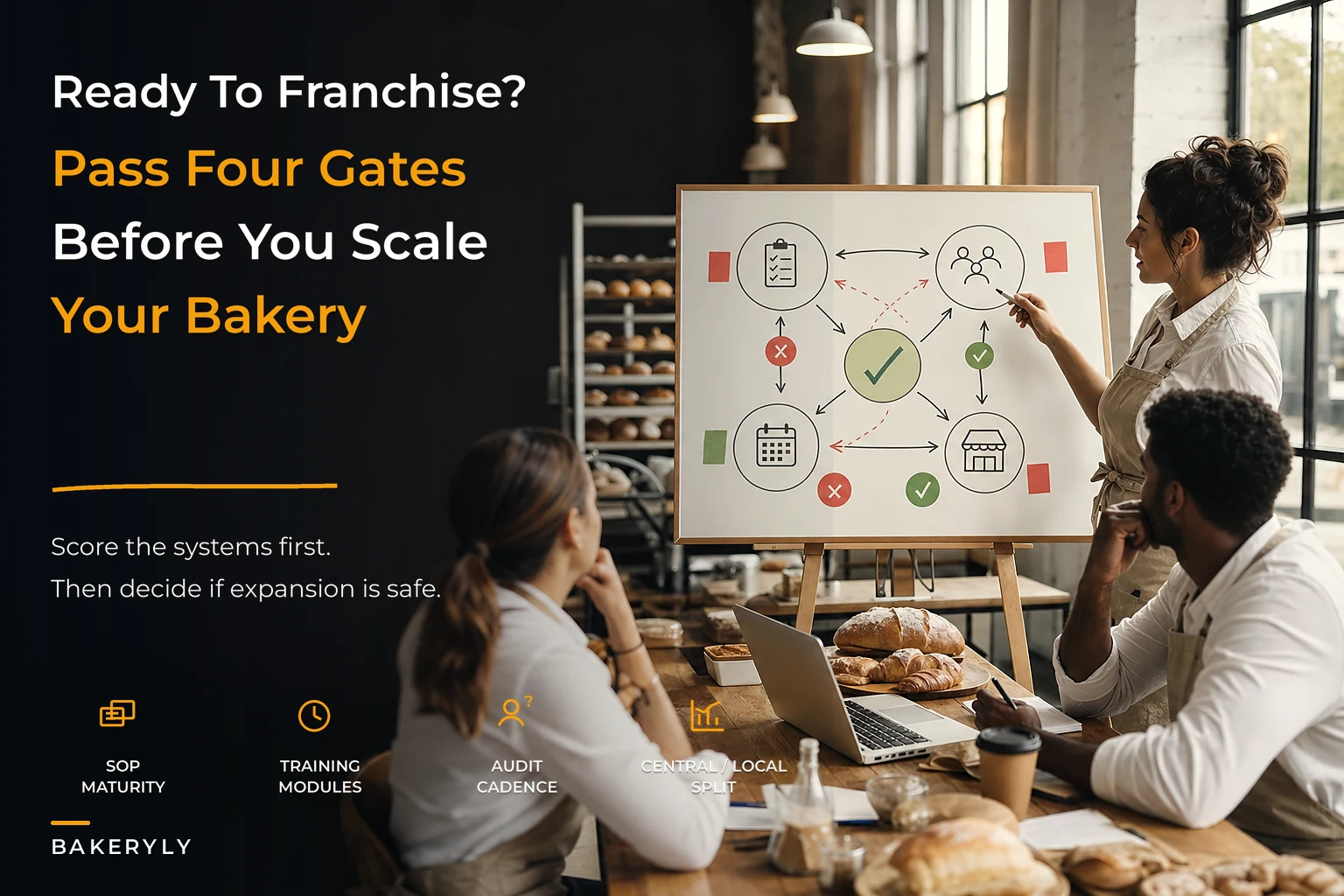
The four readiness gates
Rather than a fuzzy "how ready are you" score, think in gates. A gate is binary: you pass or you don't. You can't average your way past one. If your SOP maturity is stellar but you have no audit cadence, you're not "75% ready" — you're blocked at the audit gate.
-
SOP maturity — is the work documented well enough that a stranger can execute it?
-
Training modules — can you take someone from zero to competent on a predictable timeline?
-
Audit cadence — do you have a repeatable way to catch drift before it becomes brand damage?
-
Central/local split — do you know exactly what headquarters controls versus what the operator decides?
Each gate has a pass/fail threshold. Below is the scorecard, but first it helps to understand what each gate is actually testing.
Gate 1: SOP maturity
SOP maturity isn't about having documents. Plenty of bakeries have a binder somewhere. Maturity is about whether those documents are current, followed, and specific enough to remove judgment where judgment is dangerous.
There's a useful maturity ladder here:
| Level | What it looks like | Franchise-ready? |
|---|---|---|
| 0 – Tribal | Knowledge in people's heads, nothing written | No |
| 1 – Ad hoc | Scattered notes, some checklists, inconsistent | No |
| 2 – Documented | Written SOPs exist but aren't consistently followed | Not yet |
| 3 – Enforced | SOPs followed daily, versioned, updated when things change | Minimum bar |
| 4 – Self-correcting | SOPs drive training, get audited, improve on a cycle | Ideal |
You need to be at Level 3 minimum to pass this gate, and honestly Level 4 for anything beyond your first two or three units. The jump from Level 2 to Level 3 is where most bakeries stall, because writing SOPs is easy and enforcing them means confronting your best people about why they're freelancing. If you've already done the work of moving from scattered checklists to structured digital procedures, you're most of the way there — the reasoning behind that shift is covered in depth in why phased digital SOPs beat ad-hoc checklists for small bakeries.
Time a new hire on a random SOP and note where they hesitate; those spots usually need more explicit steps.
A quick self-test: pull one SOP at random. Hand it to a new hire. Watch them try to execute it without asking a single question. If they get stuck three times in the first ten minutes, your SOP is at Level 2 dressed up as Level 3.
Gate 2: Training modules
The training gate tests time-to-competence. If it takes six months of hands-on shadowing to make someone useful, you can't franchise — a franchisee doesn't have six months and doesn't have you.
Ready operations break training into modules with clear completion criteria. Not "learn the ovens" but "can load, monitor, and unload three consecutive bake cycles hitting target color and internal temp without supervision." Each module has a defined outcome, a way to verify it, and a rough duration.
-
Week 1 Food safety, allergen handling, opening/closing procedures, POS basics
-
Week 2 Core production — mixing, proofing, shaping for the top 10 SKUs
-
Week 3 Bake execution, quality standards, waste tracking
-
Week 4 Front-of-house flow, order handoff, daily reconciliation
-
Weeks 5–6 Full shift runs under observation, then solo with spot checks
The gate you're testing: can a motivated novice reach independent operation in roughly 4–6 weeks? If your answer is "it depends on the person," you fail. Franchise training can't depend on the person. It has to depend on the module.
The common mistake is treating training as knowledge transfer instead of competence verification. Watching a video and nodding isn't training. A signed-off checklist proving someone independently produced acceptable output — that's training.
Gate 3: Audit cadence
Everything drifts. Portion sizes creep, cleaning shortcuts sneak in, a franchisee decides your bagel recipe is "basically the same" with cheaper flour. Without audits, you find out when a customer complains or a health inspector shows up. By then it's a brand problem, not an operations problem.
Audit cadence is the gate most first-time franchisors skip because it feels bureaucratic. But an audit isn't a punishment — it's the immune system of a multi-unit brand. The question is whether you have a rhythm that catches drift early.
-
Daily (self) operator completes a short standards checklist — temps, key portion checks, cleanliness, waste log
-
Weekly (self + review) operator submits numbers; HQ reviews for outliers
-
Monthly (remote) structured review of photos, logs, and KPIs against standard
-
Quarterly (on-site) full walkthrough audit, scored, with corrective actions and deadlines
The gate: do you have a defined cadence with someone accountable for running it, and a scoring rubric that produces a number? If your "audit" is the owner dropping by when they feel like it, you don't have a cadence. You have anxiety. This connects directly to the operating rhythm laid out in scaling a bakery to multiple sites, which digs into how a light audit rhythm holds standards across locations.
Gate 4: The central/local split
This is the gate everyone underestimates. A franchise lives or dies on getting the split right: what does headquarters control absolutely, and what can the local operator decide?
Too centralized and operators feel like button-pushers, morale tanks, and they can't adapt to local conditions. Too loose and your brand fragments into 30 slightly different bakeries wearing the same logo.
| Decision area | Central (HQ) | Local (operator) |
|---|---|---|
| Core recipes & specs | ✅ Locked | ❌ |
| Approved supplier list | ✅ | Order quantities only |
| Menu — core SKUs | ✅ | ❌ |
| Menu — local/seasonal specials | Approval | ✅ Propose |
| Pricing | Guardrails/ranges | Within range |
| Staffing levels & schedules | Standards | ✅ Day-to-day |
| Marketing — brand assets | ✅ | Local promo within guidelines |
| Store hours | Minimums | ✅ Extend |
The gate: can you produce a document like the above where every meaningful decision has a clear owner? If there are gray zones — "well, it depends" — those gray zones are where your first franchise dispute will happen. Write them down before someone signs a contract, not after.
The readiness scorecard
Here's a practical way to score yourself. Rate each gate honestly, and remember: a single fail blocks the whole thing. You don't get to franchise on three out of four.
SOP maturity gate — PASS if:
-
Top 15 SKUs have complete, current, step-by-step SOPs
-
SOPs specify measurements, times, temps, and visual cues (not "bake until done")
-
Version control exists — you know which version is current
-
A new hire can execute a random SOP with minimal questions
Training gate — PASS if:
-
Training is modular with defined completion criteria
-
Time-to-competence is 4–6 weeks and repeatable across people
-
Competence is verified by output, not attendance
-
Materials exist independent of you being present
Audit gate — PASS if:
-
Daily/weekly/monthly/quarterly cadence is defined and assigned
-
A scoring rubric produces a number, not a vibe
-
Corrective actions have owners and deadlines
-
You've run at least one full cycle internally
Central/local gate — PASS if:
-
Every major decision has a documented owner
-
Recipe and supplier control is unambiguous
-
Operators have defined room to adapt locally
-
Gray zones have been resolved in writing
Score it: 4 passes and you're structurally ready to pilot. 3 passes means fix the fourth before you talk to a franchise attorney. 2 or fewer means you're running a great bakery that isn't a franchise yet — and that's fine, it just means the work ahead is documentation, not lawyers.
A realistic readiness scenario
Consider a bakery-café doing around $1.2M a year, two locations, owner-operated. They wanted to franchise and were convinced they were ready because both stores were profitable.
They scored themselves against the gates. SOP maturity: passed, barely — they'd invested in digital procedures the year before. Training: failed. Their "training" was the owner working alongside new staff for as long as it took, which for one recent hire meant nearly three months. Audit: failed — no cadence at all, the owner just knew when something felt off because they were in both stores constantly. Central/local: not even started.
Two out of four. Not ready.
The fix took about seven months of unglamorous work. They built modular training with sign-off checklists and got time-to-competence down to roughly five weeks. They established a monthly-remote, quarterly-on-site audit rhythm and ran two full cycles on their own second location as a dry run. They wrote out the central/local split, which forced some genuinely hard conversations about whether operators could tweak recipes (answer: no) and adjust local pricing (answer: within a band).
When they revisited the scorecard, all four gates passed. The interesting part wasn't just that they could now franchise — their existing second location got noticeably more consistent once it was being run against documented standards instead of the owner's memory. Franchise readiness made the base business better. That's usually how it goes.
When franchising is the wrong move
Passing the gates means you can franchise. It doesn't mean you should.
Franchising is a bad idea if your margins only work because you're the free labor holding everything together. Strip out the founder's unpaid overtime and if the unit economics collapse, a franchisee — who has to pay staff for everything you do yourself — will lose money. That's the fastest way to end up in litigation.
It's also the wrong move if your concept depends on something that can't be replicated — a farmers-market slot, a viral local reputation, a lease nobody else could get. Some bakeries are excellent businesses and terrible franchises for reasons that have nothing to do with operations.
And it's premature if you've only ever run one location. Your second and third company-owned stores are the real proving ground. They tell you what breaks when you are the "franchisor" and can't be everywhere. If you can't run three of your own units cleanly against these gates, don't hand the fourth to a stranger.
The system view
The reason to think in gates rather than a general readiness score is that these four systems are interlocking. Weak SOPs make training slow, because trainers improvise. Slow training means inconsistent operators, which means audits find more problems, which means HQ spends its time firefighting instead of growing. A fuzzy central/local split means nobody's even sure which of those problems is the franchisee's fault to begin with.
Fix one gate in isolation and the others drag it back down. That's why "we have great recipes and a strong brand" isn't a franchise. A franchise is a documented, teachable, auditable, clearly-governed operating system that happens to make baked goods.
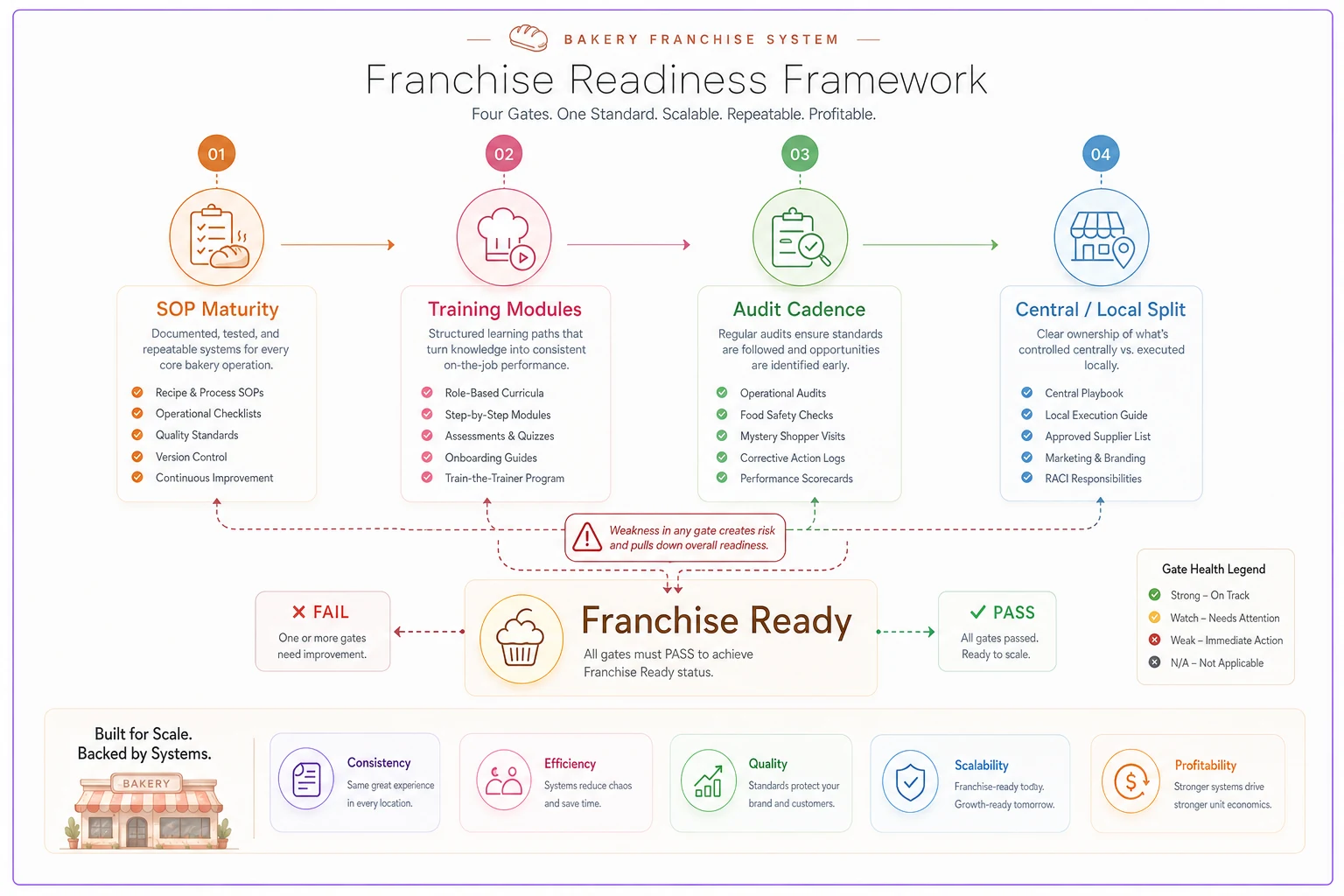
The diagram above shows how weaknesses in one gate can cascade into the others and how getting all four to green produces a stable 'Franchise Ready' outcome.
Get the four gates to green, in the right order, and you're not just ready to franchise — you've built a better bakery in the process, whether you ever sell a single unit or not.
Get the four gates to green, in the right order, and you're not just ready to franchise — you've built a better bakery in the process, whether you ever sell a single unit or not.