


Running three bakery locations isn't the same as running one bakery three times. The operational complexity compounds in ways that catch most owners off guard—usually around month four of the second location when product quality starts varying wildly between sites.
Most bakery owners fall into one of two camps when they try to scale: those who try to control everything centrally and burn out their management team, or those who let each site run independently and end up with three different businesses under one brand.
Neither works. Bakeries have elements that absolutely need to be consistent across locations and elements that genuinely benefit from local flexibility. Your sourdough starter process needs to be identical everywhere. Your morning production volumes don't.
The operational split that actually works
The multi-site bakeries that maintain quality while scaling share a specific governance structure. They split operations into three categories:
Central control items are non-negotiable. Recipe specifications, food safety protocols, brand standards, pricing. A customer ordering a chocolate croissant should get the same thing at your downtown location as at your suburban site.
Local adaptation zones give site managers flexibility within defined boundaries. Production volumes, staffing schedules, display arrangements, community engagement. Your university district location might need 200 morning pastries. Your business district site might need 80.
Shared resource pools create efficiency without forcing uniformity. Equipment maintenance, ingredient ordering, and specialized staff can be coordinated centrally while execution stays local.
| Operational Area | Central Control | Local Flexibility | Coordination Method |
|---|---|---|---|
| Recipe execution | Exact specifications, mixing times, temperatures | Batch sizes, production timing | Central recipe cards with local volume annotations |
| Staffing | Core roles, training standards, pay scales | Shift patterns, break coverage, task distribution | Central competency matrix, local scheduling |
| Ingredient ordering | Approved vendors, quality specs, pricing | Order quantities, delivery schedules | Pooled purchasing power, site-specific deliveries |
| Customer service | Service standards, complaint escalation | Local regulars program, community partnerships | Central training, local relationship building |
| Equipment | Maintenance standards, replacement criteria | Daily cleaning schedules, usage patterns | Central maintenance contracts, local daily checks |
This structure prevents the chaos of three different bakeries while avoiding the rigidity that makes local managers feel like they're just executing someone else's plan with no agency.
Transfer rules that prevent site-to-site chaos
Product transfers between sites kill profitability faster than almost any other multi-site issue. A croissant that costs $1.20 to make can carry $3.50 in real cost once you factor in coordination time, transport, quality degradation, and admin overhead.
Never miss a bake or delivery again.
Bakeryly helps you schedule, track, and manage every order effortlessly.
- Unified order tracking
- Real-time inventory alerts
- Staff shift management
No credit card required
Smart transfer systems start with clear triggers—not ad-hoc phone calls when one site runs low. When Site A drops below 30% of expected afternoon inventory by 11am, the transfer protocol activates. Not "we're running low on muffins," but "muffin inventory at 11am shows 8 units against an expected 30 for the 12–5pm window."
High-stability, high-value items (packaged cookies, cake slices) can transfer up to 30 minutes travel time if margin exceeds $4 per unit.
Medium-stability items (morning pastries, unfrosted items) transfer only between sites within 15 minutes during non-peak traffic, and only for orders exceeding $40 total value.
Low-stability items (cream-filled pastries, custom decorations) don't transfer except for pre-arranged large orders over $100.
Document every transfer with a simple three-part form: sending site inventory adjustment, receiving site intake log, transport temperature verification. Takes about 90 seconds but prevents the inventory discrepancies that compound into thousands in annual shrinkage.
Rotate the transfer coordinator role weekly so assistant managers understand transfer costs and think twice before requesting movements.
Rotating the transfer coordinator role weekly between assistant managers ensures everyone understands the real cost of transfers and thinks twice before requesting one.
Capacity pooling without creating dependency
The appeal of multi-site operations is sharing expensive resources—specialty equipment, skilled decorators, bulk purchasing. But pooling resources wrong creates single points of failure that can hit multiple locations at once.
Equipment pooling works for specialty items used less than twice weekly. An $8,000 fondant printer can serve three locations if each site blocks specific production windows. But your dough sheeter stays put—the productivity loss from sharing core equipment outweighs any cost savings.
Skills pooling needs careful scheduling. Your cake decorator might work Tuesday/Thursday at Site A, Monday/Wednesday at Site B, Friday at Site C. That only works with a documented handoff process and actual backup coverage. When they call in sick, all three sites need contingency plans—not just hope.
Purchasing pooling delivers the clearest wins with the least operational risk. Negotiating flour prices for 15,000 pounds monthly beats three separate 5,000-pound negotiations. But keep delivery schedules separate to avoid one site's storage functioning as another's warehouse.
Pooled resources need their own coordination structure—a shared calendar visible at all locations, clear booking protocols, and documented transport responsibilities. Otherwise you end up with the "I thought you were bringing the specialty tips" failures that derail production days.
One practical rule for ingredients: if a site uses less than 20% of the pooled volume, they should order independently. Managing pooled purchasing when one location uses 180 pounds monthly and another uses 12 creates more friction than it solves.
The audit cadence that catches problems before customers do
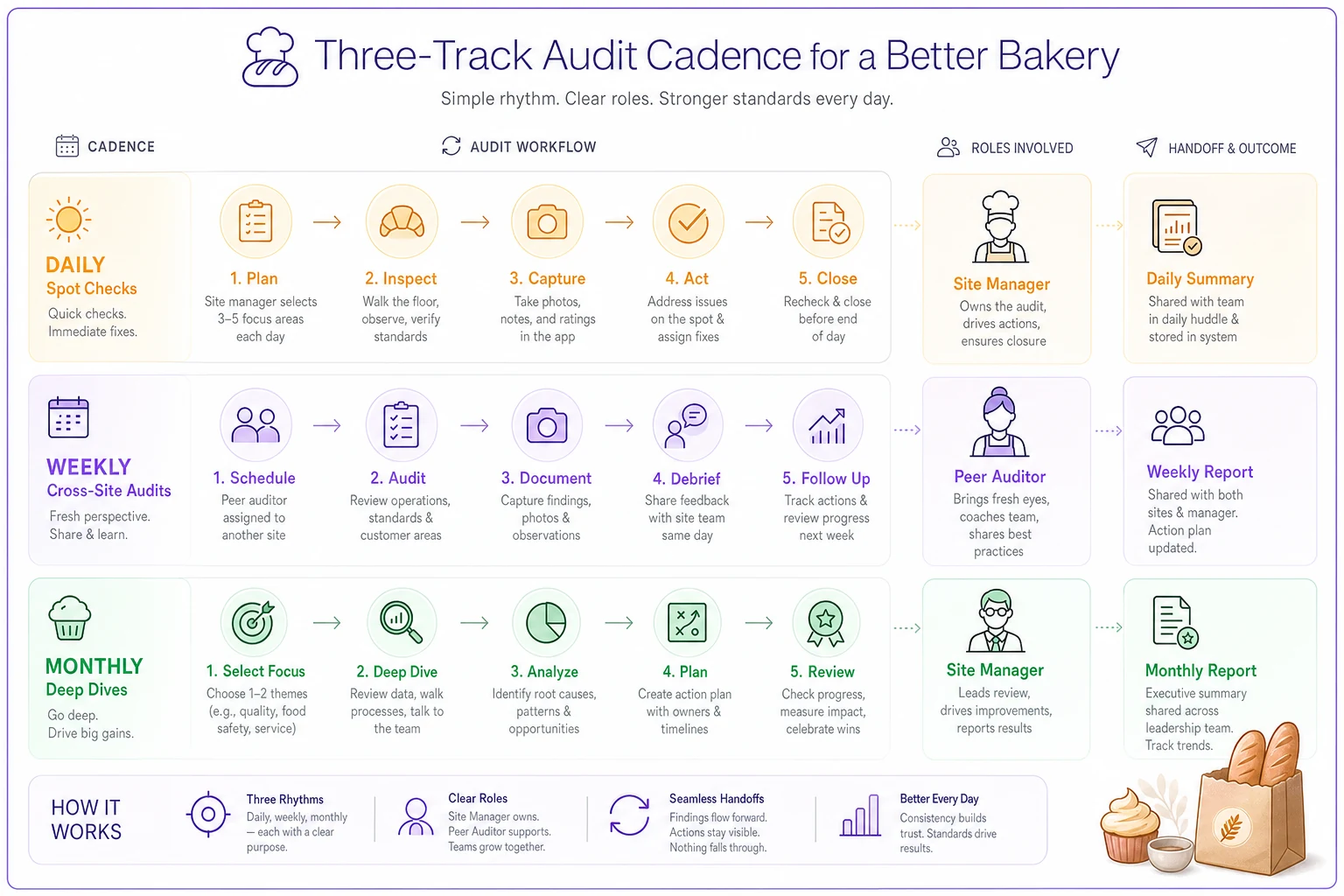
Multi-site audits fail when they become annual compliance exercises. The system that actually drives consistency runs on three parallel tracks:
Daily spot checks take five minutes and focus on one element. Monday: recipe weight checks on three random items. Tuesday: temperature log completion. Wednesday: customer area cleanliness. This light, consistent pressure maintains standards without overwhelming anyone.
Weekly cross-site audits have site managers audit each other's locations using a 20-point checklist. Downtown audits suburban on Tuesday, suburban audits university district on Wednesday, university district audits downtown on Thursday. Peer review catches blind spots that individual managers miss at their own sites.
Monthly deep dives examine one operational area thoroughly. January might focus on ingredient storage and rotation. February on customer service consistency. March on production efficiency. Going deep on one area monthly beats a shallow annual review of everything.
The tools matter less than consistency and follow-through. A simple template that people actually use beats a complex system that gets abandoned after two months:
Weekly Cross-Site Audit Template
Production Standards (5 points)
-
Recipe cards posted and current
-
Scaling calculations visible
-
Temperature logs completed
-
Product dating correct
-
Work surfaces organized
Customer Experience (5 points)
-
Display case arrangement matches planogram
-
Pricing clearly marked
-
Sampling station stocked (if applicable)
-
Seating area clean
-
Bathroom check log current
Back of House (5 points)
-
Ingredient storage labeled and dated
-
Equipment cleaning logs completed
-
Waste tracking sheet updated
-
Staff break area maintained
-
Delivery area organized
Administrative (5 points)
-
Cash procedures followed
-
Shift handoff notes completed
-
Customer feedback log reviewed
-
Maintenance requests documented
-
Schedule posted for next week
Score each item 0–2 (missing, partial, complete) for a 40-point maximum. Below 32 triggers immediate remediation. Below 28 requires a management visit within 24 hours.
A visual workflow of the three audit tracks can help teams follow the cadence.
Score each item 0–2 (missing, partial, complete) for a 40-point maximum. Below 32 triggers immediate remediation. Below 28 requires a management visit within 24 hours.
Making governance stick without micromanaging
The best governance systems become invisible once embedded. Site managers shouldn't feel constantly watched or measured against impossible standards. They should feel like the systems are making consistency easier than chaos.
Roll out governance gradually. One element per month, not a complete operational overhaul dropped on three sites at once. Month one: establish the central vs. local split for five core areas. Month two: implement transfer protocols. Month three: begin weekly cross-audits.
Build feedback loops in from the start. The monthly managers' meeting should include 30 minutes specifically on governance friction. What central standards need local adaptation? Which local variations should become standard? Transfer rules that seemed logical on paper sometimes prove ridiculous in practice—find out before they create real problems.
Track metrics that actually connect to profitability. Product consistency scores, transfer costs as a percentage of revenue, audit scores by category, and time spent on inter-site coordination all signal whether your governance structure helps or gets in the way.
Governance structures also need to evolve. Systems that work well for three sites might start breaking at five. Plan for that now.
The technology layer that makes multi-site coordination possible
Manual coordination between sites eats through manager hours that should be spent on quality control and customer experience. The right operational software turns multi-site governance from a constant struggle into something that largely runs in the background.
AI-powered operational platforms handle the coordination tasks that drain management time. Inventory levels sync automatically across locations. Transfer requests route through approval workflows without phone tag. Audit checklists populate based on date and auditor, with results aggregating into trends visible across all sites.
The real value is pattern recognition. When operational software identifies that your university district location consistently under-orders Thursdays for Friday demand, it flags the issue before it becomes a stockout. When transfer requests between two specific sites spike every third week, the system suggests investigating the underlying forecast problem rather than just approving more transfers.
This layer also reinforces governance standards without feeling punitive. Recipe modifications get flagged before they affect product quality. Pricing discrepancies surface before customers notice. The procurement system automatically applies negotiated rates across all locations, so individual sites can't accidentally overpay a supplier.
For bakeries scaling beyond three or four locations, this infrastructure stops being optional. Manual coordination that barely holds together at three locations falls apart completely at six. The investment in proper operational software pays back through reduced waste, fewer emergencies, and managers focused on growth instead of firefighting.
A real scaling scenario: three locations, one standard
When Neighborhood Bakery Collective expanded from one to three locations over eighteen months, they initially let each site operate independently beyond basic recipes. By month six of the third location, they were running three different businesses. Downtown had developed its own sandwich menu. Suburban was doing custom cakes the others weren't equipped for. University district had pivoted heavily toward grab-and-go.
Customer complaints about inconsistency forced a governance overhaul. They implemented:
-
Central control over all recipes, pricing, and core menu items (allowing 20% local variation for seasonal items)
-
Transfer protocols limiting movements to pre-approved items with over $3 margin per unit
-
Weekly cross-audits using the 40-point scoring system across four categories
-
Pooled purchasing for flour, butter, and eggs (saving roughly $2,400 monthly)
-
Dedicated Friday afternoon production of specialty items distributed Saturday morning
The integration took four months and initially felt restrictive to managers who'd grown used to full autonomy. But standardization freed up around 15 hours weekly of coordination time that had been going toward ad-hoc problem-solving. Product consistency complaints dropped from around twelve per month to two. And for the first time, they could actually analyze location performance—because they were finally comparing equivalent operations.
The fourth location opened in three weeks from lease signing, compared to three months for location three. The governance framework that felt like bureaucracy had become the infrastructure that made faster growth possible.
Building governance that scales with growth
Moving from single-site to multi-site fundamentally changes what makes a bakery successful. Production systems that work brilliantly in one location need governance layers to maintain quality across several.
The key insight: governance isn't about control, it's about clarity. Clear boundaries between central standards and local adaptation. Clear triggers for resource sharing. Clear accountability through regular audits. Clear technology infrastructure to reduce coordination friction.
Bakeries that get this right can scale profitably while keeping the quality and character that made the first location work. Those that don't either become rigid operations that lose local connection, or chaotic collections of vaguely related businesses that happen to share a name.
Start with the fundamental split between what must be consistent and what benefits from local adaptation. Build transfer and pooling rules that account for the real costs of coordination. Implement audit systems that improve operations rather than just checking boxes. Layer in technology that makes governance automatic rather than something you have to force.
The goal isn't perfect standardization—it's profitable growth that maintains quality while giving each location enough flexibility to actually serve its community. That balance is probably the hardest thing to achieve in multi-site bakery operations, but it's also what separates the ones that grow well from the ones that expand themselves into exhaustion.
Ready to elevate your bakery operations?
Join 2,000+ bakeries using Bakeryly to streamline workflows, reduce waste, and delight more customers.