

Most seasonal menu failures don't happen in November. They happen in September, when someone says "we'll figure out the pumpkin cruffin closer to launch," and then closer to launch turns into three panicked days of scaling a recipe nobody proofed at volume.
The pattern is almost always the same. The idea is good. The test bake in a home-sized batch tasted great. Then production tries to run 400 units on a Tuesday and the dough behaves completely differently, the filling weeps in the case, the supplier who was "definitely going to have" the spiced pumpkin puree quotes a four-week lead time, and you're launching a signature holiday item you've never actually made at scale.
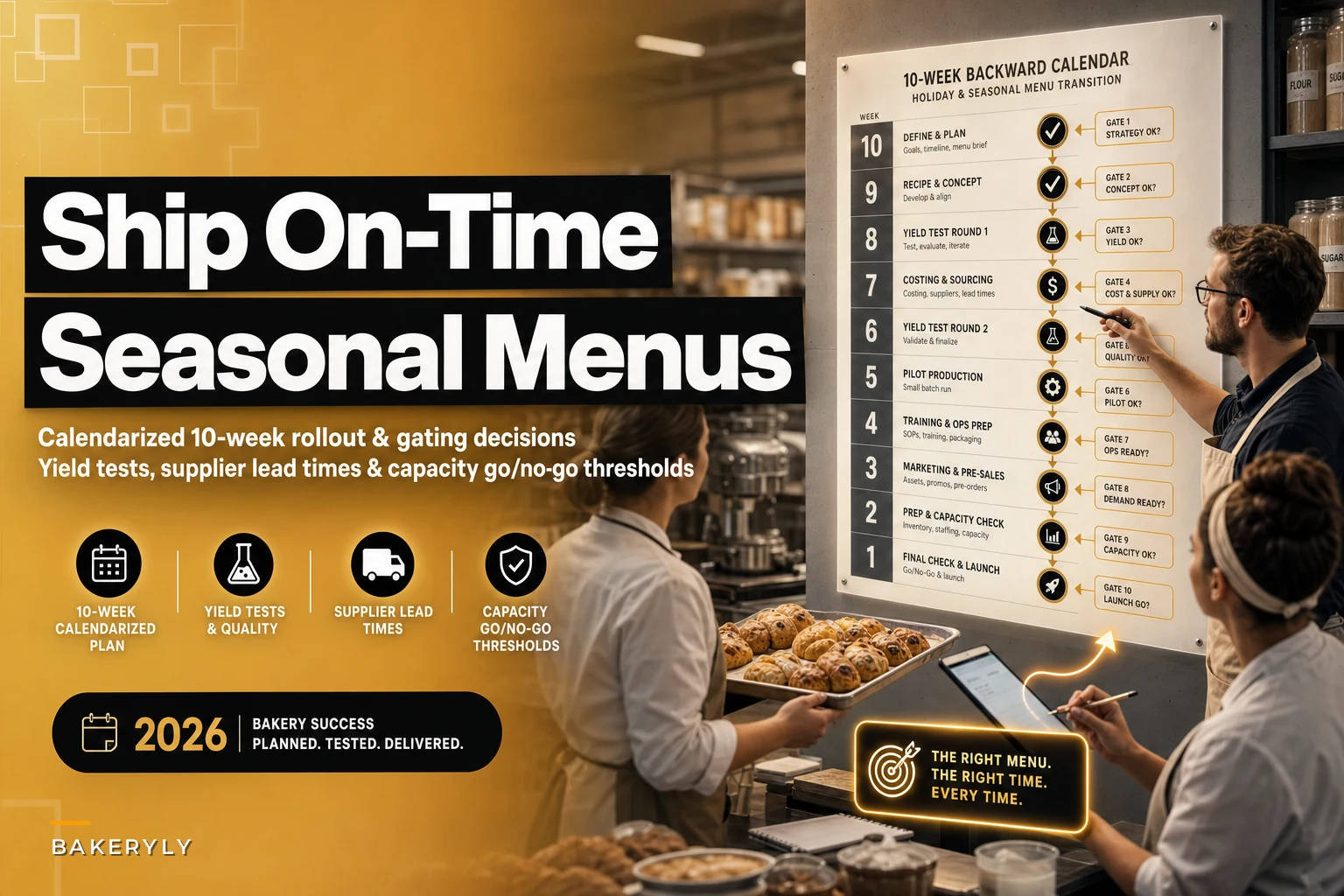
This is a calendar, not a pep talk. Ten weeks out from launch, working backward, with hard gates at specific points where you decide go, no-go, or delay. The whole point is to fail cheaply in week 8 instead of expensively in week 1.
Why seasonal launches slip (and why it's predictable)
Seasonal menu work competes with daily production, and daily production always wins. Nobody's going to skip the morning croissant bake to test a cranberry-orange scone that launches in six weeks. So the seasonal work gets pushed into the cracks, and the cracks are never big enough.
There's also a decision-avoidance problem. Owners don't want to kill a seasonal item they're excited about, so it stays "in development" long past the point where it should have been cut. By the time reality forces the call, there's no time to build an alternative. You launch the mediocre version because it's the only version you have.
-
Yield surprises at scale. A recipe that yields 24 clean units in a test batch yields 18 usable ones at 10x because of edge waste, uneven portioning, or a filling that doesn't hold.
-
Lead-time blindness. Specialty ingredients — real vanilla, specific chocolate, seasonal purees, decorative items — have longer and less reliable lead times than your daily flour and butter.
-
Capacity collisions. The new item needs oven time or proofing space during your busiest window, and nobody mapped that until launch morning.
-
No kill switch. There's no agreed threshold for cancelling an item, so weak items limp onto the menu and eat labor.
The fix isn't working harder in the final week. It's putting decisions on a calendar with thresholds attached, so the go/no-go happens on schedule whether you're emotionally ready or not.
The 10-week backward calendar
Think of launch day as week 0. Everything counts backward. The dates below assume a full seasonal menu of 4–8 new or returning SKUs. Scale the intensity down for a two-item swap.
| Week | Phase | Key gate | If gate fails |
|---|---|---|---|
| Week 10 | Concept lock | Menu list frozen, no new additions after this | Push item to next season |
| Week 9 | Recipe + costing | Target margin confirmed per SKU | Reformulate or cut |
| Week 8 | First scaled test bake | Yield within 10% of projection | Second test or cut |
| Week 7 | Supplier confirmation | Written lead times + minimums in hand | Sub ingredient or cut |
| Week 6 | Second yield test | Consistent yield across two batches | Cut item |
| Week 5 | Capacity mapping | Fits production without displacing core | Rescope or delay |
| Week 4 | Pre-batch plan freeze | Batch sizes and schedule locked | — |
| Week 3 | Staff training + prep sheets | Team can produce unsupervised | Extend training |
| Week 2 | Soft launch / dry run | One-day live test in case | Adjust or hold |
| Week 1 | Final go/no-go | All gates green | Launch reduced menu |
| Week 0 | Launch | — | — |
The value is in the second and third columns. Any calendar tells you what to do when. The gates tell you what has to be true to move forward, and what happens when it isn't. That third column is what most bakeries never write down — and it's what keeps you from launching a broken item.
Week 10–9: Lock the concept, then cost it
The most important thing you do in week 10 is close the list. Whatever seasonal SKUs you're running, that's the list. No "oh, we should also do a gingerbread thing" in week 5. Late additions are where slippage lives, because they haven't been through any of the gates the other items have.
Week 9 is costing, and this is where a surprising number of items should die. Run the full recipe cost at your intended batch size — including seasonal ingredients at current quoted prices, not last year's. A holiday item that penciled out fine when vanilla was cheaper might not clear your margin floor now.
Set a hard margin threshold before you cost anything, so the decision is math, not feelings. If your floor is 68% gross margin on retail SKUs and the spiced pear danish comes in at 61% even after you tune the portion, it doesn't launch as-is. Either the price goes up, the formula changes, or it waits.
If you don't already have a repeatable way to test and score seasonal items, it's worth building one before you're mid-rollout. The framework in our guide on building a repeatable bakery menu-engineering system covers sample sizes and seasonal decision rules that plug directly into these week-9 gates.
Week 8: The first scaled test bake (this is the big one)
Test bakes done at home-batch or single-batch size lie to you. Not always, but often enough that you can't trust them. The way dough behaves, how fillings set, the amount of edge waste, the consistency of portioning — all of it shifts when you scale up.
Week 8 is your first honest look. Run the item at a realistic production batch, not a doubled home recipe. Then measure two things: actual usable yield versus projected yield, and how the item holds in the case over a realistic display window.
A typical example: a bakery projected 240 mini seasonal tarts from a batch plan. The first scaled bake produced 240 shells, but 31 cracked or over-baked at the edges of the sheet pans and another 12 had filling that sank. Usable, sellable count: 197. That's an 18% yield gap. On a costed item that assumed 240, an 18% shortfall can quietly turn a 68% margin item into something closer to 55% once you account for the waste — and nobody would have caught it until the numbers looked off two weeks after launch.
The gate for week 8 is simple: actual yield within 10% of projection. Outside that, you either run a second test with a fixed cause — different pan position, lower temp, adjusted portion — or you cut the item. What you don't do is assume it'll sort itself out by launch.
Scaling problems have specific recurring causes — hydration shifts, mixing time, oven load. If your yield gaps trace back to the recipe not behaving at volume, the breakdown of common failures in scaling recipes without wrecking texture is worth working through before your second test bake.
Week 7: Supplier confirmation in writing
This is the gate people skip, and it's the one that reliably burns them. "The supplier said they'd have it" is not a lead time. You need a written confirmed lead time and minimum order quantity for every seasonal-specific ingredient.
The reason this matters at week 7 and not week 3: if a specialty ingredient has a four-week lead time and you find out at week 3, you're already too late. At week 7 you still have room to place the order, or to switch to an approved substitute while there's time to re-test.
-
[ ] Ingredient confirmed available for your launch window
-
[ ] Written lead time (order-by date calculated backward from launch)
-
[ ] Minimum order quantity and whether you can actually use it before it expires
-
[ ] Price confirmed for the season (not a "should be around" quote)
-
[ ] Backup supplier or approved substitute identified
That last line is quiet insurance. When a single-source seasonal item falls through — and one usually does at some point — the difference between a smooth swap and a delayed launch is whether you identified the backup in week 7 or week 1.
Week 6–5: Second yield test and capacity mapping
Week 6 is your confirmation test. One good batch can be luck. You want consistent yield across two separate runs, ideally on different days with different people, because that's what actual production looks like. If batch one yields 197 usable and batch two yields 235, you don't have a recipe yet — you have a coin flip, and the case will show it.
Week 5 is capacity, and it's more arithmetic than anything else. Every new SKU needs mixer time, bench space, proofing room, oven slots, and cooling space — during a window that's already busy. Seasonal items don't exist in some separate production universe. They fight your core products for the same oven at 5 a.m.
Map it concretely. If the seasonal tart needs 20 minutes of oven time in the exact window you bake your best-selling croissants, something has to give. Either you shift the bake earlier, add capacity, or reduce the batch size of the seasonal item. The gate: the item fits without displacing a core product that earns more per oven-hour. If it can't clear that bar, it's a smaller launch or it waits.
Week 4: Freeze the pre-batch plan
By week 4, batch sizes stop being flexible. You lock a pre-batch plan: exact batch quantities, which days each item is produced, how much gets made for opening versus held, and what the par levels are.
Frozen means frozen — no "let's just double it this week" improvisation during launch, because that's how you end up with 400 units of something that sells 180. The frozen plan should specify, per SKU: batch size, production days, target opening quantity, and the reorder trigger for ingredients. Writing it down forces you to reconcile your optimistic launch projections against actual confirmed capacity and yields. That's often where an owner realizes the plan they had in their head doesn't survive contact with the numbers.
Week 3–2: Training and a real dry run
Week 3 is training, and the test is whether your team can produce the item without you standing over them. If the seasonal item only works when the owner is at the bench, it doesn't work. Write the prep sheet, run the team through it, then step back and watch someone make it start to finish.
Week 2 is a soft launch — put the item in the case for one real day, at real volume, and watch what happens. Does it sell at the rate you assumed? Does it hold long enough? Does the line slow down because it's fiddly to package? A one-day dry run catches things no test bake will, because it includes the full workflow: production, display, sale, and how it interacts with everything else on the board.
The gate for week 2 is straightforward but has teeth: the item can be produced, displayed, and sold through a full day without special intervention. If it can't, you have one week to fix it or you hold it.
Week 1–0: Final go/no-go and the reduced-menu option
The final gate is a review of every earlier gate. All green, you launch as planned. The thing most bakeries handle badly is what happens when it's not all green — and the answer is you launch the reduced menu. The three items that passed every gate go live. The two that didn't wait for next season or come in as a mid-season addition once they're actually ready.
This is the discipline that separates bakeries that ship on time from ones that don't. A partial launch of items that work beats a full launch where two of them break. Customers don't miss the item they never saw. They absolutely notice the item that sold out by 9 a.m. because you under-yielded, or the one that looked sad in the case because it wouldn't hold.
When this full 10-week process makes sense — and when it doesn't
Run the full calendar when:
-
You're launching 4+ new or substantially reworked seasonal SKUs
-
The season represents a meaningful chunk of your annual revenue (most holiday windows do)
-
You've been burned by a rushed seasonal launch before
-
Seasonal items use ingredients you don't stock year-round
Scale it down when:
-
You're swapping one or two well-understood items you've run before
-
The seasonal change is a flavor variation on an existing production process, not a new product
-
Your seasonal ingredients are things you already buy regularly
Skip it entirely when you're re-running a proven seasonal menu with no changes and confirmed suppliers. In that case, all you need is the supplier confirmation gate and a capacity check. Don't build ceremony around a process you've already de-risked.
The judgment call is honest risk assessment. A new signature holiday item with a specialty ingredient and a scaling challenge is exactly what this calendar exists for. Last year's cinnamon scone that you'll make identically doesn't need ten weeks of gates.
A real scenario
A single-location bakery doing roughly $9k–$11k in weekly revenue ran their fall menu the usual way: decided the SKUs in early October, tested at home-batch scale, and started full production the week of launch. Three of five items launched fine. The other two were problems. A maple-pecan item under-yielded badly at scale — they lost close to a fifth of every batch to breakage — and a spiced apple hand pie relied on a puree with a lead time nobody had confirmed, so the first two weeks of the season ran with a rushed substitute that customers noticed.
The following year they ran a backward calendar. The maple-pecan item failed its week-8 yield gate — yield came in around 22% under projection — got one reformulation attempt, failed again at week 6, and was cut. The apple hand pie's supplier gate at week 7 surfaced the lead-time problem early enough to lock a confirmed order. They launched four items instead of five.
The four that launched held their margins because they'd all cleared the yield and capacity gates. No launch-week scramble, no substitute-ingredient apology, and the item they cut came back mid-season once they'd fixed the yield. Fewer items, but every item worked.
How the gates flow week by week
For anyone who processes this kind of thing visually, here's the decision flow across the ten weeks:
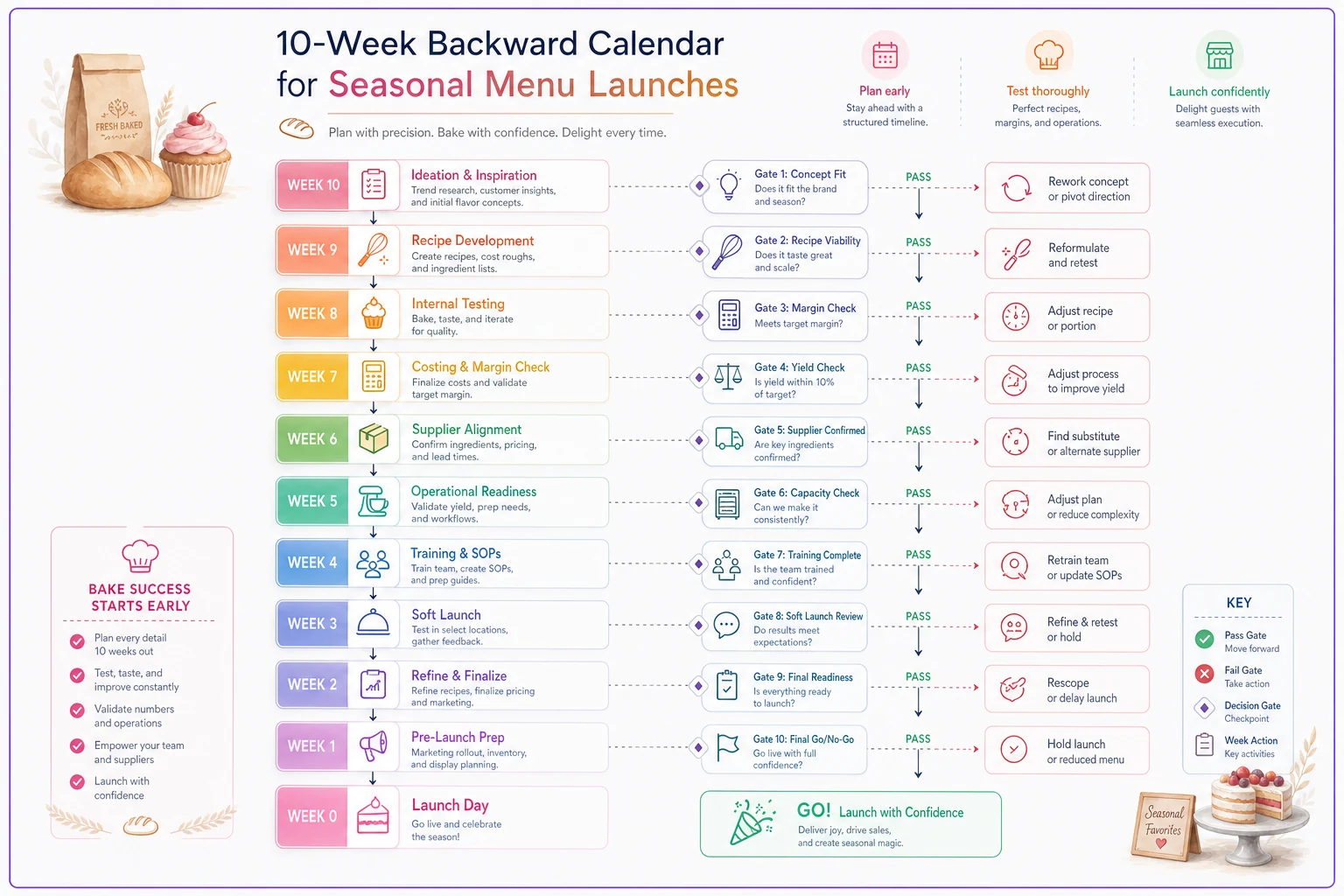
[Week 10: Concept lock] ↓ [Week 9: Recipe + costing] → margin fails? → Cut or reformulate ↓ [Week 8: First scaled yield test] → >10% gap? → Second test or cut ↓ [Week 7: Supplier confirmation] → lead time missing? → Sub or cut ↓ [Week 6: Second yield test] → inconsistent? → Cut ↓ [Week 5: Capacity mapping] → displaces core? → Rescope or delay ↓ [Week 4: Pre-batch plan freeze] ↓ [Week 3: Staff training] ↓ [Week 2: Soft launch / dry run] → can't run unsupervised? → Hold ↓ [Week 1: Final go/no-go] → not all green? → Launch reduced menu ↓ [Week 0: Launch]
The one thing that makes this stick
The calendar only works if the gate decisions actually get made on schedule, and that's the part that fails when it lives in someone's head. The gates need to be visible — dates, owners, and thresholds written where the whole team sees them, so the week-8 yield test doesn't quietly slip to week 6, which slips to launch week, which is where you started.
Whether that's a shared production calendar, a project board, or the scheduling layer of whatever production and workflow system you already run, the mechanism matters less than the habit. Put the gate dates on the calendar the day you lock the concept. Attach the threshold to each one. Then let the calendar make the decision you'd otherwise avoid.
Seasonal launches don't slip because bakers are careless. They slip because the decisions have no deadline and the deadline has no threshold. Give both a date, and the item either earns its place in the case or it waits — and either way, you ship on time.