

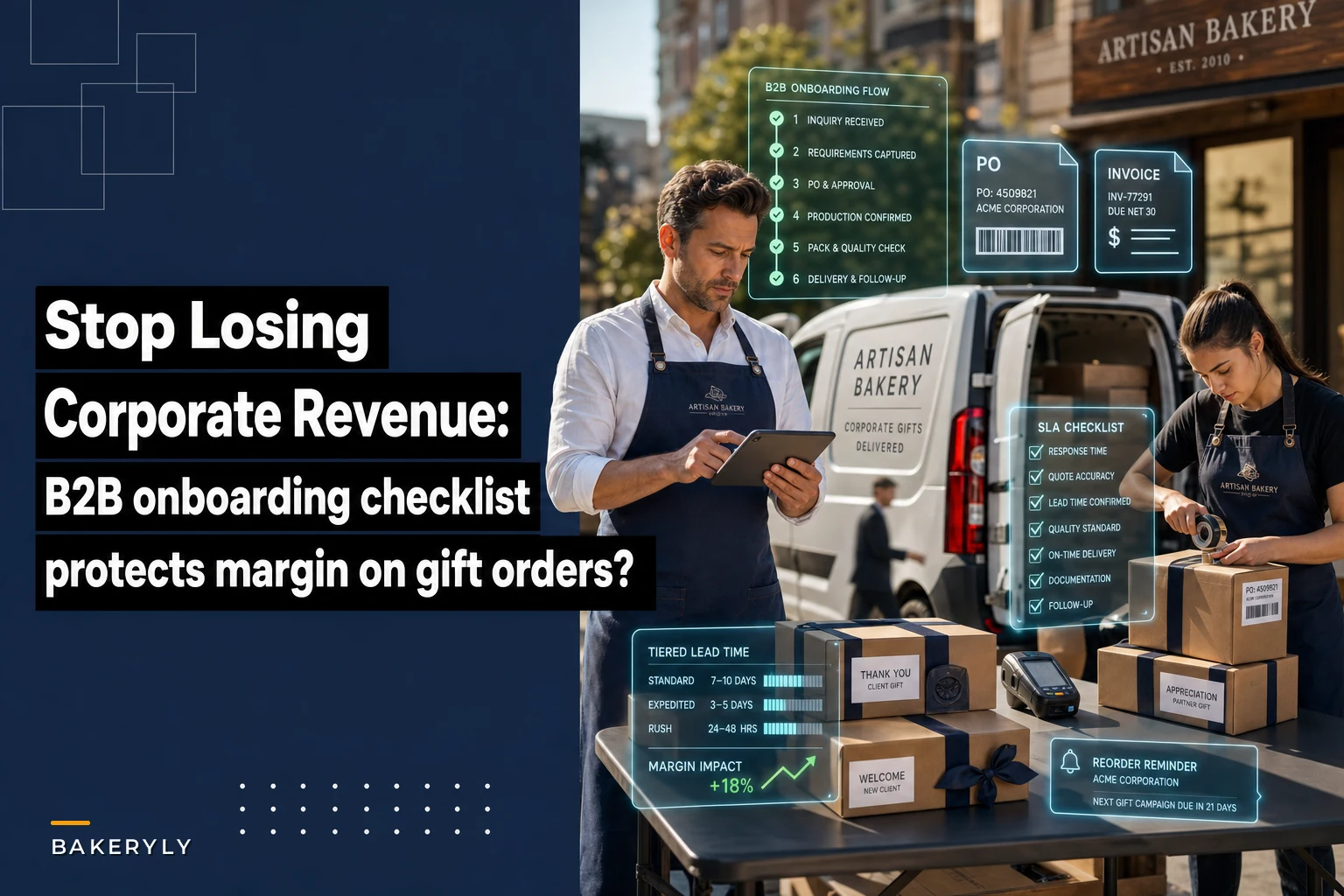

A law firm calls in early November. They want 40 gift boxes for clients, delivered to the office by December 12th, each with a handwritten card. You quote a price, they say yes, and everyone's thrilled. Then the actual order becomes 40 boxes across three delivery addresses, with two dietary swaps you didn't price, a logo they want printed on the ribbon, and an accounts-payable department that pays on Net 45 instead of the "day of" you assumed.
By the time it's done, the margin you thought was 60% is closer to 30%, and you've spent six hours in email threads nobody billed for. The order looked like a win. On paper it barely was.
This is the gap most bakeries fall into with corporate and gift work. The retail counter runs on instinct and speed. Corporate buyers run on paperwork, approvals, and expectations you never agreed to in writing. A corporate bakery onboarding checklist is what closes that gap — it forces the messy stuff (SLAs, packaging specs, invoicing terms, lead times, margin floors) to get decided before production, not discovered halfway through.
Below are the specific parts that matter, and the handoff that actually converts a first order into predictable revenue.
Why corporate orders quietly bleed margin
Retail and corporate are different animals, and treating them the same is where the money leaks.
-
Revision cycles. A gift box mockup gets emailed, then changed twice. Each round is 20–40 minutes of someone's time.
-
Split logistics. "40 boxes" becomes 12 to one office, 18 to another, 10 to individual home addresses because half the team is remote.
-
Payment drift. They pay on their terms, not yours. Cash you counted on for December ingredient buys shows up in late January.
-
Scope creep dressed as small favors. "Can you also throw in a few extra for the reception desk?" Ten free boxes feel polite in the moment and cost real money.
The baking is almost never the problem. The problem is everything wrapped around the baking that nobody scoped. The order is profitable in the kitchen and unprofitable in the inbox.
The fix isn't more hustle. It's a minimum-viable agreement — the smallest set of written terms that removes the ambiguity — plus a clean handoff so the second order doesn't restart the chaos from zero.
The minimum-viable agreement: five parts, nothing fancy
You don't need a lawyer-drafted 12-page contract. Most corporate buyers actually prefer something short they can approve without looping in legal. The goal is a one-to-two page document that locks the five things responsible for 90% of the damage.
1. The service-level agreement (what you actually promise)
Keep it concrete and boring. Vague promises are how expectations inflate.
-
Order cutoff e.g., custom gift orders confirmed at least 10 business days before delivery; standard boxes 5 business days.
-
Confirmation window you'll acknowledge and confirm feasibility within 1 business day of receiving a PO.
-
Revision limit two rounds of design/spec revisions included; additional rounds billed at a flat rate.
-
Delivery window promise delivered within a stated 3-hour window, not "by end of day," which invites complaints.
The revision limit is the sleeper here. Unlimited "just one more tweak" is where corporate accounts quietly eat your margin. Naming the number ends the drip.
2. Packaging spec (defined, priced, and versioned)
Corporate gifting lives and dies on presentation, which means packaging is a cost center you have to pin down, not absorb. Spell out exactly what's included at the quoted price and what costs extra.
| Packaging element | Included in base | Upgrade (priced separately) |
|---|---|---|
| Standard kraft box + tissue | ✔ | — |
| Custom ribbon color | — | +$1.20 per box |
| Printed logo card | — | +$2.50 per box |
| Handwritten cards | — | +$1.75 per box |
| Cold-pack / insulated for shipping | — | quoted per order |
The point of the table isn't the exact prices — it's that someone made a decision about each line before the order ran. Presentation orders have tighter tolerances than a counter sale, and packaging ends up being a bigger share of cost than most owners expect going in.
3. Lead times (real ones, not optimistic ones)
The most common corporate blowup is a client assuming you can turn 60 boxes around in 48 hours because you once did 12 overnight. Publish lead times by order size, and hold them.
-
Up to 25 units 5 business days
-
26–75 units 8 business days
-
76–150 units 12 business days
-
150+ or multi-site delivery custom, quoted individually
Tie these to your actual production capacity. If your ovens and staff can produce X presentation boxes per day on top of normal retail without wrecking the counter, that number sets your lead time. Corporate work that cannibalizes your walk-in business isn't incremental revenue — it's shuffled revenue at lower margin.
4. Invoicing terms (this is the one owners skip and regret)
Corporate buyers pay on invoice, and their finance department has its own rhythm. You have to state your terms anyway and negotiate from there.
-
Deposit 50% deposit to confirm any order above a set threshold (say $500).
-
Balance terms balance due Net 15 from delivery, not Net 45.
-
Late terms stated late fee or interest after 30 days.
-
PO requirement you need a purchase order number before production starts on invoice accounts.
The deposit rule is what protects you from the fully-built-then-ghosted scenario. The deposit-and-staging logic is the same discipline that protects one-off custom work — if you want the fuller version of deposit rules and staging checklists, it's worth pulling from the catering workflow for custom orders and lifting the deposit structure straight into your corporate template.
5. Margin rules (your internal floor, not shown to the client)
This part stays on your side of the desk. Before you quote, set a hard floor: no corporate order goes out below a defined contribution margin — say 45% after ingredients, packaging, labor for assembly, and delivery.
-
Delivery beyond X miles adds a flat surcharge.
-
Multi-address delivery is priced per drop, not per order.
-
Rush orders inside the standard lead time carry a rush multiplier.
-
Sub-threshold orders (below a minimum count) carry a small-order fee.
The floor is what stops a friendly sales conversation from talking you into a break-even job. When someone asks for a discount on volume, you can say yes down to the floor and no further, without doing panic math on the phone.
A real scenario: the recurring gift account that almost wasn't
A neighborhood bakery — one location, strong morning trade — landed a real estate brokerage that wanted closing-gift boxes for clients. First order: 22 boxes, no written terms. It ran fine but messy. Around nine emails back and forth, two last-minute address changes, and payment that showed up 38 days later.
They almost declined the second inquiry because the first felt like more trouble than it was worth. Instead they built a one-page agreement — SLA, packaging spec sheet, Net 15 with a 50% deposit, and a lead-time tier. They set a 48% margin floor.
The brokerage signed it without blinking. Over the following year the account settled into a predictable rhythm: roughly 15–30 boxes a month, deposits collected upfront, revisions capped at two. Per-order coordination time dropped from 3–4 hours to under an hour. Contribution margin moved from somewhere in the low-30s to sitting right around the floor — call it high-40s.
Nothing about the baking changed. The paperwork did the work. And critically, the second order didn't restart from scratch because they'd done the handoff.
The account handoff checklist (where one-offs become repeatable)
This is the part almost everyone misses. A great first order that lives entirely in one person's head and inbox is not an account — it's a one-off you got lucky on. The handoff is what converts it.
It has two jobs: capture everything the first order taught you, and make the second order a 10-minute setup instead of a fresh negotiation.
-
- [ ] Signed agreement filed where anyone taking the next order can find it — not buried in one manager's email.
-
- [ ] Locked spec recorded exact box, ribbon color, card style, insert card wording — whatever they chose, saved as their default.
-
- [ ] Delivery profile saved addresses, receiving contact names, dock/reception access notes, best delivery windows.
-
- [ ] Billing contact and terms captured AP email, PO requirement yes/no, agreed terms, deposit rule.
-
- [ ] Dietary and allergen notes flagged on the account so nobody re-asks or re-messes it up.
-
- [ ] Margin actuals logged what the order actually cost vs. quoted, so you can adjust pricing before the next round.
-
- [ ] Reorder trigger set a note or reminder tied to their likely cadence (monthly, quarterly, holiday-only).
That last one matters more than it looks. Corporate gifting is seasonal and predictable — closings, quarter-ends, holidays, client-appreciation weeks. If you're waiting for them to remember you, you're leaving reorders on the table. The cadence thinking behind turning one-time buyers into regulars applies to corporate accounts too — the difference is the cadence follows their business calendar, not an individual's craving.
Keep the signed agreement and locked spec in the same shared folder or CRM field so any staffer can see the defaults before taking an order.
The workflow, start to finish
A corporate inquiry comes in → you send the one-page agreement plus packaging spec → they confirm and pay a deposit against a PO → the locked spec drops into production at the correct lead-time tier → delivery goes out inside the promised window → balance invoices at Net 15 → the handoff checklist runs and the account profile gets saved → a reorder reminder fires at the expected cadence.
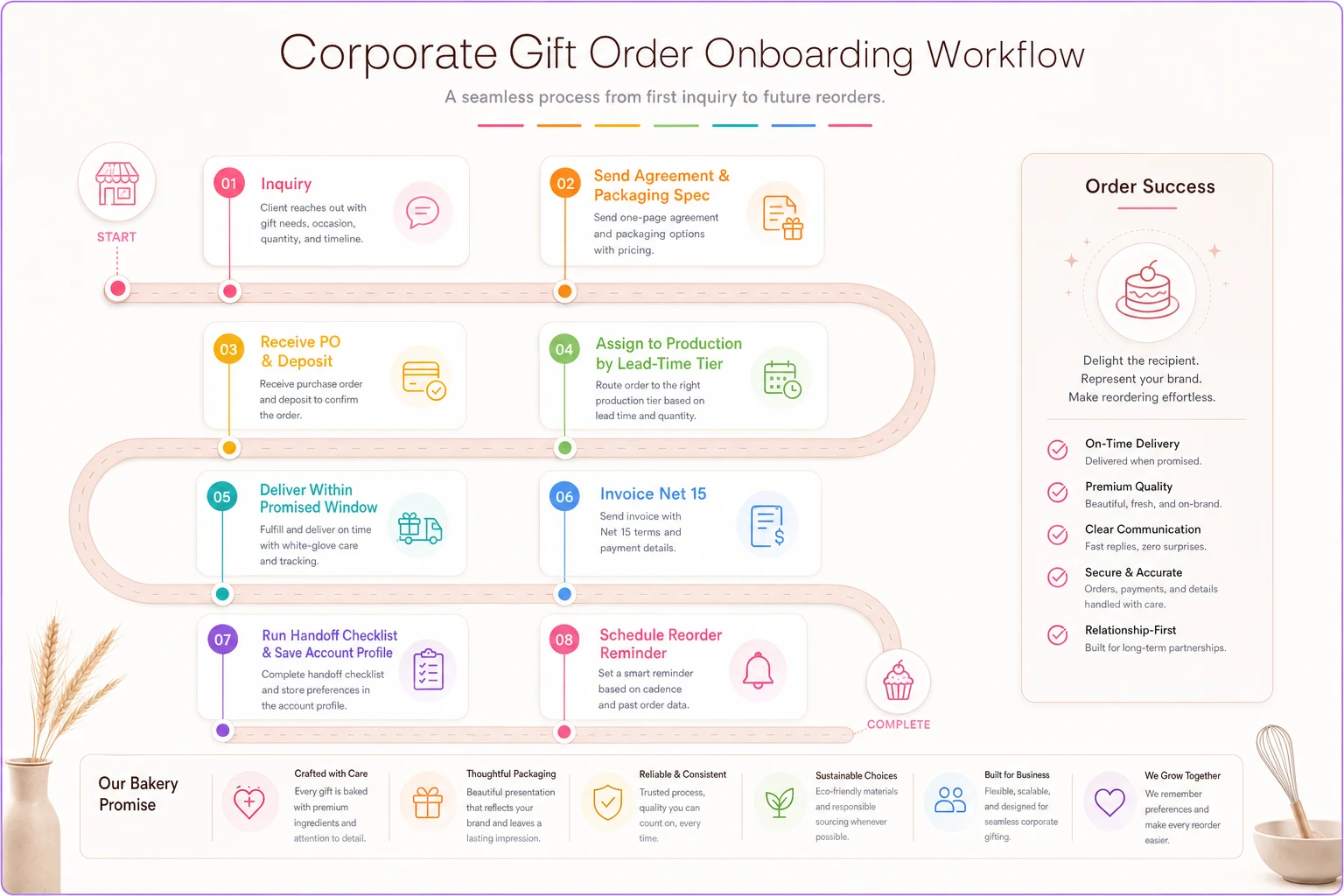
The first time through, this feels like overhead. By the third order it's the reason corporate work becomes the calmest, most predictable revenue you have — because it's not running on memory and goodwill.
Whether you keep this in a shared doc, a spreadsheet, or an operational platform where account profiles, agreements, and reorder reminders live in one place, the mechanism matters more than the tool. What kills margin is information living in one person's head. Centralizing the agreement, the spec, and the billing terms so any staff member can take the reorder cleanly is the whole game.
When to build this out — and when not to bother
This system pays for itself fast if corporate and gift orders are a real, recurring slice of your business — or you want them to be. If you're getting inquiries and turning them down because they feel like too much hassle, that hassle is the missing template.
When it clearly makes sense:
-
You're getting repeat corporate inquiries, even irregularly.
-
Gift-box or bulk orders are eating disproportionate email time.
-
You've had at least one order where the final margin surprised you badly.
When it's overkill:
-
Corporate work is a once-a-year fluke you don't want to grow.
-
Your volume is small enough that a single email thread genuinely handles it.
Who should not do this half-heartedly: anyone tempted to write the agreement but never enforce the deposit or the revision cap. A margin floor you don't hold is just a number in a doc. The enforcement is the product.
The bottom of it
Corporate revenue looks unpredictable because most bakeries handle it unpredictably — every order re-negotiated, re-scoped, and re-remembered from scratch. The orders aren't chaotic. The handling is.
A short agreement that fixes SLA, packaging, lead times, invoicing, and a private margin floor — paired with a handoff that saves the account so the next order is trivial — that's the entire difference between a lucky one-off and a line of revenue you can actually forecast. Build it once, hold the floor, and corporate work stops being the order you dread and starts being the one you count on.
A short agreement that fixes SLA, packaging, lead times, invoicing, and a private margin floor — paired with a handoff that saves the account so the next order is trivial — that's the entire difference between a lucky one-off and a line of revenue you can actually forecast. Build it once, hold the floor, and corporate work stops being the order you dread and starts being the one you count on.