

Your bakery customer retention system probably isn't a system at all. It's more likely a collection of disconnected tactics—punch cards gathering dust somewhere near the register, random email blasts about weekend specials, maybe a subscription box you launched six months ago that nobody really remembers exists.
The real problem isn't that customers don't want to come back. Walk into any successful neighborhood bakery at 8am and you'll see the same faces ordering the same things. The problem is that most bakeries treat retention like it's separate from operations. Loyalty programs get filed under marketing. Subscriptions are a "nice-to-have revenue stream." Promotions are something you do when sales dip.
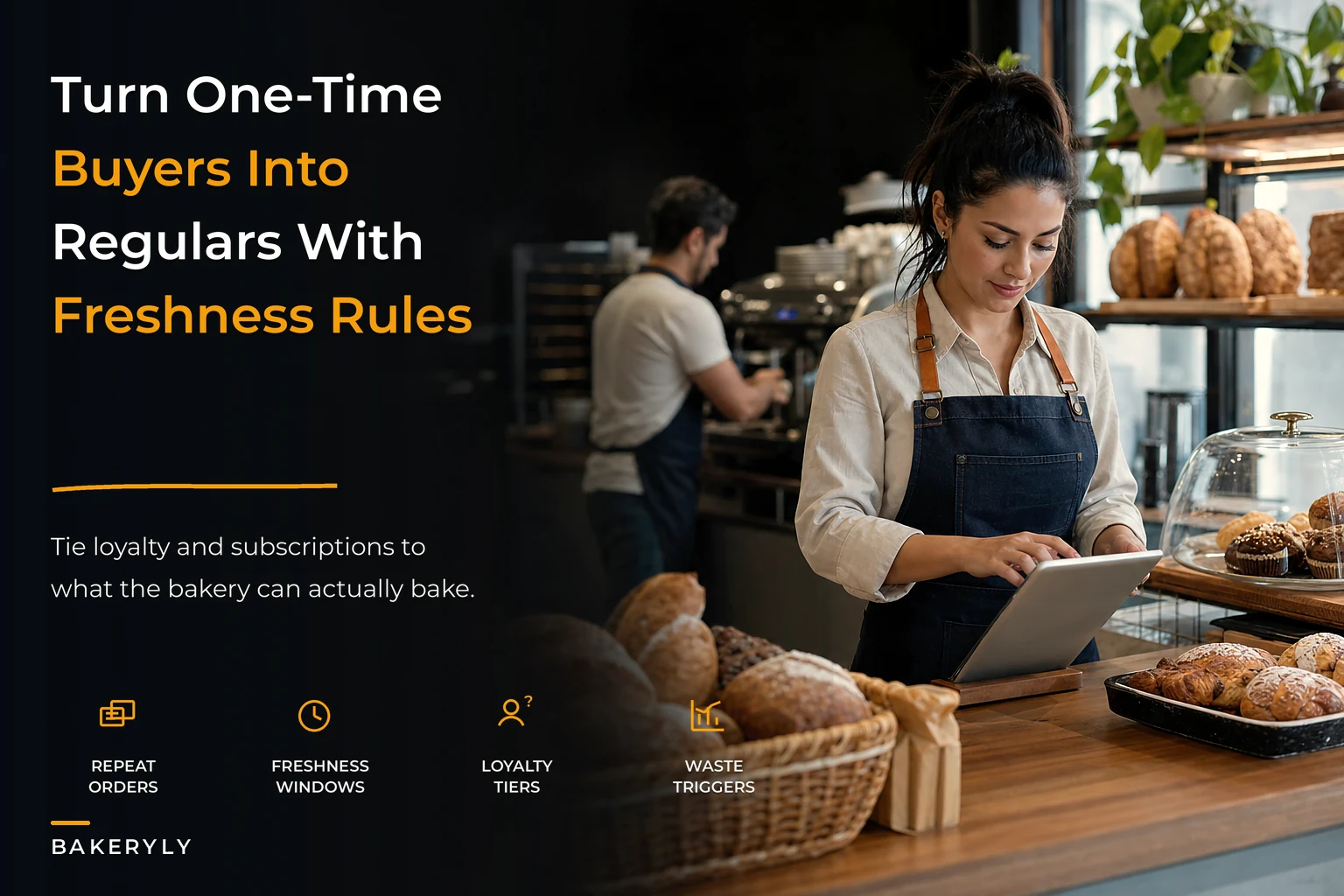
What actually drives retention in bakeries is simpler and more annoying to fix: it's the overlap between when products taste best, when customers want them, and what your production capacity allows. Everything else—the tiers, the points, the perks—those are just mechanisms to align customer behavior with operational reality.
Why traditional loyalty programs fail in bakeries
Most bakeries copy loyalty structures from coffee shops or restaurants without thinking through why those models break down for baked goods. A coffee shop can give you the tenth drink free because every drink has roughly the same margin and production cost. Their inventory doesn't expire in hours. They don't have to coordinate loyalty rewards with production schedules that start at 3am.
In bakeries, the operational complexity multiplies fast. A croissant at 7am is a different product than a croissant at 2pm. Your chocolate cake has a three-day shelf life, your sourdough can last a week. Some items freeze well for subscription boxes, others turn into cardboard overnight.
When you layer a generic loyalty program on top of all that, things get messy. Customers redeem free items during your busiest hours and throw off production counts. Subscription boxes cannibalize walk-in sales. Promotional timing ignores freshness windows, so you're either giving away product that would have sold at full price or pushing inventory nobody wants.
The worst part? Most bakery owners can sense something's off but can't pinpoint it. Lower margins despite higher sales. More waste even though you're moving more product. Busier days that somehow feel less profitable. That's usually what a retention program fighting against operations looks like.
The freshness window problem nobody talks about
Every bakery product has what I'd call a "profit decay curve." Not just when items go bad—but when they stop being worth full price, when they shift from profit center to day-old rack, when they become a loss leader instead of an asset.
Take a butter croissant. Fresh out of the oven at 7am, you might charge $4.50. By noon, customers start expecting a small discount. By 3pm, it's competing with your afternoon pastries. Tomorrow morning, it's a $2 day-old item. Each window changes not just the price point but the customer willing to pay it.
Multiply that across 30 to 50 SKUs with different decay curves. Morning baguettes have maybe six hours of peak value. Decorated cupcakes hold for two days. Sourdough stays solid for nearly a week. Each product category needs different retention mechanics, different promotional timing, different subscription logic.
Most retention programs ignore this entirely. They offer blanket discounts that don't account for freshness. They promise subscription deliveries without thinking about production timing. They create loyalty tiers that reward volume without caring about product mix.
| Product Category | Peak Value Window | Retention Mechanic | Subscription Viability |
|---|---|---|---|
| Morning pastries | 0-4 hours | Rush-hour loyalty multipliers | Limited (same-day only) |
| Decorated items | 0-48 hours | Pre-order tier benefits | High (3-day lead time) |
| Bread loaves | 0-24 hours | Next-day pickup rewards | Medium (2x weekly) |
| Coffee cakes | 0-72 hours | Weekend bundle promotions | High (weekly delivery) |
The table above is a starting point, not a final answer. Your specific products will have their own curves, and the only way to know them accurately is to track actual sales data over time rather than guessing.
Building tiers that actually align with operations
Most loyalty tiers are built around spending. Spend $100, become Silver. Spend $500, become Gold. This ignores everything about how bakeries actually work.
Better tier mechanics reward behaviors that make your operations run smoother. The customer who pre-orders their weekend pastries every Thursday is more operationally valuable than someone who spends the same amount through random walk-ins. The subscriber who picks up the same items every Tuesday and Friday helps you predict demand and cut waste.
Here's how operational tiers look in practice:
Tier 1: Walk-in Regular (visits 2-3x monthly)
-
Basic points accumulation
-
Access to day-old deals after 2pm
-
SMS alerts for surplus inventory
Tier 2: Predictable Customer (weekly visits, consistent timing)
-
1.5x point multiplier during off-peak hours
-
24-hour hold on popular items
-
Early access to seasonal menu items
Tier 3: Pre-order Champion (orders 48+ hours ahead)
-
2x points on pre-orders
-
Free customization on decorated items
-
Priority production slots for holidays
Tier 4: Subscription Anchor (weekly/bi-weekly subscription)
-
Subscription price lock for 6 months
-
Swap privileges (change items up to 24 hours before)
-
Exclusive access to limited-run products
Each tier rewards behavior that makes your operation easier to run. Pre-orders let you batch production. Off-peak visits smooth out rushes. Subscriptions create predictable baseline demand. The tiers aren't just about spending—they're about operational value.
The subscription promise trap
Every bakery owner who's tried subscriptions hits the same wall eventually. You promise fresh bread every Tuesday, then Tuesday is Christmas. You guarantee chocolate croissants in the weekly box, but your supplier shorts you on chocolate. Customers want to skip a week, swap items, change delivery days—and suddenly your "simple" subscription program needs a part-time manager.
The deeper issue is that bakery subscriptions can't work like software subscriptions. You can't promise unlimited inventory. You can't guarantee specific items months in advance. You can't ignore seasonality, supplier issues, and production constraints.
Successful bakery subscriptions are built on controlled flexibility. Instead of promising specific items, you promise categories. Instead of rigid weekly delivery, you use credit systems. Instead of fighting operational reality, you build subscriptions that accommodate it.
Here's what tends to work:
Credit-based subscriptions: Customers pay $60 monthly for $75 in credit. They use it whenever, for whatever, but unused credits expire monthly. This smooths cash flow without locking you into specific production commitments.
Category subscriptions: Promise "2 loaves, 4 pastries, 1 cake slice weekly" rather than specific items. Customers choose from what's available. You keep flexibility while they get variety.
Surge-protected subscriptions: Subscribers get standard pricing even during peak periods—holidays, weekends—when walk-in prices go up. They're paying for price stability, not specific products.
The key is making promises you can actually keep while protecting your ability to adapt. Every promise that sounds great in a marketing email becomes an operational commitment someone has to fulfill at 4am.
KPI triggers that prevent retention system collapse
Your bakery customer retention system needs automatic pressure valves—points where the system adjusts before it breaks. Most bakeries only notice problems after they've already compounded: subscription cancellations spike, loyalty redemptions crater, promotional response rates tank.
Better systems catch issues earlier:
Freshness Score: Track the average age of products at the time of sale. If items are consistently selling close to expiration—say, averaging 18+ hours for items with 24-hour windows—your retention offers need to kick in sooner. When croissants keep hitting the day-old rack, your afternoon loyalty multipliers aren't doing the job.
Redemption Clustering: Monitor when loyalty rewards actually get redeemed. If more than 40% happen during your top three rush hours, adjust your multipliers to push redemption off-peak. One bakery had roughly 65% of free item redemptions happening Saturday mornings, which made their busiest period even more chaotic than it needed to be.
Subscription Modification Rate: Track how often subscribers change or skip orders. Above 30% weekly modifications usually means your base offering doesn't match demand well. Below 5% might mean customers aren't engaged with the program at all.
Tier Migration Velocity: Watch how fast customers move between tiers. If nobody's reaching Tier 3 within six months, your requirements are probably too steep. If everyone's hitting top tier in two months, you're not creating meaningful differentiation.
These aren't vanity metrics—they're operational warnings. When freshness scores drop, waste costs are about to spike. When redemptions cluster, labor efficiency takes a hit. Your KPI system needs to drive actual decisions, not just track numbers on a dashboard.
Waste-aware incentive design
Traditional loyalty programs reward consumption. Buy more, get more points. In a bakery, this creates a real problem: you're incentivizing purchases that might turn into waste anyway.
Closing-time accelerators: Points multiply based on how close you are to closing. Buy a croissant at 7am, get standard points. Buy it at 4pm—two hours before closing—get 3x points. Customers feel like they're scoring deals while you're moving inventory that would otherwise expire.
Surprise upgrade moments: When production overshoots demand (and it will), automatically upgrade loyal customers. Ordered a 6-pack of dinner rolls? Here's 8 for the same price. It feels generous while solving an inventory problem.
Day-old subscription tiers: Create a specific tier for customers who explicitly want day-old products at steep discounts. One bakery runs a "$20 monthly all-you-can-grab day-old" membership. Members come daily around 5pm, clear yesterday's inventory, and feel like they found a great deal. Everyone wins.
Run a weekly day-old audit to set closing-time accelerator thresholds.
The psychology matters here. Customers don't want to feel like they're buying inferior product. But they love feeling like insiders—people who know when to shop, how to find deals, where the hidden value is. Waste-aware incentives tap that without devaluing your fresh items.
Sample post-purchase flows that actually convert
Most bakeries send the same follow-up to everyone: "Thanks for your purchase! Here's 10% off your next visit." This ignores everything about purchase patterns and actual customer behavior.
Effective post-purchase flows get triggered by specific behaviors and point toward specific actions. Here's how that looks across a few common purchase scenarios:
First-time morning pastry buyer (purchased 6-9am):
-
Immediate
SMS receipt with tomorrow's fresh-bake schedule
-
Day 2
"Your croissants are finishing proofing for tomorrow. Reserve yours now?"
-
Day 7
"Skip the morning wait. Pre-order tonight for pickup tomorrow."
-
Day 14
Tier 2 invitation if they've returned
Whole cake purchaser (birthday/special occasion):
-
Immediate
Care instructions + photo contest entry
-
Day 3
"How was your celebration? 15% off cake slices this week to relive it."
-
Day 30
"Another birthday coming up? Lock in this month's pricing for your next cake."
-
Day 85
Reminder for quarterly celebrations
Bread subscription cancellation (just ended subscription):
-
Immediate
Credit for remaining value, no questions asked
-
Day 3
"Your usual bread is fresh today. One-time purchase?"
-
Day 10
"Try our walk-in loyalty program—no commitment needed."
-
Day 30
Win-back offer for modified subscription terms
Each flow references actual products, actual timing, actual customer actions. That specificity is what pushes conversion rates from the typical 2-3% range up toward 12-15% for well-targeted sequences. Generic follow-ups just don't perform in a business where the product changes daily.
The inventory capacity reality check
Nobody tells you this when you're building a retention program: your oven capacity is your actual constraint, not customer demand. You can create the best loyalty program imaginable, but if your ovens max out at 200 croissants per morning, that's your ceiling.
Most retention systems ignore production capacity until it's too late. Subscriptions oversell. Rewards cluster during peaks. Promotions drive demand you can't fulfill. Then you're stuck choosing between angry customers or burnt-out staff working overtime.
Production-capped tiers: Only 50 Tier 4 subscription spots available. Creates exclusivity while protecting capacity.
Time-slot redemptions: Loyalty rewards can only be redeemed during specific windows tied to production schedules.
Dynamic promotional throttling: If morning production is above 85% capacity, afternoon promotions automatically get more aggressive to shift demand.
This isn't about limiting growth. It's about sustainable growth. A retention program that consistently oversells your capacity leads to quality problems, staff turnover, and eventually, churn. The math always catches up.
Promotional cadence that matches seasonal reality
Most bakeries run promotions reactively. Sales slow, you discount. Holidays approach, you promote. Weather changes, you adjust. This approach means you're always a little behind the curve.
Better promotional cadence gets built into your retention system from the start. Your menu engineering cycles should inform your promotional calendar. Seasonal ingredients should drive limited-time tier benefits. Production capacity should determine promotional intensity.
A quarter might look something like this:
Weeks 1-4: Post-holiday recovery
-
Subscription acquisition push (people have New Year's energy)
-
Health-conscious tier benefits (whole grain multipliers)
-
Aggressive day-old promotions (lighter traffic means more waste)
Weeks 5-8: Valentine's/President's Day build
-
Pre-order incentives ramp up
-
Decorated item tier benefits activate
-
Limited-edition subscription box launches
Weeks 9-13: Spring transition
-
Loyalty point accelerators for new seasonal items
-
Tier migration campaigns (push Tier 2 to Tier 3 before Easter)
-
Subscription modification windows open
The cadence isn't arbitrary—it's tied to what's actually happening in your kitchen. When you know Valentine's week will max out decorated item production, you don't also run croissant promotions. When spring ingredients arrive, you incentivize trial through multipliers instead of blanket discounts. The calendar and the kitchen need to talk to each other.
Making the system self-correcting
The best retention systems don't need constant manual adjustments. They have built-in feedback loops that respond to operational signals automatically.
One bakery built their entire system around dynamic responses. When daily waste exceeded 8%, next-day loyalty multipliers automatically increased. When subscription modification requests spiked, the system opened additional swap windows. When certain items kept hitting the day-old rack, they were automatically pulled from subscription boxes.
This doesn't require complex technology to start. It requires building decision rules into your retention mechanics:
Waste triggers promotions: Instead of manually creating discounts when you notice waste piling up, build rules. "If chocolate croissant waste rate exceeds 15% for three consecutive days, activate 2-for-1 afternoon special."
Demand shifts tiers: "If Tier 3 pre-orders exceed production capacity two weeks straight, increase Tier 3 requirements by 20%."
Subscriptions adapt to seasons: "If pumpkin items are available, automatically offer them as subscription swaps. If stone fruits arrive, create limited-time tier benefits."
These adjustments prevent the slow drift that kills retention programs. You're not waiting for quarterly reviews to notice problems—the system catches them before they compound.
Here's a simple flow illustrating how those triggers connect.
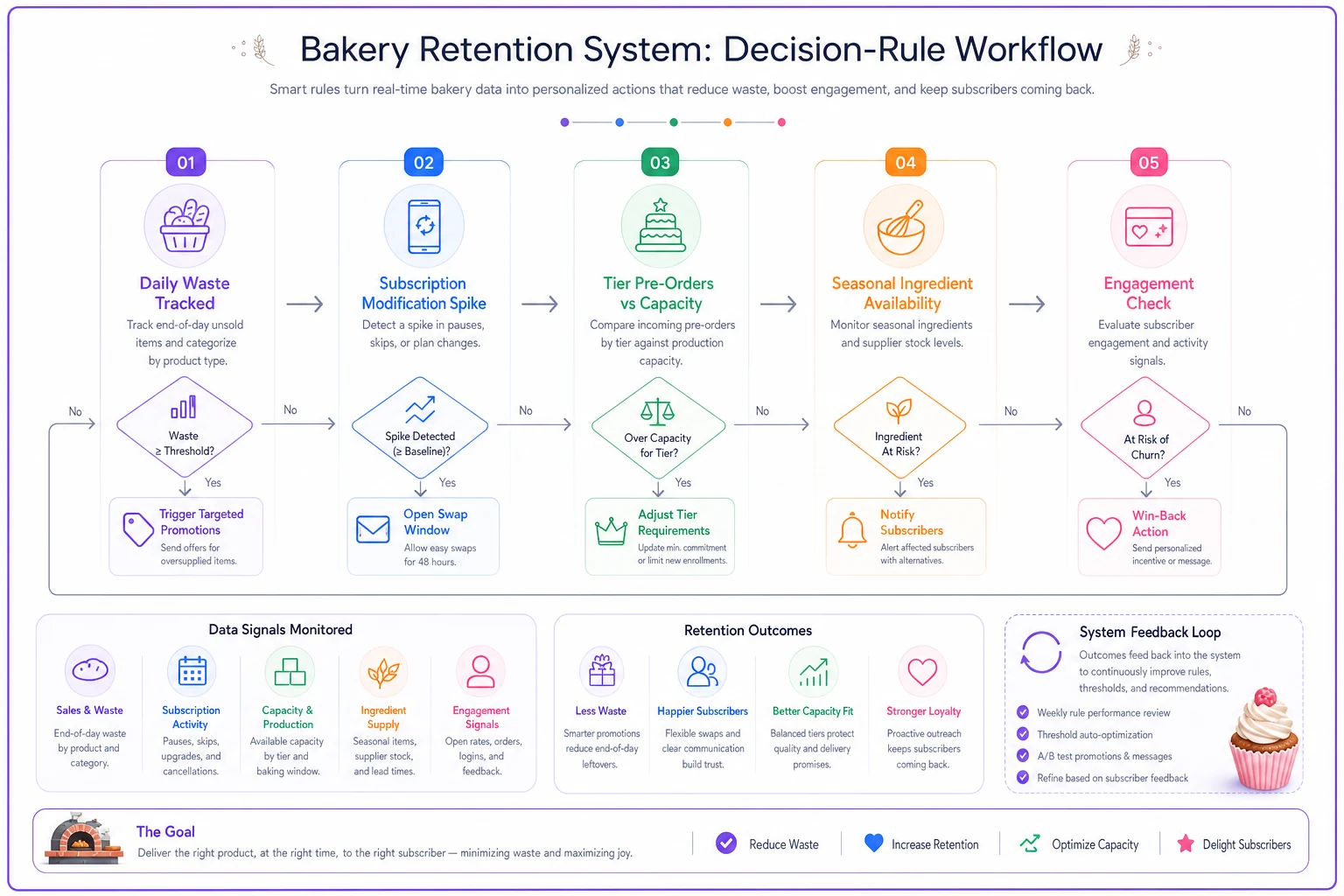
[Daily Waste Tracked] → exceeds threshold? YES → Activate afternoon loyalty multipliers NO → No change [Subscription Modifications Spike] → above 30%? YES → Open additional swap windows NO → Monitor next week [Tier 3 Pre-orders vs Capacity] → over capacity 2 weeks? YES → Increase Tier 3 requirements by 20% NO → Hold current thresholds [Seasonal Ingredient Arrives] → in subscription swap list? YES → Notify subscribers, offer as swap NO → Add to next menu cycle
It's not glamorous, but having these rules documented and consistently applied is what separates a retention system that holds together from one that slowly falls apart.
The technology question everyone asks
Around the six-month mark of running a manual retention system, every bakery owner asks the same thing: what software should I be using?
The answer depends on where you are operationally. If you're still figuring out your freshness windows, don't invest in complex loyalty platforms. If you can't predict tomorrow's production, don't launch subscriptions that require weeks of planning.
-
Under 500 customers
Spreadsheets and SMS. Track tiers manually, send promotions via text. Focus on getting the mechanics right first.
-
500-2,000 customers
A basic loyalty app plus email automation. Let technology handle points and communications while you focus on operations.
-
2,000+ customers
An integrated platform that connects loyalty, subscriptions, inventory, and production. At this scale, manual coordination genuinely isn't viable.
The mistake most bakeries make is jumping to complex technology before the operational foundation is solid. AI-powered operational software can help by connecting these pieces—tracking freshness windows, adjusting promotional timing based on inventory, managing subscription modifications without manual intervention. But even the best platform can't fix a retention system built on faulty assumptions about customer behavior or production capacity.
Fix the mechanics first, then add technology to scale what works.
Where retention systems typically break down
After watching a lot of bakery retention programs launch and fail, the breakdown points are surprisingly consistent.
First, owners underestimate the operational burden. Every loyalty tier needs monitoring. Every subscription needs fulfillment coordination. Every promotion needs inventory planning. What starts as a simple punch card program quietly becomes a part-time job nobody actually has time for.
Second, channel conflict gets ignored. Subscription customers get annoyed when walk-ins get better promotions. Morning regulars feel cheated when afternoon customers get bigger discounts. Wholesale accounts wonder why retail customers get all the perks. Without a clear channel strategy, retention programs generate as many complaints as they do repeat visits.
Third—and this one's predictable—bakeries promise what they can't deliver. "Fresh bread every morning" sounds great until your baker calls in sick. "Personalized birthday cakes for all Tier 4 members" works until you've got twelve birthdays on the same Saturday. Promises made in planning meetings become production nightmares.
The breakdowns are predictable, which means they're preventable. Build your system assuming things will go wrong. Plan for sick days, supplier issues, demand spikes. Create fallback options for every major promise. Document what happens when things fail, not just when they work.
The retention system that grows with you
Your bakery customer retention system shouldn't need constant crisis management. But it also can't be something you set up once and ignore.
Start with the fundamentals: understand your freshness windows, map your production capacity, identify your customer patterns. Build retention mechanics that align with those realities instead of fighting them. Create tiers that reward operational value, not just spending. Design subscriptions with flexibility built in—not rigid promises you'll eventually struggle to keep.
Most importantly, connect your retention system to your core operations. Your loyalty program should make morning rushes smoother, not more chaotic. Your subscriptions should stabilize demand, not create production surprises. Your promotions should reduce waste while building customer relationships.
The bakeries that get this right don't think of retention as a marketing program. They treat it as an operational system that also happens to drive customer loyalty. When freshness windows align with promotional timing, when subscription promises match production capacity, when loyalty tiers encourage behaviors that improve operations—retention starts to feel almost automatic.
You don't need sophisticated technology to get started. You need clear thinking about where customer behavior and operational reality actually intersect. Once you've figured that out, scaling becomes a technology problem. Until then, it's an operational challenge that no amount of software will solve for you.
The best retention system isn't the one with the most features. It's the one that turns your operational constraints into customer benefits, your production schedule into promotional advantages, and your freshness windows into loyalty mechanics that actually hold up in the real world.