
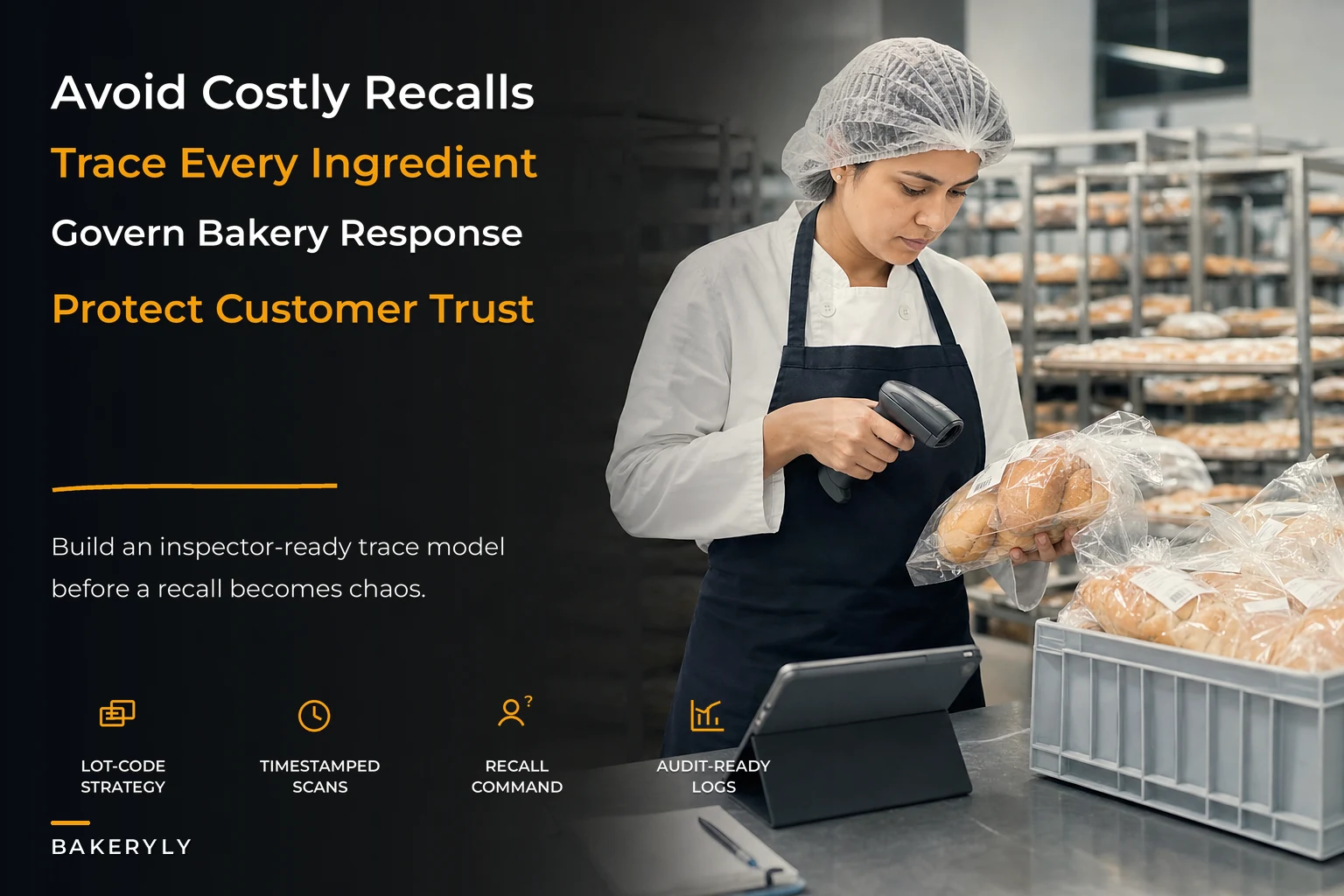

Most small bakeries don't fail a recall because they used a bad ingredient. They fail because they can't answer three questions fast enough: Which batches used the affected lot? Where did those batches go? Who do we need to call? If those answers take half a day of digging through handwritten batch sheets and text-message order threads, you've already lost control of the situation—and probably some customers too.
Bakery recall traceability isn't really an ingredient problem. It's a data problem wearing a food-safety costume. The actual recall—pulling product, notifying people, documenting what you did—is straightforward once your records line up. The hard part is building records that line up before anything goes wrong, without drowning your morning crew in paperwork they'll quietly stop filling out by week three.
This covers how trace systems actually break in small bakeries, what a "minimal but inspector-acceptable" model looks like, and the specific workflows that make a recall a two-hour event instead of a two-day crisis.
Where traceability quietly falls apart
The failure almost never looks dramatic at first. It looks like a bakery that's "mostly" tracking things.
The pattern tends to go like this. A bakery buys flour, butter, chocolate, and nuts from three or four suppliers. The receiving person writes delivery info on the invoice, maybe notes the lot on a clipboard. Production logs batches in a notebook—"AM croissant dough, 2 bins." Then product flows out across the cafe case, wholesale deliveries, catering orders, and online pickups. Each of those channels tracks itself differently.
-
Which deliveries included that lot number
-
Which production batches used almond flour during that window
-
Which finished SKUs those batches became
-
Which of those SKUs went to which customers, cafe sales, or wholesale accounts
Every one of those links lives in a different place, in a different format, often in someone's memory. The chain isn't broken in one spot—it's broken at every handoff between receiving, production, and fulfillment. And handoffs are exactly where small operations lose information, because nobody owns the connection between two systems.
The deeper issue: traceability isn't a document you keep. It's a set of links you preserve. Lot → batch → SKU → destination. If any single link isn't captured at the moment it happens, you can't rebuild it later no matter how good your intentions are. You can't remember on Thursday which butter lot went into Monday's laminated dough.
The minimum viable trace chain
You don't need enterprise software or a barcode gun on every bin to be inspector-acceptable. You need four connected records, and each one has to carry an identifier the next one can reference.
Never miss a bake or delivery again.
Bakeryly helps you schedule, track, and manage every order effortlessly.
- Unified order tracking
- Real-time inventory alerts
- Staff shift management
No credit card required
1. Inbound lot capture. Every ingredient delivery gets its supplier lot code recorded against your internal receiving record, with date and quantity. This is where most chains already start breaking—people record that flour arrived, not which lot.
2. Batch lot assignment. Every production batch gets its own internal lot code, and that batch record lists which ingredient lots went in. One croissant dough batch might reference a flour lot, a butter lot, and a yeast lot.
3. SKU-to-batch linkage. Finished products carry the batch lot code—on a tray tag, a case label, a packing slip line. A dozen croissants in the cafe case trace back to a specific dough batch.
4. Destination logging. Where that SKU went: sold at the counter on a given day, delivered to a wholesale account, fulfilled as online order #4471.
Capture those four things with consistent codes and you can run the trace in either direction. Forward (ingredient lot → affected customers) for recalls. Backward (customer complaint → which batch → which ingredients) for investigating a problem. Both directions matter, and a surprising number of bakeries can only do one.
A lot-code scheme that doesn't require a PhD
[DATE]-[PRODUCT]-[SHIFT/BATCH] Example: 0614-CROIS-A2 That tells you June 14, croissant line, batch A2. Your crew can write it on a tray tag in two seconds. It sorts chronologically. And it's unique enough that two batches never collide.
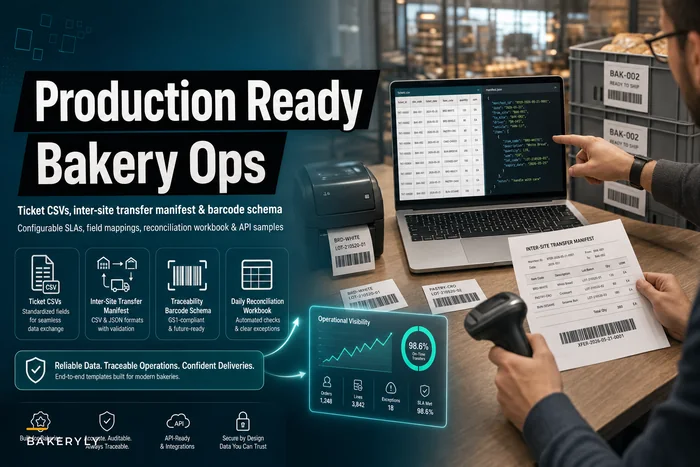
For a slightly more structured version that plays nicely with scanning and spreadsheets, pair the human code with a longer canonical ID behind the scenes. If you want a ready barcode structure to build from, the traceability barcode schema in our operational templates post gives you a format you can adopt instead of inventing one from scratch.
Scan workflows: where speed and discipline meet
The reason bakeries skip scanning isn't that it's hard. It's that it adds friction at the exact moments when the crew has the least time—receiving at 6am, pulling trays during a rush. The workflow has to be built around minimum touches, not maximum data.
-
Delivery arrives. Receiver pulls up the expected order.
-
Scan or type the supplier lot from the case/bag (one per ingredient line, not per unit).
-
Confirm quantity. Done.
One lot capture per ingredient, not per box. Chasing per-unit granularity is where good intentions go to die. For a small bakery, lot-per-ingredient-per-delivery is plenty for an inspector and plenty for an actual recall.
-
Batch start Scan or enter the batch lot code, then tap the ingredient lots being used. Thirty seconds.
-
Tray/case tagging The batch lot prints on the tray tag or case label automatically.
You want fewer, higher-value scan points, not more. Every extra scan is a place the workflow can fail when it's busy. Capture lots at the two moments where the information is unambiguous—when ingredients enter a batch, and when a batch becomes a labeled product—and let everything else inherit from those.
One lot capture per ingredient line at receiving and one scan at batch start gives the best balance of speed and traceability for most small bakeries.
This is also where allergen handling and traceability overlap. If you're already segregating stations and tracking which batch ran on which line, your trace data and your allergen controls reinforce each other. Our take on keeping that simple lives in why simple allergen SOPs beat complex plans in small bakeries, and the same principle applies here: the system people actually follow beats the perfect system they quietly abandon.
A simple flow of the scanning points:
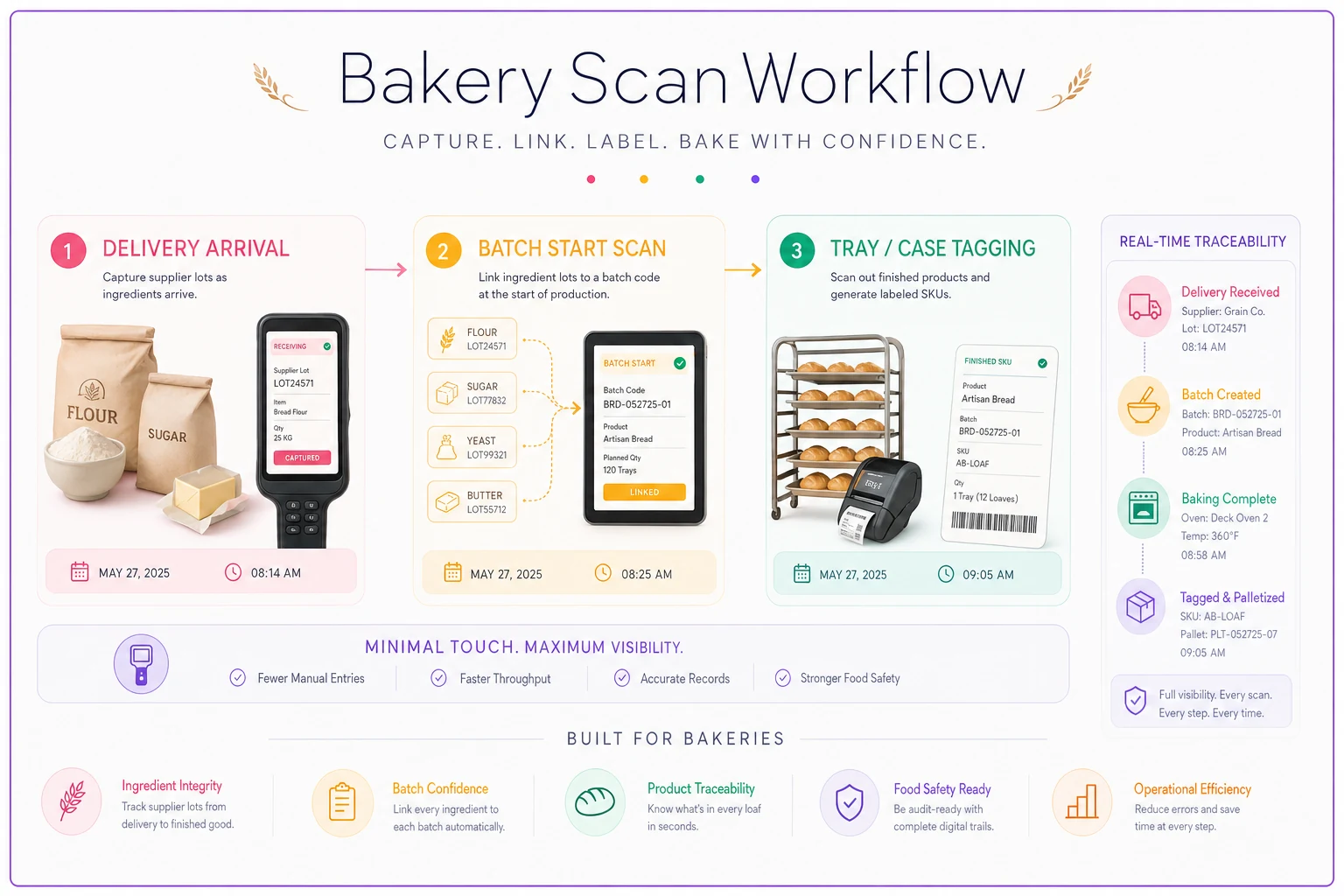
You want the workflow to be obvious at glance and require as few interactions as possible while leaving a clear, timestamped trail.
Paper vs. digital trace: when each actually makes sense
Not every bakery needs a digital system tomorrow. But the tradeoff is worth understanding honestly, because the wrong choice either wastes money or quietly fails you during the one event that matters.
| Factor | Paper / spreadsheet trace | Scan-based digital trace |
|---|---|---|
| Setup cost | Near zero | Moderate (devices, setup) |
| Recall query time | Hours of manual digging | Minutes, filtered by lot |
| Error rate at handoffs | High—transcription, memory gaps | Low—codes carry forward automatically |
| Works during a rush | Only if discipline is strong | Yes, if scan points are minimal |
| Multi-channel lookup | Painful—each channel separate | Unified—one query across channels |
| Audit readiness | Depends entirely on handwriting | Timestamped, consistent logs |
| Best fit | Single location, low SKU count, one channel | Multi-channel, wholesale, or multi-site |
Paper works fine if you're a single-location bakery with maybe 20 SKUs, mostly counter sales, and a receiving person who's genuinely rigorous. Plenty of bakeries operate this way safely for years.
Paper stops working the moment you add wholesale accounts, online orders, or a second location. Now the destination side of the chain fragments across systems that don't talk to each other, and reconstructing "which accounts got batch 0614-CROIS-A2" means cross-referencing three different records by hand under time pressure.
A single channel, you can trace in your head on a slow day. Four channels, you can't—and that's precisely when a recall becomes genuinely dangerous, because the product is already spread wide before you know there's a problem.
Sample trace queries you should be able to answer in minutes
An inspector-acceptable system isn't proven by your binder. It's proven by how fast you can answer real questions. These are the queries worth pressure-testing. If any of them takes longer than a few minutes, you have a gap regardless of how thick your records are.
Forward trace (recall direction): > "Supplier lot ALM-2291 is recalled. Which of our batches used it, which SKUs resulted, and which customers, wholesale accounts, and counter days received those SKUs?"
Backward trace (complaint direction): > "A customer reported a problem with a croissant bought on June 15. Which batch was in the case that day, what ingredient lots went in, and did any other product share those lots?"
Scope-sizing query: > "For batch 0614-CROIS-A2, what's the total quantity produced, how much was sold vs. still in stock, and how much went to each channel?"
That third one is the unsung hero. The biggest driver of recall cost isn't the product itself—it's over-recalling because you can't define the scope precisely. If you can prove only 60 of a 240-unit batch ever shipped and the rest is still in your freezer or was sold and consumed days ago, you've just made the problem a quarter of its original size.
The recall playbook: minimizing impact when it's real
When a recall triggers, decisions get made fast and under stress. That's the worst time to figure out your process. A one-page playbook, written while calm, is worth more than any software.
-
Freeze the suspect lots. The moment you identify affected ingredient or batch lots, physically quarantine anything still on-site. Tape, a bin, a sign—whatever stops it moving.
-
Run the forward trace. Produce the full list of affected batches, SKUs, and destinations. This is where your minutes-not-hours system pays for itself.
-
Classify severity. Allergen or pathogen risk is different from a quality issue. The severity determines how aggressive notification needs to be.
-
Notify affected destinations first. Wholesale accounts and catering clients before public anything—they may be reselling your product and need to pull it immediately.
-
Handle counter/retail customers. For known customers (online orders, loyalty), direct contact. For anonymous counter sales, a posted notice and, if risk warrants, a public notification.
-
Document every step with timestamps. Who you called, when, what you said, what came back.
-
Reconcile recovered product. Account for what came back vs. what was out there, so you know when the event is actually closed.
The notifications should already exist as fill-in-the-blank templates before you ever need them. Writing from scratch during a recall guarantees they'll be slow, inconsistent, and probably more alarming than they need to be. Three you should pre-write:
-
Wholesale/B2B notice Lot codes affected, specific products, the action you need them to take (pull from shelves, hold for pickup), and your contact. Keep it factual and immediate.
-
Direct customer notice For named customers—clear subject line, the specific product and purchase window, the risk in plain language, and exactly what to do (discard, return for refund).
-
Public/posted notice For counter sales where you can't identify buyers. Simpler, more cautious language, posted at point of sale and on your channels.
The pattern that separates good notifications from panic-inducing ones: state the specific lot and product, state the action, state the risk level honestly, and don't editorialize. Customers forgive a well-handled recall. They don't forgive feeling misled or getting a vague scary message with no clear instruction.
Audit-ready logs: proving it without a binder avalanche
"Audit-ready" doesn't mean more paper. It means consistent, timestamped records that connect. An inspector isn't impressed by volume—they're checking whether your chain holds and whether you can demonstrate it on demand.
The minimum audit trail covers:
-
Receiving logs with supplier lots, dates, quantities
-
Batch records linking ingredient lots to batch lots
-
Label/tagging records linking batch lots to finished SKUs
-
Destination records (sales, deliveries, wholesale manifests)
-
Any past recall or mock-recall documentation
-
Corrective actions taken when gaps were found
That last two matter more than people expect. Running an occasional mock recall—picking a random batch and timing how fast you can trace it fully—does two things. It proves your system works, and it generates exactly the kind of documentation that tells an inspector you take this seriously. A bakery that can show "we ran a mock recall last quarter, traced batch X in 40 minutes, found this gap, fixed it" is in a completely different position than one with a spotless-looking binder and no proof it functions under pressure.
A real scenario: the multi-channel almond flour pull
A two-location bakery with a cafe, a small wholesale route to four cafes, and online pickup got a supplier recall notice on an almond flour lot. They'd shifted to a scan-based trace model about five months earlier—mostly because reconstructing anything across their channels by hand had become unmanageable.
Their own estimate was that the trace would've taken most of a day before the system: pulling batch notebooks, cross-referencing wholesale delivery slips, guessing at counter sales by date range. The over-recall risk was real too. Without batch-level scope, they'd likely have pulled every almond-containing SKU across both locations to be safe—roughly 180–200 units, plus refunds and strained wholesale relationships.
With lots carried forward through batches to destinations, the forward trace ran in about 25 minutes. The affected lot touched three batches over two days, producing almond croissants and one catering order of financiers. Actual exposure: around 70 units, two wholesale accounts, and one catering client. They notified both accounts within the hour, pulled the catering order before delivery, posted a counter notice, and quarantined the remaining in-stock product.
The net difference wasn't just the smaller recall scope. The whole thing stayed contained—two accounts called instead of four confused ones, one clear counter notice instead of a store-wide scare, and documentation clean enough that the health inspector's follow-up was a short conversation rather than a scheduled visit. Customers who got a precise, calm notification mostly stuck around.
When to invest, and when not to
Build the digital scan model when you're running wholesale, online orders, catering, or more than one location. The multi-channel destination problem is where manual tracing genuinely fails, and that's non-negotiable territory.
Stay on a disciplined paper or spreadsheet model when you're a single location with a tight SKU list and one dominant sales channel—and your receiving discipline is already strong. Spending on scanning hardware to track a counter-only operation with 15 SKUs is solving a problem you don't have yet.
Don't do either half-heartedly. The worst position is a partial system—scanning receiving but not batches, or tracking batches but losing the destination link. A partial chain gives you false confidence and still breaks at the handoff. If you're going to build it, build the full lot → batch → SKU → destination chain even in its simplest form, because a chain with one missing link is just an expensive habit.
Traceability also overlaps heavily with broader continuity planning. A recall is one flavor of operational disruption, and the bakeries that handle it well usually already think in terms of "what's our documented response when something goes wrong." If you haven't mapped that out more broadly, our continuity playbook for when equipment or suppliers fail covers the same muscle applied to other failures.
The real lesson
A recall tests a system you built months earlier, under conditions you don't control, on a timeline you didn't choose. You can't improvise your way through it—you can only reveal whether the links were captured when they happened.
The bakeries that come through a recall with their reputation intact aren't the ones with the thickest food-safety binder. They're the ones who made capturing four connected records part of normal work, so that when the notice arrives, the trace is already there waiting to be run.
Start with the chain. Pick a lot-code format your crew will actually write down. Capture lots at the two unambiguous moments. Preserve the destination link across every channel you sell through. Then run a mock recall next month and find out where it breaks—because it will break somewhere, and far better to learn that on a quiet Tuesday than on the day it counts.
Ready to elevate your bakery operations?
Join 2,000+ bakeries using Bakeryly to streamline workflows, reduce waste, and delight more customers.