

Most bakery owners track cash in the till and flour in the back, but almost nobody connects the two in real time. That disconnect is where working capital quietly drains away. Perishable inventory isn't just stuff on a shelf — it's money you've already spent that's decaying by the hour. A tray of croissants is a short-term bond that matures at 4pm and defaults by closing.
Bakeries rarely govern inventory the way a finance person would govern a depreciating asset. They govern it the way a baker thinks: "do we have enough?" That question keeps the ovens running, but it doesn't protect your cash. You end up with freezers full of frozen fruit purchased six weeks ago, butter stacked three deep because it was on sale, and a weekly COGS number nobody can explain until the accountant shows up and it's too late to fix anything.
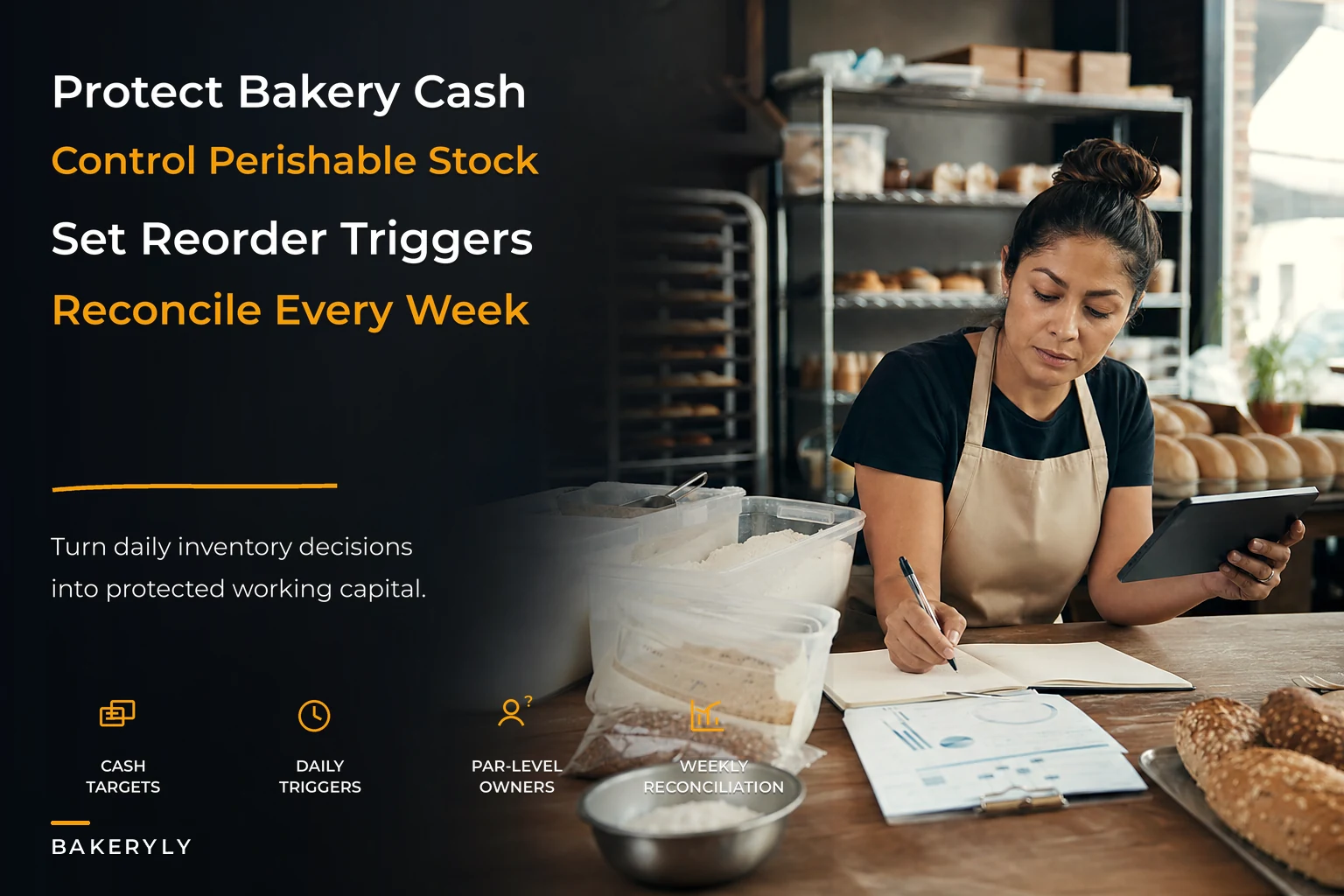
This piece is about building a system where perishables are treated as a financially controlled asset — with daily triggers, working-capital targets, replenishment rules, and a weekly reconciliation cadence that a shift manager can actually run without a finance degree.
Why inventory governance breaks in bakeries specifically
Other businesses can afford loose inventory discipline because their stock doesn't spoil. A hardware store carrying 20% too much inventory just has slightly less cash and slightly more shelf space. A bakery with 20% too much perishable inventory has waste — real money walking out in the compost bin.
What makes it worse is the timing mismatch. You pay for ingredients upfront, often on 7–14 day terms, but the cash doesn't come back until the finished product sells. If production runs ahead of demand, you've converted cash into inventory with a shelf life measured in days. The faster you grow, the more cash gets stuck in this cycle — which is why plenty of bakeries hit a revenue record one month and a cash crunch the next.
A few patterns show up again and again:
-
Buying to a recipe, not to a forecast. Ordering enough for "a busy week" without defining what busy means in actual units.
-
No separation between raw inputs and finished goods. Flour spoilage and unsold-pastry spoilage are completely different problems with different fixes, but they get lumped into one "waste" bucket.
-
Reconciliation that happens monthly or never. By the time you spot the drift, you've repeated the mistake dozens of times.
-
Over-ordering to avoid stockouts. Understandable, but it quietly inflates your working capital requirement and hides slow-moving SKUs.
The financial-control foundation here overlaps with what we covered in a simple financial-control system small bakeries can run without an accountant — this article is the inventory-specific layer that sits on top of that.
The two assets hiding inside "inventory"
Before any triggers or targets make sense, you have to split inventory into two financially distinct categories, because they behave nothing alike.
Raw inputs (flour, butter, sugar, eggs, packaging) have longer shelf lives, more predictable usage, and supplier-driven reorder cycles. The governance question here is: how much cash should be tied up in the back room at any given moment?
Finished and semi-finished goods (proofed dough, baked product, decorated cakes) decay fast and are extremely demand-sensitive. The governance question is different: are we converting cash into product faster than customers convert product into cash?
Here's the breakdown most bakeries never make:
| Dimension | Raw inputs | Finished goods |
|---|---|---|
| Shelf life | Weeks to months | Hours to days |
| Main risk | Over-buying, price shock | Overproduction, spoilage |
| Cash impact | Working capital tied up | Direct margin loss |
| Control lever | Par levels + order cadence | Production quantity + daily triggers |
| Review rhythm | Weekly reconciliation | Daily trigger + end-of-day |
| Owner of the number | Whoever places orders | Shift manager |
The mistake is applying one governance style to both. Monthly ordering logic works fine for flour and destroys you on éclairs.
Daily triggers: the shift-manager layer
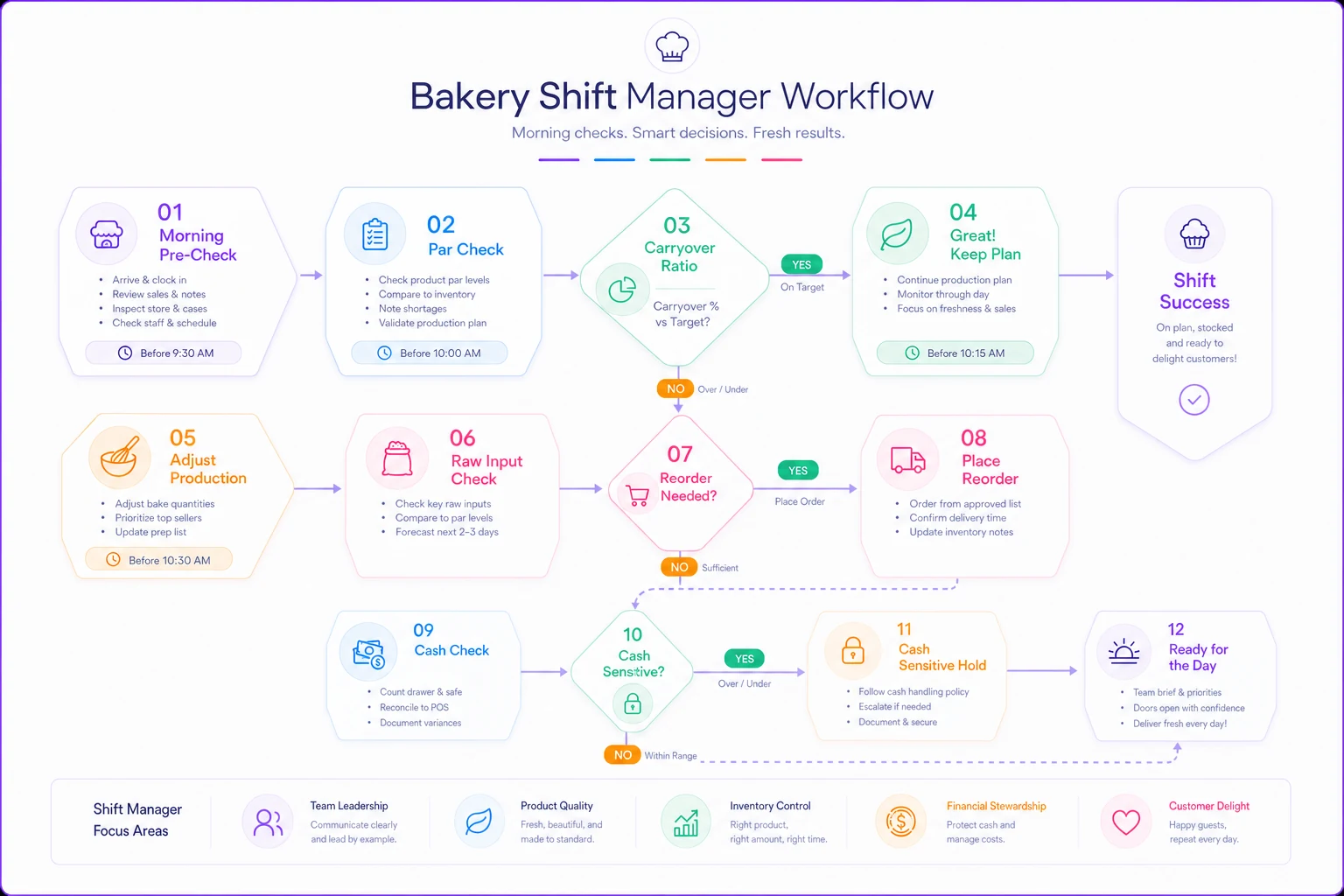
Daily triggers are the fast loop. They don't require accounting knowledge — they require a number and a rule. The point is to give whoever's running the shift a small set of decisions they can make before 10am that protect cash without calling the owner.
-
Morning par check. For each finished-goods SKU, compare on-hand (carryover + fresh bake) against the day's par. Anything 20% over par gets flagged for a display push or markdown schedule before it ages.
-
Carryover ratio. If yesterday's unsold product on any SKU exceeded roughly 10–12% of what was produced, today's bake for that SKU drops by one batch tier. No meeting required.
-
Raw input low-water mark. Any input below its reorder point gets added to the next order — but only to the par ceiling, never "a bit extra."
-
Cash-sensitive hold. On slow days (defined by your own weekday/weekend baseline), high-cost SKUs — anything using premium chocolate or nuts — only bake to confirmed preorders plus a thin display buffer.
The discipline here depends on forecasting grounded in real patterns, not gut feel. If you haven't separated weekday and weekend demand behavior yet, your triggers will be noisy — we go deep on that in a 6–12 week method for forecasting ingredient demand for weekends vs weekdays.
A quick visual of the shift-level workflow can help the team run the triggers consistently.
The thing most owners miss: daily triggers aren't about perfect accuracy. They're about bounding the downside. A trigger that stops you from over-baking a single high-cost SKU on a slow Tuesday pays for the entire system over a quarter.
Working-capital targets: the number that anchors everything
This is the part nobody sets, and it's really the whole game. A working-capital target tells you how much cash you're willing to have parked in inventory at any moment. Without it, "do we have enough?" always drifts toward "we have way too much."
-
Raw inputs
target something like 7–14 days of COGS, depending on supplier delivery frequency and any volume-discount tradeoffs.
-
Finished goods
target under one day — you want near-zero overnight finished inventory outside of par-driven buffers and confirmed orders.
Here's how a small bakery might set this. Say food COGS runs roughly $9k–$11k a week, with the raw-input portion at about 70% of that. If you want to hold around 10 days of raw inputs, your target raw inventory value sits near $9k–$11k at any point. The moment a stock count values your back room at $15k, you know immediately that $4k–$5k of cash is stranded, and you stop ordering until it burns down.
Two things people consistently get wrong:
-
They set the target once and never revisit it when supplier terms or sales volume change. If you negotiate better delivery frequency, your target should drop, freeing cash. The negotiation side of that is worth pairing with a structured ordering system like the one in a procurement system for small bakeries with cadence, minimums and vendor scorecards.
-
They chase bulk discounts that blow past the target. A 6% saving on butter you won't use for five weeks isn't a saving — it's a loan you made to your supplier at your own expense.
That single comparison — actual inventory value vs. target days-on-hand — replaces a dozen vague conversations about whether you're "carrying too much."
Replenishment policy: par levels tied to cash, not comfort
Par levels are where most of this becomes concrete. The problem with typical par levels is that they're set by feel and never tied back to the working-capital target. A proper par is a range with a floor (reorder point) and a ceiling (max hold), and the ceiling exists specifically to protect cash.
Here's a par-level template structure that connects the dots:
| Field | What it does |
|---|---|
| SKU / input | The item |
| Unit of count | How you actually count it (cases, kg, trays) |
| Reorder point | Floor that triggers an order |
| Par ceiling | Max you're allowed to hold (tied to days-on-hand target) |
| Order multiple | Supplier minimum / case size |
| Decision threshold | The cash/COGS rule that overrides the default |
That last row is what makes this financial governance instead of a shopping list. Decision thresholds are explicit rules like:
-
If an input's share of weekly COGS rises above its historical band by more than roughly 3–4 points, pause top-ups and investigate price or waste before reordering.
-
If finished-goods carryover exceeds target two days running, cut the par ceiling for that SKU by one tier for the rest of the week.
-
If cash-on-hand drops below your floor, raw-input orders default to reorder point only — no building toward ceiling until cash recovers.
Par ceilings do more financial work than reorder points. Everyone obsesses over not running out. Almost nobody sets a hard "stop buying" line, which is exactly where cash leaks.
Weekly reconciliation: the cadence that keeps it honest
Daily triggers manage the day. Weekly reconciliation is where you catch drift before it compounds. The goal is a 30–45 minute routine a manager can run — not a month-end accounting exercise.
A weekly reconciliation covers five things:
-
Count vs. system. Physical stock value against what your records say you should have. The gap is your real shrinkage and waste signal.
-
Actual days-on-hand vs. target. Are you above or below your working-capital target, and by how much?
-
Theoretical vs. actual COGS. What recipes say you should have used vs. what inventory movement says you actually used. The variance points at waste, over-portioning, or theft.
-
Carryover and waste by SKU. Not a lump sum — ranked by SKU so you can see which items drive most of the loss.
-
Par adjustments. Based on the above, which pars move up or down next week.
The deliverable should be something a non-accountant can read at a glance: inventory value vs. target, top waste SKUs, COGS variance, and a short list of par changes. If your reconciliation produces a spreadsheet nobody acts on, it's theater. The output has to be decisions — pars changed, orders paused, SKUs flagged.
Keep the weekly reconciliation under 45 minutes and focus on producing decisions, not reports.
A realistic warning sign: if your theoretical-vs-actual COGS variance is consistently above 4–6%, you don't have a pricing problem, you have an inventory-control problem, and no menu change will fix it.
A short real scenario
A single-location bakery doing roughly $14k–$16k a week in sales had decent margins on paper but was always tight on cash. Food COGS looked normal at a glance, but they'd never split raw inputs from finished goods and had no working-capital target. Orders went in by habit; the walk-in was always full.
When they finally counted and valued raw inventory, it came out around $17k against what should have been closer to $10k for their volume — roughly $7k of cash frozen in the back room, mostly from bulk-buy deals and over-ordering butter and specialty flour. On the finished side, carryover on three pastry SKUs was running 15–18%, quietly eating margin every afternoon.
They set a 10-day raw-input target, hard par ceilings, and a Monday reconciliation. Nothing dramatic happened week one. Over about two months, raw inventory drifted down to target, which freed up most of that stranded cash, and tightening pars on the three worst SKUs cut daily finished-goods waste to under 8%. No new revenue, no price increase — just the same business holding less dead money and throwing away less product.
When this level of governance makes sense (and when it doesn't)
When it's worth it: You're past the point where the owner personally places every order and remembers every number. Usually that's a bakery with a few staff, multiple shifts, or more than a handful of perishable SKUs. If cash feels tight despite decent sales, that's the tell — your working capital is probably stuck in inventory.
When it's overkill: A tiny operation with one baker, a dozen SKUs, and daily hand-ordering doesn't need formal days-on-hand targets. The owner is the governance system. Adding templates there just creates admin for admin's sake.
Who should not start here: If your recipes aren't standardized and you can't state a theoretical yield per batch, build that first. Inventory governance runs on knowing what should have been used. Without reliable recipe costing, your COGS variance is just noise and every reconciliation will end in a shrug.
Where software quietly earns its place
None of this requires fancy tools to start — a spreadsheet, honest counts, and the discipline to act on them will get you most of the way. But the cadence is where it gets heavy. Daily counts, par comparisons, COGS variance, and weekly reconciliation add up to real manual hours, and manual processes drift the moment a shift gets busy.
This is where AI-assisted operational software helps without taking over the thinking. A platform that pulls POS sales, production records, and stock counts into one place can flag par breaches and carryover spikes automatically, surface COGS variance before the weekly review, and keep the dashboard current so a shift manager sees the numbers instead of rebuilding them. The judgment — what to bake, what to hold, what to cut — stays with your people. The software just removes the clerical drag that makes most governance systems collapse after three good weeks.
The point isn't automation for its own sake. Inventory governance only works if the right numbers are in front of the right person at the right moment, consistently. Tooling that keeps that loop running is what turns a good system on paper into one that actually holds.
Closing thought
Perishable inventory is probably the most expensive asset in your bakery that nobody manages like an asset. Flour, butter, and finished product sitting past their useful window aren't "stock" — they're cash you've already converted into something with an expiration date.
Once you start governing it that way — with real targets, hard ceilings, daily triggers, and a weekly cadence that produces decisions instead of reports — the fog around your cash position lifts. You stop wondering where the money went and start seeing exactly where it's parked, and how fast you can get it back.
Perishable inventory is probably the most expensive asset in your bakery that nobody manages like an asset. Flour, butter, and finished product sitting past their useful window aren't "stock" — they're cash you've already converted into something with an expiration date. Once you start governing it that way — with real targets, hard ceilings, daily triggers, and a weekly cadence that produces decisions instead of reports — the fog around your cash position lifts. You stop wondering where the money went and start seeing exactly where it's parked, and how fast you can get it back.