

Your morning rush hits. Croissants gone by 9:15. Meanwhile, those fruit danish you made twelve of? Eight still sitting there at 2pm, and you know exactly where they're headed — straight to the waste bin or a desperate 75%-off flash sale that barely covers ingredient cost.
This isn't about making better pastries. Your danish are probably excellent. The real issue runs deeper: most bakeries price their perishable SKUs based on food cost and competitor benchmarks, completely ignoring how oven capacity, freshness windows, and daily demand patterns actually intersect.
The bakeries that handle this well aren't running complex spreadsheets or paying consultants. They've just connected their pricing directly to production constraints and waste forecasts. That's it.
The hidden geometry of bakery capacity
Think about your oven — not the temperature settings or bake times, but the actual physical space. A standard deck oven fits maybe 8 sheet pans. Each pan holds different quantities depending on the product. Croissants need room to expand, so you get around 12 per sheet. Danish pack tighter at 16. Muffins in their tins, 24.
Now layer in your production schedule. First bake at 5am needs to cover opening at 7am plus the morning rush. But different items have wildly different freshness windows. Croissants start degrading around the 4-hour mark. Danish can push 8 hours. Muffins hold for nearly 12.
Most bakeries price everything like it has the same shelf life and production flexibility — full price until some arbitrary afternoon markdown, maybe a day-old discount rack. That's like driving with only a gas pedal and an emergency brake. You're missing all the controls in between.
The real constraint isn't just oven space. It's oven space multiplied by freshness window, divided by demand velocity. A croissant that sells in 2 hours effectively uses less "capacity" than a danish sitting for 6 hours, even if they take the same pan space to produce.
Mapping price bands to actual capacity constraints
Here's what an intelligent perishable SKU pricing structure looks like when you map it to real constraints:
Never miss a bake or delivery again.
Bakeryly helps you schedule, track, and manage every order effortlessly.
- Unified order tracking
- Real-time inventory alerts
- Staff shift management
No credit card required
Morning Premium (0–2 hours from bake):
-
Croissants
Full price ($4.50)
-
Danish
Full price ($4.00)
-
Muffins
Full price ($3.50)
Mid-Morning Adjustment (2–4 hours):
-
Croissants
10% off ($4.05) — approaching freshness edge
-
Danish
Full price ($4.00) — still well within window
-
Muffins
Full price ($3.50) — barely started aging
Afternoon Shift (4–6 hours):
-
Croissants
25% off ($3.38) — past prime, clearing needed
-
Danish
10% off ($3.60) — starting to age
-
Muffins
Full price ($3.50) — still fresh
Late Day Clear (6+ hours):
-
Croissants
40% off ($2.70) or removed
-
Danish
25% off ($3.00)
-
Muffins
15% off ($2.98)
The critical part — these aren't fixed discounts. They're triggers based on remaining inventory versus expected demand.
If you've only got 3 croissants left at 10am and typically sell 5 between then and noon, hold price. But if you've got 15 danish at 2pm and typically sell 2 between then and close, trigger the markdown immediately.
Building your waste forecast matrix
Every bakery owner knows the pain of tossing product, but few actually track waste patterns in any systematic way. Here's what it looks like with real numbers from a neighborhood bakery doing about $18k weekly:
| SKU | Monday | Tuesday | Wednesday | Thursday | Friday | Saturday | Sunday |
|---|---|---|---|---|---|---|---|
| Croissants | 2–3 units | 1–2 units | 2–3 units | 1–2 units | 4–5 units | 0–1 units | 6–8 units |
| Danish | 4–6 units | 3–5 units | 3–4 units | 3–5 units | 2–3 units | 1–2 units | 8–10 units |
| Muffins | 1–2 units | 1–2 units | 2–3 units | 1–2 units | 0–1 units | 0–1 units | 3–4 units |
| Scones | 3–4 units | 2–3 units | 2–3 units | 2–3 units | 1–2 units | 0 units | 5–6 units |
Notice Sunday? That's your canary in the coal mine. High Sunday waste almost always means weekend production assumptions are off. But beyond that, this matrix tells you exactly when to trigger price adjustments.
When danish waste creeps above 4 units consistently, your afternoon pricing isn't aggressive enough. When croissant waste hits zero on Saturdays, you're either nailing production or underpricing — check which by looking at sellout time.
The ingredient overlap problem nobody talks about
Something that comes up constantly in bakeries: they'll run out of chocolate croissants at 9am while chocolate muffins sit until close. Same chocolate. Same oven. Completely different velocity and margin profiles.
Your pricing strategy needs to account for ingredient overlap, especially for premium components. When multiple SKUs share expensive ingredients — chocolate, nuts, seasonal fruit — your pricing bands should nudge customers toward items with better capacity utilization.
A bakery in Denver worked this out with their almond products. Almond croissants at $5.50 had a narrow freshness window and sold out daily. Almond danish at $4.50 had a longer window and moderate waste. Almond financiers at $3.50 had the longest window and minimal waste. By keeping the financier price attractive relative to the others, they shifted demand toward the product that best utilized almond inventory without generating waste. Simple adjustment, real impact.
Decision matrix for SKU-specific pricing triggers
Stop guessing when to markdown. Here's the decision matrix that actually works:
Trigger Evaluation (check hourly after 10am):
-
Freshness timer
Hours since bake ÷ Maximum freshness window
-
Inventory ratio
Current units ÷ Average remaining-day sales
-
Capacity pressure
Tomorrow's production space needed
-
Ingredient overlap
Shared premium ingredients approaching expiry
Action thresholds:
-
If freshness timer > 50% AND inventory ratio > 2.0
Trigger 15% markdown
-
If freshness timer > 75% AND inventory ratio > 1.5
Trigger 25% markdown
-
If freshness timer > 75% AND capacity pressure exists
Trigger 40% markdown
-
If ingredient overlap risk exists
Trigger targeted bundle pricing
The key is running through these triggers on a schedule, not just when someone notices the display case looking full.
Running this manually is completely doable, but the discipline required to check these triggers every hour without fail is harder than it sounds. Most bakery staff are slammed during peak hours and the trigger checks slip. That's where the system breaks down.
A workflow diagram showing how the freshness timer percentage and inventory ratio feed into a decision tree — at each hourly checkpoint, the combined values route to either hold price, trigger 15% markdown, trigger 25% markdown, or trigger 40% markdown, with a separate branch for ingredient overlap risk that routes to bundle pricing instead.
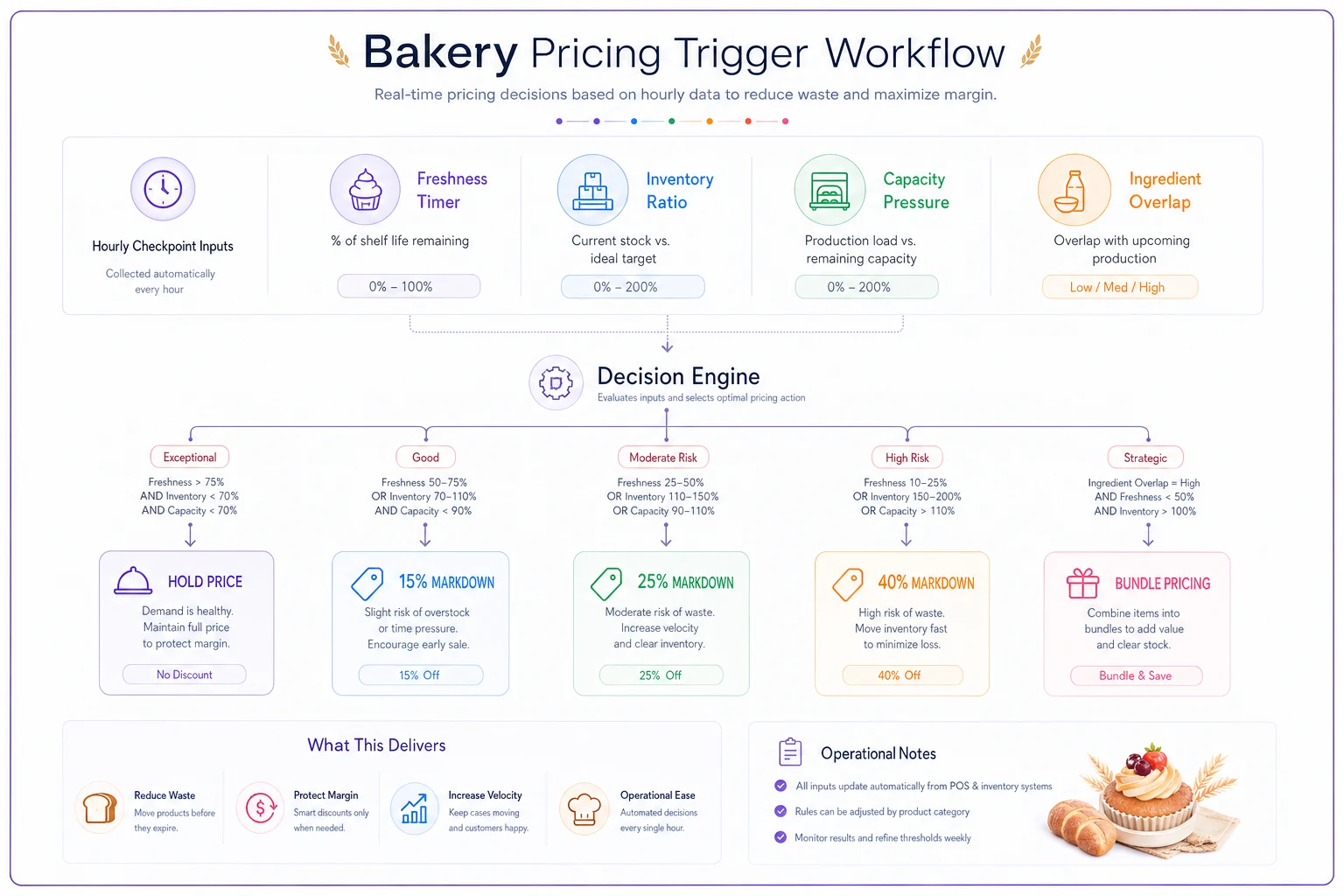
Use the flow above to drive hourly checks in your pricing system.
Real-world implementation: Portland bakery case study
A Portland bakery doing around $395k annually had a classic problem — beautiful laminated pastries requiring skilled labor and expensive butter, but inconsistent sell-through meant waste was steadily eating into margins.
Before implementing capacity-aware pricing:
-
Average daily waste
18–24 units
-
Waste cost
roughly $2,800 monthly
-
Afternoon sales
15% of daily total
-
Customer complaints about stale product
frequent
They mapped every SKU to three variables: oven batches per day, freshness window in hours, and average hourly sales velocity. Then built pricing triggers based on the intersection.
Six weeks after implementation:
-
Average daily waste
6–10 units
-
Waste cost
roughly $950 monthly
-
Afternoon sales
28% of daily total
-
Customer complaints
basically eliminated
The biggest surprise was that total revenue went up about 8%. Dynamic pricing drove more afternoon traffic, and customers started timing their visits to catch specific markdowns. The predictability of the system created its own demand pattern — which is something you genuinely can't manufacture with random discounting.
Common mistakes that kill margin
Each of these mistakes compounds over time. One bad decision becomes standard practice, and suddenly you've built a pricing structure that works against your own production constraints.
-
Mistake 1
Uniform markdown timing
Setting all products to markdown at 2pm ignores freshness reality. Your cookies might still be perfect at 2pm while your croissants turned questionable at noon. -
Mistake 2
Percentage-only thinking
A 25% discount on a high-margin item might still be profitable. The same discount on a low-margin item means you're essentially paying customers to take your product. Calculate absolute margin dollars remaining, not just percentages. -
Mistake 3
Ignoring production batching
If you can only bake danish in batches of 24 but average daily demand is 18, you need aggressive afternoon pricing to move those last 6 units — otherwise you're choosing between waste or day-old rack depreciation. -
Mistake 4
Fighting natural demand patterns
Some products just don't sell after lunch. No amount of discounting will move a breakfast pastry at 4pm. Better to produce less and maintain morning price integrity.
One bad decision becomes standard practice, and suddenly you've built a pricing structure that works against your own production constraints.
The wholesale complication
Running wholesale alongside retail makes this whole system more complex. Wholesale orders lock in oven capacity but guarantee zero waste. Retail gives you margin upside but waste risk. The operations that handle this well use a cascade approach:
-
Morning
Full retail price for walk-ins
-
Mid-morning
Wholesale pickup window (pre-ordered at wholesale rates)
-
Afternoon
Retail markdowns on remaining inventory
-
Next day
Day-old wholesale to cafes, if applicable
Wholesale commitments act as your waste insurance while retail captures margin. But you need to firewall the capacity — don't let wholesale orders cannibalize your retail freshness window.
Technology and monitoring reality
The dream is a POS system that automatically adjusts prices based on inventory levels and time. The reality for most small bakeries? You're lucky if your POS handles basic discounts without crashing.
Manual but systematic:
-
Laminated trigger chart at the register
-
Phone timer for hourly checks after 10am
-
Pre-programmed discount buttons (15%, 25%, 40%)
-
Daily waste log (paper is fine)
-
Weekly review of waste patterns
For bakeries ready to level up operationally, AI-powered management platforms can automate these triggers entirely. The system tracks inventory in real-time, references historical sales patterns, and applies pricing adjustments based on your rules — no manual check-ins required. Some platforms can even forecast tomorrow's production needs based on today's sell-through, which cuts overproduction before it becomes a waste problem. That's the kind of operational feedback loop that's hard to replicate manually once you're juggling 20+ SKUs.
Pre-program discount buttons to match your most common trigger bands so staff can apply markdowns in seconds during busy shifts.
But even the manual version beats the "discount everything at 3pm and hope for the best" default most bakeries fall into.
The production feedback loop
Your pricing strategy should inform tomorrow's production, not just clear today's inventory. When you track which items consistently hit waste thresholds, you know exactly where to cut production. When certain items trigger markdowns but still sell through, you might have room to produce more.
-
Item produced
-
Time of sellout (if applicable)
-
Units wasted
-
Markdown triggered (yes/no)
-
Units sold at markdown
After two weeks, patterns become pretty clear. Those fancy kouign-amann you love making — if they hit markdown triggers daily and still generate waste, cut production by 20%. Those boring bran muffins that sell out by 10am at full price? Make more. The data usually confirms what you already suspect but haven't had the numbers to justify acting on.
Bundle strategies for stubborn SKUs
Some items just don't respond to simple discounting. A lingering danish at 2pm might not move at 25% off, but bundle it with a coffee for $6.50 total? Different story.
-
Pastry + coffee after 2pm
-
Mix and match three items approaching freshness windows
-
Family four-pack of items with shared ingredients
-
Tomorrow's breakfast box for items with longer windows
The key is making the bundle feel like value, not desperation. "Afternoon coffee break special" sounds appealing. "Please buy our old danish" does not.
Seasonal capacity constraints
Capacity-aware pricing needs seasonal adjustment. That oven running at 60% capacity in January might be completely slammed in December. Summer fruit pastries have different freshness curves than winter items loaded with stable ingredients like chocolate and nuts.
-
Holiday weeks
Higher prices hold longer due to demand
-
Summer months
Shorter freshness windows require more aggressive markdowns
-
Back-to-school
Morning rush intensity affects trigger timing
-
Tourist seasons
Different price sensitivity, adjust bands accordingly
Seasonal drift is one of the more common reasons a well-functioning pricing system starts underperforming. What worked in March needs revisiting in June.
The customer perception challenge
The fear most bakery owners have: customers waiting until afternoon to get discounts, killing morning business. In practice, this rarely plays out the way owners imagine.
Morning customers want maximum freshness and selection. They're buying for the experience, not the discount. Afternoon customers are price-sensitive but weren't coming in at 7am anyway. You're capturing different segments, not cannibalizing existing sales.
The real risk is training customers to expect inconsistent pricing. That's why systematic triggers beat random desperation discounts. When customers learn the pattern, they plan accordingly — which actually helps you predict demand.
Building your implementation roadmap
Week 1–2: Data gathering
-
Track current waste by SKU and day; Note sellout times for popular items; Calculate true freshness windows — when quality noticeably drops; Review your existing margin structure
-
Week 3–4
Design your pricing bands — Set freshness-based trigger points; Calculate minimum acceptable margins at each band; Create your decision matrix; Train staff on the new system
-
Week 5–6
Pilot and adjust — Run the system for full weeks; Track waste reduction; Monitor customer response; Adjust triggers based on results
-
Week 7–8
Refine and systematize — Lock in successful triggers; Create standard operating procedures; Set up measurement templates to track performance; Plan for seasonal adjustments
Run the weeks as described, collect results, and iterate based on what the data shows.
When this system doesn't work
Capacity-aware pricing won't save you in every situation:
-
Location problems
If foot traffic dies after the morning rush, no pricing strategy fixes that.
-
Quality issues
Discounting bad product just confirms it's bad.
-
Overwhelming variety
Too many SKUs makes triggers unmanageable.
-
Production chaos
Without consistent batch planning, pricing can't compensate for the underlying mess.
Fix the fundamentals first, then optimize pricing. It's tempting to jump straight to pricing tactics when margins are tight, but if production is inconsistent or foot traffic genuinely dies after noon, you're treating symptoms. Pricing is a multiplier — it amplifies what's already working, not a substitute for what isn't.
The bottom line on perishable SKU pricing
Most bakeries treat pricing like a set-it-and-forget-it decision made when designing menu boards. For perishable SKUs, static pricing guarantees either waste or missed revenue — often both at the same time.
The bakeries winning at this understand pricing as an operational tool, not just a financial one. They use it to manage capacity, minimize waste, and capture value from every hour their ovens run.
Start simple. Pick your three highest-waste items. Map their freshness windows. Create basic pricing triggers. Track results for two weeks. Once you see the waste reduction and margin improvement, expanding the system across your full range becomes an obvious next step.
Every unit you sell at a smart markdown instead of tossing saves margin. Every customer who buys that afternoon danish instead of walking past puts dollars in your register. Add those up across a year, and you're looking at meaningful recovered profit — often tens of thousands for a bakery doing solid volume.
Your ovens have fixed capacity. Your ingredients have a fixed shelf life. Your customers have varying price sensitivities throughout the day. Connect those realities through consistent pricing triggers, and the daily battle against waste starts to feel a lot more manageable.
Ready to elevate your bakery operations?
Join 2,000+ bakeries using Bakeryly to streamline workflows, reduce waste, and delight more customers.