

The problem with most bakery SOPs isn't that they're missing. It's that they're wrong — quietly, slowly, over months — and nobody notices until an audit, a sick day, or a new hire exposes the gap.
You write the croissant lamination procedure in January. By June, your head baker has tweaked the resting time twice, the proof box got replaced with a different model, and the "official" SOP still references the old one. Now you've got two versions floating around: the paper copy in the binder and the real one living in someone's head. That gap is SOP drift, and it's probably the single most expensive thing in your bakery that nobody ever puts a number on.
This article is about the bakery SOP lifecycle — how a procedure gets written, updated, verified, and retired without turning into a graveyard of outdated PDFs. The goal isn't more paperwork. It's keeping what's written and what's actually done in sync, especially once you're running more than one location.
Why SOP drift is actually a coordination problem, not a documentation problem
Most owners treat SOPs as a writing task. You sit down, document the process, print it, laminate it, done. But an SOP isn't a document — it's a snapshot of a process at one moment in time. And bakery processes don't hold still.
Ingredients change. A flour supplier switches mills and the hydration shifts. Equipment gets swapped. Staff find faster shortcuts — some good, some not. Seasonal menus rotate in and out. Every one of these is a small edit to how work actually gets done, and almost none of them make it back into the written procedure.
What shows up across a lot of small food operations is that drift rarely comes from one big change. It's an accumulation of small, undocumented adjustments. Each one feels too minor to bother updating the SOP. Six months later, the written procedure describes a bakery that no longer exists.
The failure compounds when you add people and locations:
-
A new hire trains off the outdated SOP, learns the wrong resting time, and produces inconsistent product for weeks.
-
Your second location copies the "master" SOP that was already three edits behind.
-
An inspector asks for your allergen cleaning procedure, and the document doesn't match what staff actually do at the station.
None of these are documentation failures. They're coordination failures — nobody owns the loop between "process changed" and "document updated."
What breaks at scale
With one location, drift is survivable because the owner is physically there. You see the shortcut, you correct it, the knowledge stays in your head. The SOP is almost decorative.
The moment you open a second site, that invisible correction mechanism disappears. You're no longer standing at the bench. The SOP stops being a backup and becomes the only connection between how you want things done and how they actually get done 20 miles away.
The pattern that shows up again and again: a bakery scales from one to three sites, each site slowly develops its own version of the same procedure, and within a year the three locations are producing noticeably different product under the same brand name. Customers notice. The sourdough at the original shop tastes different from the new one. Nobody did anything wrong on purpose — the procedures just drifted apart because there was no shared, versioned source of truth.
This is exactly the territory covered in scaling a bakery to multiple sites — once you're multi-site, consistency stops being automatic and has to be engineered.
The lifecycle: how an SOP should actually move
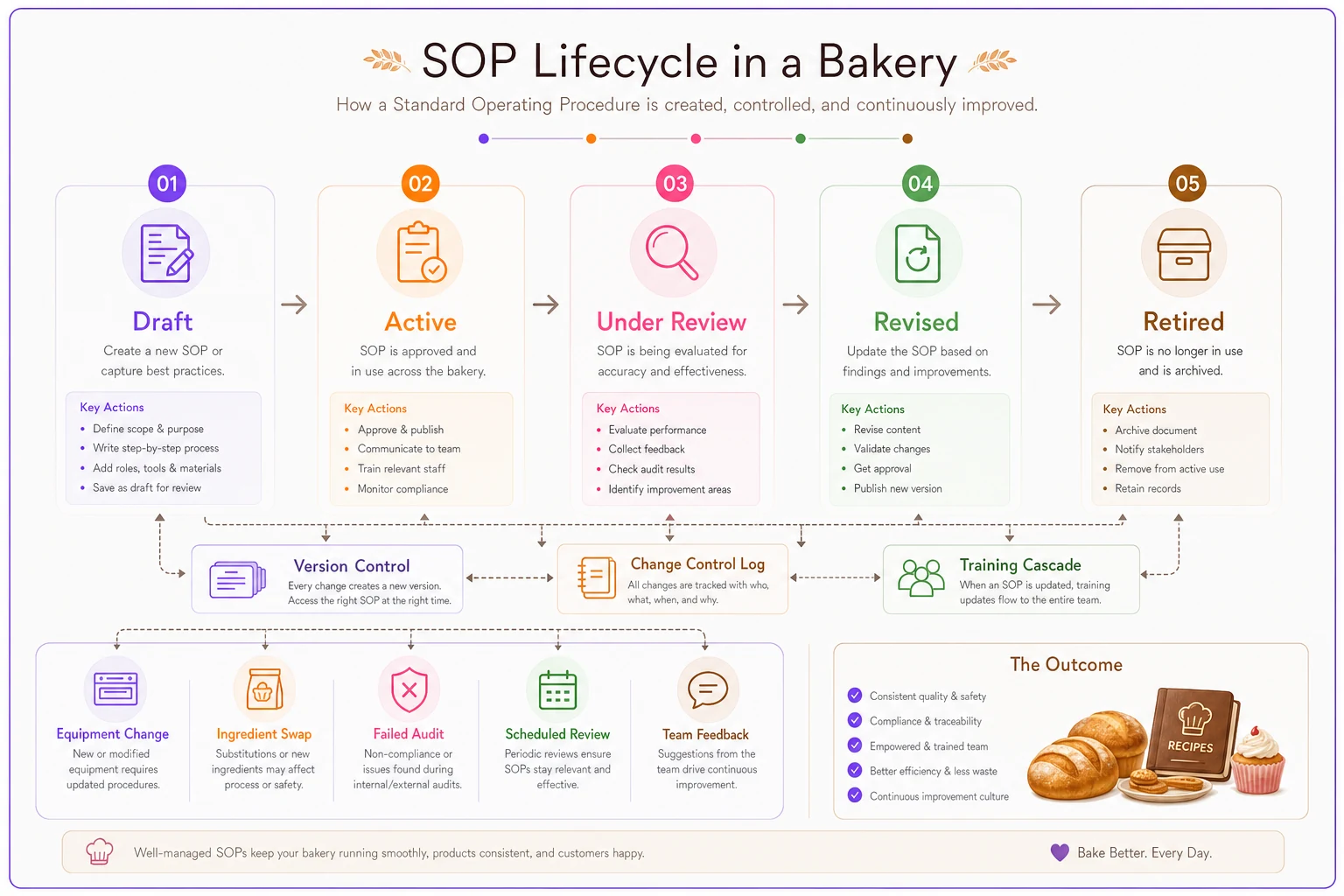
Think of each SOP as something with a life, not a permanent object. It gets born, it changes, it gets checked, and eventually it dies or gets replaced. Five stages:
-
Draft — someone writes the first version based on current practice.
-
Active — it's the official procedure, in use, trained against.
-
Under review — a trigger (equipment change, ingredient swap, failed audit) flags it for update.
-
Revised — a new version is published, the old one is archived (not deleted).
-
Retired — the SKU is discontinued or the process is obsolete; the SOP is pulled from circulation but kept in the archive for traceability.
The stage most bakeries skip is #3. There's no trigger system. Procedures only get reviewed when something has already gone wrong. A working lifecycle has triggers that push an SOP into review before the failure happens — a new oven, a new supplier, a customer complaint, a seasonal changeover, or just a scheduled calendar date.
Here's a quick visual of that lifecycle.
Minimal machine-readable templates
| Field | Example | Why it matters |
|---|---|---|
| SOP ID | LAM-003 | Unique, stable reference across all sites |
| Title | Croissant lamination | Human-readable |
| Version | v2.3 | Tracks which iteration is current |
| Effective date | 2026-03-14 | When this version went live |
| Owner | Head baker | One accountable person |
| Linked equipment | Proof box PB-2 | Flags SOP when equipment changes |
| Linked ingredients | Flour T55, European butter 82% | Flags SOP when a supplier changes |
| Review trigger | Equipment swap / 6-month cycle | Tells you when to re-check |
| Status | Active | Draft / Active / Review / Retired |
Keep the body simple: numbered steps, critical control points marked clearly (temperatures, times, weights), and a short "what good looks like" line at the end. The header block is what makes it machine-readable — those linked fields are how you later connect "we changed butter suppliers" to "these four SOPs need review."
Versioning conventions that don't confuse the morning crew
Versioning fails when it's either too loose ("finalv2REAL_final.docx") or too rigid for a kitchen. The middle ground that works:
Major.Minor format. Bump the major number when the process changes in a way that affects the product or safety — new fermentation time, different allergen handling, new equipment. Bump the minor number for clarifications, typo fixes, or wording that doesn't change what staff actually do.
So v2.0 → v2.1 is a clarification. v2.1 → v3.0 means something real changed and everyone needs to be re-trained or at least notified.
That distinction matters operationally. Minor changes can just be announced. Major changes require a re-train step before the new version goes active. If your team can't tell at a glance whether a change requires re-training, your versioning isn't doing its job.
Never edit an active SOP in place. Always create the next version and archive the old one.
One rule that saves enormous confusion: never edit an active SOP in place. Always create the next version and archive the old one. When a customer complaint comes in three months later about a product made in April, you need to pull up exactly which version of the procedure was active that week. Overwriting destroys that trail.
Change-control logs: the cheapest insurance you'll ever run
A change-control log is a single running record of every SOP change. It's boring. It's also the thing that saves you during an audit, a dispute, or a food-safety incident.
Each entry needs five things:
-
Date of the change
-
SOP ID and new version
-
What changed (one line, plain language)
-
Why (trigger
equipment, ingredient, complaint, scheduled review)
-
Who approved it
> 2026-04-02 | LAM-003 v3.0 | Reduced final proof from 2h to 1h45m | New proof box PB-2 runs warmer | Approved: J. Okafor
That one line answers the three questions every investigation asks: what changed, why, and who signed off. Without it, you're reconstructing history from memory — and memory in a busy bakery is unreliable by about week two.
The log also exposes patterns you'd otherwise miss. If one SOP has been revised eight times in four months, that's not a documentation problem. That's a process that isn't stable yet, and it's telling you to go fix the underlying workflow before you bother documenting it further.
Audit checklists and cadence: checking that paper matches reality
An SOP audit isn't checking whether the document exists. It's checking whether what's written matches what's happening at the bench. Those are completely different questions, and most "audits" only answer the first one.
A real SOP audit walks the floor with the procedure in hand and verifies:
-
Is the posted version the current one? (Check version number against the master.)
-
Are staff actually following the written steps, or a drifted shortcut?
-
Do the critical control points (temps, times, weights) match what's happening?
-
Does linked equipment/ingredient info still match reality?
-
Are retired SOPs actually removed from the station?
A workable audit cadence
| SOP category | Audit frequency | Example |
|---|---|---|
| Food safety / allergen | Monthly | Allergen station cleaning, cooling procedures |
| Critical production | Quarterly | Lamination, sourdough build, oven loading |
| Standard production | Twice yearly | Standard muffin batch, glaze prep |
| Front-of-house / admin | Twice yearly | Till reconciliation, display rotation |
Frequency matters more than depth. A light monthly check on high-risk procedures catches drift early. A heavy annual audit catches it after it's already caused problems.
This connects directly to how you run daily handoffs. If your shift handover checklist references the current SOP versions, drift gets caught at the shift level before it ever reaches a formal audit.
Train-the-trainer: how consistency survives across sites
This is where multi-site bakeries actually lose consistency — not in the documents, but in the training. If every location trains its own people its own way, you'll get drift no matter how clean your SOPs are. The document can be perfect and still get taught wrong.
The fix is train-the-trainer. Instead of training every baker directly, you certify one trainer per site against the master SOPs, and they train their team. The key is that trainers are certified against the same source, re-certified when major versions change, and audited the same way the procedures are.
A train-the-trainer rollout for a new or revised SOP:
-
Central certification. The SOP owner trains and certifies each site trainer on the new version. The trainer demonstrates the procedure back — not just reads it.
-
Cascade with a script. Trainers get a short, standardized teaching script so the way it's taught is consistent, not just the content.
-
Hands-on verification. Each trained staff member demonstrates the critical steps. Sign-off goes in the record with the SOP version number.
-
Spot-check within two weeks. The trainer verifies the new procedure actually stuck, not just that it was taught.
-
Close the loop. Trainer reports back to the SOP owner. If multiple sites struggled with the same step, the SOP wording probably needs a minor revision.
That last step is the one people skip, and it's the most valuable. Your trainers are your early-warning system for unclear procedures. If three sites all misread the same instruction, the problem is the instruction, not the staff.
This whole approach builds naturally on the idea that phased digital SOPs beat ad-hoc checklists — structured rollout is what makes consistency survive at scale.
A real scenario
A three-location bakery — roughly 40 staff total — kept getting customer complaints that the flagship product tasted different depending on which shop you bought it from. Same recipe, same supplier, three different results.
When they finally walked all three stations with the master SOP in hand, they found the lamination procedure had drifted at each site. One location was proofing around 20 minutes longer because their proof box ran cooler. Another had quietly simplified a folding step. The master SOP matched none of the three.
They weren't running a bad recipe. They were running three undocumented recipes under one name.
The fix wasn't dramatic. They rebuilt the SOP with a proper header block, assigned one owner, set up a change-control log, and ran a train-the-trainer cycle to re-certify one person per site. They added a monthly spot-check on the five highest-risk procedures and called it done.
Within a couple of months, the three sites were producing noticeably more consistent product — not identical, kitchens never are, but close enough that the complaints dropped off. The quieter win came later: when they switched butter suppliers, the linked-ingredient field flagged exactly which SOPs needed review. They caught the hydration change before it hit the floor instead of after.
When this level of governance makes sense — and when it doesn't
When it makes sense: You're running more than one shift or more than one location, you've had consistency complaints, or you're planning to scale. The moment you're not physically at every bench, versioned SOPs and audit cadence stop being optional.
When it's overkill: A single-owner-operated shop where you make everything yourself doesn't need a formal change-control log. You are the change-control log. Spending hours building versioning infrastructure for a two-person bakery is effort that should go into actually baking.
Who should wait: If your core processes aren't stable yet — you're still tweaking the recipe weekly, still figuring out the workflow — don't lock it into a rigid SOP system. Stabilize the process first, then document it. Documenting an unstable process just means constant revisions and a system that becomes noise.
Where tooling quietly helps
Most of this can run on spreadsheets and a shared drive when you're small. The friction shows up as you grow: keeping version numbers synced across sites, making sure each station is showing the current version, linking an ingredient change to the right procedures, proving during an audit which version was active on a given date.
That's the point where an operational platform that tracks SOP versions, logs changes automatically, and ties training sign-offs to specific versions starts paying for itself — not because the system is fancy, but because it removes the manual coordination that is the actual source of drift. The value isn't automation for its own sake. It's that the loop between "process changed" and "document and training updated" closes on its own instead of depending on someone remembering to do it.
The tool is still secondary though. The discipline comes first: one owner per SOP, a real versioning convention, a change-control log, an audit cadence, and a train-the-trainer loop that feeds problems back to the source. Get those habits running on paper, and whatever system you adopt later just makes them faster.
The point of all this
SOP drift doesn't announce itself. It's the slow accumulation of small, sensible changes that never made it back into the written procedure — until the day a new hire, an inspector, or a frustrated customer makes the gap impossible to ignore.
The bakery SOP lifecycle isn't about writing more documents. It's about keeping the written process and the real process pointed at the same thing, especially once you're not the one standing at every bench. Versioning tells you what's current. Change-control logs tell you what happened. Audits tell you whether paper matches reality. Train-the-trainer keeps all of it consistent across every site and every shift. Miss any one of those, and drift creeps back in — quietly, the way it always does.