

Three years ago, I watched a small artisan bakery in Portland launch subscriptions. They hit 200 subscribers in six weeks. Then the wheels fell off completely.
Tuesday croissant subscribers started showing up on Wednesdays. Weekend bread subscribers demanded weekday pickups. Production had no idea who was getting what. They were baking extra "just in case" while still running out of subscriber items. Within four months, they killed the entire program.
Last month, that same bakery relaunched subscriptions using a capacity-based tier system. They're at 450 subscribers with zero production chaos. The difference? They built their subscription operations around production reality, not what customers wished was possible.
Most bakeries approach this backwards. They design customer-friendly tiers first, then try forcing production to match. That's like designing a plane's interior before figuring out if it can fly.
Why freshness windows determine everything else
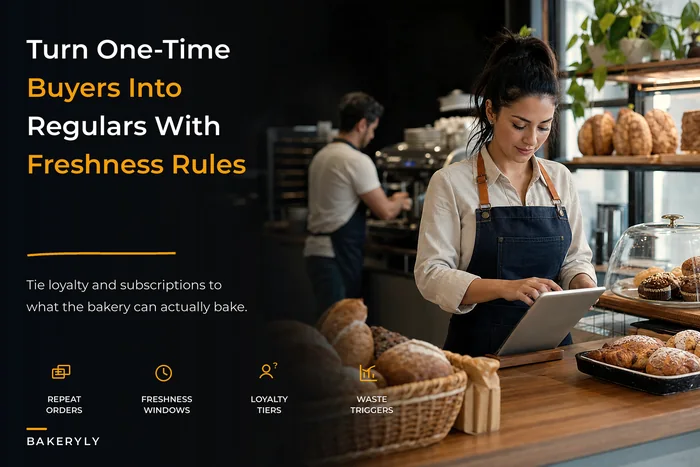
Every bakery product has a freshness reality. Croissants peak within 4 hours of baking. Sourdough holds for 3 days. Danish pastries give you maybe 8 hours before quality drops noticeably.
These freshness windows create natural subscription boundaries. You can't offer "anytime pickup" on morning pastries when they're stale by noon. You can't promise same-day bread swaps when your dough needs 18 hours of fermentation.
Freshness-based tiers in practice look something like this:
Morning Glory Tier (4-hour window)
-
Products
croissants, danish, morning pastries
-
Pickup
7am–11am only
-
Capacity
30% of morning production
-
Swap window
none (too tight)
-
Refund
credit only, no cash
Daily Bread Tier (12-hour window)
-
Products
sourdough, baguettes, sandwich loaves
-
Pickup
7am–7pm
-
Capacity
40% of bread production
-
Swap window
24 hours notice
-
Refund
50% credit if canceled by noon previous day
Weekly Flex Tier (72-hour window)
-
Products
cookies, brownies, shelf-stable items
-
Pickup
any 3 consecutive days
-
Capacity
20% of these items
-
Swap window
48 hours
-
Refund
full credit with 48 hours notice
Each tier's rules flow directly from product characteristics. You're not creating arbitrary policies—you're codifying operational reality.
Capacity allocation that protects walk-in revenue
Here's the subscription math nobody talks about: converting a $4 daily walk-in into a $60 monthly subscriber sounds great until you realize that customer was spending $120 a month before. You just cut revenue in half while guaranteeing production.
Never miss a bake or delivery again.
Bakeryly helps you schedule, track, and manage every order effortlessly.
- Unified order tracking
- Real-time inventory alerts
- Staff shift management
No credit card required
Smart subscription operations protect against that cannibalization through strict capacity limits. Never allocate more than 30–40% of any product category to subscriptions. Here's why.
Your production has natural variance. Monday might need 100 croissants. Saturday might need 180. If subscriptions lock in 80 croissants daily, you're either overproducing on slow days or shorting walk-ins on busy ones.
Some bakeries try floating the allocation—letting it vary by day. It fails every time. Subscribers expect consistency. They don't care that Saturday is busier. They paid for their morning croissant.
Instead, build allocation rules that acknowledge daily patterns:
| Day | Total Croissant Production | Subscription Allocation | Walk-in Reserve |
|---|---|---|---|
| Monday | 100 | 30 (30%) | 70 |
| Tuesday | 110 | 33 (30%) | 77 |
| Wednesday | 105 | 31 (30%) | 74 |
| Thursday | 115 | 34 (30%) | 81 |
| Friday | 140 | 42 (30%) | 98 |
| Saturday | 180 | 54 (30%) | 126 |
| Sunday | 160 | 48 (30%) | 112 |
This fixed-percentage approach means subscription growth follows production growth. You're not boxing yourself in.
Cutoff windows that match production schedules
Most bakeries set cutoff times based on what sounds reasonable to customers. "Order by 6pm for next-day pickup" feels friendly. But your production doesn't start at 6pm—it starts at 3am. Between that 6pm cutoff and the 3am start, you still need to aggregate orders, adjust batch sizes, prep ingredients, and print production sheets.
For next-day morning items:
-
Production starts
3am
-
Prep needed by
2am
-
Orders finalized
midnight
-
System processing
11pm
-
Customer cutoff
10pm (previous day)
That 10pm cutoff might seem late, but it's honest. Earlier cutoffs just create buffer time where nothing useful happens. Later cutoffs risk production chaos.
Some bakeries try variable cutoffs—2pm for bread, 6pm for pastries, 8pm for cookies. This complexity confuses everyone. Pick one cutoff that works for your earliest production item. Everything else gets the extra lead time built in automatically.
The swap window formula nobody explains
Subscription swaps seem simple until Tuesday's sourdough subscriber wants Wednesday's rye. Now production needs to know: do you reduce Wednesday sourdough? Increase Wednesday rye? What about Tuesday's rye that's already proofing?
Swap window = Production lead time + 6 hours minimum
If sourdough needs 18 hours from mix to bake, your swap window is 24 hours. If cookies need 2 hours, your swap window is 8 hours. This gives production time to adjust without waste.
But different swap windows for different products creates its own problem. Counter staff can't remember that bread swaps need 24 hours while cookie swaps need 8.
Pick your longest production item and make that your universal swap window. Yes, cookies could technically swap faster. But operational simplicity beats theoretical flexibility every time.
Refund governance that prevents gaming
Every subscription system gets gamed eventually. Customers learn they can subscribe for busy weekends, then cancel during slow weekdays. They figure out how to pause during vacations without losing their spot. They find refund loopholes.
No refunds, only credits.
Cash refunds incentivize gaming. Credits keep money in your ecosystem. A customer with $20 in credits will usually spend $30. A customer with $20 cash back is probably gone.
Minimum commitment periods.
Three-month minimums prevent weekend-only gaming. Some customers will balk—but those aren't real subscription customers anyway. They're discount seekers.
Pause limits.
Two pause periods per year, maximum two weeks each. This handles legitimate vacations without enabling chronic pausers.
Tier-specific flexibility.
Morning pastry subscribers can't pause—too disruptive to production planning. Weekly flex subscribers can pause anytime since the production impact is minimal. Match flexibility to operational cost.
One bakery I worked with discovered that around 40% of subscription "pauses" happened during slow months. Customers were effectively subscribing for busy seasons only. They added a $10 restart fee for paused subscriptions. Pausing dropped 70%.
Daily production limits and the override temptation
Your production has a daily ceiling—oven capacity, mixer size, or just how much your baker can physically output. Subscriptions must respect these limits absolutely. The moment you start "squeezing in" extra subscribers, the whole system starts to crack.
Hard stops on each tier:
-
Morning Glory
maximum 50 subscribers (based on morning pastry capacity)
-
Daily Bread
maximum 80 subscribers (based on oven capacity)
-
Weekly Flex
maximum 100 subscribers (based on storage space)
Waitlist mechanics.
When a tier fills, new customers join a waitlist. Critically, waitlisted customers should get priority on walk-in allocation. They're showing commitment. Reward it.
The override trap.
It's Tuesday. You have 50 Morning Glory subscribers—your max. A regular walks in wanting to subscribe. You know Thursday's usually lighter. Maybe you squeeze them in? Don't. Once you override limits, staff learns the limits are negotiable. Next week it's 52. A month later it's 60. Then production crashes, quality drops, and the subscription program implodes.
Inventory variability and promise management
Some weeks you have extra strawberries. Some weeks suppliers short you on chocolate. Subscription promises need to account for this variability without blindsiding customers.
Wrong approach: "Subscribe to our fruit danish selection!" Then scramble when berry prices spike.
Right approach: define substitution hierarchies customers agree to when they sign up.
-
Primary item
Strawberry danish
-
Tier 1 substitute
Any berry danish
-
Tier 2 substitute
Any fruit danish
-
Tier 3 substitute
Credit for next pickup
Customers choose their acceptable substitution level at signup. Some want strawberry or nothing. Others just want something fruity. You're setting expectations explicitly rather than making promises you can't always keep.
This hierarchy also shapes purchasing decisions. If 30 subscribers accept "any berry" substitution, you can buy mixed berries when strawberry prices spike. The substitution system becomes a purchasing flexibility tool—which is genuinely useful.
The production sheet integration everyone skips
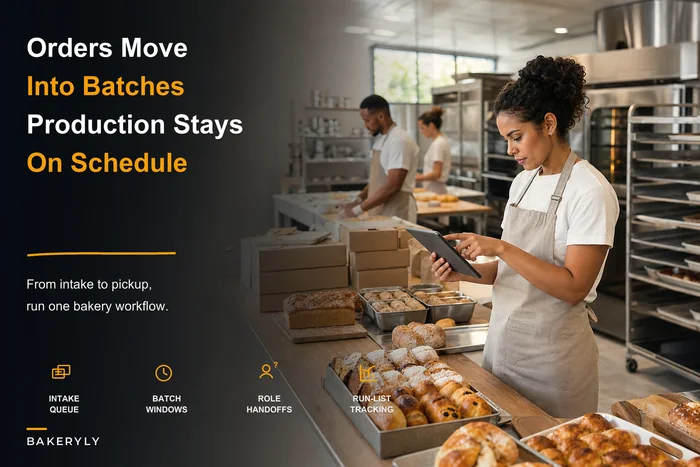
Subscription orders can't live as a separate list that production checks after handling walk-in prep. They need to be part of your core production workflow.
Without that integration, here's what happens:
CROISSANT PRODUCTION - MONDAY Historical demand: 100 Subscription locked: 30 Walk-in needed: 70 Buffer (20%): 20 TOTAL TO PRODUCE: 120 Breakdown:
-
Subscription orders
30 (set aside by 6:30am)
-
Walk-in stock
90 (display by 7am)
Subscriptions become part of base production math, not an afterthought. This seems obvious, but most bakeries run two parallel systems—one for regular production, one for subscriptions. That's how items get missed.
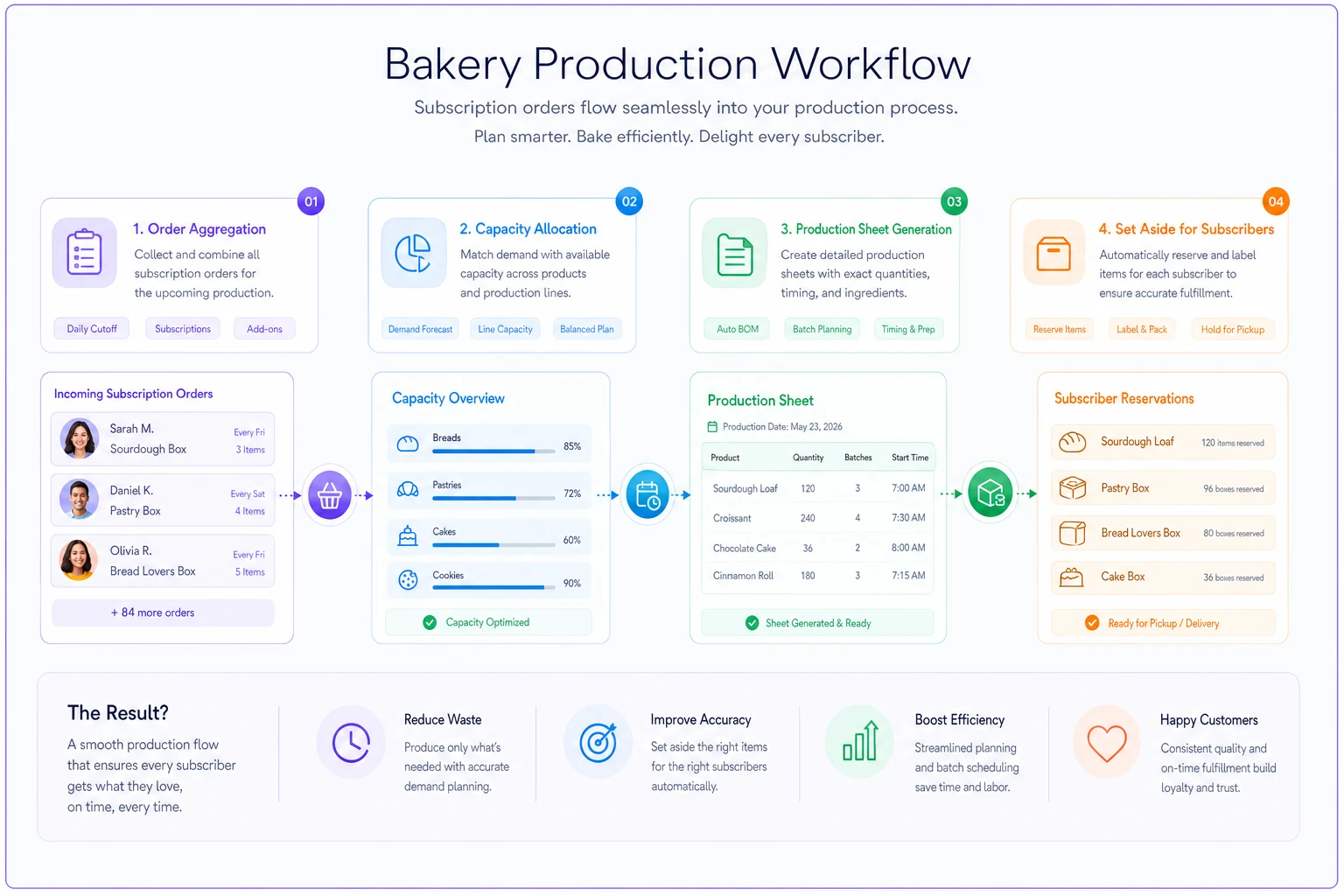
Here's a simple visual of orders flowing into the same sheet production uses—the point is to stop having subscriptions be an afterthought.
When subscription tiers should follow customer patterns, not product categories
Most bakeries create product-based tiers. Bread subscription. Pastry subscription. Cookie subscription. Logical, but often wrong.
Real customer behavior follows patterns. The morning commuter wants a pastry and coffee. The family wants weekend bread and treats. The office manager wants Friday meeting pastries. Pattern-based tiers match actual demand:
Commuter Club
-
1 morning pastry + 1 coffee daily
-
Weekdays only
-
7–9am pickup window
-
No swaps (too tight operationally)
Weekend Family Pack
-
2 loaves + 6 pastries
-
Saturday or Sunday pickup
-
Can split between days
-
24-hour swap window
Office Friday
-
12 assorted pastries
-
Friday pickup only
-
Can change assortment weekly
-
48-hour notice for changes
These tiers reflect how customers actually buy. More importantly, they simplify operations. The commuter club is pure morning production. Weekend packs batch into weekend baking. Office Friday orders fold into catering prep.
The tech stack that makes subscriptions possible (or impossible)
Running bakery subscription operations on paper or basic spreadsheets is flying blind. You need three technical capabilities at minimum:
Real-time capacity tracking.
Each tier needs live capacity status. When Morning Glory hits 50 subscribers, the system stops accepting more automatically. Manual tracking means overselling.
Automated production integration.
Subscription orders must flow directly into production sheets. Manual transfer creates errors and missed items.
Customer self-service basics.
Subscribers need to pause, swap, and check credits themselves. If every change requires a phone call, subscription management becomes a part-time job.
This is where the right operational software earns its cost. AI automation handles the repetitive work—capacity checking, order aggregation, credit tracking—while you focus on actually baking. Some platforms can flag subscribers who look like they're about to churn based on usage patterns, giving you a chance to reach out before they cancel.
That said, even solid software won't fix bad subscription design. You need the operational foundation first. Strong customer retention systems support subscriptions, but subscriptions still need to support production reality.
Financial allocation rules that keep subscriptions profitable
Subscription revenue feels different than walk-in revenue. It's predictable, recurring, paid upfront. That psychological difference leads to financial mistakes.
The common error: treating subscription revenue as "bonus money" and using it for equipment or expansion. Then next month, you need it for ingredients and it's already spent.
Since subscribers prepay, you're holding money for future product delivery. If someone pays $60 for a month of daily pastries and it's day 10, you owe them $40 worth of product. That $40 is a liability, not recognized revenue.
Monthly subscription collected: $60 Daily value: $2 Days delivered: 10 Revenue recognized: $20 Liability remaining: $40
This prevents spending subscription money before you've delivered the goods.
Scaling readiness indicators
Watch these operational signals when deciding whether to grow:
Add a new tier when:
-
Waitlist for existing tiers exceeds 20% of capacity
-
Customers repeatedly request specific combinations you're not offering
-
You have consistent production slack in a category
Increase tier capacity when:
-
You've run at 95%+ capacity for 3 consecutive months
-
Production has expanded (new oven, new baker, new shift)
-
Walk-in demand still exceeds reserve after increases
Pause subscription growth when:
-
Fulfillment errors exceed 2% weekly
-
Subscription prep time exceeds 20% of total production time
-
Complaints about product availability start climbing
That last one matters most. Subscriptions should enhance your bakery, not dominate it. When managing subscriptions starts overshadowing actual baking, you've scaled past where you should be.
The Monday morning subscription drill
Before opening on Mondays, run through three quick checks.
Review last week's metrics:
-
How many swaps? Over 10% usually means wrong tier design.
-
How many failed pickups? Over 5% points to communication problems.
-
How many refund requests? Over 2% suggests expectation mismatches.
Check the upcoming week:
-
Any capacity constraints?
-
Any ingredient shortages affecting substitutions?
-
Any holidays requiring pause management?
Verify production integration:
-
Are subscription numbers reflected in production sheets?
-
Do substitution hierarchies match current inventory?
-
Are new subscribers properly onboarded?
This takes maybe 20 minutes. Skip it and small issues compound into complaints, then cancellations.
Why most bakery subscriptions fail
There are three fundamental reasons subscription programs fall apart.
First, they prioritize customer wishes over production reality. "Anytime pickup" sounds great until your morning baker is setting aside subscription items at 4am while prepping for the 7am rush.
Second, they treat subscriptions as a marketing program rather than an operational system. Subscriptions touch production, inventory, staffing, and cash flow. Marketing can attract subscribers. Operations determines whether you keep them.
Third, they launch fully instead of iterating. Start with one simple tier. Run it for three months. Learn what breaks. Fix it. Then add another tier. This feels slow, but it prevents the spectacular failures that kill programs entirely.
The Portland bakery from the beginning learned these lessons the hard way. Their second launch worked because they built around operational truth instead of subscription theory. They accepted that the program would be less flexible than customers wanted. They protected walk-in revenue. They built supplier variability into their substitution rules.
Your bakery can run subscriptions successfully. But it means building operations-first, setting realistic boundaries, and having the discipline to say no when subscription demands start threatening core operations. The recurring revenue is nice. The predictable production is better. Start small, test it properly, scale gradually, and never stop respecting your production limits—because a sustainable program that runs for years beats a flashy one that crashes after six months.
Ready to elevate your bakery operations?
Join 2,000+ bakeries using Bakeryly to streamline workflows, reduce waste, and delight more customers.