

Most bakeries don't lose money on wholesale because a single account is bad. They lose it because the whole book of recurring accounts drifts over time, and nobody's watching the drift. A grocery account you signed two years ago at a decent margin is now eating Thursday capacity at a price that hasn't moved while flour, butter, and labor all have. A café that started at two dozen a day is now ordering eighty on short notice and expecting the same lead time. None of this shows up as a crisis. It shows up as a slow, confusing feeling that your busiest wholesale weeks aren't your most profitable ones.
That gap — between volume and profit — is almost always a governance problem. Not a sales problem, not a production problem. You don't have a system that classifies accounts, sets rules by class, and forces a regular look at whether each account still earns its place on the schedule. This article is about building that system: bakery wholesale governance that actually holds up as the account book grows past the point where you can keep it all in your head.
Why recurring accounts drift (and why it's invisible until it hurts)
Wholesale accounts feel settled once they're running. The order comes in, you bake it, the driver drops it, the invoice goes out. Repeat. Because it's repeating, nobody re-examines it. And repetition is exactly where the erosion hides.
-
No per-account P&L. Most bakeries track wholesale as one line. One revenue number, one vague "it's profitable overall" feeling. The two accounts bleeding you are hidden inside the eight that carry you.
-
Scope creep is silent. An account that negotiated 30-unit minimums starts calling in 55 on Fridays. The relationship is friendly, so nobody re-prices. The friendliness is the trap.
-
Costs move, prices don't. Ingredient and labor inputs ratchet up quietly. Without a scheduled renegotiation trigger, your contract prices are frozen at whatever the market looked like the day you signed.
-
Capacity gets allocated by habit, not by value. The account that shouts loudest or has been around the longest gets the prime production slot — regardless of whether it's your best margin.
The fix isn't to renegotiate everything in a panic. It's to put structure around the account book so these things surface on a schedule instead of surprising you.
Start by sorting: tiered account classes
You can't govern fourteen accounts with fourteen sets of rules living in someone's memory. The first move is to stop treating all wholesale accounts as the same thing and sort them into classes. Each class gets its own defaults — minimums, lead times, pricing floor, change-order rules, how much capacity it's allowed to reserve.
Three or four classes based on a mix of volume, margin, and operational cost (how fragile the product is, how far the delivery, how erratic the ordering) works well for most bakeries. Here's a structure to adapt:
| Class | Typical profile | Minimum order | Lead time for changes | Margin floor | Capacity priority |
|---|---|---|---|---|---|
| A – Anchor | High volume, stable, predictable orders | Negotiated high | 72 hrs for +/- changes | Protected, reviewed quarterly | First claim on prime slots |
| B – Core | Steady mid-volume, reliable | Standard | 48 hrs | Standard floor | Scheduled after A |
| C – Flex | Low or erratic volume, nice-to-have | Higher per-unit, low minimum | 48 hrs, no last-minute | Premium (they pay for flexibility) | Fills gaps only |
| D – Watch | Underperforming on margin or behavior | — | — | On notice | Candidate for renegotiation or exit |
The point of classes isn't bureaucracy. It's that decisions get faster and fairer. When a Class C account calls Thursday afternoon asking to triple Friday's order, the answer is already written: no, that violates the lead-time rule for your class, here's what we can do. You're not negotiating from scratch every time, and you're not letting the smallest accounts set the terms for the whole schedule.
One thing worth sitting with: the account you'd assume is your anchor often isn't. A high-volume grocery chain can easily land in Class B or even D once you load in delivery distance, returns rate, and razor-thin pricing. Meanwhile a mid-sized restaurant group that orders predictably, pays on time, and takes product at your door can be the quietest Class A in your book. Volume feels like importance. Margin and behavior actually are.
Build account scorecards so classes aren't just a gut call
Classes only work if you can place accounts into them with something firmer than a hunch. That's what account scorecards are for — a lightweight, repeatable snapshot of each account that you update on a cadence, not whenever it occurs to you.
A usable scorecard tracks maybe six to eight things:
-
Gross margin per account (revenue minus true cost — ingredients, packaging, allocated labor, delivery)
-
Order predictability (how much do actuals swing from the forecast)
-
Change-order frequency (how often they break the lead-time rule)
-
Payment behavior (days-to-pay, disputes)
-
Returns / credits rate (especially for fragile product)
-
Capacity consumed during peak windows (are they crowding your best slots)
-
Revenue trend (growing, flat, shrinking)
The most useful version is a simple two-axis read: margin on one axis, operational friction on the other. High margin, low friction — that's your protected core. High margin but high friction — worth keeping, but the friction needs a price attached. Low margin, low friction — fine as filler, don't give it prime capacity. Low margin, high friction — that's a Class D conversation, and it needs to happen on a schedule, not when you finally snap.
Account: Harborview Café Revenue: $4,180 Ingredient cost: -$1,560 Packaging: -$210 Allocated production labor: -$890 Delivery (allocated): -$380 Returns / credits: -$145 --------------------------------------- Contribution: $995 (≈24%) Change orders last month: 6 (3 inside lead time → fee waived) Days-to-pay: 41
That café looks healthy on revenue. But six change orders and a 41-day pay cycle are friction signals. The 24% contribution is real, yet three waived rush fees quietly gave back part of it. Without a scorecard, you'd never catch that — you'd just feel vaguely annoyed every time Harborview called.
Here's a quick workflow for maintaining scorecards and class assignments.
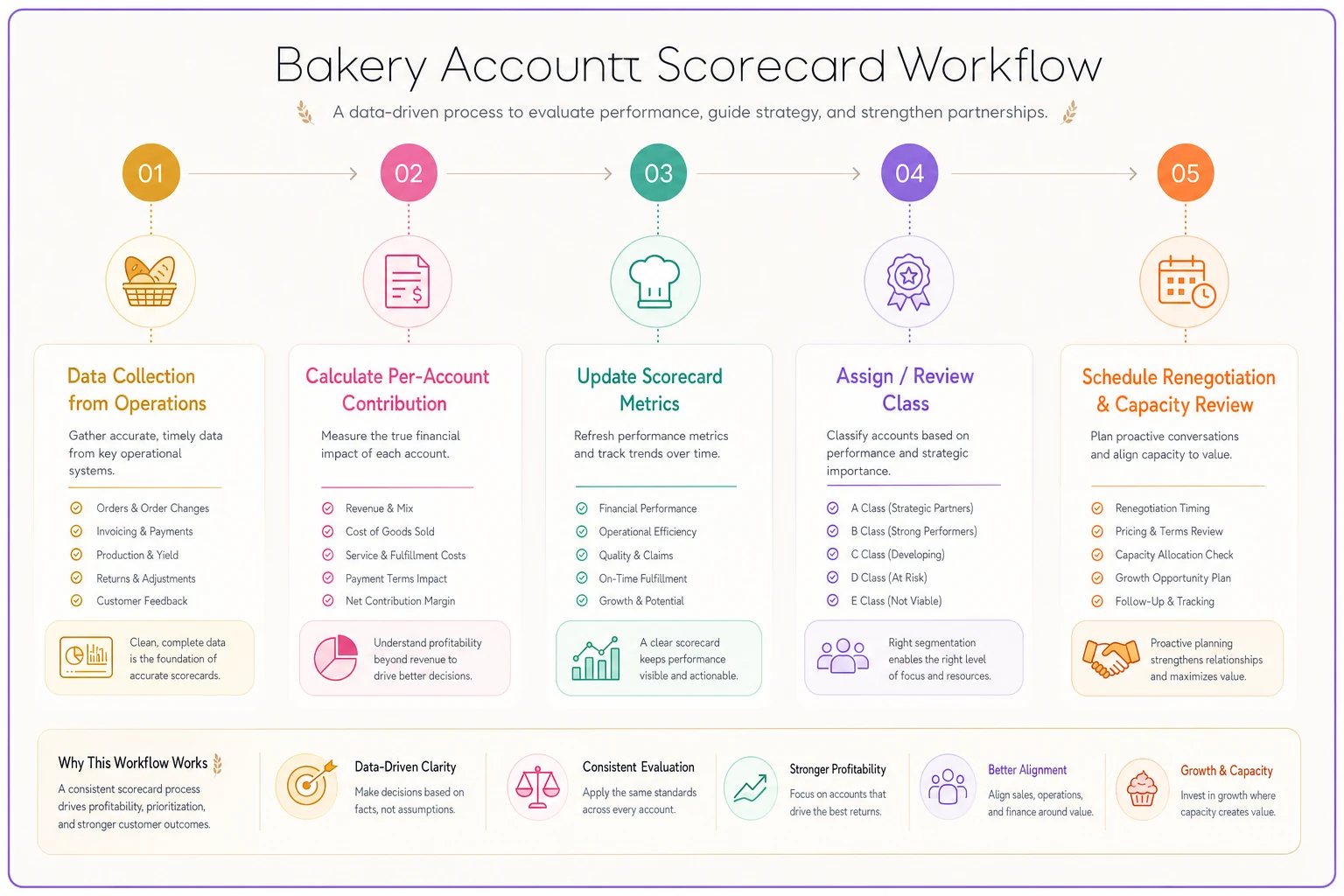
Keep the workflow simple: data in, score updated, class reviewed, and a calendar reminder set for the next review.
Renegotiation cadences: stop waiting for the relationship to break
The single most expensive habit in wholesale is treating renegotiation as a confrontation you only start when things get bad. By then you've absorbed months or years of eroded margin, and the conversation is tense because it's overdue.
-
Set a review date for every account at signing. Class A and B
annual price review, minimum. Class C: every six months, because they're the most volatile. Put it on a calendar the moment the account goes live.
-
Define auto-trigger thresholds. If a key input cost (flour, butter, eggs) moves beyond a set band — say 8–10% — it triggers an off-cycle review regardless of the calendar. Same if an account's change-order count or volume jumps past its class norm.
-
Pre-write the opener. The conversation is easier when it's framed as routine. "We do an annual cost review on all our wholesale pricing — here's where input costs have moved and what that means for your pricing effective next month." Predictable, not personal.
-
Give yourself a walk-away number per class. Below the margin floor for that class, the account either re-prices or moves to Class D. Decide this before you're in the room.
The reason cadence matters more than any single negotiation tactic: it changes who's in control. An account that knows your prices get reviewed every year doesn't treat your rate card as permanent. An account that knows you never revisit pricing will happily let you eat every cost increase indefinitely. Much of the groundwork here overlaps with how you set terms up front — a disciplined B2B onboarding checklist that protects margin makes these later reviews far less awkward, because the account was never told the price was frozen forever.
Fulfillment SLAs and packaging standards: the quiet margin killers
Pricing gets all the attention, but a surprising amount of wholesale margin leaks through fulfillment and packaging — the stuff you never put in writing because "everybody knows how it works." Nobody does, which is why it drifts.
Fulfillment SLAs are simply the promises you're willing to make, written down and matched to account class. What's the cutoff time for next-day orders? What's the lead time for a volume change? What happens when they order past the cutoff — hard no, or a rush fee? What's your fill-rate commitment, and what's the remedy if you miss it? When these aren't defined, every account invents its own expectations, and your team spends its mornings adjudicating disputes instead of baking.
A clean SLA by class prevents the worst scenario: a Class C account's last-minute request bumping a Class A's standing order because the person taking the call had no rule to fall back on. This is also where wholesale and retail collide — a wholesale rush order quietly consuming the oven time your café counter was counting on. Keeping those two worlds from eating each other is its own discipline; we went deep on it in integrating wholesale and café production in one plan, and your SLAs are the enforcement layer that makes that integration stick.
Packaging standards sound trivial until you count them. Each account that wants its own box, its own label, its own case count adds SKU complexity, slows your pack line, and raises your error rate. Bakeries running eleven different packaging configs for fourteen accounts — most of them minor variations nobody actually required — is more common than you'd think. A governance approach sets standard packaging per class, with custom packaging treated as a priced add-on, not a free courtesy. If an account wants bespoke boxes, that's fine — it's a line item, and it maps to a Class C-style premium because it costs you flexibility.
A quick checklist for tightening fulfillment and packaging governance:
-
[ ] Written SLA per account class (cutoffs, lead times, fill-rate, remedies)
-
[ ] Rush/change-order fees defined and actually charged
-
[ ] Standard packaging spec per class, with custom as a priced add-on
-
[ ] Case counts and labeling standardized to cut pack-line errors
-
[ ] Returns and credit policy in writing (who eats damage, and when)
-
[ ] One owner responsible for enforcing SLAs, not "whoever answers the phone"
A governance approach makes these items enforceable: SLA per class, packaging standardization, and an owner to charge fees and resolve disputes so your team isn't improvising every morning.
Capacity-allocation reviews: who gets your best oven time
This is the part most bakeries never formalize, and it's the one that decides whether growth makes you richer or just busier. Capacity is finite. Peak windows — the Thursday and Friday production that feeds weekend wholesale demand — are the scarcest resource you have. Every account is implicitly competing for those slots, and if you allocate by habit or by whoever asked first, you're almost guaranteeing your lower-value accounts crowd out your higher-value ones.
A capacity-allocation review is a regular meeting — monthly works for most, weekly during peak seasons — where you look at committed capacity against the account book and ask: are our best-margin, lowest-friction accounts getting first claim on the prime windows? The scorecards feed directly into this. Class A gets protected capacity. Class C fills gaps. Class D doesn't get to reserve peak time at all until it re-prices.
A realistic scenario of what this surfaces: a bakery doing roughly $40k–$45k a month in wholesale runs a capacity review and finds that two Class C accounts — low margin, erratic, custom packaging — were collectively holding about 18% of Friday production capacity. That capacity had been quietly promised away over time, order by order, with nobody deciding it on purpose. Reassigning it meant one Class C account accepted a Thursday delivery instead, one accepted a modest price bump to keep its Friday slot, and the freed capacity went to expanding the two strongest Class A accounts that had actually been asking for more. No new customers, no new equipment — just the same ovens pointed at better-paying work. The contribution improvement showed up within a couple of months.
That's the whole point of governance: the gains come from reallocation, not from selling harder.
A short real scenario: the account book that looked fine
A single-location bakery with a small wholesale program — around a dozen accounts, roughly $38k monthly wholesale revenue — was convinced wholesale was its healthy, boring engine. Retail had the drama; wholesale "just ran."
When they finally built per-account scorecards, the picture wasn't what they expected. Three accounts were under 12% contribution once delivery and returns were loaded in. One of those three was the account they'd always described as their biggest and most prestigious — high volume, famous local name, and a price that hadn't moved in nearly three years while butter had done what butter does. It was consuming prime Friday capacity at a margin that barely covered the labor to make it.
They didn't drop it. They ran the scheduled renegotiation they'd been avoiding — framed as a routine annual cost review — and raised the price about 9%, moved two of its change-prone orders to firmer lead times, and standardized its packaging to the Class B default. The account grumbled and stayed. Meanwhile they moved one genuinely unprofitable, high-friction Class C account to a self-pickup arrangement instead of delivery, which flipped it from a loss into a modest contributor.
Net effect over the following quarter: wholesale revenue barely changed — up maybe a few percent — but wholesale contribution rose by something in the range of a quarter. Same accounts, mostly. The difference was governance: classes, scorecards, a renegotiation they actually ran, and a capacity review that stopped the prestige account from bullying the schedule.
When this system makes sense — and when it's overkill
When it's worth building: Once you're past five or six recurring accounts, or once wholesale is a meaningful share of revenue, you need this. The moment you can no longer hold every account's terms, quirks, and true margin in your head is the moment drift starts — and that happens earlier than most owners expect.
When it's overkill: If you've got two or three wholesale accounts and spare oven capacity, formal classes and quarterly scorecards are more process than you need. A simple annual price check and a per-account margin glance is plenty. Don't build governance machinery for a problem you don't have yet — just don't wait until you're at fourteen accounts to start, because retrofitting rules onto accounts that have never seen them is the hard version.
Who should be careful: Bakeries whose wholesale is mostly relationship-driven and informal should introduce structure gradually. If you drop a full SLA-and-reclassification regime on long-standing accounts overnight, you'll create friction that outweighs the margin gain. Phase it — start with scorecards and pricing cadence, add SLAs and packaging standards once accounts are used to the idea that you review things on a schedule.
Keeping it running without it becoming a full-time job
The honest obstacle to all of this isn't understanding it — it's maintaining it. Scorecards that live in someone's spreadsheet get updated for two months and then abandoned. Review dates get missed because nobody owns the calendar. Renegotiations slip because the quarter got busy. The system decays back into drift, which is exactly where you started.
A few things keep governance alive. Assign one owner for the account book — the person who runs the capacity review and keeps scorecards current. Keep the cadence light enough to actually do; a rough monthly scorecard beats a perfect quarterly one that never happens. And wherever you can, let your existing systems do the data collection for you. The same per-account cost and order data you'd track for a procurement system — the kind of cadence-and-scorecard discipline covered in building a procurement system with vendor scorecards — is the backbone of account scorecards too. If your order management, invoicing, and production data already live in one place, pulling a per-account contribution number stops being a monthly chore and becomes something you can glance at. AI-assisted operational tools can flag the drift for you — an account creeping past its change-order norm, an input cost crossing a renegotiation trigger, a Class C quietly eating peak capacity — so the review surfaces the right accounts instead of making you hunt for them.
Assign one owner for the account book — the person who runs the capacity review and keeps scorecards current.
The goal isn't more admin. It's that the account book stops surprising you. When classes, scorecards, renegotiation cadences, SLAs, packaging standards, and capacity reviews all point at the same data, wholesale becomes what it was supposed to be: your steady, profitable base — not the busy work that quietly funds everyone but you.
The goal isn't more admin. It's that the account book stops surprising you. When classes, scorecards, renegotiation cadences, SLAs, packaging standards, and capacity reviews all point at the same data, wholesale becomes what it was supposed to be: your steady, profitable base — not the busy work that quietly funds everyone but you.